Glycoscience
Subcategories of "Glycoscience"
- Aminosugars(108 products)
- Glyco-Related Antibodies(283 products)
- Glycolipids(46 products)
- Glycosaminoglycans (GAGs)(55 products)
- Glycosides(419 products)
- Monosaccharides(6,619 products)
- Oligosaccharides(3,711 products)
- Polysaccharides(505 products)
Found 11027 products of "Glycoscience"
2, 4- Anhydro- 6- deoxy- L- mannonic acid methyl ester
CAS:2, 4-Anhydro-6-deoxy-L-mannonic acid methyl ester is a modified oligosaccharide that is synthesized from D-mannose. This compound can be used as a building block for the synthesis of complex carbohydrates and glycosides. It can also be used for the fluorination of saccharides and glucose derivatives. 2,4-Anhydro-6-deoxy-L-mannonic acid methyl ester is an important intermediate in the production of fluoroquinolones and other pharmaceuticals. It is also a precursor to antihistamines, antiarrhythmics, antibiotics, anticancer drugs, and antimalarial drugs.Formula:C7H12O5Purity:Min. 95%Molecular weight:176.17 g/mol3,4,6-Tri-O-acetyl-D-galactal
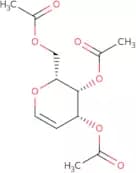
CAS:3,4,6-Tri-O-acetyl-D-galactal is a versatile building block used for the synthesis of mono- and oligosaccharides. The galactal double bond affords a ready means through which to introduce new functionality or introduce deoxy positions at the C1 and C2 positions to afford functionalised monosaccharides and also allows galactals to be used as glycosylation donors.Formula:C12H16O7Purity:Min. 98 Area-%Color and Shape:Slightly Yellow Clear LiquidMolecular weight:272.25 g/molD-Glucono-1,5-lactone
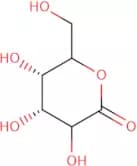
CAS:D-Glucono-1,5-lactone is a chemical compound that is a member of the class of compounds known as diketones. It can be used in chemical biology and polymer chemistry to probe hydrogen bonding interactions, polymer compositions, and redox potentials. D-Glucono-1,5-lactone has been shown to inhibit the growth of cells in culture by inhibiting DNA synthesis. This inhibition is due to its ability to bind with high affinity to nucleic acids and prevent the formation of the enzyme complexes required for transcription and replication. The effects are reversible.
Formula:C6H10O6Purity:Min. 95%Color and Shape:PowderMolecular weight:178.14 g/molD-Glucose 1-13C
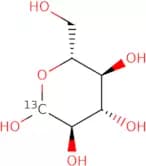
CAS:D-Glucose 1-13C is a kinetic isotope that is used to study the metabolic pathways of glucose. The presence of 13C in the molecule allows for the identification of metabolites and provides an accurate measurement of metabolic rate. This isotope has been used to study lipid metabolism in exudates from animals, as well as fatty acid synthesis in microsomes from rats. D-Glucose 1-13C has also been used in studies on yeast, specifically Saccharomyces cerevisiae strain and Saccharomyces cerevisiae strain.Formula:CC5H12O6Purity:Min. 95%Color and Shape:White PowderMolecular weight:181.15 g/molAustraline
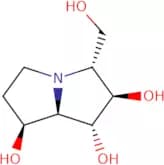
CAS:Inhibitor of alpha-glucosidase II
Formula:C8H15NO4Purity:Min. 95%Color and Shape:PowderMolecular weight:189.21 g/mol3,4,6-Trichloro-3,4,6-trideoxy-D-glucose
3,4,6-Trichloro-3,4,6-trideoxy-D-glucose is a fluorinated monosaccharide that is synthesized from 3,4,6-trichloro-1,2,-dideoxy-D-glycero-hexuronic acid and D-(+)-glucose. It has been modified by the addition of three chlorine atoms to form the trisaccharide. This modification was achieved using a click reaction with allyl bromide and copper iodide. The compound has been shown to be useful as a reagent for the methylation of glycans with NCS in order to study glycan structure.Formula:C6H9Cl3O3Purity:Min. 95%Molecular weight:235.5 g/mol(2S, 3R, 4S) -2- [(1S) - 1- Hydroxyethyl] - 3, 4- pyrrolidinediol
CAS:(2S, 3R, 4S) -2- [(1S) - 1- Hydroxyethyl] - 3, 4- pyrrolidinediol is a synthetic chemical compound that is used in the synthesis of complex carbohydrates. This chemical has been modified by fluorination and methylation. It can be custom synthesized to meet specific needs and is available at high purity with an CAS number of 225234-44-6.Formula:C6H13NO3Purity:Min. 95%Molecular weight:147.17 g/mol3,4-O-Isopropylidene-L-arabinono-1,5-lactone
This compound is a lactone that has been synthesized by reacting the 2-deoxy-l-ribose with 3,4-O-isopropylidene-d-lactone. The resulting product has been shown to be an efficient x-ray crystal.Purity:Min. 95%1,6-Anhydro-b-D-mannopyranose
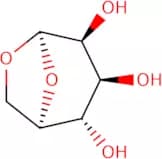
CAS:Organic tracer generated by burning cellulose; used for ageing wines and spiritsFormula:C6H10O5Purity:Min. 90 Area-%Color and Shape:White Off-White PowderMolecular weight:162.14 g/molAmiprilose hydrochloride
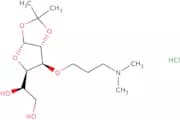
CAS:Amiprilose hydrochloride is a nonsteroidal anti-inflammatory drug (NSAID) that inhibits the production of prostaglandins. It has been shown to have antimicrobial properties against skin cells and has been used as a topical treatment for wounds. Amiprilose may also be effective in treating inflammatory diseases, such as rheumatoid arthritis and ulcerative colitis, by inhibiting the production of IL-2 receptors. This drug is also used as a diagnostic tool in infectious diseases and has been found to be active against various bacteria, including Staphylococcus aureus and Escherichia coli; fungi including Candida albicans, Saccharomyces cerevisiae, and Aspergillus niger; protozoa such as Entamoeba histolytica; and viruses such as herpes simplex virus type 1. Amiprilose can inhibit inflammation by blocking the activity of leukotrienes. It is also
Formula:C14H27NO6·HClPurity:Min. 95%Color and Shape:PowderMolecular weight:341.83 g/mol2-Hydroxypropyl-b-cyclodextrin
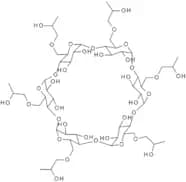
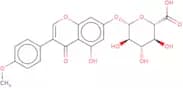
CAS:This beta-cyclodextrin (β-CD) derivative is a functionalized cyclic oligosaccharide composed of seven glucose units, characterized by a hydrophilic exterior and a lipophilic cavity (bigger than α-CD and smaller than γ-CDs), which allows it to encapsulate various guest molecules. This structural feature facilitates its use in multiple applications, including pharmaceuticals, food enhancement, and cosmetics. In the pharmaceutical industry, it enhances the solubility and stability of poorly water-soluble drugs, improving their bioavailability and efficacy while also masking unpleasant tastes. The food sector utilizes it as a stabilizer for flavors, colors, and nutrients, extending shelf life by protecting sensitive ingredients from degradation. In cosmetics, it serves as a complexing agent for fragrances and active components, ensuring their stability and controlled release. Its use expands to many other fields, including nanotechnology for drug delivery systems, environmental remediation for extracting organic pollutants, textiles for slow-release fragrances, and analytical chemistry for chiral separation.Formula:C42Hn)O35·(C3H7O)nPurity:Min. 98.0 Area-%Color and Shape:PowderBiochanin A b-D-glucuronide
CAS:Biochanin A b-D-glucuronide is a synthetic chemical compound. It is a monosaccharide that is modified by methylation and fluorination. This product has been shown to have antiviral activity against herpes simplex virus type 1, 2, and 3 in vitro and in vivo. Biochanin A b-D-glucuronide also has anti-inflammatory properties, which may be due to its ability to inhibit prostaglandin synthesis.Formula:C22H20O11Purity:Min. 95%Color and Shape:PowderMolecular weight:460.39 g/mol3,5-O-Isopropylidene-D-lyxonic acid-1,4-lactone
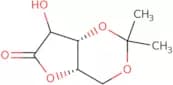
CAS:3,5-O-Isopropylidene-D-lyxonic acid-1,4-lactone is a custom synthesis that has been modified by fluorination and methylation. It is a monosaccharide with CAS No. 1931946-53-0. The product is an Oligosaccharide that is synthesized from saccharides, which are carbohydrates. The product is also glycosylated and contains sugar and complex carbohydrates.Formula:C8H12O5Purity:Min. 95%Molecular weight:188.18 g/molCarboxymethyl-dextran sodium salt - Average MW 70,000
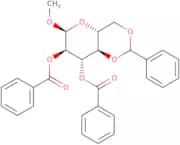
CAS:Sodium carboxymethyl dextran is a white, odourless and tasteless powder, which is freely soluble in water or electrolyte solutions. Applications that have been described for carboxymethyl dextran include carriers of paramagnetic contrast agents, preparation of conjugates of pharmacologically active compounds and carboxymethyl dextrans in biosensors. A number of other uses in cosmetics, agriculture, foods, paints and textiles have been the subject of patent applications.Color and Shape:PowderMethyl 2,3-di-O-benzoyl-4,6-O-benzylidene-a-D-glucopyranoside
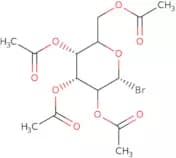
CAS:Methyl 2,3-di-O-benzoyl-4,6-O-benzylidene-a-D-glucopyranoside is a synthetic compound that has been shown to be an inhibitor of the receptor for the proinflammatory cytokine TNF. It has been proposed as a possible treatment for chronic kidney disease, acute phase, and neurodegenerative diseases such as chronic pain. Methyl 2,3-di-O-benzoyl-4,6-O-benzylidene-a-D-glucopyranoside is an inhibitor of factor receptors and inhibits the activation of NFκB in a dose dependent manner. This inhibition leads to decreased production of proinflammatory cytokines such as TNF.Formula:C28H26O8Purity:Min. 95%Color and Shape:PowderMolecular weight:490.5 g/molAcetobromo-D-glucose - 2% CaCO3
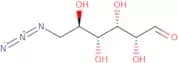
CAS:Intermediate for β-glucosides; potential PET surface modification reagentFormula:C14H19BrO9Purity:Min. 95%Color and Shape:White PowderMolecular weight:411.2 g/mol6-Azido-6-deoxy-D-glucose
CAS:6-Azido-6-deoxy-D-glucose is a fluorescent compound that can be used as a probe for the visualization of glycosidase activity. The compound is synthesized from D-glucose by reacting it with 6-azidohexyl nitrate and sodium hydroxide in a chemoenzymatic reaction. This compound has been shown to bind to the cell nucleus, which can be observed using microscopy. The uptake of this compound into cells is dependent on the degree of polymerization, with monomers being taken up at a higher rate than oligomers or polymers. 6-Azido-6-deoxy-D-glucose is also an inhibitor of beta-cyclodextrin glycosidase, which prevents the hydrolysis of beta cyclodextrins.Formula:C6H11N3O5Purity:Min. 97 Area-%Color and Shape:Off-White PowderMolecular weight:205.17 g/molDabigatran 2-Acyl Glucuronide-D3
Dabigatran 2-Acyl Glucuronide-D3 is a Methylation, Custom synthesis, Click modification, CAS No., Oligosaccharide, Polysaccharide, saccharide, Carbohydrate, Fluorination, complex carbohydrate, High purity, Modification, Monosaccharide sugar that is synthetically produced. This product has a purity of >98% and is used as an research reagent in the field of chemistry. It can also be used as an intermediate in the production of other products.Purity:Min. 95%Lewis X tetrasaccharide
CAS:Lewis X tetrasaccharide (LX4) is a glycan that is found on the surface of human cells. It is an important diagnostic marker for microbial infections and has been shown to be present on the surfaces of both normal skin cells and malignant cells. The presence of LX4 can be detected using a monoclonal antibody in vitro. This glycan can also be used as a model system to study ischemia–reperfusion injury, since it has been shown to be sensitive to oxidative changes caused by reactive oxygen species generated during reperfusion. Studies have also shown that LX4 binds to enzymes such as malonic acid oxydoreductase, which are involved in the metabolism of lysine, arginine, and proline.
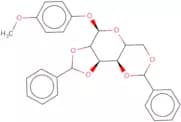
Formula:C26H45NO20Purity:Min. 90%Color and Shape:White PowderMolecular weight:691.64 g/mol4-Methoxyphenyl 2,3:4,6-di-O-benzylidene-α-D-mannopyranoside
CAS:4-Methoxyphenyl 2,3:4,6-di-O-benzylidene-a-D-mannopyranoside is a water soluble polysaccharide that is a methylated derivative of mannose. It has been fluorinated at the 4 position and modified with benzyl groups at the 2, 3, and 6 positions. This compound is used in custom synthesis to synthesize oligosaccharides or polysaccharides.Formula:C27H26O7Purity:Min. 95%Molecular weight:462.49 g/mol


![(2S, 3R, 4S) -2- [(1S) - 1- Hydroxyethyl] - 3, 4- pyrrolidinediol](/_next/image/?url=https%3A%2Fstatic.cymitquimica.com%2Fproducts%2F3D%2Fthumb-webp%2FMH163319.webp&w=3840&q=75)