Glycoscience
Glycoscience is the study of carbohydrates and their derivatives, as well as the interactions and biological functions they participate in. This field of research is crucial for understanding a wide variety of biological processes, including cell recognition, signaling, immune response, and disease development. Glycoscience has important applications in biotechnology, medicine, and the development of new drugs and therapies. At CymitQuimica, we offer a wide selection of high-quality, high-purity products for glycoscience research. Our catalog includes monosaccharides, oligosaccharides, polysaccharides, glycoconjugates, and specific reagents, designed to support researchers in their studies on the structure, function, and applications of carbohydrates in biological systems. These resources are intended to facilitate scientific discoveries and practical applications in various areas of bioscience and medicine.
Subcategories of "Glycoscience"
- Aminosugars(108 products)
- Glyco-Related Antibodies(282 products)
- Glycolipids(46 products)
- Glycosaminoglycans (GAGs)(55 products)
- Glycosides(419 products)
- Monosaccharides(6,622 products)
- Oligosaccharides(3,682 products)
- Polysaccharides(503 products)
Found 11041 products of "Glycoscience"
Sort by
Purity (%)
0
100
|
0
|
50
|
90
|
95
|
100
3,4,6-Tri-O-acetyl-2-deoxy-2-phthalimido-b-D-glucopyranosyl chloride
CAS:<p>3,4,6-tri-O-acetyl-2-deoxy-2-phthalimido-b-D-glucopyranosyl chloride is a modification of the carbohydrate. It is a complex carbohydrate that has been custom synthesized for research purposes. It can be used as a monosaccharide or polysaccharide in glycosylation reactions. This compound has not been fluorinated and the CAS number is 7772-87-4.</p>Formula:C20H20ClNO9Purity:Min. 95%Molecular weight:453.83 g/molHexyl 2-acetamido-2-deoxy-b-D-glucopyranoside
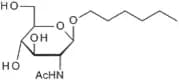
CAS:<p>Hexyl 2-acetamido-2-deoxy-b-D-glucopyranoside is a sugar that is used in the study of immune reactions. It can be used to measure albumin levels and tissue samples, as well as in animal experiments. Hexyl 2-acetamido-2-deoxy-b-D-glucopyranoside has been shown to have toxic effects on cells, which may be due to its ability to inhibit DNA concentrations. This substance also has a directional fluorescence, which means that it will emit light in one direction only when stimulated with light of a certain wavelength.</p>Formula:C14H27NO6Purity:Min. 95%Molecular weight:305.37 g/molHexyl b-D-thioglucopyranoside
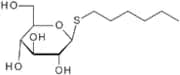
CAS:<p>Hexyl b-D-thioglucopyranoside is an insect pheromone that attracts male mealworms. It can be used for the detection of chiral elements, such as carbon and hydrogen. The profile of hexyl b-D-thioglucopyranoside is dynamically programmable and can be modified to detect different types of insects by changing the carbon skeleton. Hexyl b-D-thioglucopyranoside has been shown to have a strong electromagnetic activity, which may be due to its carbon skeleton.</p>Formula:C12H24O5SPurity:Min. 95%Color and Shape:White To Off-White SolidMolecular weight:280.38 g/mol4-Hydroxypropofol-4-O-b-D-glucuronide
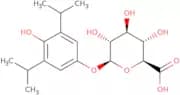
CAS:<p>4-Hydroxypropofol-4-O-b-D-glucuronide (HPG) is a synthetic carbohydrate with a 4,5-dihydroxypropyl group at C2 and an O-glycosidic bond between the hydroxyl group at C1 and the b position of a glucuronic acid. HPG is used in the synthesis of complex carbohydrates and saccharides. It can be methylated in order to produce 5,6-dimethoxycarbonyloxypropyl glycosides or glycosylated to produce mannosides. HPG has been synthesized by click modification from 4,5-dihydroxypropionic acid.</p>Formula:C18H26O8Purity:Min. 95%Molecular weight:370.4 g/mol5-Acetamino-4-hydroxy-2-(4-nitro-phenoxy)-6-(1,2,3-trihydroxy-propyl)-tetrahydro-pyran-2-carboxylic acid methyl ester
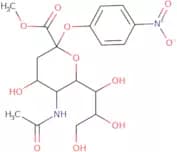
CAS:<p>5-Acetamino-4-hydroxy-2-(4-nitro-phenoxy)-6-(1,2,3-trihydroxy-propyl)-tetrahydro-pyran-2-carboxylic acid methyl ester is a synthetic glycosylated molecule that is available as custom synthesis. It is an oligosaccharide that has been modified with fluorination, saccharide modification, and click chemistry. It can be used for the synthesis of polysaccharides. It has a CAS number of 59694-35-8 and a molecular weight of 614.06 g/mol.</p>Formula:C18H24N2O11Purity:Min. 95%Molecular weight:444.39 g/molHyaluronic acid sodium salt - Average MW 1.0 - 2.0 million Da
CAS:<p>Hyaluronic acid sodium salt is a polymer that is made up of repeating disaccharide units of N-acetylglucosamine and glucuronic acid. It can be used in regenerative medicine to help with the healing process by supporting the growth of new tissue, as well as providing a cushioning effect against mechanical stress. This product can also be used as a food additive or supplement to help with joint health. In addition, hyaluronic acid sodium salt has been shown to improve inflammatory responses in human dermal fibroblasts.</p>Formula:(C14H22NO11Na)nOctyl 2-acetamido-3,4,6-tri-O-acetyl-2-deoxy-b-D-glucopyranoside
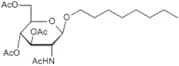
CAS:<p>Octyl 2-acetamido-3,4,6-tri-O-acetyl-2-deoxy-b-D-glucopyranoside is an antigen that is expressed in tumor tissue. It is a polynucleotide molecule that can be used for the diagnosis of cancer and autoimmune diseases. The octyl 2-acetamido-3,4,6-tri-O acetyl 2 deoxy b D glucopyranoside molecule is a programmable molecule that can be used to induce a specific phenotype in cells. Octyl 2 acetamido 3,4,6 tri O acetyl 2 deoxy b D glucopyranoside has been shown to be an effective antigen for the generation of CD8+ T cells.</p>Formula:C22H37NO9Purity:Min. 95%Molecular weight:459.53 g/mol4-Azido-2,3-di-O-benzoyl-4-deoxy-6-O-trityl-a-D-glucopyranoside
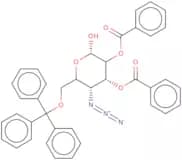
<p>4-Azido-2,3-di-O-benzoyl-4-deoxy-6-O-trityl-a-D-glucopyranoside is a synthetic glycosylation reagent that can be used for the synthesis of oligosaccharides. It is a fluorinated sugar that can be custom synthesized to order. 4A2B4D6OATG is a high purity product with CAS No. 62990-51-1 and has been modified using click chemistry to incorporate azide functional groups.</p>Formula:C39H33N3O7Purity:Min. 95%Molecular weight:655.7 g/mol2-(L-Fuco-tetrahydroxypentyl)-4(R)-1,3-thiazolidine-4-carboxylic acid
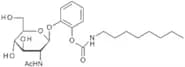
CAS:<p>2-(L-Fuco-tetrahydroxypentyl)-4(R)-1,3-thiazolidine-4-carboxylic acid is a high purity custom synthesis sugar. It has been synthesized by click modification and fluorination of 2-(L-fuco-tetrahydroxypentyl)-4(R)-1,3-thiazolidine-4-carboxylic acid methyl ester. This compound can be used in glycosylation with oligosaccharides, monosaccharides, saccharides and complex carbohydrates.</p>Formula:C10H19NO6SPurity:Min. 95%Molecular weight:281.33 g/mol2-(N-Octylcarboamido)phenyl-2-acetamido-2-deoxy-b-D-glucopyranoside
<p>2-(N-Octylcarboamido)phenyl-2-acetamido-2-deoxy-b-D-glucopyranoside is a modified carbohydrate which is used as a synthetic monosaccharide. It is also used in the preparation of Oligosaccharides, Carbohydrates, and Complex Carbohydrates. 2-(N-Octylcarboamido)phenyl-2-acetamido-2-deoxy-b-D--glucopyranoside has been fluorinated to 2-(N-[3,5-(diiodo)phenyl]carboamido)phenyl)-2-[3,5-(diiodo)phenyl]-acetamide.</p>Formula:C23H36N2O8Purity:Min. 95%Molecular weight:468.54 g/molD-(-)-Lyxose
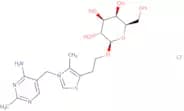
CAS:<p>Please enquire for more information about D-(-)-Lyxose including the price, delivery time and more detailed product information at the technical inquiry form on this page</p>Formula:C5H10O5Purity:Min. 99 Area-%Molecular weight:150.13 g/molThiamine galactoside
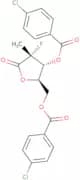
CAS:<p>Thiamine galactoside is a custom synthesis of a monosaccharide. It is modified with fluorination, methylation and saccharide. The resulting product has a molecular weight of 578.08 g/mol and the chemical formula C24H34N6O18S2.</p>Formula:C18H27O6N4S·C2H3O2Purity:Min. 95%Molecular weight:486.54 g/mol3,5-Di-O-p-chlorobenzoyl-2-deoxy-2-fluoro-2-C-methyl-D-ribofurano-1,4-lactone
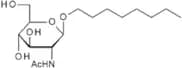
CAS:<p>3,5-Di-O-p-chlorobenzoyl-2-deoxy-2-fluoro-2-C-methyl-D-ribofurano-1,4-lactone is a synthetic sugar molecule that has been modified with fluorination. This sugar is a monosaccharide and its synthesis has been customised to your requirements. 3,5-Di-O-p-chlorobenzoyl--2 deoxy 2 fluoro 2 C methyl D ribofurano 1 4 lactone is available in high purity and can be synthesized with the click modification. It can also be modified with methylation or glycosylation.</p>Formula:C20H17Cl2FO6Purity:Min. 95%Molecular weight:443.25 g/molOctyl 2-acetamido-2-deoxy-b-D-glucopyranoside
CAS:<p>Octyl 2-acetamido-2-deoxy-b-D-glucopyranoside is a lyotropic liquid that is flammable. It can be used to prepare potassium hydride, which is an organometallic. Potassium hydride reacts with organic acids and atorvastatin to produce argon gas. This reaction can be done in the presence of chlorine gas instead of air. Preparative methods for octyl 2-acetamido-2-deoxy-b-D-glucopyranoside include heating it in a vacuum or under argon gas and then reacting it with potassium tetrachlorocobaltate in water or ethanol solution.</p>Formula:C16H31NO6Purity:Min. 95%Molecular weight:333.42 g/mol1-[[2-N-(5-Nitrothiazolyl)carboxamido]phenyl]-2,3,4-tri-O-acetyl-b-D-glucuronide methyl ester
<p>1-N-(5-Nitrothiazolyl)carboxamido-2,3,4-tri-O-acetyl-b-D-glucuronide methyl ester (NTG) is a glycosylated compound that was synthesized by click chemistry. It is an Oligosaccharide with a single sugar and a molecular weight of 514. The CAS number for NTG is 150158-09-8. NTG has been custom synthesized to order. The purity level of NTG is >99%.</p>Formula:C23H23N3O13SPurity:Min. 95%Molecular weight:581.51 g/mol4-C-Acetoxymethyl-1,2-di-O-acetyl-3,5-di-O-benzyl-a-D-ribofuranose
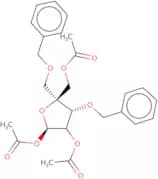
<p>4-C-Acetoxymethyl-1,2-di-O-acetyl-3,5-di-O-benzyl-a-D-ribofuranose is a custom synthesis that belongs to the class of complex carbohydrates. It is an oligosaccharide with a CAS number. This product is a modification of saccharides and has been methylated and glycosylated. This product has been fluorinated using the click chemistry reaction, which has made it more stable. 4CAMDBF is high purity and synthetic.</p>Formula:C26H30O9Purity:Min. 95%Color and Shape:Colourless syrup.Molecular weight:486.51 g/molAnhydro-4-azido-5,6,8-tri-O-benzyl-1,2,4-trideoxy-D-glycero-D-gulo-oct-1-ynitol
CAS:<p>Anhydro-4-azido-5,6,8-tri-O-benzyl-1,2,4-trideoxy -D-glycero-D-gulo-oct 1 -ynitol is a methylated saccharide. It is a fluorinated sugar that can be used as an intermediate in the synthesis of oligosaccharides and polysaccharides. This compound has been modified by click chemistry to allow for the incorporation of azide groups at the 3′ position of the sugar moiety. The modification allows for the synthesis of complex carbohydrates with high purity and high yield. The product is a white powder that is soluble in water.</p>Formula:C29H29N3O4Purity:Min. 95%Color and Shape:Colourless syrupMolecular weight:483.56 g/mol4-Methylphenyl 2,3,4-tri-O-acetyl-b-D-thioglucuronide methyl ester
CAS:<p>4-Methylphenyl 2,3,4-tri-O-acetyl-b-D-thioglucuronide methyl ester is a synthetic, fluorinated monosaccharide. It is a custom synthesis for use in glycosylation reactions. The product can be used as a carbohydrate building block in the synthesis of oligosaccharides and polysaccharides. This compound is also suitable for click modification and methylation reactions. 4-Methylphenyl 2,3,4-tri-O-acetyl-b-D-thioglucuronide methyl ester has CAS number 61025-09-0 and purity of >99%.</p>Formula:C20H24O9SPurity:Min. 95%Molecular weight:440.47 g/mol3,4,6-Tri-O-benzyl-2-deoxy-D-galactopyranose
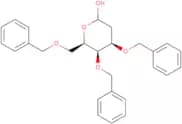
CAS:<p>3,4,6-Tri-O-benzyl-2-deoxy-D-galactopyranose is a synthetic monosaccharide. It is custom synthesized with the desired modifications and can be used in glycosylation, polysaccharide modification, or click chemistry to modify other molecules. 3,4,6-Tri-O-benzyl-2-deoxy-D-galactopyranose is an amber glassy solid that is soluble in water and ethanol. This product has a CAS No. of 94189-64-7 and a molecular weight of 438.23 g/mol.</p>Formula:C27H30O5Purity:Min. 95%Molecular weight:434.52 g/molb-L-Glucose-1-phosphate ammonium salt
<p>b-L-Glucose-1-phosphate ammonium salt is a modification of the natural glucose molecule. It is used in the synthesis of oligosaccharides and complex carbohydrates. This compound can be custom synthesized and has a high purity level. It is often used as a starting material for other chemical modifications, such as methylation, glycosylation, and fluorination. b-L-Glucose-1-phosphate ammonium salt is found naturally in nature as one of the building blocks of polysaccharides, which are long chains of sugar molecules that make up many organic compounds.</p>Formula:C6H19N2O9PPurity:Min. 95%Color and Shape:PowderMolecular weight:294.2 g/mol





![1-[[2-N-(5-Nitrothiazolyl)carboxamido]phenyl]-2,3,4-tri-O-acetyl-b-D-glucuronide methyl ester](/_next/image/?url=https%3A%2Fstatic.cymitquimica.com%2Fproducts%2F3D%2Fthumb-webp%2FMN04558.webp&w=3840&q=75)