Glycoscience
Glycoscience is the study of carbohydrates and their derivatives, as well as the interactions and biological functions they participate in. This field of research is crucial for understanding a wide variety of biological processes, including cell recognition, signaling, immune response, and disease development. Glycoscience has important applications in biotechnology, medicine, and the development of new drugs and therapies. At CymitQuimica, we offer a wide selection of high-quality, high-purity products for glycoscience research. Our catalog includes monosaccharides, oligosaccharides, polysaccharides, glycoconjugates, and specific reagents, designed to support researchers in their studies on the structure, function, and applications of carbohydrates in biological systems. These resources are intended to facilitate scientific discoveries and practical applications in various areas of bioscience and medicine.
Subcategories of "Glycoscience"
- Aminosugars(108 products)
- Glyco-Related Antibodies(282 products)
- Glycolipids(46 products)
- Glycosaminoglycans (GAGs)(55 products)
- Glycosides(419 products)
- Monosaccharides(6,622 products)
- Oligosaccharides(3,682 products)
- Polysaccharides(503 products)
Found 11041 products of "Glycoscience"
Sort by
Purity (%)
0
100
|
0
|
50
|
90
|
95
|
100
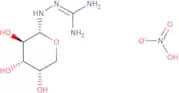
N1-a-L-Arabinopyranosylamino-guanidine HNO3
CAS:<p>This compound is a custom synthesis with a complex carbohydrate. It has CAS No. 109853-80-7 and is a polysaccharide that is modified, methylated, glycosylated, and fluorinated. This compound is a sugar with high purity and a click modification. It can be used as an intermediate in the synthesis of other compounds or saccharides.</p>Formula:C6H14N4O4·HNO3Purity:Min. 95%Molecular weight:269.21 g/mol4'-O-(b-D-2'',3'',4'',6''-Tetra-O-acetyl-glucopyranosyl)-4-nitrophloretin
CAS:<p>4'-O-(b-D-2'',3'',4'',6''-Tetra-O-acetyl-glucopyranosyl)-4-nitrophloretin is a modified carbohydrate that contains glucose, glucuronic acid, and nitrobenzene. It is a synthetic compound with a high purity and custom synthesis. The 4'-O-(b-D-2'',3'',4'',6''-Tetra-O-acetyl-glucopyranosyl)-4-nitrophloretin has been methylated, glycosylated, and click modified for research purposes.</p>Formula:C29H31NO15Purity:Min. 95%Molecular weight:633.55 g/mol2, 3, 6, 2', 3', 4', 6'-Hepta- O- acetyl- D- maltose
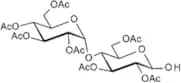
CAS:<p>2, 3, 6, 2', 3', 4', 6'-Hepta-O-acetyl-D-maltose is a fluorinated monosaccharide that is used in the synthesis of glycosides. It has a CAS number of 56285-96-2 and can be custom synthesized. This product is an oligosaccharide that can be modified by glycosylation, methylation, or click modification. It is a complex carbohydrate with a high purity and can be used in the modification of sugars.</p>Formula:C26H36O18Purity:Min. 95%Color and Shape:White to off-white solid.Molecular weight:636.55 g/mol5-Azido-5-deoxy-α-D-glucofuranose
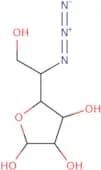
CAS:<p>Please enquire for more information about 5-Azido-5-deoxy-α-D-glucofuranose including the price, delivery time and more detailed product information at the technical inquiry form on this page</p>Formula:C6H11N3O5Purity:Min. 95%Molecular weight:205.17 g/mol3,2',3',4'-Tetra-O-acetyl-6,6'-di-O-tert-butyldimethylsilyl-lactal
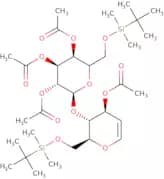
CAS:<p>3,2',3',4'-Tetra-O-acetyl-6,6'-di-O-tert-butyldimethylsilyl-lactal is a glycosylation agent that can be used in the synthesis of oligosaccharides and polysaccharides. It can be fluorinated to create a reactive site for methylation and click modification. 3,2',3',4'-Tetra-O-acetyl-6,6'-di-O-tert-butyldimethylsilyl-lactal is an acetylated lactal with a silyl ether protecting group. This product has been custom synthesized and is available in high purity.</p>Purity:Min. 95%N-Acetyl-4-O-[3,4,6-tri-O-acetyl-2-(acetylamino)-2-deoxy-β-D-glucopyranosyl]-α-muramic acid-1,6-diacetate
CAS:<p>2-Acetamido-4-O-(2-acetamido-2-deoxy-3,4,6-tri-O-acetyl-b-D-glucopyranosyl)-1,6-di-O-[N-(acetylamino)glycoloyl]-D--muramic acid is a synthetic sugar that is used in biotechnology and pharmaceuticals. It is synthesized by the glycosylation of 2,3,4,6 - triacetyl b - D - glucopyranoside with 1,6 di - O - N - acetyl - D - muramic acid. 2 Acetamido 4 O (2 acetamido 2 deoxy 3 4 6 tri O acetyl b D glucopyranoside) 1 6 di O N acetyl D muramic acid has been shown to inhibit bacterial growth through methylation and modification of bacterial enzymes.</p>Formula:C29H42N2O18Purity:Min. 95%Molecular weight:706.66 g/molmyo-Inositol 2,3,4,5,6-pentakisphosphate decasodium salt
CAS:<p>Myo-inositol 2,3,4,5,6-pentakisphosphate decasodium salt is an analog of inositol. It has been shown to have physiological functions in the human body. Myo-inositol 2,3,4,5,6-pentakisphosphate decasodium salt is a significant interaction with camp levels that may be due to its uptake by cells and plasma mass spectrometry. It also interacts with cellular organelles such as the mitochondria and endoplasmic reticulum. This compound can bind to myo-inositol and inhibit phosphoinositide 3-kinase activity. It has been shown to have a biological effect in vivo through structural analysis and vivomodel studies.</p>Formula:C6H7Na10O21P5Purity:Min. 95%Molecular weight:799.87 g/molQuinovic acid 3-O-(3',4'-O-isopropylidene)-b-D-fucopyranoside
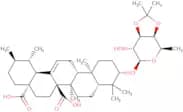
CAS:<p>Quinovic acid 3-O-(3',4'-O-isopropylidene)-b-D-fucopyranoside is a monocyclic aromatic hydrocarbon that belongs to the class of phthalic acids. It is a white or light yellow crystalline solid that has been used as an absorber for rubber, polyester, and other organic solvents. This compound has been shown to be carcinogenic in animal studies with leukemia cells in mice and rats. Quinovic acid 3-O-(3',4'-O-isopropylidene)-b-D-fucopyranoside also induces bone resorption in animals.</p>Purity:Min. 95%Allyl 2-acetamido-3-O-benzyl-2-deoxy-b-D-glucopyranose
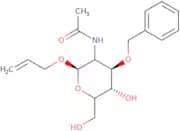
CAS:<p>Allyl 2-acetamido-3-O-benzyl-2-deoxy-b-D-glucopyranose is a modification of allyl 2,3,4,6,7,8,-hexahydroxyheptopyranose. It is an oligosaccharide that is a member of the carbohydrate family. Allyl 2-acetamido-3-O-benzyl -2deoxy-b D glucopyranose is synthesized by methylating and glycosylating allyl 2,3,4,6,7,8 hexahydroxyheptopyranose with acetic acid in the presence of sulfuric acid. This compound has CAS number 65730-00-9.</p>Formula:C18H25NO6Purity:Min. 95%Molecular weight:351.4 g/molBenzyl 5-amino-5-deoxy-2,3-O-isopropylidene-6-O-trityl-a-D-mannofuranoside
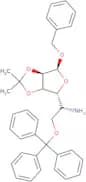
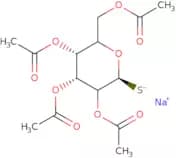
CAS:<p>Benzyl 5-amino-5-deoxy-2,3-O-isopropylidene-6-O-trityl-a-D-mannofuranoside is a complex carbohydrate that is synthesized by the glycosylation of benzyl 5-amino-5,6,7,8,9,10,11,12,13,14-, 2,3,4-, or 6-(N","N"-dimethylamino)ethyl 5-[(2","N"-dimethylamino)-ethoxycarbonyl]-5-[(2","N"-dimethylamino)ethoxycarbonyl]-4H-[1]benzopyranose with 6-(N","N"-dimethylaminomethylene)-a-"D"mannofuranose. The chemical modification includes fluorination and methylation. This product has a CAS number of 9136415 and purity of more than</p>Formula:C35H37NO5Purity:Min. 95%Molecular weight:551.67 g/mol2,3,4,6-Tetra-O-acetyl-b-D-thioglucopyranose sodium salt
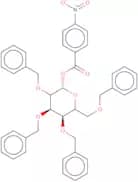
CAS:<p>2,3,4,6-Tetra-O-acetyl-b-D-thioglucopyranose sodium salt is a synthetic monosaccharide that can be used for glycosylation. This product is synthesized by the addition of acetyl groups to the 2-, 3-, 4-, and 6-positions on the glucose moiety. The resulting product has been shown to have a high degree of purity as well as a low content of impurities.</p>Formula:C14H19O9SNaPurity:Min. 95%Molecular weight:386.35 g/mol2,3,4,6-Tetra-O-benzyl-1-O-(4-nitrobenzoyl)-b-D-glucopyranose
<p>2,3,4,6-Tetra-O-benzyl-1-O-(4-nitrobenzoyl)-b-D-glucopyranose is a synthetic sugar that is the building block for oligosaccharides and polysaccharides. It has been modified with fluorination and methylation to produce a high purity product. The CAS number for this compound is 248940-24-5.</p>Formula:C41H39NO9Purity:Min. 95%Molecular weight:689.77 g/molGM3-Ganglioside ammonium
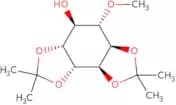
CAS:<p>Ganglioside GM3 (ammonium salt) has a core disaccharide structure (Galβ1,4Glc) with sialic acid linked a2,3 to the galactose residue and ceramide linked β to position 1 on the reducing terminal glucose residue (Ledeen, 2009). Ganglioside GM3 is strongly associated with human tumors, such as, lung, brain and melanomas where it is over expressed. It is seen as a possible tumor-associated carbohydrate antigen for cancer immunotherapy (Changping, 2019). GM3 ganlioside is implicated in various other diseases involving chronic inflammation, such as, insulin resistance, leptin resistance, T-cell function and immune disorders (e.g. allergic asthma). GM3 ganglioside has also been shown to play an essential role in murine and human auditory systems, and a common pathological feature of GM3S deficiency is deafness (Inokuchi, 2018).</p>Formula:C59H111N3O21xNH4Purity:Min. 95%Molecular weight:1,198.52 g/molPinitol diacetonide
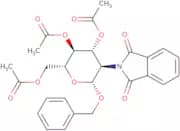
CAS:<p>Pinitol diacetonide is an acceptor substrate for β-galactosidase, a glycosyl hydrolase that catalyzes the hydrolysis of terminal galactose residues from the non-reducing end of certain glycolipids. Pinitol diacetonide has been shown to be enzymatically active in both aerobic and anaerobic conditions. This product can also be used as a substrate for 1,4-β-D-galactosyltransferase, which catalyzes the transfer of D-galactose from 1,4-β-D-glucose to the nonreducing end of certain glycolipids. Pinitol diacetonide is not a suitable substrate for p-nitrophenyl galactosyltransferase, an enzyme that catalyzes the transfer of p-nitrophenol from L -pyranosides to the nonreducing end of certain glycolipids.<br>Pin</p>Formula:C13H22O6Purity:Min. 95%Molecular weight:274.31 g/molBenzyl 3,4,6-tri-O-acetyl-2-deoxy-2-phthalimido-b-D-glucopyranoside
CAS:<p>Benzyl 3,4,6-tri-O-acetyl-2-deoxy-2-phthalimido-b-D-glucopyranoside is a carbohydrate compound that is used in the synthesis of complex carbohydrates and glycoproteins. This product can be custom synthesized to customer specifications using our unique capabilities. It is a high purity, methylated, glycosylated, and click modified sugar.</p>Formula:C27H27NO10Purity:Min. 95%Molecular weight:525.52 g/mol6-Chloro-6-deoxy-D-allitol
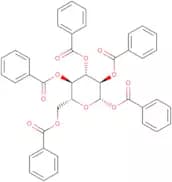
<p>6-Chloro-6-deoxy-D-allitol is a custom synthesis, complex carbohydrate that belongs to the group of oligosaccharides. It is an Oligosaccharide, which is a type of polymer containing a small number of monomer units. This product can be found in CAS No., Polysaccharide, Modification, saccharide, Methylation, Glycosylation, Click modification and Carbohydrate. This product has been modified using fluorination and it’s high purity with a purity greater than 95%.</p>Formula:C6H13ClO5Purity:Min. 95%Molecular weight:200.62 g/mol1,2,3,4,6-Penta-O-benzoyl-b-D-glucopyranose
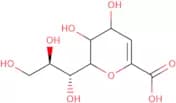
CAS:<p>1,2,3,4,6-Penta-O-benzoyl-b-D-glucopyranose is a synthetic substrate that has been validated for use in heparin assays. It is an inhibitor of the enzyme sulfate protease and can be used to study the role of this enzyme in inflammation. 1,2,3,4,6-Penta-O-benzoyl-b-D-glucopyranose has also been shown to inhibit the activity of neutrophils (a type of white blood cell) and monocytes (a type of white blood cell). This compound has been shown to have antitumor activity as well as antiinflammatory activities.</p>Formula:C41H32O11Purity:Min. 95%Molecular weight:700.69 g/mol2,6-Anhydro-3-deoxy-D-glycero-D-galacto-non-2-enoic-acid
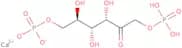
CAS:<p>2,6-Anhydro-3-deoxy-D-glycero-D-galacto-non-2-enoic acid is a carbohydrate that has been used to study the effect of immunocompromised patients on invasive aspergillosis. It has been shown to be an efficient substrate for sialidases and homologous sialidases. This carbohydrate has also been shown to have a reactive bond cleavage in the presence of catalytic enzymes, such as sialidases and glycosyltransferases. The kinetic data suggest that this carbohydrate is more accessible than other carbohydrates. The conformational change may be due to a barrier that is overcome by the catalytic enzyme.</p>Formula:C9H14O8Purity:Min. 95%Color and Shape:White Off-White PowderMolecular weight:250.21 g/molD-Fructose-1,6-diphosphate monocalcium salt
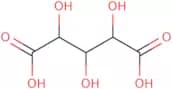
CAS:<p>D-Fructose-1,6-diphosphate monocalcium salt is a complex carbohydrate that is produced by methylation of D-fructose 1,6-diphosphate. This compound belongs to the class of saccharides and has been modified using fluorination. It is also an important glycosylation site for many proteins. In addition, it can be used as a synthetic substrate in click chemistry and as a building block for oligosaccharides or polysaccharides.</p>Formula:C6H12O12P2·CaPurity:Min. 95%Molecular weight:378.18 g/molRibaric acid disodium salt
CAS:<p>Ribaric acid is a polycarboxylic acid that is used as a disinfectant and corrosion inhibitor. It has been shown to have synergistic effects with other compounds, such as azobenzene. Ribaric acid also has the ability to inhibit the growth of bacteria, enzymes and fungi. The structure of ribaric acid is composed of alternating carboxylate groups and hydroxyl groups, which give it its biodegradable properties. It can be used in deionized water due to its high resistance to hydrolysis. One study showed that ribaric acid inhibited the growth of bacteria by disrupting their cell wall synthesis and inhibiting their DNA synthesis by interacting with bacterial DNA gyrase.</p>Formula:C5H6Na2O7Purity:Min. 95%Molecular weight:224.08 g/mol


![N-Acetyl-4-O-[3,4,6-tri-O-acetyl-2-(acetylamino)-2-deoxy-β-D-glucopyranosyl]-α-muramic acid-1,6-di…](/_next/image/?url=https%3A%2Fstatic.cymitquimica.com%2Fproducts%2F3D%2Fthumb-webp%2FOA05067.webp&w=3840&q=75)