Glycoscience
Glycoscience is the study of carbohydrates and their derivatives, as well as the interactions and biological functions they participate in. This field of research is crucial for understanding a wide variety of biological processes, including cell recognition, signaling, immune response, and disease development. Glycoscience has important applications in biotechnology, medicine, and the development of new drugs and therapies. At CymitQuimica, we offer a wide selection of high-quality, high-purity products for glycoscience research. Our catalog includes monosaccharides, oligosaccharides, polysaccharides, glycoconjugates, and specific reagents, designed to support researchers in their studies on the structure, function, and applications of carbohydrates in biological systems. These resources are intended to facilitate scientific discoveries and practical applications in various areas of bioscience and medicine.
Subcategories of "Glycoscience"
- Aminosugars(108 products)
- Glyco-Related Antibodies(282 products)
- Glycolipids(46 products)
- Glycosaminoglycans (GAGs)(55 products)
- Glycosides(419 products)
- Monosaccharides(6,622 products)
- Oligosaccharides(3,682 products)
- Polysaccharides(503 products)
Found 11041 products of "Glycoscience"
Sort by
Purity (%)
0
100
|
0
|
50
|
90
|
95
|
100
NA2F N-Glycan
CAS:<p>NA2F N-Glycan is a custom synthesized, high purity and monosaccharide glycoprotein. NA2F N-Glycan has been fluorinated and methylated to produce NA2F N-Glycan. The product is a complex carbohydrate that is comprised of an oligosaccharide and polysaccharide. NA2F N-Glycan is synthesized from the sugar saccharide, which is a hexose made up of six carbon atoms that are bonded to each other in a ring.</p>Formula:C68H114N4O50Purity:Min. 85 Area-%Color and Shape:PowderMolecular weight:1,787.63 g/mol1,2,3,4,5,6-Hexa-O-acetyl-D-mannitol
CAS:<p>1, 2, 3, 4, 5, 6-Hexa-O-acetyl-D-mannitol (1,2,3,4,5,6-HOM) is a glycoside that belongs to the group of pentose sugars. It is the only natural hexose sugar that contains an acetate residue in its structure. 1,2,3,4,5,6-HOM is found in plants and animals and has been shown to have anti-cancer properties. The reaction products of 1 with various enzymes are also studied for their cancer inhibitory effects. This molecule has also been shown to inhibit lipid peroxidation in mitochondria.<br>1,2,3,4,5,6-HOM binds to cell surface receptors on cancer cells and inhibits growth by inhibiting the synthesis of DNA and RNA.</p>Formula:C18H26O12Purity:Min. 95%Color and Shape:PowderMolecular weight:434.39 g/mol4-Nitrophenyl 2-acetamido-3,6-di-O-benzoyl-2-deoxy-b-D-glucopyranoside
CAS:<p>4-Nitrophenyl 2-acetamido-3,6-di-O-benzoyl-2-deoxy-b-D-glucopyranoside is a synthetic saccharide that can be used in the production of complex carbohydrates. This product has been modified with fluorination, methylation, and click modification. 4NP2AG is a monosaccharide that can be synthesized by modifying acetamido group with nitrophenol (4NP). It can also be used as an Oligosaccharide or Polysaccharide.</p>Formula:C28H26N2O10Purity:Min. 95%Molecular weight:550.51 g/molb-D-Galactopyranosyl-(1,4)-O-b-D-glucopyranosyl-(1,4)-D-glucose
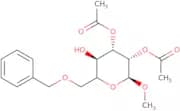
<p>This custom synthesis complex carbohydrate has a CAS number and is a polysaccharide. It is modified by methylation, glycosylation, click modification, and fluorination. This carbohydrate has high purity and is synthesized synthetically.</p>Purity:Min. 95%6-O-Benzyl-2,3-di-O-acetyl-methyl-a-D-glucopyranoside
CAS:<p>6-O-Benzyl-2,3-di-O-acetyl-methyl-a-D-glucopyranoside is a high purity synthetic compound with a CAS number of 162284. It is a carbonyl sugar that has been modified with fluorination and methylation. The 6 position of the glucose monosaccharide has been acetylated to give an O6 benzyl group. This compound is used for glycosylation and click chemistry modifications.</p>Formula:C18H24O8Purity:Min. 95%Molecular weight:368.38 g/mol3',4'-O-Carbonyl-6,6'-di-O-tert-butyldiphenylsilyl lactal
CAS:<p>3',4'-O-Carbonyl-6,6'-di-O-tert-butyldiphenylsilyl lactal is a synthetic oligosaccharide that has been modified with a click modification. It is comprised of 3 different monosaccharides, one saccharide, and one carbonyl group. This carbohydrate is synthesized from the natural sugar D-ribose, which is modified with an O-tert-butyldiphenylsilyl lactal. The synthesis begins with the addition of a methyl group to the sugar's primary hydroxyl group. Then the sugar is reacted with fluorine gas to form an ether bond between the sugar's primary hydroxyl and its secondary hydroxyl. The final step in the synthesis involves glycosylation of the terminal hydroxyl groups on each monosaccharide.</p>Formula:C45H54O10Si2Purity:Min. 95%Molecular weight:811.08 g/mol1,2-O-Ethylidene b-D-mannopyranose
CAS:<p>1,2-O-Ethylidene b-D-mannopyranose is a complex carbohydrate that is synthesized from the modification of mannose with 1,2-O-ethylidene b-D-mannopyranose. This modification can be accomplished by either methylation or glycosylation. Modification of mannose with 1,2-O-ethylidene b-D-mannopyranose has been shown to increase the stability of the molecule and improve its resistance to degradation. The methylation of mannose with 1,2-O-ethylidene b-D-mannopyranose has been shown to produce a variety of derivatives that may have potential applications in drug design and cancer treatment. This complex carbohydrate is an important component in many saccharides and polysaccharides. It has also been used as a fluorinating agent in organic synthesis.</p>Formula:C8H14O6Purity:Min. 95%Molecular weight:206.2 g/molLacto-N-fucopentaose III-APD-HSA
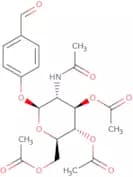
<p>Lacto-N-fucopentaose III-APD-HSA is a custom synthesis, complex carbohydrate that has been modified with methylation and glycosylation. It is an oligosaccharide that is found in human serum albumin. Lacto-N-fucopentaose III-APD-HSA has been shown to have antitumor activity. It also inhibits the growth of bacteria by binding to bacterial DNA gyrase and topoisomerase IV, which are enzymes that maintain the integrity of bacterial DNA. This compound binds to two sites on the 16S ribosomal RNA of bacteria and can inhibit protein synthesis, leading to cell death by inhibiting production of proteins vital for cell division. Lacto-N-fucopentaose III-APD-HSA has undergone fluorination and click modification.<br>Methylation: A process whereby a methyl group (-CH3) is added to an organic molecule via a chemical</p>Purity:Min. 95%4-Formylphenyl 2-acetamido-3,4,6-tri-O-acetyl-2-deoxy-b-D-glucopyranoside
CAS:<p>4-Formylphenyl 2-acetamido-3,4,6-tri-O-acetyl-2-deoxy-β--glucopyranoside is a pyranoside that is a potent inhibitor of the enzyme glycosidase. It is used to study the interactions between enzymes and substrates. The crystal structure of 4FFAP has been determined using X-ray diffraction data. This compound has a six membered ring with two acetamido groups and one carbonyl group attached to the same carbon atom in the ring. 4FFAP interacts with other molecules through hydrogen bonding and van der Waals forces.</p>Formula:C21H25NO10Purity:Min. 95%Molecular weight:451.42 g/mol(2R,3R,4S,5R,6S)-3,4,5-Trihydroxy-2-hydroxymethyl-7,9-diaza-1-oxa-spiro[4,5]decane-10-one-8-thione
CAS:<p>(2R,3R,4S,5R,6S)-3,4,5-Trihydroxy-2-hydroxymethyl-7,9-diaza-1-oxa-spiro[4,5]decane-10-one-8-thione is a custom synthesis of a polysaccharide. It has been modified to include fluorination and methylation. The monosaccharides present are glucose and galactose. This polysaccharide also has a saccharide linkage to an oligosaccharide that contains glycosylation sites for sugar groups.</p>Formula:C8H12N2O6SPurity:Min. 95%Molecular weight:264.26 g/mol3-Deoxy-3-fluoro-D-glucitol
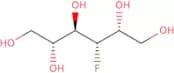
CAS:<p>3-Deoxy-3-fluoro-D-glucitol is a glucose analog that is used as a marker for glycogen in tissue extracts. 3-Deoxy-3-fluoro-D-glucitol has been shown to be the most sensitive molecular marker for muscle glycogen concentrations, although it does not react with all types of muscle. It can also be used as a marker for glycogen content in extracts of tissue or cells because it reacts with locusta migratoria fat body. In addition, 3-deoxy-3-fluoro-D-glucitol can be used as a nuclear magnetic resonance (NMR) probe to study the structure of trehalose and fructose. The compound has been shown to bind to locusta migratoria fat body and can be used as an NMR probe to study the structure of trehalose and fructose.</p>Formula:C6H13FO5Purity:Min. 95%Molecular weight:184.16 g/mol2,3,6-Trimethyl-γ-cyclodextrin
CAS:<p>This gamma-cyclodextrin (γ-CD) derivative is a modified cyclic oligosaccharide composed of eight glucose units, featuring a larger cavity size than α- and β-cyclodextrins. This structural characteristic allows γ-CDs to form inclusion complexes with a wider range of guest molecules, making it particularly versatile in various industries. In the food sector, it is used as a carrier and stabilizer for flavors, fat-soluble vitamins, and polyunsaturated fatty acids, protecting volatile compounds from evaporation. In pharmaceuticals, it enhances the solubility and bioavailability of poorly water-soluble drugs and, thanks to its larger ring size, allows for the encapsulation of larger molecules or even entire drug molecules. γ-CDs and derivatives are also used for environmental remediation and, in analytical chemistry, for the extraction and concentration of target substances.</p>Formula:C72H128O40Purity:Min. 95%Color and Shape:PowderMolecular weight:1,633.8 g/molD-Galactose diethyldithioacetal
CAS:<p>D-Galactose diethyldithioacetal is a phenylhydrazone that has an affinity for the C-3 position of sugars. It is synthesised from D-galactose and diethyldithiocarbonyl chloride, with a borohydride reduction to give the hydroxyl group. The hydroxyl group reacts with methyl glycosides or carbohydrates to produce 3-substituted glycosides or 3-substituted carbohydrate. D-Galactose diethyldithioacetal also inhibits glycosidase enzymes, which are enzymes that break down sugars, and thus prevents the digestion of sugars. The chemical structure of D-galactose diethyldithioacetal was determined by magnetic resonance spectroscopy. The product was found to be L-fucitol (a sweetener) after desulfurization using hydrogen gas for removal of sulfur compounds.</p>Formula:C10H22O5S2Purity:Min. 95%Molecular weight:286.41 g/mol5-(Acetylamino)-5-deoxy-3-S-phenyl-3-thio-D-erythro-a-L-gluco-2-nonulopyranosonic acid methyl ester 2,4,7,8,9-pentaacetate
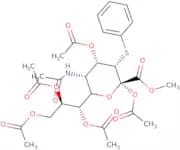
CAS:<p>5-(Acetylamino)-5-deoxy-3-S-phenyl-3-thio-D-erythro-a-L-gluco-2-nonulopyranosonic acid methyl ester 2,4,7,8,9-pentaacetate is a synthetic monosaccharide that can be used for glycosylation and polysaccharide modification. It can also be used as a click chemistry building block to modify sugars. This product has been custom synthesized for the specific needs of our customers. The purity of this compound is greater than 98%.</p>Formula:C28H35NO14SPurity:Min. 95%Molecular weight:641.64 g/molGal[2346Ac]b(1-3)GlcN3[46Bzd]-b-MP
<p>Gal[2346Ac]b(1-3)GlcN3[46Bzd]-b-MP is a custom synthesis that has been modified with fluorination, methylation, and modification. The product contains a monosaccharide, oligosaccharide, saccharides, and complex carbohydrates.</p>Formula:C34H39N3O15Purity:Min. 95%Molecular weight:729.68 g/mol4-Aminophenyl 2,3,4-tri-O-acetyl-b-D-glucuronide methyl ester
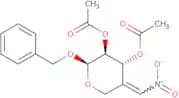
CAS:<p>4-Aminophenyl 2,3,4-tri-O-acetyl-b-D-glucuronide methyl ester is an organic compound that belongs to the group of Modifications. It is a colorless solid with a melting point of about 200. °C. This product is used in the synthesis of oligosaccharides and carbohydrates. The molecular formula for 4-aminophenyl 2,3,4-tri-O-acetyl-b-D-glucuronide methyl ester is C8H14N2O5 and its molecular weight is 240.24 g/mol. The CAS Registry Number (RN) for this product is 25218-22-8 and its EINECS number is 249 3 578 - 7 .</p>Formula:C19H23NO10Purity:Min. 95%Molecular weight:425.39 g/molBenzyl 2,3-di-O-acetyl-4-deoxy-4-C-nitromethylene-b-D-arabinopyranoside
CAS:<p>Benzyl 2,3-di-O-acetyl-4-deoxy-4-C-nitromethylene-b-D-arabinopyranoside is a synthetic sugar. It is a complex carbohydrate with two saccharides and one monosaccharide. The saccharides are glucose and galactose, and the monosaccharide is arabinose. Benzyl 2,3-di-O-acetyl-4-deoxy-4C nitromethylene bD arabinopyranoside has been modified by fluorination, methylation, glycosylation and click chemistry to create a high purity product.</p>Formula:C17H19NO8Purity:Min. 95%Molecular weight:365.33 g/mol(2R,3S,4R)-3,4-Dihydroxypyrrolidine-2-carboxylic acid
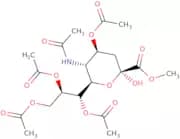
CAS:<p>(2R,3S,4R)-3,4-Dihydroxypyrrolidine-2-carboxylic acid is a methylated compound that has been synthesized by the click modification of an oligosaccharide. It is used as an intermediate in the synthesis of saccharides and polysaccharides. This product can be used for the fluorination of complex carbohydrates and for the modification of monosaccharides or sugars. The purity level of this product is high and it has been modified to have a desirable property.</p>Formula:C5H9NO4Purity:Min. 95%Molecular weight:147.13 g/mol4,7,8,9-Tetra-O-acetyl-N-acetyl-D-neuraminic acid methyl ester
CAS:<p>4,7,8,9-Tetra-O-acetyl-N-acetyl-D-neuraminic acid methyl ester is a modified form of sialic acid. This compound is a glycosylation product that has been modified with methyl groups and fluorine atoms. The fluorination of the molecule increases its stability and prevents it from being hydrolyzed by enzymes such as β-galactosidase. 4,7,8,9-Tetra-O-acetyl-N-acetyl-D-neuraminic acid methyl ester is often used in the synthesis of polysaccharides and oligosaccharides for medical purposes. This compound can be custom synthesized for research purposes or to meet special requirements.</p>Formula:C20H29NO13Purity:Min. 95%Color and Shape:White to off-white solid.Molecular weight:491.44 g/mol2-(L-Arabino-tetrahydroxybutyl)-4(R)-1,3-thiazolidine-4-carboxylic acid
CAS:<p>2-(L-Arabino-tetrahydroxybutyl)-4(R)-1,3-thiazolidine-4-carboxylic acid is a synthetic compound that has been modified to include sugar groups. It can be used for the synthesis of oligosaccharides and monosaccharides. The carbohydrate group has been modified with fluorination, glycosylation, and methylation. This modification can be useful in the production of complex carbohydrates.</p>Formula:C8H15NO6SPurity:Min. 95%Molecular weight:253.27 g/mol



![(2R,3R,4S,5R,6S)-3,4,5-Trihydroxy-2-hydroxymethyl-7,9-diaza-1-oxa-spiro[4,5]decane-10-one-8-thione](/_next/image/?url=https%3A%2Fstatic.cymitquimica.com%2Fproducts%2F3D%2Fthumb-webp%2FMT01909.webp&w=3840&q=75)


![Gal[2346Ac]b(1-3)GlcN3[46Bzd]-b-MP](/_next/image/?url=https%3A%2Fstatic.cymitquimica.com%2Fproducts%2F3D%2Fthumb-webp%2FOG60595.webp&w=3840&q=75)