Antifungals
Antifungals are compounds specifically designed to stop, prevent, and eliminate the growth of fungi. In this category, you will find a wide variety of antifungal agents essential for research and therapeutic applications. These compounds are crucial in treating fungal infections and preventing their recurrence, making them vital tools in both medical and agricultural settings. Researchers and healthcare professionals can explore numerous antifungals to understand their mechanisms, optimize their efficacy, and develop new treatments to combat resistant fungal strains. The extensive selection of antifungals supports ongoing advancements in fungal research and the development of effective antifungal therapies.
Found 837 products of "Antifungals"
Sort by
Purity (%)
0
100
|
0
|
50
|
90
|
95
|
100
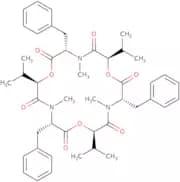
Beauvericin
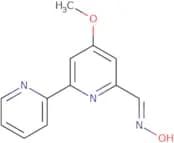
CAS:<p>Beauvericin is a cyclic peptide that is isolated from the fungus Fusarium. It has been shown to have antimicrobial activity against bacteria, as well as a variety of other biological properties. Beauvericin has been shown to inhibit mitochondrial membrane potential and induce toxicity in some animal models. Beauvericin also inhibits protein synthesis and causes cell death by inhibiting DNA polymerase activity. This compound is active against cancer cells, including HL-60 cells, which are derived from human lymphocytes and are used as a model for leukemia. Beauvericin can be extracted from an ETOA extract of the fungus Fusarium oxysporum; this extract has shown anti-cancer effects in vitro assays.</p>Formula:C45H57N3O9Purity:Min. 95%Molecular weight:783.95 g/molCaerulomycin A
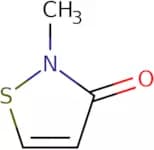
CAS:<p>Caerulomycin A is a bioactive compound classified as a natural broad-spectrum antibiotic, which is derived from various Streptomyces species found in soil. Its mode of action involves inhibiting fungal and bacterial growth by interfering with essential cellular processes, effectively curbing the proliferation of pathogenic microorganisms. This potent molecule achieves its effects by binding to specific cellular targets, thereby disrupting cell wall synthesis and other critical metabolic pathways.</p>Formula:C12H11N3O2Purity:Min. 95%Molecular weight:229.23 g/mol2-Methyl-4-isothiazolin-3-one
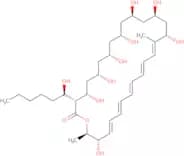
CAS:Controlled Product<p>2-Methyl-4-isothiazolin-3-one or MIT is a powerful antimicrobial and antifungal agent which is widely used in personal care products. It is also used in industrial applications as a preservative and antifouling agent.</p>Formula:C4H5NOSPurity:Min. 96%Color and Shape:Yellow PowderMolecular weight:115.15 g/molFilipin III
CAS:<p>Filipin III is a polyene macrolide antibiotic, which is extracted from Streptomyces filipinensis. Known for its unique mode of action, Filipin III interferes with cholesterol-rich membranes by binding to ergosterol and cholesterol. This interaction disrupts the membrane structure, altering membrane permeability and ultimately affecting cell viability.</p>Purity:Min. 95%Levofloxacin
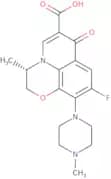
CAS:<p>Levofloxacin is a fluoroquinolone antibiotic with a mode of action that inhibits bacterial DNA gyrase and topoisomerase IV. It is used for treating bacterial infections like pneumonia and urinary tract infections.</p>Formula:C18H20FN3O4Purity:Min. 95%Color and Shape:PowderMolecular weight:361.37 g/molSordarin sodium salt
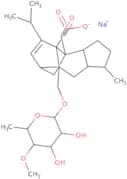
CAS:<p>Sordarin sodium salt is an antifungal agent, characterized as a semisynthetic derivative produced from the fermentation products of filamentous fungi, specifically belonging to the phylum Ascomycota. This compound exerts its effects by selectively inhibiting fungal protein synthesis. It achieves this by obstructing the function of elongation factor 2 (EF-2), an essential component of fungal ribosomal activity, thereby disrupting the translational elongation step of protein synthesis.</p>Formula:C27H39NaO8Purity:Min. 95%Molecular weight:514.58 g/molAureothin
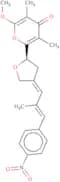
CAS:<p>Aureothin is a bioactive compound, classified as a polyketide antibiotic, which is derived from the culture of the bacterium Streptomyces thioluteus. This compound operates primarily through the inhibition of protein synthesis by interfering with the aminoacylation of tRNA with specific amino acids. Its mode of action disrupts cellular protein synthesis, which is essential for cell growth and function, leading to its potent antibacterial and antifungal activities.</p>Formula:C22H23NO6Purity:Min. 95%Color and Shape:PowderMolecular weight:397.42 g/mol41-Oxo-rapamycin
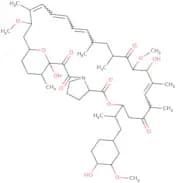
CAS:<p>41-Oxo-rapamycin is a synthetic derivative of rapamycin, which is a macrocyclic lactone. It is derived from Streptomyces hygroscopicus, a gram-positive bacterium known for producing various bioactive compounds. The mode of action of 41-Oxo-rapamycin involves binding to the FK506-binding protein (FKBP12), forming a complex that subsequently inhibits the mammalian target of rapamycin (mTOR) pathway. This inhibition results in the suppression of T-cell proliferation and modulation of immune responses.</p>Formula:C51H77NO13Purity:Min. 95%Molecular weight:912.2 g/molMalformin C
CAS:<p>Malformin C is a cyclic pentapeptide, which is a secondary metabolite derived from certain strains of the fungus Aspergillus. Its mode of action involves disrupting cellular processes by interfering with cell division. Specifically, it is thought to affect mitotic spindle formation, leading to abnormal cell cycle progression.</p>Formula:C23H39N5O5S2Purity:Min. 95%Color and Shape:PowderMolecular weight:529.72 g/molNaftifine N-Oxide
CAS:<p>Naftifine N-Oxide is an antifungal agent, which is derived from synthetic chemical processes. Its structure is based on the modification of the known antifungal, naftifine, by introducing an N-oxide functional group, which may enhance certain pharmacokinetic properties. As a synthetic derivative, Naftifine N-Oxide is specifically designed to interfere with the biosynthesis of ergosterol, an essential component of fungal cell membranes. By inhibiting squalene epoxidase, an enzyme crucial to the ergosterol pathway, Naftifine N-Oxide effectively disrupts the development and maintenance of the fungal cell membrane, compromising cell integrity and leading to antifungal activity.</p>Formula:C21H21NOPurity:Min. 95%Molecular weight:303.4 g/molNeoaureothin
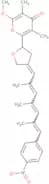
CAS:<p>Neoaureothin is a natural antibiotic product, which is derived from marine actinomycetes with a complex polyketide structure. Its mode of action involves the inhibition of bacterial protein synthesis by binding selectively to the ribosomal subunits, thereby obstructing the translation process in susceptible microbial strains. The specificity of its action allows it to target a broad spectrum of Gram-positive bacteria while presenting a lower risk of resistance development compared to traditional antibiotics.</p>Formula:C28H31NO6Purity:Min. 95%Molecular weight:477.5 g/mol21-Norrapamycin
CAS:<p>21-Norrapamycin is a macrocyclic lactone antibiotic, which is derived from the bacterium Streptomyces hygroscopicus. Its chemical structure is closely related to that of rapamycin, a well-known immunosuppressant. The mode of action of 21-Norrapamycin involves the inhibition of the mechanistic target of rapamycin (mTOR) signaling pathway. By binding to the FK506-binding protein 12 (FKBP12), it forms a complex that then inhibits mTOR, a crucial regulator of cell growth, proliferation, and survival.</p>Formula:C50H77NO13Purity:Min. 95%Molecular weight:900.1 g/molAntifungal agent 33
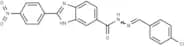
CAS:<p>Antifungal 33 (4e) strongly inhibits Candida albicans. MIC: 16 μg/ml; IC50: 0.19 μg/ml.</p>Formula:C21H14ClN5O3Color and Shape:SolidMolecular weight:419.82Succinate dehydrogenase-IN-1
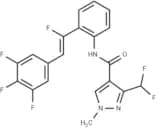
CAS:<p>Succinate dehydrogenase-IN-1 (Compound 34) acts as an inhibitor of succinate dehydrogenase (SDH), exhibiting an IC50 value of 0.94 μM and a KD of 22.4 μM. This compound also demonstrates antifungal activity, with EC50 values against Rhizoctonia solani, Sclerotinia sclerotiorum, Monilinia fructicola, and Botrytis cinerea measured at 0.04 μM, 1.13 μM, 1.61 μM, and 1.21 μM, respectively.</p>Formula:C20H13F6N3OColor and Shape:SolidMolecular weight:425.33FBA-IN-1
CAS:<p>FBA-IN-1 (2a11) is the first covalent, allosteric CaFBA inhibitor, effective against Azole-resistant strains with a MIC 80 of 1 μg/mL.</p>Formula:C15H13NOSePurity:98.79%Color and Shape:SolidMolecular weight:302.23Benthiavalicarb isopropyl
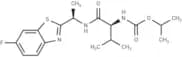
CAS:<p>Benthiavalicarb isopropyl is a fungicide, specifically targeting downy mildew and blight.</p>Formula:C18H24FN3O3SPurity:98%Color and Shape:SolidMolecular weight:381.46Tebuconazole-d9
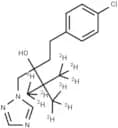
CAS:<p>Tebuconazole-d9 is a GC/LC-MS standard for quantifying the triazole fungicide tebuconazole, affecting seed/foliar fungi and androgen receptors.</p>Formula:C16H13ClD9N3OColor and Shape:SolidMolecular weight:316.87Iprovalicarb
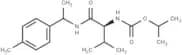
CAS:<p>Iprovalicarb is a fungicide aimed at oomycetes.</p>Formula:C18H28N2O3Purity:98%Color and Shape:SolidMolecular weight:320.43Mollugogenol A
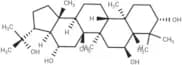
CAS:<p>Mollugogenol A: a Gammacerane saponin from Mollugo pentaphylla with antifungal and spermatocidal properties; damages sperm membrane.</p>Formula:C30H52O4Color and Shape:SolidMolecular weight:476.73Sortin2
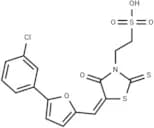
CAS:<p>Sortin2 is a sorting inhibitor that acts upstream from the morphological marker of lateral root primordium formation, the mitotic activity.</p>Formula:C16H12ClNO5S3Purity:98%Color and Shape:SolidMolecular weight:429.92