Nucleotides
Subcategories of "Nucleotides"
Found 2637 products of "Nucleotides"
2'-O-Methylguanosine 5'-triphosphate lithium salt - 100mM aqueous solution
CAS:2'-O-Methylguanosine 5'-triphosphate lithium salt is a synthetic nucleotideFormula:C11H18N5O14P3·xLiPurity:Min. 95%Color and Shape:Clear LiquidMolecular weight:537.21 g/mol6-(Benzylamino)-3-methyl-1,2,3,4-tetrahydropyrimidine-2,4-dione
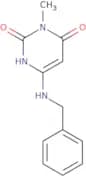
CAS:6-(Benzylamino)-3-methyl-1,2,3,4-tetrahydropyrimidine-2,4-dione (BMPT) is a synthetic cytokinin that belongs to the group of 6-benzylaminopurines. BMPT is an inhibitor of cytokinin receptor kinases, as it is a benzyl uracil derivative. BMPT can be used as a building block for the synthesis of other compounds and has been used as an inhibitor of cell growth in various organisms.
Formula:C12H13N3O2Purity:Min. 95%Molecular weight:231.25 g/molAracytidylyl-(5′→5′)-cytidine
CAS:Please enquire for more information about Aracytidylyl-(5′→5′)-cytidine including the price, delivery time and more detailed product information at the technical inquiry form on this pageFormula:C18H25N6O12PPurity:Min. 95%Molecular weight:548.4 g/mol9-(β-D-Arabinofuranosyl)adenine 5'-monophosphate
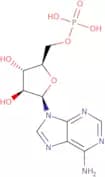
CAS:9-(β-D-Arabinofuranosyl)adenine 5'-monophosphate (Ara-AMP) is a prodrug that is converted to adenine arabinoside in vivo. It is used as an antiviral agent for the prevention of hepatitis B and C. Ara-AMP inhibits viral DNA synthesis by acting as a competitive inhibitor of adenosine triphosphate, which is required for viral DNA polymerase activity. Ara-AMP also has antiviral properties against some RNA viruses, such as HIV and influenza virus. Ara-AMP can be administered orally or by injection, making it suitable for use in children who are unable to take oral medication.Formula:C10H14N5O7PPurity:Min. 95%Color and Shape:White PowderMolecular weight:347.22 g/mol4-Chloro-5-iodo-pyrrolo[2,3-d]pyriMidine-7-carboxylic acid tert-butyl ester
CAS:Focuses is a chemical compound that does not have any known commercial or industrial uses.Purity:Min. 95%Stearoyl coenzyme A free acid hydrate
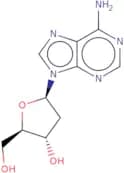
CAS:Stearoyl coenzyme A free acid hydrate is a natural, non-synthetic lipid molecule that belongs to the group of fatty acids. It is found in the form of a white crystalline powder and has a melting point at approximately 56°C. Stearoyl CoA free acid hydrate is an essential component of cellular metabolism, carrying out reactions such as desaturase, dextran sulfate, and other enzyme activities. Stearoyl CoA free acid hydrate may have therapeutic applications for metabolic disorders and obesity. The enzyme complex that catalyzes the synthesis of stearoyl CoA free acid hydrate in adipocytes is ATP-binding cassette transporter (ABC) A1 and ABCG1, which are members of the superfamily of ATP-binding cassette (ABC) transporters. It also plays a role in regulating immune responses via Toll-like receptor 4 (TLR4).Formula:C39H70N7O17P3S•H2OPurity:Min. 92 Area-%Color and Shape:White PowderMolecular weight:1,052.01 g/mol2'-Deoxyadenosine
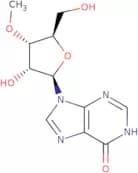
CAS:2'-Deoxyadenosine is a nucleoside that is found in DNA. It has been shown to have potent anticancer activity against carcinoma cell lines and to bind to the adenosine receptor A3. 2'-Deoxyadenosine has also been shown to inhibit the production of inflammatory cytokines, such as tumor necrosis factor-α and interleukin-6, from nuclear extracts of mouse tumor cells. This nucleoside may be a potential drug target for the treatment of cancer and inflammation.Formula:C10H13N5O3Purity:Min. 98 Area-%Color and Shape:PowderMolecular weight:251.24 g/mol3'-O-Methylinosine
CAS:3'-O-Methylinosine is a synthetic nucleoside that inhibits the synthesis of viral DNA and RNA by interacting with the enzyme ribonucleotide reductase. This antiviral agent has been shown to be effective against a wide range of viruses, including human cytomegalovirus, herpes simplex virus type 1, varicella-zoster virus, and influenza A virus. 3'-O-Methylinosine has also been shown to inhibit the growth of cancer cells in vitro and in vivo.
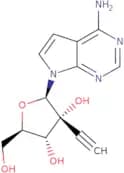
Formula:C11H14N4O5Purity:Min. 95%Color and Shape:White PowderMolecular weight:282.25 g/mol7-Deaza-2'-C-ethynyladenosine
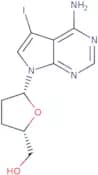
CAS:7-Deaza-2'-C-ethynyladenosine (7DAA) is a research inhibitor that is classified as a polymerase inhibitor. It binds to the active site of the viral NS5B polymerase and inhibits RNA synthesis, which leads to virus replication. 7DAA has shown activity against hepatitis B virus (HBV) and hepatitis C virus (HCV). It also shows multifunctional properties in its inhibition of HBV genotypes A1, A3, and D1. In addition, 7DAA interacts with the RNA binding site on HCV polymerase protein and prevents binding of the viral RNA genome to this site. 7DAA also inhibits HIV replication by preventing assembly of the reverse transcriptase enzyme complex at an early stage.Formula:C13H14N4O4Purity:Min. 95%Color and Shape:PowderMolecular weight:290.27 g/mol7-Deaza-2',3'-dideoxy-7-iodoadenosine
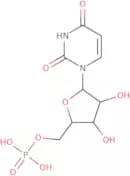
CAS:7-Deaza-2',3'-dideoxy-7-iodoadenosine is a nucleoside analogue that is used as an antiviral, anticancer, and antifungal agent. It is a modified form of adenosine which inhibits viral replication by inhibiting the activity of reverse transcriptase. 7-Deaza-2',3'-dideoxy-7-iodoadenosine has also been shown to inhibit DNA synthesis in cells by blocking the incorporation of dCTP into DNA. This nucleoside analogue has shown potential for use as an activator in phosphoramidite chemistry and as a deoxyribonucleoside in oligonucleotide synthesis.Formula:C11H13IN4O2Purity:Min. 95%Color and Shape:PowderMolecular weight:360.15 g/mol1-b-D-Arabinofuranosyluracil 5'-monophosphate
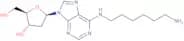
CAS:1-b-D-Arabinofuranosyluracil 5'-monophosphate is a pyrimidine nucleotide analog. Because of its structural similarity to natural nucleotides, it can interact with enzymes involved in nucleic acid synthesis. It is also a metabolite of Ara-U (arabinosyluracil), which is itself a compound studied for its biological activity. Scientists could potentially use this molecule in research to study how cells process and use nucleotides, and to understand how changes in nucleotide structure can affect biological processes.Formula:C9H13N2O9PPurity:Min. 95%Color and Shape:PowderMolecular weight:324.18 g/molN6-(6-Aminohexyl)-2'-deoxyadenosine
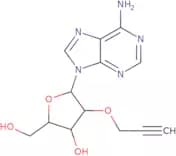
CAS:N6-(6-Aminohexyl)-2'-deoxyadenosine is a novel nucleoside that is structurally related to the natural nucleosides, dATP and dGTP. It has been shown to be an activator of ribonucleosides and phosphoramidites, which are used in the synthesis of DNA and RNA. N6-(6-Aminohexyl)-2'-deoxyadenosine has also been shown to inhibit cancer cells as well as antiviral activity against HIV-1.Formula:C16H26N6O3Purity:Min. 95%Color and Shape:Slightly Yellow PowderMolecular weight:350.43 g/mol2'-O-Propargyladenosine
CAS:2'-O-Propargyladenosine is a modified nucleoside that belongs to the group of deoxyribonucleosides. It is an activator of viral DNA polymerases, which causes the synthesis of viral DNA to stop. This compound has antiviral and anticancer activities. 2'-O-Propargyladenosine has been shown to be effective against various human cancer cell lines in vitro and in vivo. It is a synthetic nucleoside with high purity, showing no detectable impurities by HPLC analysis.
Formula:C13H15N5O4Purity:Min. 95%Color and Shape:White PowderMolecular weight:305.29 g/mol8-Nitroguanosine
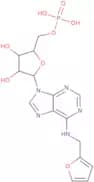
CAS:8-Nitroguanosine is a nucleotide analogue that inhibits the activity of cyclic GMP in cells. It has been found to inhibit the growth of bacteria and cancer cells, as well as to stimulate the production of reactive oxygen species in brain cells. 8-Nitroguanosine has also been shown to inhibit the activity of cyclase enzymes in liver cells, which may be useful for treating liver disease. 8-Nitroguanosine is used as a chemical base for monoclonal antibodies that are used to study brain functions and pathogenic mechanisms.Formula:C10H12N6O7Purity:Min. 95%Molecular weight:328.24 g/molKinetin riboside-5'-monophosphate sodium salt
CAS:Kinetin riboside-5'-monophosphate sodium salt is a synthetic nucleotide that has been modified to include a phosphate group at the 5' position. Kinetin riboside-5'-monophosphate sodium salt is an activator of DNA synthesis and can be used for the treatment of viral infections. It also shows anticancer activity and is effective against cancer cells that are resistant to other cancer drugs.Formula:C15H16N5Na2O8P·H2OPurity:Min. 95%Color and Shape:PowderMolecular weight:489.29 g/mol2'-Deoxyuridine-5'-monophosphate disodium salt
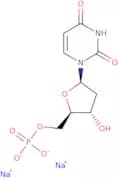
CAS:2'-Deoxyuridine-5'-monophosphate disodium salt (2DUMP) is a nucleoside analog that inhibits the synthesis of DNA and RNA by inhibiting the enzyme thymidylate synthase. 2DUMP is a covalent inhibitor of thymidylate synthase, which prevents the formation of dTMP from deoxyuridine 5'-triphosphate. This compound has been shown to be effective in treating squamous cell cancer and hyperproliferative diseases such as chronic myelogenous leukemia. 2DUMP is also used as an antiviral agent against HIV, herpes simplex virus, and varicella zoster virus. It has been shown to bind to benzalkonium chloride (BAK) in biological samples such as serum or plasma. 2DUMP binds to BAK through a covalent linkage between the 3' hydroxyl group on BAK and the phosphate group on 2DUMPFormula:C9H11N2O8PNa2Purity:Min. 95%Color and Shape:PowderMolecular weight:352.15 g/molLamivudine-5'-triphosphate tetratriethylammonium salt - ca.15 mM Aqueous solution
Lamivudine-5'-triphosphate tetratriethylammonium salt - ca.15 mM Aqueous solution is an antiviral drug used to treat HIV/AIDS and hepatitis B infections. It is a potent inhibitor of human immunodeficiency virus type 1 (HIV-1) replication, acting by blocking the viral enzyme reverse transcriptase. Lamivudine-5'-triphosphate tetratriethylammonium salt - ca.15 mM Aqueous solution also inhibits cellular viral DNA synthesis and has been shown to exhibit anticancer activity in vitro and in vivo. This product is synthesized from raw materials through a novel process that involves modification of the phosphoramidite monophosphate with tetratriethylammonium salts.Formula:C32H74N7O12P3SPurity:Min. 95%Molecular weight:873.96 g/mol3-Acetylpyridine adenine dinucleotide disodium, reduced form
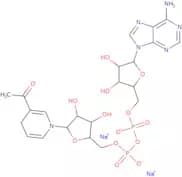
CAS:Reduced synthetic analog of NADH with an acetylpyridine modification. It is used as a reducing substrate to study the mechanisms of NAD(P)+-dependent reductases and to probe the active sites and catalytic processes of these important enzymes through its altered spectroscopic and binding properties. The disodium salt ensures good solubility for biochemical applications.Formula:C22H30N6O14P2•Na2Purity:Min. 95%Color and Shape:Slightly Yellow PowderMolecular weight:710.43 g/mol5-Methoxyuridine-5'-triphosphate sodium, 100mM aqueous solution
CAS:5-Methoxyuridine-5'-triphosphate is a monophosphate nucleoside that serves as a precursor for the synthesis of 5-methoxyuridine (5MU) and other nucleosides. It has antiviral effects, and is used in the treatment of herpes zoster infection. 5-Methoxyuridine-5'-triphosphate is an analog of uridine and deoxyribonucleosides with antiviral activity, which can be used to treat herpes zoster infection. This drug also has anticancer properties, which may be due to its ability to inhibit DNA synthesis by inhibiting ribonucleotide reductase and DNA polymerase, leading to cell death.Formula:C10H17N2O16P3•NaxPurity:Min. 95%Color and Shape:Clear LiquidMolecular weight:514.17 g/mol2-O-Ethylthymidine
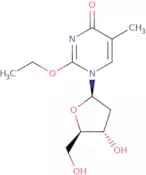
CAS:2-O-Ethylthymidine is a nucleoside that is used to study the structure and dynamics of DNA. It can be synthesized by reacting 1-β-D-arabinofuranosylbenzene with ethylmercury acetate. 2-O-Ethylthymidine can be used in kinetic studies as it is specific for dna. It has been shown to have a conformational change, which is stabilized by the presence of an aromatic ring such as phenanthrene. This compound was also found to inhibit neuroblastoma cell growth in vitro.
Formula:C12H18N2O5Purity:Min. 95%Color and Shape:PowderMolecular weight:270.28 g/mol



![4-Chloro-5-iodo-pyrrolo[2,3-d]pyriMidine-7-carboxylic acid tert-butyl ester](/_next/image/?url=https%3A%2Fstatic.cymitquimica.com%2Fproducts%2F3D%2Fthumb-webp%2FNC44293.webp&w=3840&q=75)