Nucleosides
Nucleosides are fundamental building blocks of nucleic acids, composed of a nitrogenous base attached to a sugar molecule. In this section, you can find a wide variety of nucleosides essential for research in molecular biology, biochemistry, and pharmacology. These compounds play crucial roles in the synthesis of DNA and RNA, and are also vital in various metabolic processes. Nucleosides are used in studying genetic material, developing antiviral and anticancer therapies, and understanding cellular mechanisms. At CymitQuimica, we provide high-quality nucleosides to support your research and development needs, ensuring purity and reliability for your experimental applications.
Found 3567 products of "Nucleosides"
Sort by
Purity (%)
0
100
|
0
|
50
|
90
|
95
|
100
Guanosine 5'-monophosphate disodium salt
CAS:<p>Guanosine 5'-monophosphate disodium salt (GMPDS) is an antiviral agent that inhibits the synthesis of viral nucleic acids by competitive inhibition of the enzyme ribonucleotide reductase. GMPDS has been shown to inhibit the replication of a number of RNA viruses, including influenza A and B, herpes simplex virus type 1, and human immunodeficiency virus type 1. This drug also has been shown to decrease cyclic adenosine monophosphate (cAMP) levels in cells by inhibiting phosphodiesterase activity. GMPDS is used for treatment of infectious diseases such as influenza A, herpes, and HIV-1.</p>Formula:C10H12N5Na2O8PPurity:Min. 98 Area-%Color and Shape:White Off-White PowderMolecular weight:407.18 g/mol2'-Amino-2'-deoxyadenosine-5'-triphosphate sodium salt - aqueous solution
CAS:<p>2'-Amino-2'-deoxyadenosine-5'-triphosphate sodium salt - aqueous solution is a modified ATP analog, where the ribose has a 2'-amino substitution. This compound has potential research applications</p>Formula:C10H17N6O12P3·xNaPurity:Min. 95 Area-%Color and Shape:PowderMolecular weight:506.2 g/mol5-Aza-7-deazaguanosine
CAS:<p>5-Aza-7-deazaguanosine is a nucleoside analogue that has antiviral activity against herpes simplex virus, influenza, and other DNA viruses. 5-Aza-7-deazaguanosine is an analog of guanosine with the addition of a 7-deaza group on the nitrogen atom. This drug inhibits viral replication by inhibiting the polymerase function of the viral NS5B protein, which is essential for DNA synthesis. The structure activity relationship studies have shown that this compound has anti-hepatitis B virus activity, but not against hepatitis C virus. 5-Aza-7-deazaguanosine has been shown to be effective in animal models as well as in humans without any significant toxicity issues.</p>Formula:C10H13N5O5Purity:Min. 95%Color and Shape:PowderMolecular weight:283.24 g/molGuanosine 3',5'-bisdiphosphate lithium salt - 100mM aqueous solution
CAS:<p>Regulates gene transcription; inhibits the synthesis of tRNA and rRNA</p>Formula:C10H17N5O17P4·xLiPurity:Min. 85 Area-%Color and Shape:Colorless PowderMolecular weight:602.16 g/moldNTP pre-mixes, 10 mM aqueous solution
CAS:<p>dATP, dTTP, dCTP and dGTP pre-mixed in a single vial</p>Formula:C10H16N5O12P3Purity:Min. 95%Color and Shape:Clear LiquidMolecular weight:491.18 g/mol2'-Deoxy-5'-O-DMT-uridine 3'-CE phosphoramidite
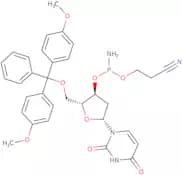
CAS:<p>2'-Deoxy-5'-O-DMT-uridine 3'-CE phosphoramidite is an antibiotic that inhibits bacterial growth by binding to DNA, preventing transcription and replication. It has been shown to have antibacterial activity against a wide variety of bacteria, including staphylococcus, tuberculosis and vibrio cholerae. 2'-Deoxy-5'-O-DMT-uridine 3'-CE phosphoramidite is a chemotaxis regulator in the biosynthetic pathway of certain bacteria. These bacteria use this compound as a precursor for the production of other antibiotics. This antibiotic binds to the regulatory site on bacterial chemotaxis and inhibits the response to attractants such as sugars or amino acids.</p>Formula:C39H47N4O8PPurity:Min. 98 Area-%Color and Shape:White Off-White PowderMolecular weight:730.81 g/mol2-Hydrazinoadenosine
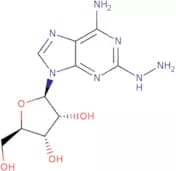
CAS:<p>2-Hydrazinoadenosine is an active analogue of adenosine. It is a potent agonist for the adenosine receptor subtypes A1 and A2A with high affinity. 2-Hydrazinoadenosine has been shown to inhibit cardiac contractility in animal models, as well as to produce hypotension, bradycardia, and bronchodilation in humans. This drug also has a functional effect on the heart by binding to adenosine receptors, which leads to the inhibition of catecholamine release. This drug is used clinically as an antiarrhythmic agent and a vasodilator in coronary artery disease.</p>Formula:C10H15N7O4Purity:Min. 95%Color and Shape:PowderMolecular weight:297.27 g/mol8-Amino[1''-(N''-dansyl)-4''-aminobutyl]-5'-(1-aziridinyl)-5'-deoxy adenosine
CAS:<p>8-Amino-[1''-(N''-dansyl)-4''-aminobutyl]-5'-(1-aziridinyl)-5'-deoxyadenosine is a novel nucleoside phosphoramidite that has antiviral and anticancer activity. It is currently under development as a potential treatment for Hepatitis C, HIV and cancer. 8-Amino-[1''-(N''-dansyl)-4''-aminobutyl]-5'-(1-aziridinyl)-5'-deoxyadenosine is an activator of the enzyme ribonucleotide reductase, which converts ribonucleotides to deoxyribonucleotides. It also inhibits the synthesis of DNA and RNA by inhibiting the enzyme DNA gyrase and topoisomerase IV. 8-Amino-[1''-(N''-dansyl)-4''-aminobutyl</p>Formula:C28H37N9O5SPurity:Min. 95%Color and Shape:PowderMolecular weight:611.72 g/mol2-Chloroadenosine hemihydrate
CAS:<p>2-Chloroadenosine hemihydrate is a synthetic purine nucleoside analog, closely related to adenosine, with a chlorine atom substituted at the 2-position on the adenine ring. This molecule has potential application in research.</p>Formula:C10H12ClN5O4H2OPurity:Min. 95%Color and Shape:PowderMolecular weight:310.69 g/mol2'-Deoxy-2'-fluoro-2'-C-methylcytidine
CAS:<p>2'-Deoxy-2'-fluoro-2'-C-methylcytidine is a nucleoside analog with modifications on both the sugar and the nucleobase. It is a derivative of cytidine, with fluorine attached to the 2' carbon of the sugar (deoxyribose) and a methyl group at the 2' carbon of the sugar as well. These modifications provide the compound with unique properties, such as potnetial increased resistance to enzymatic degradation, which can make it useful in antiviral and anticancer applications.</p>Formula:C10H14FN3O4Purity:Min. 95%Color and Shape:PowderMolecular weight:259.23 g/mol2'-Deoxycytidine-5'-diphosphate trisodium salt hydrate
CAS:<p>2'-Deoxycytidine-5'-diphosphate trisodium salt hydrate is a nucleoside that is used as an antiviral agent in the treatment of herpes zoster and varicella zoster. This drug also has anticancer properties, which may be due to its ability to inhibit DNA synthesis. 2'-Deoxycytidine-5'-diphosphate trisodium salt hydrate is a novel nucleotide analogue that has been modified to improve its stability, solubility and bioavailability. It can be used as a starting material for the synthesis of phosphoramidites by reacting with phosphorous pentoxide at elevated temperatures and pH. CAS No. 151151-32-5</p>Formula:C9H12N3O10P2·Na3Purity:Min. 95%Color and Shape:White Off-White PowderMolecular weight:453.12 g/mol5-Methyl-L-uridine
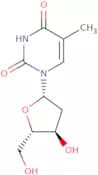
CAS:<p>5-Methyl-L-uridine is an antiviral drug which belongs to a class of compounds called nucleoside analogues. It is used in the treatment of chronic hepatitis B and C, as well as for prevention of hepatitis A and B. 5-Methyl-L-uridine inhibits the virus by turning off the production of viral DNA and RNA, through interactions with the virus's polymerase chain reaction process. This drug also prevents protein synthesis in cells infected with viruses such as HIV, herpes simplex virus type 1, and influenza A virus. 5-Methyl-L-uridine is a prodrug that is converted to its active form, uridine monophosphate, by enzymes in the liver. The cytotoxic effects of 5-methyluridine on cancer cells have been shown to be due to inhibition of cellular DNA synthesis and repair pathways.</p>Formula:C10H14N2O6Purity:Min. 95%Color and Shape:White PowderMolecular weight:258.23 g/mol4-Amino-2,6-dihydroxy-5-nitrosopyrimidine
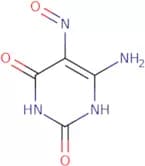
CAS:<p>4-Amino-2,6-dihydroxy-5-nitrosopyrimidine is a molecule that has been shown to be an effective inhibitor of the enzyme tyrosinase in the oxidation of tyrosine to DOPA, which is a precursor of melanin. It is believed that vibrational and structural changes during these reactions are responsible for the inhibitory effects. 4-Amino-2,6-dihydroxy-5-nitrosopyrimidine has also been shown to have anti cancer effects on glioma cells. This molecule binds to copper ions, forming a chelate ring that can stabilize reactive intermediates and terminate free radicals. The chlorine atom on this molecule may be responsible for its cytotoxic effects by reacting with nucleophilic sites on proteins. The functional groups on this molecule react with acid catalysts, such as protonation or dehydration reactions.</p>Formula:C4H4N4O3Purity:Min. 98 Area-%Color and Shape:PowderMolecular weight:156.1 g/mol4-[(1Z)-2-(4-Chlorophenyl)vinyl]pyridine
CAS:<p>4-[(1Z)-2-(4-Chlorophenyl)vinyl]pyridine is a modified nucleoside that is used in anticancer drugs. It has shown antiviral and antitumor effects. 4-[(1Z)-2-(4-Chlorophenyl)vinyl]pyridine is synthesized by condensing 4-chlorobenzaldehyde and 2,3-dichloropyridine. The nucleoside has been modified to be phosphorylated at the 5′ position and contains a ribonucleotide moiety and a deoxyribonucleotide moiety. This product is of high purity and quality, with an activator group at the 5′ position.</p>Formula:C13H10ClNPurity:Min. 95%Molecular weight:215.68 g/mol2'-O-(tert-Butyldimethylsilyl)-5'-O-DMT-N2-isobutyryl-guanosine
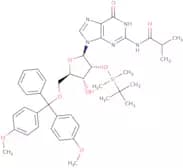
CAS:<p>2'-O-(tert-Butyldimethylsilyl)-5'-O-DMT-N2-isobutyryl-guanosine is a synthetic nucleoside that has been modified with a tert-butyldimethylsilyl group. This modification is used to improve the efficiency of coupling reactions between nucleosides and phosphoramidites in oligonucleotide synthesis. The 2'-O-(tert-Butyldimethylsilyl)-5'-O-DMT-N2-isobutyryl guanosine is also used as a chromophore in spectroscopy experiments and as a ligand in metal coordination chemistry.</p>Formula:C41H51N5O8SiPurity:Min. 98 Area-%Color and Shape:Off-White PowderMolecular weight:769.96 g/mol4-(b-D-Ribofuranosyl)-vic-triazolo[4,5-b]pyridin-5-one
CAS:<p>Ribonucleosides, Deoxyribonucleosides and Activator are a group of synthetic compounds that are used in the synthesis of DNA. Ribonucleosides and Deoxyribonucleosides are nucleotides that contain ribose or deoxyribose as the sugar moiety. Activator is an activator for DNA polymerase, which catalyses the formation of a phosphodiester bond between two adjacent 3'-5' phosphate groups on a single strand of DNA. Ribonuclesides, Deoxyribonucleosides and Activator are used in recombinant DNA technology to synthesize DNA molecules containing modified bases. The CAS number for Ribonuclesides, Deoxyribonucleosides and Activator is 59892-40-9.</p>Formula:C10H12N4O5Purity:Min. 95%Molecular weight:268.23 g/mol2'-Deoxy-N2,3-ethenoguanosine
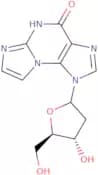
CAS:<p>2'-Deoxy-N2,3-ethenoguanosine is a novel antiviral agent that is phosphorylated by the viral enzyme ribonucleotide reductase and then incorporated into viral DNA. This compound is an activator of deoxyribonucleoside monophosphate activity and inhibits the synthesis of DNA and RNA. 2'-Deoxy-N2,3-ethenoguanosine has been shown to inhibit the growth of cancer cells in culture and may be useful for treating cancer.</p>Formula:C12H13N5O4Purity:Min. 95%Molecular weight:291.26 g/mol5'-O-DMT-N2-isobutyrylguanosine
CAS:<p>5'-O-DMT-N2-isobutyrylguanosine is a novel phosphoramidite monophosphate, which has been modified with an isobutyryl group. This compound was synthesized in order to be used as a nucleoside analogue and antimetabolite for the treatment of cancer. It also has antiviral properties and inhibits the replication of DNA by inhibiting transcription. 5'-O-DMT-N2-isobutyrylguanosine is an anticancer agent that can be used to treat tumors that are resistant to other chemotherapy drugs. It also inhibits the growth of cells by preventing the synthesis of proteins needed for cell division.</p>Formula:C35H37N5O8Purity:Min. 95%Color and Shape:White PowderMolecular weight:655.7 g/mol2'-Deoxy-L-uridine
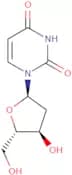
CAS:<p>2'-Deoxy-L-uridine is a nucleoside that is found in the human body. It phosphorylates l-thymidine, which is a natural substrate, and this reaction prevents the formation of diphosphate from d-ribose 5'-monophosphate. 2'-Deoxy-L-uridine is an exogenous substance that inhibits cell growth by affecting protein synthesis and DNA replication. 2'-Deoxy-L-uridine has been shown to be more efficient than wild type uridine in inhibiting cell growth in vitro at concentrations of 1 mM or greater. The enantiomers of 2'-deoxy-L-uridine affect cell growth differently, with the (R)-enantiomer being more potent than the (S)-enantiomer.</p>Formula:C9H12N2O5Purity:Min. 95%Color and Shape:White PowderMolecular weight:228.2 g/mol5-(Isopentenylaminomethyl)uridine
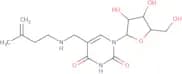
CAS:<p>5-(Isopentenylaminomethyl)uridine is a modified uridine nucleoside that is used in biochemical research. It is the precursor to 5-amino-2'-deoxyuridine, which is converted to 5-iodo-2'-deoxyuridine. This modified uridine nucleoside can be used as a linker molecule for DNA and RNA ligation reactions and for analysis of biological samples. 5-(Isopentenylaminomethyl)uridine has been shown to inhibit the expression of genes in eukaryotes and prokaryotes. It also has been shown to inhibit the ribosome by binding to the peptidyl transferase center (PTC).</p>Formula:C15H23N3O6Purity:Min. 95%Molecular weight:341.36 g/mol


![8-Amino[1''-(N''-dansyl)-4''-aminobutyl]-5'-(1-aziridinyl)-5'-deoxy adenosine](/_next/image/?url=https%3A%2Fstatic.cymitquimica.com%2Fproducts%2F3D%2Fthumb-webp%2FNA16503.webp&w=3840&q=75)


![4-[(1Z)-2-(4-Chlorophenyl)vinyl]pyridine](/_next/image/?url=https%3A%2Fstatic.cymitquimica.com%2Fproducts%2F3D%2Fthumb-webp%2FNC65881.webp&w=3840&q=75)
![4-(b-D-Ribofuranosyl)-vic-triazolo[4,5-b]pyridin-5-one](/_next/image/?url=https%3A%2Fstatic.cymitquimica.com%2Fproducts%2F3D%2Fthumb-webp%2FNR04971.webp&w=3840&q=75)