Nucleosides
Nucleosides are fundamental building blocks of nucleic acids, composed of a nitrogenous base attached to a sugar molecule. In this section, you can find a wide variety of nucleosides essential for research in molecular biology, biochemistry, and pharmacology. These compounds play crucial roles in the synthesis of DNA and RNA, and are also vital in various metabolic processes. Nucleosides are used in studying genetic material, developing antiviral and anticancer therapies, and understanding cellular mechanisms. At CymitQuimica, we provide high-quality nucleosides to support your research and development needs, ensuring purity and reliability for your experimental applications.
Found 3567 products of "Nucleosides"
Sort by
Purity (%)
0
100
|
0
|
50
|
90
|
95
|
100
1-(2',3',5'-Tri-O-acetyl-b-D-arabinofuranosyl)uracil
<p>1-(2',3',5'-Tri-O-acetyl-b-D-arabinofuranosyl)uracil is a novel nucleoside analog with antiviral and anticancer activities. It is a modified nucleoside that is synthesized from 2',3',5'-triacetyl b-D-arabinofuranosyl uracil. The synthesis of this compound involves the use of acetylation, which produces a monophosphate form of the nucleoside. This product has been shown to be an activator in the synthesis of DNA and RNA.</p>Purity:Min. 95%Lamivudine 5'-monophosphate ammonium salt
CAS:<p>Lamivudine 5'-monophosphate ammonium salt is a novel antiviral agent that inhibits the viral polymerase by competing with natural dNTPs. It has been shown to be effective against Hepatitis B virus (HBV) and human immunodeficiency virus type 1 (HIV-1). Lamivudine 5'-monophosphate ammonium salt is a synthetic nucleoside that is phosphorylated to form its active form, lamivudine 5'-triphosphate ammonium salt. This drug has been shown to inhibit tumor growth in vivo and in vitro.</p>Formula:C8H15N4O6PSPurity:Min. 95%Molecular weight:326.27 g/mol2',3',5'-Tri-O-acetylnebularine
CAS:<p>2',3',5'-Tri-O-acetylnebularine is a modified nucleoside that is synthesized from nebulareine. It has been shown to inhibit the growth of cancer cells, as well as HIV and influenza virus. This drug also has antiviral effects against herpes simplex virus type 1 (HSV-1) and herpes simplex virus type 2 (HSV-2). 2',3',5'-Tri-O-acetylnebularine inhibits viral replication by inhibiting DNA synthesis and RNA transcription, which prevents the production of proteins needed for cell multiplication.</p>Formula:C16H18N4O7Purity:Min. 95%Molecular weight:378.34 g/mol5-Fluoro-1-(2'-L-menthyloxycarbonyl-1'-3'-oxathiolan-5'-yl)-cytosine
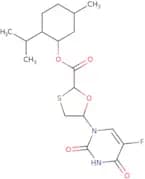
CAS:<p>5-Fluoro-1-(2'-L-menthyloxycarbonyl-1'-3'-oxathiolan-5'-yl)-cytosine is a nucleoside, a type of chemical compound containing both a sugar (deoxyribose) and an organic molecule (a base). It is an antiviral agent that inhibits the production of viral DNA by inhibiting the enzyme DNA polymerase. 5-Fluoro-1-(2'-L-menthyloxycarbonyl-1'-3'-oxathiolan-5'-yl)-cytosine is also an anticancer agent that can inhibit the production of cancer cells in vitro and in vivo. This product is a novel monophosphate nucleotide analog with high purity and CAS number 1422361-25-8.</p>Purity:Min. 95%5-Bromo-2',3'-dideoxyuridine
CAS:<p>5-Bromo-2',3'-dideoxyuridine is a nucleoside analogue that is used as a chemotherapeutic drug against various types of cancer. It has been shown to have anti-tumour activity by interfering with the synthesis of deoxyribonucleic acid (DNA) and ribonucleic acid (RNA). 5-Bromo-2',3'-dideoxyuridine binds to the sugar ring in DNA and inhibits the enzyme DNA polymerase from synthesizing DNA. This drug also stabilizes conformations of the molecule, which are responsible for its pharmacological effects.<br>5-Bromo-2',3'-dideoxyuridine can be found in two different crystal structures, monoclinic and tetragonal. The monoclinic form is stabilized by hydrogen bonds between the puckers in the sugar ring and hydrogen bonds to neighboring molecules. This form is more soluble than the tetragonal form,</p>Purity:Min. 95%1-(5-o-(Dimethoxytrityl)-β-D-2-deoxyribofuranosyl)-3-nitropyrrole
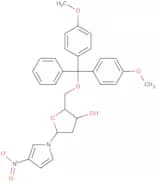
CAS:<p>1-(5-O-(dimethoxytrityl)-β-D-2-deoxyribofuranosyl)-3-nitropyrrole is a novel nucleoside phosphoramidite that has been modified to include an oxazole moiety. It is an antiviral and anticancer drug that inhibits the replication of DNA by binding to the enzyme DNA polymerase. 1-(5-O-(dimethoxytrityl)-β-D-2-deoxyribofuranosyl)-3-nitropyrrole is also a substrate for monophosphate, diphosphate, and triphosphate nucleotide kinases, which are enzymes that catalyze the phosphorylation of 5'-monophosphates. This nucleoside phosphoramidite can be used in the synthesis of oligonucleotides and modified oligonucleotides.</p>Formula:C30H30N2O7Purity:Min. 95%Molecular weight:530.6 g/mol8-Bromo-2'-deoxy-N6-DMF-5'-O-DMT-adenosine 3'-CE phosphoramidite
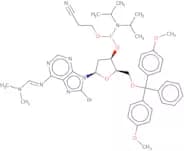
<p>8-Bromo-2'-deoxy-N6-DMF-5'-O-DMT-adenosine 3'-CE phosphoramidite is a novel nucleoside that is synthesized from 8-bromo-2'-deoxyadenosine and N,N,-diisopropylethylamine. It has been shown to have anticancer, antiviral, and antiinflammatory activities. This compound is also used as an activator in the synthesis of DNA and RNA. The purity of this product exceeds 99% and it has been modified for use with automated synthesizers.</p>Formula:C43H52BrN8O6PPurity:Min. 95%Molecular weight:887.82 g/mol3'-Deoxy-5'-O-DMT-5-methyluridine 2'-CE phosphoramidite
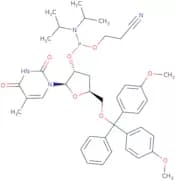
CAS:<p>3'-Deoxy-5'-O-DMT-5-methyluridine 2'-CE phosphoramidite is a nucleotide analogue that is used in the synthesis of DNA. It is a modified nucleoside that contains an amino group at the 5' position of the pentose sugar and a methyl group at the 2' position. 3'-Deoxy-5'-O-DMT-5-methyluridine 2'-CE phosphoramidite inhibits viral replication and has shown anticancer activity. It also possesses antiviral activity against Herpes simplex virus types 1 and 2, cytomegalovirus, varicella zoster virus, Epstein Barr virus, influenza A virus type A/PR/8/34 (H1N1), and human immunodeficiency virus type 1 (HIV).</p>Formula:C40H49N4O8PPurity:Min. 95%Molecular weight:744.81 g/molBiotin-18-cytidine-5'-triphosphate triethylammonium salt - 5mM aqeous solution
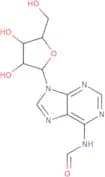
<p>Biotin-18-cytidine-5'-triphosphate triethylammonium salt - 5mM aqeous solution is an activator of DNA synthesis. It is a cytidine nucleoside with a biotin label at the 5' position that is used as a substrate in DNA synthesis reactions. Biotin-18-cytidine-5'-triphosphate triethylammonium salt - 5mM aqeous solution is also used to make phosphoramidites, which are building blocks for oligonucleotide synthesis. This product can be used in anticancer and antiviral research.</p>Formula:C34H55N8O18P3SPurity:Min. 95%Molecular weight:988.83 g/molN6-Formyl adenosine
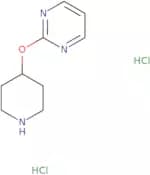
CAS:<p>N6-Formyl adenosine is an endogenous nucleotide that is dynamically modified in the human body. N6-Formyl adenosine is a reactive modification of adenosine and has been shown to be present in DNA, RNA, and proteins. It is also found in human cells and tissues, where it can be demethylated by enzymes such as DNA methyltransferase. This modification may have implications for research into the nature of messenger RNA (mRNA), which plays a crucial role in protein synthesis. N6-Formyl adenosine has been used to distinguish between mature and immature mRNA molecules by fluorescence analysis.</p>Formula:C11H13N5O5Purity:Min. 97 Area-%Molecular weight:295.25 g/mol2-(Piperidin-4-Yloxy)Pyrimidine Dihydrochloride
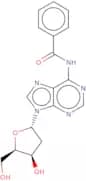
CAS:<p>2-(Piperidin-4-Yloxy)Pyrimidine Dihydrochloride is a nutrient that can be used for soil fertilization and weed control. It is a non-selective herbicide that inhibits the growth of all plants. This compound breaks down in the environment, so it is environmentally friendly. 2-(Piperidin-4-Yloxy)Pyrimidine Dihydrochloride can be applied to the soil or sprayed on leaves to control weeds. It is more efficient at controlling weeds than potassium chloride, which is another type of fertilizer.</p>Formula:C9H13N3O·2HClPurity:Min. 95%Molecular weight:252.14 g/molN6-Benzoyl-2'-deoxy-a-adenosine
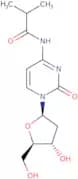
<p>N6-Benzoyl-2'-deoxy-a-adenosine is a synthetic nucleoside analog. N6-Benzoyl-2'-deoxy-a-adenosine has antiviral and anticancer properties. It is a potent inhibitor of DNA polymerase and also inhibits ribonucleotide reductase, which are enzymes crucial for DNA synthesis. N6-Benzoyl-2'-deoxy-a-adenosine inhibits the synthesis of viral RNA, leading to inhibition of viral replication. It has been shown to inhibit proliferation of tumor cells in vitro and in vivo by inhibiting DNA synthesis and inducing apoptosis.</p>Formula:C17H17N5O4Purity:Min. 95%Molecular weight:355.36 g/mol2'-Deoxy-N2-isobutyrylcytidine
CAS:<p>2'-Deoxy-N2-isobutyrylcytidine is a nucleoside analogue of cytidine that has been modified with a 2-amino-2-deoxyribose moiety. The transaminated product is more stable than the parent compound and has improved anticoagulant activity. It has also been shown to be active in inhibiting DNA synthesis and cell proliferation in vitro. 2'-Deoxy-N2-isobutyrylcytidine inhibits the growth of bacteria by binding to their ribosomes, preventing protein synthesis. This compound has also been shown to inhibit the formation of blood clots in mice.</p>Formula:C13H19N3O5Purity:Min. 95%Molecular weight:297.31 g/mol2',3',5'-Tri-O-(p-chlorobenzoyl)-5-azacytidine
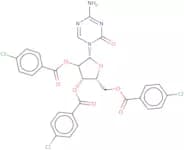
CAS:<p>2',3',5'-Tri-O-(p-chlorobenzoyl)-5-azacytidine is a novel nucleoside phosphoramidite for the synthesis of DNA and RNA. It has been modified to be resistant to antiviral and anticancer agents, as well as to be an activator of monophosphate. 2',3',5'-Tri-O-(p-chlorobenzoyl)-5-azacytidine has high purity and quality, as well as being novel and modified.</p>Formula:C29H21Cl3N4O8Purity:Min. 95%Molecular weight:659.86 g/mol2-Amino-4-(4-chlorophenyl)pyrimidine
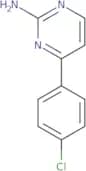
CAS:<p>2-Amino-4-(4-chlorophenyl)pyrimidine is a antiviral agent and an inhibitor of ribonucleotide reductase. It is used for the treatment of cytomegalovirus infection, herpes zoster, and chronic myeloid leukemia. 2-Amino-4-(4-chlorophenyl)pyrimidine is also used in anticancer therapy. This drug inhibits DNA synthesis by binding to the deoxyribose moiety of ribonucleosides and diphosphates in the DNA precursor pool. The drug has been shown to be active against human lymphocytic leukemia cells as well as human erythroleukemia cells but not against normal human lymphocytes.</p>Formula:C10H8ClN3Purity:Min. 95%Molecular weight:205.64 g/molO6-Benzyl-N2,3-etheno-2'-deoxy-3',5'-O-[tetrakis(isopropyl)-1,3-disiloxanediyl] guanosine
CAS:<p>O6-Benzyl-N2,3-etheno-2'-deoxy-3',5'-O-[tetrakis(isopropyl)-1,3-disiloxanediyl] guanosine is a modified nucleoside with antiviral and anticancer activities. It can be used in DNA synthesis to produce oligonucleotides that have been modified at the 2' position. O6-Benzyl-N2,3-etheno-2'-deoxy-3',5'-O-[tetrakis(isopropyl)-1,3-disiloxanediyl] guanosine is also active against diphosphate reductase. CAS No. 148437-94-9</p>Formula:C31H45N5O5Si2Purity:Min. 95%Molecular weight:623.89 g/mol2'-Deoxy-N4,N4,5-trimethylcytidine
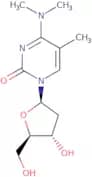
CAS:<p>2'-Deoxy-N4,N4,5-trimethylcytidine is a monophosphate nucleoside that is used as a precursor for the synthesis of DNA. It can be modified to produce phosphoramidites and ribonucleosides. 2'-Deoxy-N4,N4,5-trimethylcytidine has antiviral activity against herpes viruses and cytomegalovirus (CMV). It also has anticancer activity in animal models.</p>Formula:C12H19N3O4Purity:Min. 95%Molecular weight:269.3 g/mol2-Fluoro-I ce-phosphoramidite (convertible G ce-phosphoramidite)
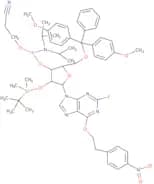
CAS:<p>Please enquire for more information about 2-Fluoro-I ce-phosphoramidite (convertible G ce-phosphoramidite) including the price, delivery time and more detailed product information at the technical inquiry form on this page</p>Formula:C54H67FN7O10PSiPurity:Min. 95%Molecular weight:1,052.2 g/molN4-Benzoyl-2'-deoxy-5'-O-levulinoylcytidine
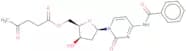
<p>N4-Benzoyl-2'-deoxy-5'-O-levulinoylcytidine is a modified nucleoside that is synthesized from 2,4-dichloroacetophenone and cytidine. It has been shown to be an activator of the ribonucleotide reductase enzyme, which converts deoxyribonucleosides into their corresponding ribonucleotides. This drug is used in cancer therapy as well as antiviral and antiretroviral therapy. N4-Benzoyl-2'-deoxy-5'-O-levulinoylcytidine is also being investigated for use in treating other diseases such as malaria and AIDS.</p>Formula:C21H23N3O7Purity:Min. 95%Molecular weight:429.43 g/molAdenosine 5’-Diphosphate-13C5
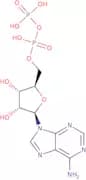
CAS:<p>Adenosine 5’-diphosphate (ADP) is a potent activator of the G-protein coupled receptor, P2Y. This receptor has been shown to be present on platelets, which are cells that are involved in the clotting process. ADP also inhibits the ion channel activity of the Na+, K+ ATPase. The effects of ADP on myocardial infarct have been studied in a model system consisting of isolated papillary muscle from rats. Adenosine 5’-diphosphate is not an inhibitor of protein synthesis, but does inhibit polymerase chain reaction amplification. It is used as a pharmacological agent for bowel disease and for treatment of chronic obstructive pulmonary disease.END></p>Formula:C5C5H15N5O10P2Purity:Min. 95%Molecular weight:432.2 g/mol





![O6-Benzyl-N2,3-etheno-2'-deoxy-3',5'-O-[tetrakis(isopropyl)-1,3-disiloxanediyl] guanosine](/_next/image/?url=https%3A%2Fstatic.cymitquimica.com%2Fproducts%2F3D%2Fthumb-webp%2FNB16630.webp&w=3840&q=75)