Nucleosides
Nucleosides are fundamental building blocks of nucleic acids, composed of a nitrogenous base attached to a sugar molecule. In this section, you can find a wide variety of nucleosides essential for research in molecular biology, biochemistry, and pharmacology. These compounds play crucial roles in the synthesis of DNA and RNA, and are also vital in various metabolic processes. Nucleosides are used in studying genetic material, developing antiviral and anticancer therapies, and understanding cellular mechanisms. At CymitQuimica, we provide high-quality nucleosides to support your research and development needs, ensuring purity and reliability for your experimental applications.
Found 3567 products of "Nucleosides"
Sort by
Purity (%)
0
100
|
0
|
50
|
90
|
95
|
100
8-(4-Amino-(2',3',4',5',6'-D5-biphenyl)-2'-deoxyguanosine
Controlled Product<p>8-(4-Amino-(2',3',4',5',6'-D5-biphenyl)-2'-deoxyguanosine is a novel, diphosphate nucleoside with antiviral and anticancer activity. It has been shown to activate the transcription of genes that are involved in cell growth and differentiation. This drug also inhibits the synthesis of viral DNA by binding to the viral DNA polymerase, thereby inhibiting its function. 8-(4-Amino-(2',3',4',5',6'-D5-biphenyl)-2'-deoxyguanosine can be used as a phosphoramidite for the preparation of oligonucleotides for use in gene therapy.</p>Formula:C22H17N6O4D5Purity:Min. 95%Color and Shape:PowderMolecular weight:439.48 g/mol2',3'-Didehydro-2',3'-dideoxy-5'-acetate inosine
CAS:<p>2',3'-Didehydro-2',3'-dideoxy-5'-acetate inosine (ddA) is a prodrug that is activated by hydrolysis to didanosine. The sodium salt of ddA has been shown to be effective in the treatment of HIV infection. Sodium ddA is a crystalline, neutralized salt with an alkaline pH and a pKa of 9.4. It has been crystallized from an alkaline solution using Raney nickel as a catalyst. This product can be used to synthesize intermediates for pharmaceuticals or other chemical products.</p>Formula:C12H12N4O4Purity:Min. 95%Molecular weight:276.25 g/mol4-Methyl-2-(methylsulfanyl)-5-pyrimidinecarboxylic acid
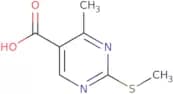
CAS:<p>Ribonucleosides, deoxyribonucleosides, and their activated forms (e.g., 4-methyl-2-(methylsulfanyl)-5-pyrimidinecarboxylic acid) are all important intermediates for the synthesis of DNA and RNA. Ribonucleosides are the key building blocks for the synthesis of DNA. They can be converted to nucleosides by removal of the ribose moiety. Deoxyribonucleosides are synthesized from ribonucleosides by removal of the hydroxyl group from carbon 2' position of ribose. The activated forms (e.g., 4-methyl-2-(methylsulfanyl)-5-pyrimidinecarboxylic acid) are useful in phosphoramidite chemistry as they have a free amine group on one side and a free sulfonyl group on the other side that can be used to react with a growing oligo or polyphosph</p>Formula:C7H8N2O2SPurity:Min. 95%Molecular weight:184.22 g/mol3'-Azido-2'-deoxy-5'-O-DMT-thymidine
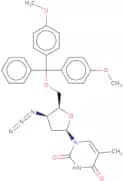
CAS:<p>3'-Azido-2'-deoxy-5'-O-DMT-thymidine is a novel and potent activator of ribonucleotide reductase. It has been shown to be an effective inhibitor of DNA synthesis and antiviral agent, with a low cytotoxicity profile. 3'-Azido-2'-deoxy-5'-O-DMT-thymidine is synthesized from DMT, which is readily available in the form of its monophosphate or diphosphate. The compound has been shown to inhibit viral replication by inhibiting viral reverse transcriptase activity. 3'-Azido-2'-deoxy-5'-O-DMT-thymidine also inhibits DNA synthesis in cancer cells.</p>Formula:C31H31N5O6Purity:Min. 95%Molecular weight:569.61 g/mol2',5'-Dideoxy-2'-fluoro-5'-iodouridine
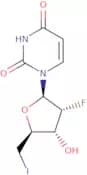
CAS:<p>2',5'-Dideoxy-2'-fluoro-5'-iodouridine is a modified nucleoside that is used in the synthesis of oligonucleotides. It can be used as an antiviral and anticancer agent. The drug has been shown to inhibit the replication of DNA and RNA, which may lead to cell death. 2',5'-Dideoxy-2'-fluoro-5'-iodouridine is also known for its high purity, novel structure and stability.</p>Formula:C9H10FIN2O4Purity:Min. 95%Molecular weight:356.09 g/mol3',5'-Di-O-acetyl-2'-deoxy-5-fluorouridine
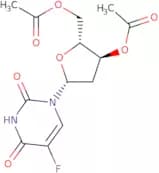
CAS:<p>3',5'-Di-O-acetyl-2'-deoxy-5-fluorouridine is an antitumor agent that belongs to the class of heterocyclic ring. It is a pyridinium salt with a benzoic acid residue at position 3 and 5'. The heterocyclic ring is derived from alkylene, which has two double bonds in the chain. This compound has low toxicity and can be synthesized from chloroform, fluorouridine, and pyridine. 3',5'-Di-O-acetyl-2'-deoxy-5-fluorouridine inhibits growth of cancer cells by binding to ribosomes and preventing RNA synthesis. It also acts as an alkylating agent that binds to DNA, leading to crosslinking between strands of DNA. This leads to cell death by apoptosis or necrosis due to interference with DNA replication.</p>Formula:C13H15FN2O7Purity:Min. 95%Molecular weight:330.27 g/mol4’-a-C-Methyluridine
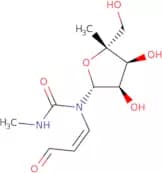
CAS:<p>4' - a-C-Methyluridine is a modified nucleoside that is used as a building block in the synthesis of DNA. It can be used for the treatment of viral infections and cancer. 4' - a-C-Methyluridine has antiviral activity against herpes simplex virus type 1 and cytomegalovirus. 4' - a-C-Methyluridine also has anticancer activity, which may be due to its ability to inhibit proliferation of cells by blocking the synthesis of DNA and RNA.</p>Purity:Min. 95%2'-Deoxy-2'-fluoroadenosine-5'-monophosphate
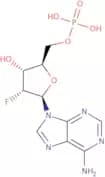
CAS:<p>2'-Deoxy-2'-fluoroadenosine-5'-monophosphate is a nucleotide that is used as an anthelmintic drug. It inhibits the synthesis of fatty acids and ATP levels in tissue culture cells. This nucleotide has also been shown to have immunomodulatory effects, which may be due to its ability to bind to receptor activity. 2'-Deoxy-2'-fluoroadenosine-5'-monophosphate binds with high affinity to the response elements of transcription factors such as NF-κB and AP1, which are involved in the regulation of gene expression and inflammatory responses.</p>Formula:C10H13FN5O6PPurity:Min. 95%Molecular weight:349.21 g/mol3'-Deoxy-3'-C-methylcytidine
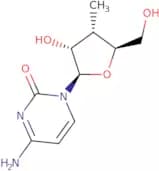
CAS:<p>3'-Deoxy-3'-C-methylcytidine is a monophosphate nucleotide that is used as an activator for DNA synthesis. It is a novel, synthetic nucleoside with high purity and high quality. 3'-Deoxy-3'-C-methylcytidine has been shown to inhibit viral replication, including human immunodeficiency virus type 1 (HIV-1), herpes simplex virus type 1 (HSV-1) and Epstein Barr virus (EBV) in cell culture. It also inhibits the growth of cancer cells in vitro by inhibiting the synthesis of DNA, RNA, and protein.</p>Formula:C10H15N3O4Purity:Min. 95%Molecular weight:241.24 g/mol2'-Deoxy-5'-DMT-5-[3-(trifluoroacetylamino)-1-E-propenyl]-uridine 3-CE phosphoramidite
CAS:<p>2'-Deoxy-5'-DMT-5-[3-(trifluoroacetylamino)-1-E-propenyl]-uridine 3-CE phosphoramidite is a synthetic nucleoside analog that has been modified to contain a triphosphate group. It is used in the synthesis of DNA or RNA. The compound is synthesized from 2,4-dichloro-N-(2,6-dimethoxybenzyl)phenylamine, which was reacted with ethyl (3-[(trifluoroacetyl)amino]propanoate) and deoxythymidine 3'-monophosphate. The CAS number for this product is 851520-76-8.</p>Purity:Min. 95%2’,5’-Dideoxy-5’-iodouridine
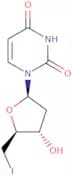
CAS:<p>2’,5’-Dideoxy-5’-iodouridine is an antiviral drug that inhibits DNA synthesis. It is a modified nucleoside analog with a phosphoramidite derivative of the natural ribonucleosides and deoxyribonucleosides. This drug is synthesized through the reaction of 2’,5’-dideoxyadenosine with 5-iodo-2-deoxyuridine in the presence of a strong base such as sodium hydride. The resulting product has a high purity, high yield, and can be used for the synthesis of DNA. 2’,5’-Dideoxy-5’-iodouridine also has anticancer properties and has been shown to inhibit cell growth in vitro at concentrations ranging from 0.1 to 1 μM.</p>Purity:Min. 95%5'-O-DMT-N2-isobutyryl-2'-O-propynylguanosine 3'-CE phosphoramidite
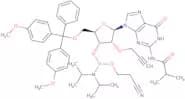
CAS:<p>5'-O-DMT-N2-isobutyryl-2'-O-propynylguanosine 3'-CE phosphoramidite is a novel modified monophosphate. It has antiviral and anticancer activities. The CAS number of 5'-O-DMT-N2-isobutyryl-2'-O-propynylguanosine 3'-CE phosphoramidite is 171486-61-6.</p>Formula:C47H56N7O9PPurity:Min. 95%Molecular weight:893.96 g/mol3'-Deoxy-5'-O-trityluridine
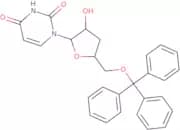
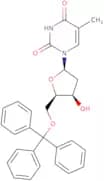
CAS:<p>3'-Deoxy-5'-O-trityluridine is a nucleoside that is structurally related to uridine. It belongs to the class of nucleosides and has a hydroxyl group at the 3' position. The 5' position is modified by an anion (most often trityl) sterically, which prevents hydrolysis by esterases or phosphatases. The efficiency of this modification can be increased by using diethyl phosphate as the protecting agent. This modification also provides protection against nucleophiles, such as hydroxyl groups in nucleosides or phosphite triester derivatives. 3'-Deoxy-5'-O-trityluridine is used in the synthesis of other nucleosides and as a substrate for diffraction experiments.</p>Formula:C28H26N2O5Purity:Min. 95%Molecular weight:470.53 g/molN2-Benzoyl-2'-deoxy-5'-O-DMT-guanosine
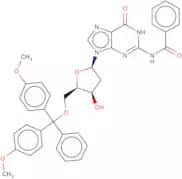
CAS:<p>N2-Benzoyl-2'-deoxy-5'-O-DMT-guanosine is a novel and potent anticancer nucleoside with antiviral activity. It is an analog of 2'-deoxy-5'-O-DMT guanosine, which was reported to be the first phosphoramidite nucleoside. N2-Benzoyl-2'-deoxy-5'-O-DMT-guanosine is an excellent candidate for DNA synthesis and has been shown to inhibit viral replication. This product is also of high purity and high quality, and can be used in research applications.</p>Formula:C38H35N5O7Purity:Min. 95%Molecular weight:673.71 g/mol5'-Deoxy-5'-(1,3-diphenyl-2-imidazolidinyl)thymidine
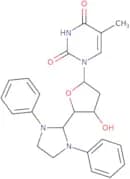
CAS:<p>5'-Deoxy-5'-(1,3-diphenyl-2-imidazolidinyl)thymidine is a modified nucleoside analog that inhibits the growth of viruses. It has been shown to be active against herpes simplex virus type 1 and 2, varicella zoster virus, cytomegalovirus, and Epstein-Barr virus. This drug is used as an antiviral medication in the treatment of viral infections.</p>Formula:C24H26N4O4Purity:Min. 95%Molecular weight:434.5 g/mol2'-Deoxy-5'-O-DMT-2'-fluorouridine 3'-O-succinate triethylammonium salt
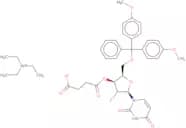
<p>2'-Deoxy-5'-O-DMT-2'-fluorouridine 3'-O-succinate triethylammonium salt is a nucleoside that is modified with a 2,2,2-trifluoroethoxycarbonyl group on the 5' position of the sugar moiety. It is an activator for phosphoramidites in DNA synthesis and has been shown to have anticancer activity. It is also used as an antiviral agent and to treat HIV and herpes virus infections. This compound has a molecular weight of 439.5 g/mol and its CAS number is 62273-03-3.</p>Formula:C34H32FN2O10·C6H16NPurity:Min. 95%Color and Shape:SolidMolecular weight:749.84 g/molb-Methylcrotonyl coenzyme A lithium salt
CAS:<p>b-Methylcrotonyl coenzyme A lithium salt is a phosphoramidite that has antiviral and anticancer properties. It is used as an activator in the synthesis of DNA, as well as a novel deoxyribonucleoside monophosphate. b-Methylcrotonyl coenzyme A lithium salt also has high purity and high quality.</p>Purity:Min. 95%Guanosine 3',5'-diphosphate tetralithium salt
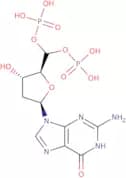
CAS:<p>Guanosine 3',5'-diphosphate tetralithium salt is a nucleoside that has antiviral and anticancer properties. It is synthesized by reacting guanosine with lithium tetrabutylammonium tetraiodide. This nucleotide can be used as a precursor for DNA synthesis, deoxyribonucleosides, and phosphoramidites. Guanosine 3',5'-diphosphate tetralithium salt has been shown to activate the synthesis of proteins in the absence of adenosine triphosphate (ATP).</p>Formula:C10H11Li4N5O11P2Purity:Min. 95%Molecular weight:466.93 g/mol5'-O-Trityl-3'-b-hydroxythymidine
CAS:<p>5'-O-Trityl-3'-b-hydroxythymidine is a nucleoside that is synthesized by the reduction of a pyrimidine with xylene. This molecule has been shown to have antibacterial activity, and also activates p53 in human cells. 5'-O-Trityl-3'-b-hydroxythymidine has been shown to inhibit the growth of cancer cells in a dose dependent manner. The functional theory for this finding is that 5'-O-Trityl-3'-b-hydroxythymidine may bind to DNA, preventing RNA polymerase from transcribing DNA into mRNA.</p>Formula:C29H28N2O6Purity:Min. 95%Molecular weight:500.54 g/mol6-Chloro-7-deaza-9-(a-D-ribofuranosyl)purine
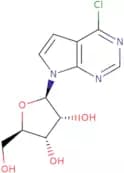
CAS:<p>6-Chloro-7-deaza-9-(a-D-ribofuranosyl)purine is an anticancer drug that belongs to the class of nucleosides. It inhibits DNA and RNA synthesis by blocking the incorporation of nucleotides into DNA or RNA. This drug may also inhibit viral replication by blocking viral polymerase activity. 6-Chloro-7-deaza-9-(a-D-ribofuranosyl)purine has been shown to be a potent activator of phosphoramidites, which are used in chemical synthesis. This novel compound is synthesized using modified diphosphate chemistry and purified to high purity.</p>Formula:C11H12ClN3O4Purity:Min. 95%Molecular weight:285.68 g/mol


![2'-Deoxy-5'-DMT-5-[3-(trifluoroacetylamino)-1-E-propenyl]-uridine 3-CE phosphoramidite](/_next/image/?url=https%3A%2Fstatic.cymitquimica.com%2Fproducts%2F3D%2Fthumb-webp%2FPD138043.webp&w=3840&q=75)