Nucleosides
Found 3573 products of "Nucleosides"
5'-O-DMT-5-methyl-(2'-O-4'-C-methylene)-uridine 3'-CE-phosphoramidite
5'-O-DMT-5-methyl-(2'-O-4'-C-methylene)-uridine 3'-CE-phosphoramidite is a nucleoside phosphoramidite and an anticancer drug. It is a modified nucleoside that has been synthesized by the chemical reaction of 5'-O-dimethoxytritylthymidine with 5'-O-DMT-5-methyl-(2'-O-4'-C-methylene)uridine 3' chloroformate. 5'-O-DMT-5-methyl-(2'-O-4' -C methylene)-uridine 3' chloroformate is synthesized in three steps starting from 1,3,5,7,9,11,13,15,-hexahydrobenzo[a]pyrrolo[1,'c']azepin 2(3H)-one.Purity:Min. 95%2'-Deoxyuridine-5'-[(a,b)-imido]diphosphate sodium salt - 10mM aqueous solution
CAS:2'-Deoxyuridine-5'-[(a,b)-imido]diphosphate sodium salt - 10mM aqueous solution is an organic compound that is used as a plant growth regulator. It inhibits the activity of plant enzymes, such as adenylate cyclase and protein kinase C, thereby blocking the production of proteins in plants. 2'-Deoxyuridine-5'-[(a,b)-imido]diphosphate sodium salt - 10mM aqueous solution has been shown to be toxic to muscle tissue and can cause acute toxicity in mammals. However, it has been found to be safe for use on plants when diluted with water.Formula:C9H15N3O10P2Purity:Min. 95%Molecular weight:387.18 g/molN2-Isobutyryl-N-trityl-morpholinoguanine methyl dimethylphosphoramide chloridate
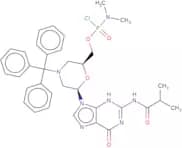
CAS:N2-Isobutyryl-N-trityl-morpholinoguanine methyl dimethylphosphoramide chloridate is a novel modified nucleoside analog with antiviral and anticancer activity. It is a phosphoramidite that is used in the synthesis of oligonucleotides and polynucleotides. N2-Isobutyryl-N-trityl-morpholinoguanine methyl dimethylphosphoramide chloridate has been shown to inhibit viral replication in vitro by inhibiting viral DNA polymerase, as well as tumor growth in vivo by inducing apoptosis. This compound has also been shown to be an activator for RNA polymerases I, II, and III.Purity:Min. 95%5'-O-DMT-2'-O-(2-methoxyethyl)uridine 3'-CE phosphoramidite
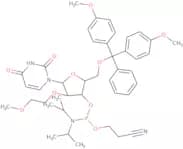
CAS:Building block for the introduction of uridine units into oligonucleotidesFormula:C42H53N4O10PPurity:Min. 95%Molecular weight:804.86 g/mol1-(3',5'-Di-O-benzoyl-2'-deoxy-2'-fluoro-D-arabinofuranosyl)uracil
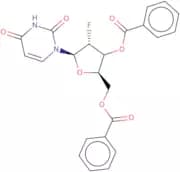
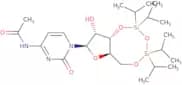
1-(3',5'-Di-O-benzoyl-2'-deoxy-2'-fluoro-D-arabinofuranosyl)uracil is a modified nucleoside that is an activator of DNA synthesis. It inhibits the activity of an enzyme called thymidine kinase and prevents the formation of the prodrug 5-fluorouracil. 1-(3',5'-Di-O-benzoyl-2'-deoxy-2'-fluoro-D-arabinofuranosyl)uracil has been shown to be active against a variety of cancer cells, including leukemia, skin cancer, and breast cancer. This drug also has antiviral and antimetabolite properties.Formula:C23H19N2O7FPurity:Min. 95%Molecular weight:454.4 g/molN-Acetyl-3',5'-O-(1,1,3,3-tetraisopropyl-1,3-disiloxanediyl)cytidine
CAS:N-Acetyl-3',5'-O-(1,1,3,3-tetraisopropyl-1,3-disiloxane diyl) cytidine is a novel modified ribonucleoside. It is an activator of DNA and RNA synthesis with anticancer properties. N-Acetyl-3',5'-O-(1,1,3,3-tetraisopropyl-1,3-disiloxane diyl) cytidine has been shown to be effective against influenza A virus and herpes simplex virus type 1. NACCTC has also shown antiviral activity against HIV type 2 in cell culture.Formula:C23H41N3O7Si2Purity:Min. 95%Molecular weight:527.76 g/mol2'-Deoxy-5'-O-DMT-guanosine-(iBu)-succinyl CPG 1400 Å
2'-Deoxy-5'-O-DMT-guanosine-(iBu)-succinyl CPG 1400 Å is an antiviral, anticancer, and high purity monophosphate of 2'-deoxy-5'-O-DMT-guanosine. It is a novel nucleoside with a modified phosphate group. This product can be used to synthesize DNA and RNA, as well as in the treatment of cancer.Purity:Min. 95%4-Methyl-2-(methylsulfanyl)-5-pyrimidinecarboxylic acid
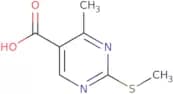
CAS:Ribonucleosides, deoxyribonucleosides, and their activated forms (e.g., 4-methyl-2-(methylsulfanyl)-5-pyrimidinecarboxylic acid) are all important intermediates for the synthesis of DNA and RNA. Ribonucleosides are the key building blocks for the synthesis of DNA. They can be converted to nucleosides by removal of the ribose moiety. Deoxyribonucleosides are synthesized from ribonucleosides by removal of the hydroxyl group from carbon 2' position of ribose. The activated forms (e.g., 4-methyl-2-(methylsulfanyl)-5-pyrimidinecarboxylic acid) are useful in phosphoramidite chemistry as they have a free amine group on one side and a free sulfonyl group on the other side that can be used to react with a growing oligo or polyphosph
Formula:C7H8N2O2SPurity:Min. 95%Molecular weight:184.22 g/molN-(2'-Deoxy- 2', 2'- difluorocytidine 5'-P- phenyl phosphate) L- alanine benzyl ester
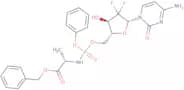
CAS:N-(2'-Deoxy- 2', 2'- difluorocytidine 5'-P- phenyl phosphate) L- alanine benzyl ester, also known as Acelarin, is primarily used in cancer treatment, including leukemia and solid tumors.
Formula:C25H27F2N4O8PPurity:Min. 98 Area-%Color and Shape:PowderMolecular weight:580.47 g/mol2',5'-Dideoxy-2'-fluoro-5'-iodouridine
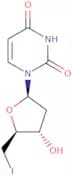
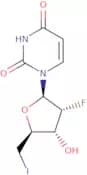
CAS:2',5'-Dideoxy-2'-fluoro-5'-iodouridine is a modified nucleoside that is used in the synthesis of oligonucleotides. It can be used as an antiviral and anticancer agent. The drug has been shown to inhibit the replication of DNA and RNA, which may lead to cell death. 2',5'-Dideoxy-2'-fluoro-5'-iodouridine is also known for its high purity, novel structure and stability.
Formula:C9H10FIN2O4Purity:Min. 95%Molecular weight:356.09 g/mol1-(3’,5’-Di-O-benzoyl-2'-Deoxy-2'-fluoro-b-D-arabinofuranosyl)uracil
CAS:1-(3’,5’-Di-O-benzoyl-2'-Deoxy-2'-fluoro-b-D-arabinofuranosyl)uracil (1DBUA) is a nucleoside phosphoramidite that is an antiviral agent. It inhibits viral replication by blocking the synthesis of DNA and RNA. 1DBUA does not have any anticancer activity and has been shown to be toxic to cells in culture. The purity of 1DBUA is high and it can be used for the preparation of oligonucleotides. 1DBUA has been modified with a benzoyl group at C1’ position. This modification improves solubility and prevents hydrolysis by esterases or glucuronidases. 1DBUA also acts as an activator in DNA polymerase reactions, which increases the efficiency of DNA synthesis.Purity:Min. 95%Adenosine 5'-difluoromethylene-5'-triphosphate triethylammonium salt
Adenosine 5'-difluoromethylene-5'-triphosphate triethylammonium salt is a novel nucleotide activator that has antiviral, anticancer, and ribonucleoside activities. This activator is a phosphoramidite monomer with an adenine base. The pharmaceutical industry uses this activator as a starting material in the synthesis of anticancer drugs and antiviral drugs. It is also used as a reagent in the production of modified DNA and RNA molecules for use in gene therapy and drug discovery.Purity:Min. 95%2'-Deoxy-2'-fluoroadenosine-5'-monophosphate
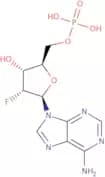
CAS:2'-Deoxy-2'-fluoroadenosine-5'-monophosphate is a nucleotide that is used as an anthelmintic drug. It inhibits the synthesis of fatty acids and ATP levels in tissue culture cells. This nucleotide has also been shown to have immunomodulatory effects, which may be due to its ability to bind to receptor activity. 2'-Deoxy-2'-fluoroadenosine-5'-monophosphate binds with high affinity to the response elements of transcription factors such as NF-κB and AP1, which are involved in the regulation of gene expression and inflammatory responses.Formula:C10H13FN5O6PPurity:Min. 95%Molecular weight:349.21 g/mol8-Bromo-5'-o-(dimethyoxytrityl)-N2-(dimethyl-aminomethylidene)-2'-deoxyguanosine
CAS:8-Bromo-5'-O-(dimethyoxytrityl)-N2-(dimethyl-aminomethylidene)-2'-deoxyguanosine (8-Bromo-5'-O-(DMT)-dG) is a novel nucleoside that is synthesized by reacting 8-bromo-5'-O-(dimethyoxytrityl)-2'-deoxyguanosine with dimethylaminomethylidene. It has antiviral, anticancer, and ribonucleoside activities. 8-Bromo-5'-O-(DMT)-dG is used as a building block for the synthesis of oligonucleotides, phosphoramidites, and other modified nucleosides. 8-Bromo-5'-O-(DMT)-dG is currently being developed as an anticancer drug.Formula:C34H35BrN6O6Purity:Min. 95%Molecular weight:703.6 g/mol2'-Deoxy-5'-DMT-5-[3-(trifluoroacetylamino)-1-E-propenyl]-uridine 3-CE phosphoramidite
CAS:2'-Deoxy-5'-DMT-5-[3-(trifluoroacetylamino)-1-E-propenyl]-uridine 3-CE phosphoramidite is a synthetic nucleoside analog that has been modified to contain a triphosphate group. It is used in the synthesis of DNA or RNA. The compound is synthesized from 2,4-dichloro-N-(2,6-dimethoxybenzyl)phenylamine, which was reacted with ethyl (3-[(trifluoroacetyl)amino]propanoate) and deoxythymidine 3'-monophosphate. The CAS number for this product is 851520-76-8.Purity:Min. 95%2’,5’-Dideoxy-5’-iodouridine
CAS:2’,5’-Dideoxy-5’-iodouridine is an antiviral drug that inhibits DNA synthesis. It is a modified nucleoside analog with a phosphoramidite derivative of the natural ribonucleosides and deoxyribonucleosides. This drug is synthesized through the reaction of 2’,5’-dideoxyadenosine with 5-iodo-2-deoxyuridine in the presence of a strong base such as sodium hydride. The resulting product has a high purity, high yield, and can be used for the synthesis of DNA. 2’,5’-Dideoxy-5’-iodouridine also has anticancer properties and has been shown to inhibit cell growth in vitro at concentrations ranging from 0.1 to 1 μM.
Purity:Min. 95%2'-O-tert-Butyldimethylsilyl-5'-O-DMT-adenosine
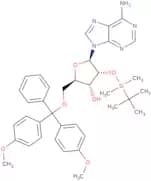
CAS:2'-O-tert-Butyldimethylsilyl-5'-O-DMT-adenosine is a modified nucleoside that is used to synthesize oligonucleotides. It is a phosphoramidite, and can be used in the synthesis of DNA or RNA. 2'-O-tert-Butyldimethylsilyl-5'-O-DMT-adenosine is an antiviral agent that has been shown to have anticancer activity in animal models. It has been shown to inhibit the production of tumor necrosis factor alpha (TNFα) and serum enzymes, such as dismutase activity, in mice with lung cancer. This drug also has a toxic effect on respiratory system cells, which may be due to its ability to induce apoptosis.
Purity:Min. 95%3'-Deoxy-5'-O-trityluridine
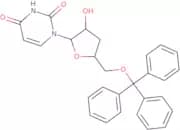
CAS:3'-Deoxy-5'-O-trityluridine is a nucleoside that is structurally related to uridine. It belongs to the class of nucleosides and has a hydroxyl group at the 3' position. The 5' position is modified by an anion (most often trityl) sterically, which prevents hydrolysis by esterases or phosphatases. The efficiency of this modification can be increased by using diethyl phosphate as the protecting agent. This modification also provides protection against nucleophiles, such as hydroxyl groups in nucleosides or phosphite triester derivatives. 3'-Deoxy-5'-O-trityluridine is used in the synthesis of other nucleosides and as a substrate for diffraction experiments.Formula:C28H26N2O5Purity:Min. 95%Molecular weight:470.53 g/molN2-Benzoyl-2'-deoxy-5'-O-DMT-guanosine
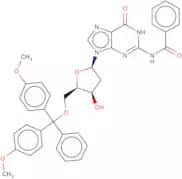
CAS:N2-Benzoyl-2'-deoxy-5'-O-DMT-guanosine is a novel and potent anticancer nucleoside with antiviral activity. It is an analog of 2'-deoxy-5'-O-DMT guanosine, which was reported to be the first phosphoramidite nucleoside. N2-Benzoyl-2'-deoxy-5'-O-DMT-guanosine is an excellent candidate for DNA synthesis and has been shown to inhibit viral replication. This product is also of high purity and high quality, and can be used in research applications.Formula:C38H35N5O7Purity:Min. 95%Molecular weight:673.71 g/molGuanosine 2',3'-cyclic phosphate triethylamine salt
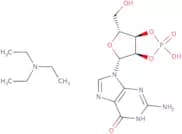
CAS:Guanosine 2',3'-cyclic phosphate triethylamine salt is a synthetic nucleoside that has antiviral and anticancer activity. It is a modified nucleoside with a cyclic phosphate group attached to the 2' position of the sugar ring. This modification prevents hydrolysis of the nucleotide by phosphodiesterases, which are enzymes that break down RNA and DNA. Guanosine 2',3'-cyclic phosphate triethylamine salt has been shown to be active against HIV-1, herpes simplex virus type 1 (HSV-1), HSV-2, and cytomegalovirus (CMV). It also inhibits the proliferation of various cancer cell lines including those from breast, prostate, lung, colon, and leukemia.Formula:C16H27N6O7PPurity:Min. 95%Molecular weight:446.4 g/mol


![2'-Deoxyuridine-5'-[(a,b)-imido]diphosphate sodium salt - 10mM aqueous solution](/_next/image/?url=https%3A%2Fstatic.cymitquimica.com%2Fproducts%2F3D%2Fthumb-webp%2FND45195.webp&w=3840&q=75)



![2'-Deoxy-5'-DMT-5-[3-(trifluoroacetylamino)-1-E-propenyl]-uridine 3-CE phosphoramidite](/_next/image/?url=https%3A%2Fstatic.cymitquimica.com%2Fproducts%2F3D%2Fthumb-webp%2FPD138043.webp&w=3840&q=75)