


Nucleosides
Found 3570 products of "Nucleosides"
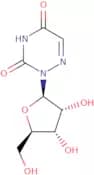
6-Azauridine
CAS:Inhibitor of uridine monophosphate synthase
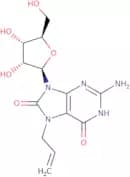
Formula:C8H11N3O6Purity:Min. 95%Color and Shape:White PowderMolecular weight:245.19 g/mol7-Allyl-7,8-dihydro-8-oxoguanosine
CAS:Agonist of toll-like receptors TLR7
Formula:C13H17N5O6Purity:Min. 95%Color and Shape:White PowderMolecular weight:339.3 g/mol2'-Deoxyuridine-5'-diphosphate triethylammonium, 10 mM aqueous solution
CAS:a deoxynucleotide diphosphate
Formula:C9H14N2O11P2•C6H15NMolecular weight:489.35 g/molTFA-aha-dC
TFA-aha-dC is a modified nucleoside analog that is an antiviral and anticancer drug. It inhibits the enzyme DNA polymerase, which is required for replication of viral and bacterial DNA. TFA-aha-dC binds to the active site of the enzyme, preventing it from binding to DNA and blocking its activity. TFA-aha-dC also has demonstrated anti-inflammatory properties.
Formula:C20H28F3N5O6Purity:Min. 95%Molecular weight:491.46 g/mol3’-O-Levulinyl-2’-deoxyadenosine
CAS:3’-O-Levulinyl-2’-deoxyadenosine is a nucleoside and a prodrug for the anticancer drug 2’,3’-dideoxyadenosine. 3’-O-Levulinyl-2’-deoxyadenosine is an activator of deoxyribonucleic acid (DNA) synthesis and also inhibits DNA repair. In mammals, 3’-O-levulinyl-2’deoxyadenosine is converted to 2’,3′ dideoxyadenosine monophosphate (ddAMP), which can be phosphorylated to ddATP in cells. 3′ -O -levulinyl -2′ -deoxyadenosine has been shown to inhibit the growth of cancer cells in vitro and in vivo.
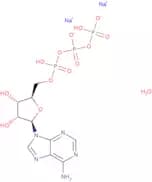
Purity:Min. 95%Adenosine 5'-triphosphate disodium salt hydrate
CAS:Adenosine 5'-triphosphate disodium salt hydrate (ATP 2Na) is a nucleoside triphosphate acting as the essential part of energy storage and metabolism in vivo. It plays a crucial role in many biological processes including neurotransmission, signal transduction, muscle contraction and cardiac function, often described as the "molecular unit of currency" for intracellular energy transfer.
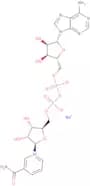
Formula:C10H14N5Na2O13P3·xH2OPurity:Min. 97 Area-%Color and Shape:White PowderMolecular weight:551.14 g/molβ-Nicotinamide adenine dinucleotide sodium dihydrate
CAS:Coenzyme and regenerating electron donor in catabolic processes
Formula:C21H26N7NaO14P2•(H2O)2Purity:Min. 95%Color and Shape:White PowderMolecular weight:721.44 g/molRef: 3D-NN44827
Discontinued product5-Bromo-2'-deoxyuridine
CAS:5-Bromo-2'-deoxyuridine (5-BrDU) is a nitrate reductase inhibitor that prevents the reduction of nitrate to nitrite by inhibiting the enzyme nitrate reductase. It is a genotoxic agent that has been shown to cause DNA damage and cell death in vitro. 5-BrDU has been shown to induce preconditioning in vivo, reducing neuronal injury after ischemia. This drug also binds to NMDA receptors and may be useful as a model system for studying neurodegenerative diseases such as Alzheimer's disease. 5-BrDU has been shown to inhibit the polymerase chain reaction in wild-type strains of bacteria, but not in strains with a mutation in their DNA gyrase genes.
Formula:C9H11BrN2O5Purity:Min. 99 Area-%Color and Shape:White Off-White PowderMolecular weight:307.1 g/molRef: 3D-NB06315
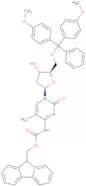
Discontinued product2'-Deoxy-5’-O-DMT-N4-Fmoc-5-methylcytidine
CAS:2'-Deoxy-5'O-DMT-N4-Fmoc-5-methylcytidine is a modified nucleoside that is used to synthesize antiviral ribonucleosides and deoxyribonucleosides. It can be used to synthesize novel anticancer drugs, which are effective against tumor cells.
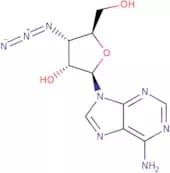
Purity:Min. 95%3'-Azido-3'-deoxyadenosine
CAS:3'-Azido-3'-deoxyadenosine is an initiator that can be used in oligoribonucleotide synthesis. It is stable, nonhydrolyzable and does not require any protecting groups for its use. 3'-Azido-3'-deoxyadenosine is efficient at initiating the synthesis of ribosomal RNA and has been shown to be a good substrate for biochemical studies. This compound is functionalized with a ribose group, which can be linked to other substances. The linkage of this compound to other substances allows it to be used as a building block for the production of oligoribonucleotides.
Formula:C10H12N8O3Purity:Min. 95%Color and Shape:PowderMolecular weight:292.25 g/molRef: 3D-FA144620
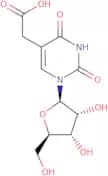
Discontinued product5-(Carboxymethyl)uridine
CAS:5-(Carboxymethyl)uridine is an uridine compound that has been shown to inhibit protein synthesis in cultured cells. It binds to the ribosome and inhibits protein synthesis by inhibiting the formation of peptide bonds. 5-Carboxymethyl-uridine has been shown to be effective against two strains of bacteria, Escherichia coli and Staphylococcus aureus, in cell culture experiments. The inhibition of bacterial protein synthesis was shown to be dose-dependent for both strains. The mechanism of action is believed to be due to its binding to the ribosome and inhibiting the formation of peptide bonds.
Formula:C11H14N2O8Purity:Min. 95 Area-%Color and Shape:White Off-White PowderMolecular weight:302.24 g/molRef: 3D-NC159474
Discontinued product8-Methylthioguanosine
CAS:8-Methylthioguanosine is a purine nucleoside that is synthesized from guanosine by the enzyme nucleoside phosphorylase. 8-Methylthioguanosine is used in the treatment of leukemia cells and has been shown to have homogeneity, with a single peak on paper chromatography. It is also an inhibitor of purine nucleotide phosphorylase, which prevents the conversion of guanosine to inosine monophosphate and leads to depletion of intracellular ATP levels. This drug binds tightly to the active site of purine nucleotide phosphorylase and inhibits its activity. 8-Methylthioguanosine may be used as a radiosensitizer for cancer therapy and can be administered intravenously or orally.
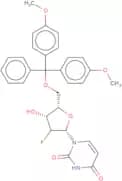
Purity:Min. 95%2'-Deoxy-5'-O-DMT-2'-fluoro-L-uridine
2'-Deoxy-5'-O-DMT-2'-fluoro-L-uridine is a nucleoside with anticancer and antiviral properties. It is used in the production of oligonucleotides, which are short chains of nucleic acids that can be synthesized in vitro to serve as probes for specific DNA or RNA sequences. 2'-Deoxy-5'-O-DMT-2'-fluoro-L-uridine is also a substrate for phosphoramidite synthesis, which converts it into 2'-deoxy-5'-O-(4,4',4''-(1,3,2-triazole)-tris(o-tolyl))uronium tetrafluoroborate (TOTU). This product has been shown to inhibit the activity of HIV reverse transcriptase and prevent the infection of cells by HIV.
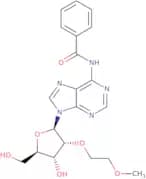
Formula:C30H29FN2O7Purity:Min. 95%Molecular weight:548.57 g/molN6-Benzoyl-2'-O-(2-methoxyethyl)adenosine
CAS:N6-Benzoyl-2'-O-(2-methoxyethyl)adenosine is a novel nucleoside that can be used as an antiviral agent. It is an activator of viral polymerase and inhibits the proliferation of cells infected with HIV. This compound has been synthesized from 2'-deoxyadenosine monophosphate, which is a precursor to RNA and DNA synthesis. N6-Benzoyl-2'-O-(2-methoxyethyl)adenosine has also been shown to inhibit the growth of experimental tumors in mice. The synthesis of this compound is reliable and reproducible, making it a high quality product.
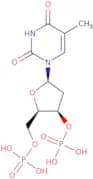
Formula:C20H23N5O6Purity:Min. 95%Molecular weight:429.43 g/molThymidine-3',5'-diphosphate sodium salt
CAS:Thymidine-3',5'-diphosphate sodium salt is a nucleoside that is used in the synthesis of oligonucleotides. It is an antiviral and anticancer agent. Thymidine-3',5'-diphosphate sodium salt has been shown to inhibit DNA synthesis, leading to cell death. It also has been shown to be effective against Hepatitis B virus and HIV-1.
Formula:C10H16N2O11P2·xNaPurity:Min. 98 Area-%Color and Shape:White PowderMolecular weight:402.19 g/molRef: 3D-NT09781
Discontinued productN1,N2,N2-Trimethyl-psi-isocytidine
N1,N2,N2-Trimethylpsi-isocytidine is a novel nucleoside analog that has antiviral, anticancer, and immunosuppressive activities. It is an activator of diphosphate kinase and inhibits the formation of deoxyribonucleotides in DNA synthesis. N1,N2,N2-Trimethylpsi-isocytidine is a modified form of cytidine that contains three methyl groups. This agent has been shown to be active against human leukemic cells and can be used for the treatment of cancer and HIV infections.
Purity:Min. 95%3’-Deoxy-5-methoxyuridine
CAS:3’-Deoxy-5-methoxyuridine is a modified nucleoside that has antiviral and anticancer properties. It is an activator of DNA synthesis, which is the first step in the process of DNA replication. It also inhibits DNA gyrase and topoisomerase II, enzymes that maintain the integrity of bacterial DNA. 3’-Deoxy-5-methoxyuridine phosphoramidites are used in anticancer drugs.
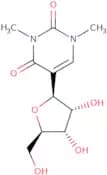
Formula:C10H12N2O6Purity:Min. 95%Molecular weight:258.23 g/mol1,3-Dimethylpseudouridine
CAS:1,3-Dimethylpseudouridine is a methylated derivative of pseudouridine, which is a naturally occurring modified nucleoside found in RNA. This compounds can be used in research applications
Formula:C11H16N2O6Purity:Min. 95%Color and Shape:PowderMolecular weight:272.25 g/molRef: 3D-ND162827
Discontinued product5'-O-Trityluridine
CAS:5'-O-Trityluridine is a nucleoside analogue that has been prepared as an oriented, oxidized, hydrogenated, xylene derivative of uridine. It is composed of ribofuranoside and uridine. The orientation is controlled by the use of trityl groups on the 5' and 3' hydroxyl groups. The alkali metal salt isomers are analysed using HPLC and GC. This compound interacts with phosphotriesters and cyclic phosphodiesters.
Formula:C28H26N2O6Purity:Min. 95%Color and Shape:White Off-White PowderMolecular weight:486.52 g/molRef: 3D-NT06665
Discontinued product7-Deazaadenosine- 2', 3'- dideoxy- 7[3- (trifluoroacetyl) amino] - 1- propyn- yl
CAS:7-Deazaadenosine is a synthetic nucleoside that is used as an antiviral and antitumor agent. It has been shown to inhibit the growth of cancer cells in vitro and in vivo. 7-Deazaadenosine also has antiviral activity, inhibiting viral DNA synthesis by interfering with the enzyme DNA polymerase. 7-Deazaadenosine has been shown to be more potent than other deoxyribonucleosides against various HIV strains, including HIV-1 group M and HIV-1 group O. This drug was originally developed for use as a chemotherapeutic agent but has since been used as a research reagent for studying the mechanism of action of various drugs on DNA.
Formula:C16H16F3N5O3Purity:Min. 95%Color and Shape:PowderMolecular weight:383.33 g/molRef: 3D-ND156888
Discontinued product









![7-Deazaadenosine- 2', 3'- dideoxy- 7[3- (trifluoroacetyl) amino] - 1- propyn- yl](/_next/image/?url=https%3A%2Fstatic.cymitquimica.com%2Fproducts%2F3D%2Fthumb-webp%2FND156888.webp&w=3840&q=75)