Nucleosides
Found 3569 products of "Nucleosides"
2-Deoxy-2-fluoro-b-D-arabinofuranosylamine
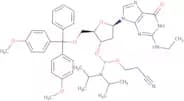
CAS:2-Deoxy-2-fluoro-b-D-arabinofuranosylamine (2DF) is a monophosphate nucleoside analog that is chemically modified to form 2DF. The 2DF has shown antiviral, anticancer, and anti-inflammatory activities. It inhibits the proliferation of cancer cells by blocking the synthesis of DNA and RNA, which are necessary for cellular reproduction. This drug also has been shown to have an activator effect on diphosphate nucleotide incorporation into DNA.Formula:C5H10FNO3Purity:Min. 95%Molecular weight:151.14 g/mol2'-Deoxy-5'-O-DMT-N2-ethylguanosine 3'-CE phosphoramidite
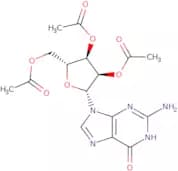
CAS:2'-Deoxy-5'-O-DMT-N2-ethylguanosine 3'-CE phosphoramidite is a novel nucleoside analogue. It is a nucleotide analog with potent antiviral and anticancer activities. This compound has been shown to be an activator of deoxyribonucleosides and ribonucleosides, which may lead to the activation of their respective polymerases. It also has high purity, quality, and stability, as well as being inexpensive. Rifapentine is an anti-tuberculosis drug that belongs to the class of rifamycins. It is the most active of the rifamycins for the treatment of tuberculosis. Rifapentine inhibits bacterial growth by binding to DNA-dependent RNA polymerase, thereby preventing transcription and replication. The high frequency of human activity has been shown using a patch-clamp technique on human erythrocytes. This active formFormula:C42H52N7O7PPurity:Min. 95%Color and Shape:SolidMolecular weight:797.88 g/mol2',3',5'-Tri-O-acetylguanosine
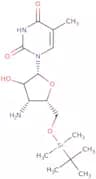
CAS:2',3',5'-Tri-O-acetylguanosine is a protected form of the nucleoside guanosine which has potential application as a synthetic intermediate in nucleic acid and nucleoside chemistry.Formula:C16H19N5O8Purity:Min. 95%Color and Shape:White PowderMolecular weight:409.35 g/mol3'-Amino-5'-O-tert-butyldimethylsilyl-3'-deoxythymidine
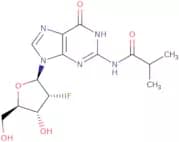
CAS:3'-Amino-5'-O-tert-butyldimethylsilyl-3'-deoxythymidine is a novel synthetic nucleoside that has been shown to have anticancer and antiviral activities. The compound is an activator of the immune system, which may be due to its ability to stimulate the production of interferon and other cytokines. 3'-Amino-5'-O-tert-butyldimethylsilyl-3'-deoxythymidine can also inhibit viral DNA polymerases. This nucleoside has been shown to inhibit the growth of leukemia cells in culture by inhibiting ribonucleotide reductase activity.Formula:C16H29N3O5SiPurity:Min. 95%Molecular weight:371.51 g/mol2'-Deoxy-2'-fluoro-N2-isobutyrylguanosine
CAS:2'-Deoxy-2'-fluoro-N2-isobutyrylguanosine is a modified nucleoside analog for research applicationsFormula:C14H18FN5O5Purity:Min. 95%Color and Shape:White PowderMolecular weight:355.33 g/mol2’,3’-Bis-O-tert-butyldimethylsilyl-5-methoxyuridine
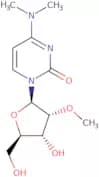
2’,3’-Bis-O-tert-butyldimethylsilyl-5-methoxyuridine is an antiviral nucleoside that is chemically synthesized from 5-methoxyuridine. It has been shown to inhibit the replication of HIV in cell cultures and animal models. This drug can be used as a phosphoramidite for the synthesis of oligonucleotides. 2’,3’-Bis-O-tert-butyldimethylsilyl-5-methoxyuridine is a novel nucleoside that has not been previously reported in the chemical literature.Purity:Min. 95%N4,N4,2’-O-Trimethylcytidine
CAS:N4,N4,2’-O-Trimethylcytidine is a novel nucleoside that has been shown to be an anticancer drug. It inhibits the growth of cells by selectively inhibiting their DNA synthesis. N4,N4,2’-O-Trimethylcytidine is also active against viruses and is able to inhibit viral replication by blocking the synthesis of deoxyribonucleosides and phosphoramidites. This compound has been synthesized in high purity and quality with CAS No. 34218-81-0.Formula:C12H19N3O5Purity:Min. 95%Color and Shape:White PowderMolecular weight:285.3 g/molPalmitoyl coenzyme A potassium salt
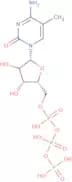
CAS:Palmitoyl coenzyme A potassium salt is a novel, modified nucleoside that has antiviral and anticancer activities. It is a phosphoramidite with a phosphate group at one end and a palmitoyl group at the other. The phosphate group is attached to the 5' position of the sugar, while the palmitoyl group is attached to the 3' position of the sugar. Palmitoyl coenzyme A potassium salt can be used in DNA synthesis.Formula:C37H65N7O17P3SKPurity:Min. 95%Color and Shape:White PowderMolecular weight:1,044.03 g/mol5-Methylcytidine-5'-triphosphate sodium salt - 100mM aqueous solution
CAS:5-Methylcytidine-5'-triphosphate sodium salt is a nucleoside diphosphate that is used as an activator in the synthesis of DNA. It is also used as a building block in the synthesis of anticancer agents, such as 5-methylcytosine monophosphate and phosphoramidites. The chemical name for this product is 5-methylcytidine-5'-triphosphate sodium salt and its CAS number is 327174-86-7. This product is available for purchase at Sigma Aldrich with a purity of 99%.Formula:C10H18N3O14P3·xNaPurity:Min. 95%Color and Shape:PowderMolecular weight:497.18 g/mol2,3'-Anhydrouridine 5'-CE phosphoramidite
2,3'-Anhydrouridine 5'-CE phosphoramidite is a novel modified phosphoramidite that can be used in the synthesis of ribonucleosides and DNA. It has antiviral activity, and is being studied as an anticancer drug. 2,3'-Anhydrouridine 5'-CE phosphoramidite has been shown to inhibit the replication of HIV-1 and herpes simplex virus type 1 (HSV-1). The nucleoside analogs are being studied for their potential use in chemotherapy.Formula:C18H27N4O6PPurity:Min. 95%Molecular weight:426.41 g/mol10-O-[1-Propyl-3-N-carbamoylcholesteryl]-TEG-CE phosphoramidite
CAS:10-O-[1-Propyl-3-N-carbamoylcholesteryl]-TEG-CE phosphoramidite is a cholesterol-conjugated phosphoramidite. The cholesteryl group is a lipophilic moiety which can be used to enhance cellular uptake of oligonucleotides.Formula:C46H82N3O7PPurity:(31P-Nmr) Min. 95 Area-%Color and Shape:Colorless PowderMolecular weight:820.13 g/molN4-Benzoyl-2'-deoxy-2'-fluorocytidine 3'-CE phosphoramidite
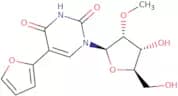
N4-Benzoyl-2'-deoxy-2'-fluorocytidine 3'-CE phosphoramidite is a novel DNA phosphoramidite monomer that has been modified to include an N4-benzoyl group at the 2'-position of the sugar. It is synthesized from 4,5-diaminopyrimidine, 1,3-bis(2-chloroethyl)carbodiimide hydrochloride (EDC), and 4-(N,N-dimethylamino)benzoic acid. The benzoyl group allows for the incorporation of this monomer into DNA in place of deoxycytidine. This product is designed to be used in oligonucleotide synthesis as an activator.Formula:C46H51FN5O8PPurity:Min. 95%Molecular weight:851.9 g/mol5'-(Furan-2-yl)-2’-O-methyluridine
CAS:5'-(Furan-2-yl)-2’-O-methyluridine is a modified nucleoside that is used as an antiviral agent. It is a monophosphate nucleotide analog and has been shown to be active against HIV, herpes simplex virus, cytomegalovirus, and Epstein Barr virus. 5'-(Furan-2-yl)-2’-O-methyluridine is synthesized by the phosphoramidite method and has high purity and quality. The CAS number for this compound is 2095417-32-4.Purity:Min. 95%Kinetin riboside
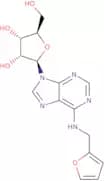
CAS:Kinetin is a plant hormone that regulates cell proliferation and differentiation. Kinetin riboside is a derivative of kinetin in which the ribose moiety has been converted to ribosyl-ribitol. Kinetin riboside has shown the ability to inhibit cancer cells by inducing apoptosis, which may be related to its ability to inhibit cyclin D2 and mitochondrial membrane potential. In addition, kinetin riboside has been shown to protect against oxidative stress and decrease mitochondrial function in cells. This compound may have therapeutic potential for cancer treatment and other diseases caused by oxidative stress or mitochondrial dysfunction.Formula:C15H17N5O5Purity:Min. 98 Area-%Color and Shape:White PowderMolecular weight:347.33 g/mol5-(Azidomethyl)-2’-deoxyuridine
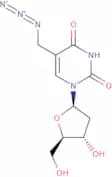
CAS:5-azidomethyl-2-deoxyuridine (AmdU) is a nucleoside that contains an azide group. The structure of the nucleoside is similar to thymidine, and it is incorporated into nascent DNA by cellular polymerases, similarly to EdU (NE08701). Unlike EdU that needs to be further modified with azides in the presence of copper catalyst, AmdU can also react in the absence of copper catalyst using spAAC Click Chemistry with strained cycloalkynes, such as cyclooctynes. This enables detection of nascent DNA in benign, copper free conditions.
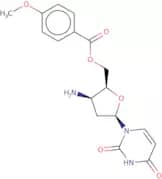
Formula:C10H13N5O5Purity:Min. 95%Color and Shape:PowderMolecular weight:283.24 g/mol3'-Amino-5'-O-p-anisoyl-2',3'-dideoxyuridine
3'-Amino-5'-O-p-anisoyl-2',3'-dideoxyuridine is a novel compound that has been synthesized. This compound is a diphosphate, which can be used as an activator for the synthesis of modified nucleosides and antiviral agents. It is also a DNA phosphoramidite, which can be used in the synthesis of oligonucleotides with high purity and high quality.
Formula:C17H19N3O6Purity:Min. 95%Molecular weight:361.35 g/molN1-Ethylpseudouridine
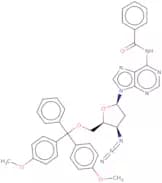
CAS:N1-Ethylpseudouridine is a synthetic RNA molecule that has been shown to be an effective antiviral agent against influenza virus in cell culture. It inhibits viral replication by binding to the ribonucleic acid (RNA) of the virus and preventing its translation into protein. N1-Ethylpseudouridine is being developed as a potential treatment for influenza A and B.Purity:Min. 95%3'-Azido-N6-benzoyl-5'-O-DMT-2',3'-dideoxyadenosine
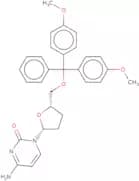
3'-Azido-N6-benzoyl-5'-O-DMT-2',3'-dideoxyadenosine is a nucleoside analog and activator that inhibits the replication of DNA. It is a novel antiviral drug that has antiproliferative properties and may be useful in the treatment of cancer. 3'-Azido-N6-benzoyl-5'-O-DMT-2',3'-dideoxyadenosine is synthesized by reacting an activated phosphoramidite with 2',3'-dideoxyadenosine monophosphate to produce 3',5' dideoxythymidine 5'-monophosphate, which is then converted to 3',5' dideoxyuridine 5'-monophosphate. The last step involves the conversion of 3',5' dideoxyuridine 5'-monophosphate to 3' azidouridine 5'-monophFormula:C38H34N8O5Purity:Min. 95%Molecular weight:682.73 g/mol2',3'-Dideoxy-5'-O-DMT-cytidine
CAS:2',3'-Dideoxy-5'-O-DMT-cytidine is a chemically modified cytidine nucleoside which can be used in synthetic chemistry, especially in nucleic acid synthesis. A dimethoxytrityl (DMT) protecting group is attached to the 5'-oxygen of the sugar. This is not biologically active, but it’s commonly used in solid-phase oligonucleotide synthesis to protect the 5' end during step-by-step DNA or RNA construction.Formula:C30H31N3O5Purity:Min. 95%Color and Shape:PowderMolecular weight:513.6 g/molN3-Methyl-2'-O-methyluridine
CAS:2'-O-methyluridine is an antiviral nucleoside that is used as a phosphoramidite in the synthesis of oligonucleotides. It has been shown to inhibit viral replication, and has been found to be effective in treating HIV-1 by inhibiting reverse transcriptase. N3-Methyl-2'-O-methyluridine also inhibits DNA synthesis and cell proliferation, and may be useful for the treatment of cancer. This modified nucleoside has been synthesized from uracil and contains a methyl group at the 3' position. The methyl group prevents 2'-O-methyluridine from being activated by cellular thymidylate synthase, which normally converts deoxyribonucleotides into ribonucleotides. This novel nucleotide has not yet been used in clinical trials but it may provide an alternative to other drugs used for cancer treatments.
Formula:C11H16N2O6Purity:Min. 95 Area-%Color and Shape:White Off-White PowderMolecular weight:272.25 g/mol





![10-O-[1-Propyl-3-N-carbamoylcholesteryl]-TEG-CE phosphoramidite](/_next/image/?url=https%3A%2Fstatic.cymitquimica.com%2Fproducts%2F3D%2Fthumb-webp%2FPP138032.webp&w=3840&q=75)