Nucleosides
Nucleosides are fundamental building blocks of nucleic acids, composed of a nitrogenous base attached to a sugar molecule. In this section, you can find a wide variety of nucleosides essential for research in molecular biology, biochemistry, and pharmacology. These compounds play crucial roles in the synthesis of DNA and RNA, and are also vital in various metabolic processes. Nucleosides are used in studying genetic material, developing antiviral and anticancer therapies, and understanding cellular mechanisms. At CymitQuimica, we provide high-quality nucleosides to support your research and development needs, ensuring purity and reliability for your experimental applications.
Found 3567 products of "Nucleosides"
Sort by
Purity (%)
0
100
|
0
|
50
|
90
|
95
|
100
N6-Succinyl adenosine
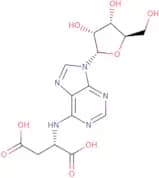
CAS:<p>N6-Succinyl adenosine is a biochemical that is involved in the transfer of fatty acids across membranes. It has been shown to be effective in transfection experiments, where it can be used to increase the expression of genes. N6-Succinyl adenosine has also been shown to be an important substrate for various dehydrogenases. Deficiency of these enzymes leads to orotic aciduria, which is characterized by elevated levels of orotic acid in blood and urine and may lead to mental retardation. A linear calibration curve was generated for diagnosis purposes, with the enzyme activities being determined using a logistic regression model.</p>Formula:C14H17N5O8Purity:Min. 95%Color and Shape:White PowderMolecular weight:383.31 g/mol2'-O-Methyladenosine 5'-triphosphate lithium salt - 100 mM aqueous solution
CAS:<p>2'-O-Methyladenosine 5'-triphosphate lithium salt - 100 mM aqueous solution is a modified nucleoside that has antiviral, anticancer, and antimalarial properties. It also has been shown to activate DNA synthesis and inhibit the growth of cancer cells.</p>Formula:C11H18N5O13P3·xLiPurity:Min. 95%Color and Shape:PowderMolecular weight:521.21 g/mol2'(3')-O-(4-Benzoyl)benzoyladenosine-5'-triphosphate triethylammonium salt
CAS:<p>2'(3')-O-(4-Benzoyl)benzoyladenosine-5'-triphosphate triethylammonium salt is a nucleoside analog of Adenosine-5'-triphosphate (ATP), a key player in cellular energy transfer. 2'(3')-O-(4-Benzoyl)benzoyl has been added to this molecule as well as a triethylammonium salt which helps to increase the stability of the molecule in solutions. 2'(3')-O-(4-Benzoyl)benzoyladenosine-5'-triphosphate triethylammonium salt has potential use as a tool for understanding how cells use ATP and how changes to ATP affect cellular processes. Other possible uses are in the study of how ATP interacts with enzymes.</p>Formula:C24H24N5O15P3·C6H15NPurity:Min. 75 Area-%Color and Shape:White PowderMolecular weight:816.58 g/mol4-Thiothymidine
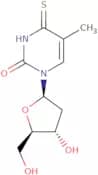
CAS:<p>4-Thiothymidine is a nucleoside analog that is converted to thymidine by the enzyme thymidine kinase. It has been shown to inhibit the growth of human skin cancer cells by binding to DNA duplexes and inhibiting the synthesis of new DNA strands. 4-Thiothymidine has also been shown to be effective against radiation-induced damage in cultured human cells and inhibits tumor growth in mice bearing a transplantable mouse skin cancer. 4-Thiothymidine can be used as an inhibitor for chemotherapy or radiation therapy for cancer patients. It is active on both site-specific and cell-specific gene targets, with a reactive hydrogen bond that helps stabilize its formation.</p>Formula:C10H14N2O4SPurity:Min. 98 Area-%Color and Shape:Yellow PowderMolecular weight:258.3 g/molN6-Benzoyl-2'-deoxy-5'-O-DMT-adenosine 3'-O-succinate triethylammonium salt
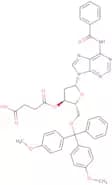
CAS:<p>N6-Benzoyl-2'-deoxy-5'-O-DMT-adenosine 3'-O-succinate triethylammonium salt is a novel nucleoside analog that has antiviral and anticancer properties. It is a ribonucleotide with an N6-(benzoyl)-2'-deoxyadenosine base linked to the 3' position of the sugar through an acetyl group, with a succinic acid moiety at the 5' position. This drug inhibits DNA synthesis and has been shown to block HIV replication in vitro. It also has activity against human papillomavirus type 16 (HPV16) infections in vivo.</p>Formula:C42H39N5O9·C6H15NPurity:Min. 95%Color and Shape:PowderMolecular weight:858.98 g/mol5-Methoxy-2-thiouridine
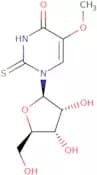
CAS:<p>5-Methoxy-2-thiouridine is the peracylated form of thiouracil. It is a reactive oxygen species, which can cause primary site lesions in cells. 5-Methoxy-2-thiouridine is a posttranscriptional modification that leads to conformational changes in the anticodon loop of tRNA molecules. This modification prevents the anticodon from pairing with its corresponding codon during translation, thereby inhibiting protein synthesis. The modifications also affect RNA processing and stability and lead to changes in gene expression.</p>Purity:Min. 95%3',5'-O-(1,1,3,3-Tetraisopropyl-1,3-disiloxanediyl)guanosine
CAS:<p>Used as a protected guanosine nucleoside in RNA synthesis. The 1,1,3,3-tetraisopropyl-1,3-disiloxanediyl (TIPDS or TBDPSi2) group acts as a bulky and selectively acid-labile protecting group for the 3' and 5' hydroxyl groups of the guanosine ribonucleoside during RNA oligonucleotide synthesis.</p>Formula:C22H39N5O6Si2Purity:Min. 97 Area-%Color and Shape:PowderMolecular weight:525.76 g/molFlavin adenine dinucleotide
CAS:<p>Flavin adenine dinucleotide, also known as FAD, plays a crucial role in several enzymatic reactions involved in metabolism. It is essential for the function of flavoproteins, which are involved in processes such as the electron transport chain and the citric acid cycle.</p>Formula:C27H33N9O15P2Purity:Min. 95%Color and Shape:PowderMolecular weight:785.5 g/mol5'-Deoxy-5'-(methylthio)adenosine
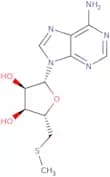
CAS:<p>5'-Deoxy-5'-(methylthio)adenosine is a nucleoside that has been shown to inhibit the growth of bowel cancer cells. 5'-Deoxy-5'-(methylthio)adenosine blocks the synthesis of DNA and RNA by inhibiting the action of enzymes involved in DNA metabolism. It also inhibits methionine synthase and phosphorylase, which are involved in protein synthesis. This compound has been shown to be effective in treating cancer tissues due to its ability to inhibit polymerase chain reactions and prevent the formation of cancerous cells.</p>Formula:C11H15N5O3SPurity:(Hplc-Ms) Min. 98 Area-%Color and Shape:White PowderMolecular weight:297.34 g/mol5'-O-DMT-a-thymidine
<p>5'-O-DMT-a-thymidine is a modified nucleoside that is used in the synthesis of DNA and RNA. This product is a high quality and pure monophosphate, which has been modified to reduce its potential for activation by phosphatases. It is suitable for use in anticancer drugs and antiviral agents.</p>Formula:C31H32N2O7Purity:Min. 95%Molecular weight:544.6 g/molAdenosine 5'-monophosphate disodium salt
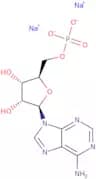
CAS:<p>Adenosine 5'-monophosphate disodium salt (AMP-Na2) is a chemical compound that has been used in the study of metabolic disorders. It belongs to the class of ethylene diamines and has been shown to increase the glomerular filtration rate. Ammonium adenosine 5'-monophosphate disodium salt has also been shown to increase the activity of glutamate decarboxylase, which converts glutamate into GABA, an inhibitory neurotransmitter. The neutral pH optimum for AMP-Na2 is 6.5-7.5, which may be due to its lysine residues. AMP-Na2 has a carbonyl group that can be oxidized by reactive oxygen species and cause oxidative injury to cells in vivo and in vitro. This damage was found mainly in microglia cells, which are responsible for removing dead or damaged neurons from the central nervous system (CNS). AMP-Na2 also activates ad</p>Formula:C10H12N5Na2O7PPurity:Min. 98 Area-%Color and Shape:PowderMolecular weight:391.19 g/mol5-Methyl-2-thiouridine
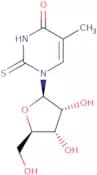
CAS:<p>5-Methyl-2-thiouridine is a nucleotide that is found in the type strain of Escherichia coli. It has been shown to be an effective inhibitor of protein synthesis, with optimum concentration at 0.1 mM. 5-Methyl-2-thiouridine binds to the ribosome and inhibits its activity. 5-Methyl-2-thiouridine also interacts with human mitochondrial RNA and alters its structure, leading to an antibody response that protects against infection by the bacteria in question. This nucleotide has also been shown to inhibit bacterial growth in wastewater treatment plants. The chemical structures of 5-methyluridine are similar to those of uridine except for a methyl group on the second carbon atom (5 position). The presence of this methyl group confers increased water permeability and decreased kinetic energy on the molecule, which can be detected using nuclear magnetic resonance spectroscopy.</p>Formula:C10H14N2O5SPurity:Min. 95%Color and Shape:White PowderMolecular weight:274.29 g/mol3’-Azido-3’-deoxy-5-fluoro-b-L-uridine
CAS:<p>3’-Azido-3’-deoxy-5-fluoro-b-L-uridine is a novel, activator ribonucleoside that is an analog of the natural nucleoside uridine. It has high quality and purity. This compound is used to synthesize deoxyribonucleosides, diphosphate, phosphoramidites, modified, anticancer and antiviral agents.</p>Purity:Min. 95%2',5'-Dideoxyadenosine
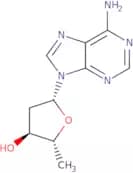
CAS:<p>2',5'-Dideoxyadenosine is a nucleotide analog that inhibits the enzyme adenylate cyclase, by binding non-competitively via the P-site</p>Formula:C10H13N5O2Purity:Min. 95%Color and Shape:White Off-White PowderMolecular weight:235.25 g/mol9-(2',3',5'-Tri-O-benzoyl-b-D-ribofuranosyl)-2-chloropurine
CAS:<p>9-(2',3',5'-Tri-O-benzoyl-b-D-ribofuranosyl)-2-chloropurine is a modified nucleoside with anticancer activity. It has been shown to be an effective activator of DNA, RNA, and protein synthesis in vitro. This drug has also been shown to have antiviral properties against herpes simplex virus type 1 (HSV1) and influenza A virus. 9-(2',3',5'-Tri-O-benzoyl-b-D-ribofuranosyl)-2-chloropurine is an analog of the natural purine metabolite hypoxanthine that can be synthesized in high purity.</p>Purity:Min. 95%3,5-Bis-O-(4-methylbenzoyl)-2-C-methyl-D-ribonic acid gama-lactone
CAS:<p>3,5-Bis-O-(4-methylbenzoyl)-2-C-methyl-D-ribonic acid gama-lactone is a novel synthetic nucleoside. It is an activation agent that releases 2'-deoxyuridine 5'-triphosphate from ribonucleotides. This nucleoside has been shown to have antiviral and anticancer properties, as well as the ability to inhibit HIV replication in vitro. It is also used for the preparation of oligonucleotide analogs for use in molecular biology research and molecular medicine.</p>Purity:Min. 95%5'-O-DMT-N2-DMF-guanosine
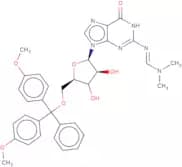
CAS:<p>5'-O-DMT-N2-DMF-guanosine is a novel nucleoside that has been modified with an acetyl group on the 5'-hydroxyl group. This nucleoside has antiviral, anticancer and deoxyribonucleoside properties. It also activates diphosphate synthesis and inhibits protein synthesis. The drug is synthesized in high purity and quality, making it an excellent activator for phosphoramidites.</p>Formula:C34H36N6O7Purity:(%) Min. 85%Molecular weight:640.69 g/mol5'-(4-Fluorosulfonylbenzoyl)adenosine HCI
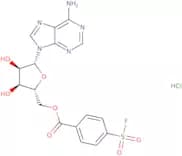
CAS:<p>ATP analog; covalent inhibitor of anthrax edema factor</p>Formula:C17H17ClFN5O7SPurity:Min. 95%Color and Shape:White Off-White PowderMolecular weight:489.86 g/mol5'-O-(4,4'-Dimethoxytrityl)adenosine
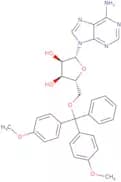
CAS:<p>5'-O-(4,4'-Dimethoxytrityl)adenosine is a phosphoramidite that can be used as an activator for the synthesis of DNA. It is also used in the preparation of modified nucleosides and has anticancer activity. 5'-O-(4,4'-Dimethoxytrityl)adenosine is a modified ribonucleoside with high quality and high purity. This product has been shown to have antiviral activity against HIV-1.</p>Formula:C31H31N5O6Purity:Min. 95 Area-%Color and Shape:White Off-White PowderMolecular weight:569.61 g/mol5'-O-Acetyl-2',3'-dideoxy-2',3'-didehydro-5-fluorouridine
CAS:<p>5'-O-Acetyl-2',3'-dideoxy-2',3'-didehydro-5-fluorouridine is a nucleoside analog. It is synthesized by substituting the hydroxyl group of uridine with a fluorine atom and the 2' position of ribose with a 5'-O-acetyl group. This modification prevents the incorporation of this nucleoside into DNA or RNA, making it an effective antiviral and anticancer agent. 5'-O-Acetyl-2',3'-dideoxy-2',3'-didehydro-5-fluorouridine has been shown to be highly active against tumor cells but not normal cells in vitro.</p>Formula:C11H11N2O5Purity:Min. 95%Molecular weight:251.22 g/mol