Nucleosides
Nucleosides are fundamental building blocks of nucleic acids, composed of a nitrogenous base attached to a sugar molecule. In this section, you can find a wide variety of nucleosides essential for research in molecular biology, biochemistry, and pharmacology. These compounds play crucial roles in the synthesis of DNA and RNA, and are also vital in various metabolic processes. Nucleosides are used in studying genetic material, developing antiviral and anticancer therapies, and understanding cellular mechanisms. At CymitQuimica, we provide high-quality nucleosides to support your research and development needs, ensuring purity and reliability for your experimental applications.
Found 3567 products of "Nucleosides"
Sort by
Purity (%)
0
100
|
0
|
50
|
90
|
95
|
100
4-Thiouridine
CAS:<p>4-Thiouridine (4-SU) is a photoactivatable ribonucleoside analogue that is widely used for RNA analysis, including short-range RNA-RNA crosslinking and nascent RNA labelling. 4-SU is typically used to modify RNA oligonucleotides, or in structure studies of RNA-protein complexes. The crosslinking thiol moiety is attached directly to the nucleotide base, thus 4-SU differs from the nucleoside uridine only by a single sulfur substitution. This means it can be incorporated into an RNA chain with minimal structural perturbation and with similar base-pairing properties, reducing the likelihood that substitution will significantly impair RNA interactions or activities.</p>Formula:C9H12N2O5SPurity:Min. 98 Area-%Color and Shape:PowderMolecular weight:260.27 g/mol2’-Deoxy-N1-methylguanosine
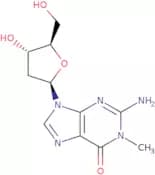
CAS:Controlled Product<p>2’-Deoxy-N1-methylguanosine is a modified purine nucleoside composed of a N¹-methylguanine, a guanine base where a methyl group is attached to the nitrogen at position 1 (N¹). This methylation blocks normal Watson-Crick base pairing, especially with cytosine, and can affect RNA structure and function. It also contains a 2′-Deoxyribose and has possible research applications</p>Formula:C11H15N5O4Purity:Min. 97 Area-%Color and Shape:PowderMolecular weight:281.27 g/mol2'-C-Methyluridine
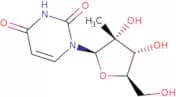
CAS:<p>2'-C-Methyluridine is a synthetic nucleoside analog derived from uridine, modified with a methyl group at the 2'-carbon of the ribose sugar. This small chemical change has important implications for RNA biology, antiviral drug development, and biochemical research, especially in targeting RNA viruses.</p>Formula:C10H14N2O6Purity:Min. 95%Color and Shape:PowderMolecular weight:258.23 g/molS-Adenosyl-L-methionine p-toluenesulfonate
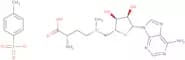
CAS:<p>Methyl donor and a cofactor for enzyme-catalyzed methylations</p>Formula:C15H23N6O5S•C7H7O3SPurity:Min. 95%Color and Shape:White PowderMolecular weight:570.64 g/molN6-Isobutyryl-2'-O-methyladenosine
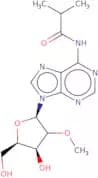
<p>N6-Isobutyryl-2'-O-methyladenosine is a nucleoside that has antiviral, anticancer, and anti-inflammatory properties. It is an analog of adenosine that is used in the synthesis of DNA and RNA. It is modified by the incorporation of an iso-butyl group at the 2' position on the ribose ring. N6-Isobutyryl-2'-O-methyladenosine was first synthesized in 1962 and has been extensively studied due to its novel properties. The phosphoramidites are activated with tetrazole or triazole, which are both strong activators. This nucleoside can be synthesized in high purity (>98%) through a modification of the conventional phosphorylation process.</p>Formula:C15H21N5O5Purity:Min. 95%Molecular weight:351.36 g/mol5-(2',3',5'-Tri-O-benzyl-b-D-ribofuranosyl)-3-methyl-2-benzyloxypyridine
CAS:<p>5-(2',3',5'-Tri-O-benzyl-b-D-ribofuranosyl)-3-methyl-2-benzyloxypyridine is a nucleoside analog that inhibits the growth of cancer cells. This compound has been shown to inhibit the synthesis of deoxyribonucleosides and ribonucleosides, and also inhibit the growth of certain viruses. 5-(2',3',5'-Tri-O-benzyl-b-D-ribofuranosyl)-3 methyl -2 benzyloxypyridine can be used as a phosphoramidite or activator in the synthesis of DNA or RNA.</p>Purity:Min. 95%2-Amino-2'-deoxyadenosine
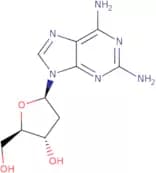
CAS:<p>2-Amino-2'-deoxyadenosine is a modified nucleoside, closely related to adenosine in which the 2'-hydroxyl group is replaced by an amino group. This compound has potential research applications</p>Formula:C10H14N6O3Purity:Min. 98 Area-%Color and Shape:White PowderMolecular weight:266.26 g/molAntisense oligonucleotide
<p>Antisense oligonucleotides are short, single-stranded nucleic acids that can be complementary to a region of messenger RNA and inhibit the translation of that mRNA into protein. Antisense oligonucleotides bind to the mRNA in a sequence-specific manner and prevent its translation into protein. This binding can also interfere with other cellular processes such as DNA replication and repair. Antisense oligonucleotide therapy has been shown to be effective in treating multidrug-resistant cancers. Treatment with antisense oligonucleotide is based on an algorithm that determines the most appropriate treatment for each individual patient.</p>Purity:Min. 95%(R)-5',P'-Ester with thiodiphosphoric acid ((HO)2P(O)OP(S)(OH)2) adenosine
CAS:<p>(R)-5',P'-Ester with thiodiphosphoric acid ((HO)2P(O)OP(S)(OH)2) adenosine is a nucleoside monophosphate. It has been shown to be an activator of the enzyme adenylate cyclase, which converts ATP into cyclic AMP, a second messenger in cell signaling. (R)-5',P'-Ester with thiodiphosphoric acid ((HO)2P(O)OP(S)(OH)2) adenosine does not have anticancer properties and does not inhibit the production of ribonucleotides or deoxyribonucleotides. This compound is synthesized using novel methods and is of high purity and quality.</p>Formula:C10H12N5Na3O9P2SPurity:Min. 95%Molecular weight:509.21 g/mol2'-Deoxyguanosine monohydrate
CAS:<p>2'-Deoxyguanosine monohydrate is a novel, modified deoxyribonucleoside that can be used for the treatment of cancer. It is synthesized from 2'-deoxyguanosine 5'-monophosphate and phosphoramidite by reacting with ammonia in DMF at room temperature.<br>The chemical structure of 2-deoxyguanosine monohydrate is shown below:</p>Formula:C10H15N5O5Purity:Min. 99.0 Area-%Molecular weight:285.26 g/mol3'-O-Amino-2'-deoxyadenosine
CAS:<p>3'-O-Amino-2'-deoxyadenosine is a novel nucleoside analogue with antiviral and anticancer properties. It was shown to be an activator of the deoxyribonucleotide synthesis process, leading to inhibition of DNA replication in vitro. This compound is synthesized by the reaction of phosphoramidites with 3'-O-amino-2'-deoxyadenosine.</p>Formula:C10H14N6O3Purity:Min. 95%Molecular weight:266.26 g/mol1-(4’-Azido-2’-deoxy-2’-fluoro-b-D-arabinofuranosyl)N4-(n-octadecanoyl)-cytosine
<p>1-(4’-Azido-2’-deoxy-2’-fluoro-b-D-arabinofuranosyl)N4-(n-octadecanoyl)-cytosine is an antiviral nucleoside that is synthesized from a 4′ azidodecanoyl derivative of cytosine. It has been shown to be effective against herpes simplex virus type 1 and 2 (HSV1, HSV2), varicella zoster virus (VZV), and Epstein Barr Virus (EBV). The antiviral mechanism of action for this compound is not known.</p>Purity:Min. 95%2’-Deoxy-2’-fluoro-N3-(n-dodecyl)uridine
<p>2’-Deoxy-2’-fluoro-N3-(n-dodecyl)uridine (2DFO) is a novel nucleoside analog that is phosphorylated to 2DFP, which is an antiviral drug that has been shown to inhibit the replication of HIV. 2DFO inhibits the activity of DNA polymerase, RNA polymerase, and reverse transcriptase, preventing the synthesis of viral DNA and RNA. This drug also inhibits the activity of human topoisomerase II alpha and beta, which are enzymes involved in replication and transcription. 2DFO binds to purine nucleosides by competitive inhibition at the enzyme active site, preventing the formation of ribonucleotides from deoxyribonucleosides.</p>Purity:Min. 95%Inosine-3',5'-cyclic-monophosphate triethylammonium - 10 mM aqueous solution
<p>Inosine-3',5'-cyclic-monophosphate triethylammonium is a synthetic nucleoside that functions as an activator of the deoxyribonucleotide synthesis. It has antiviral and anticancer properties, and has been shown to have anti-inflammatory activities. Inosine-3',5'-cyclic-monophosphate triethylammonium has been shown to inhibit the growth of cells in culture and induce apoptosis. This is due to its ability to inhibit DNA synthesis by inhibiting the enzyme ribonucleotide reductase.</p>Formula:C10H11N4O7P·NC6H15Purity:Min. 95%Molecular weight:431.38 g/mol7-Deaza-2'-deoxyguanosine
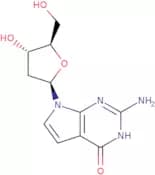
CAS:<p>7-Deaza-2'-deoxyguanosine is an analog of guanosine that has been shown to inhibit the activity of telomerase. This enzyme synthesizes a sequence of DNA called a telomere, which protects the ends of chromosomes from deterioration and prevents chromosomal end-to-end fusion. 7-Deaza-2'-deoxyguanosine has an inhibitory effect on the polymerase chain reaction (PCR) in mammalian cells and inhibits the transcription-polymerase chain reaction (PCR) in vitro. It has also been shown to be potent against cancer cells. 7-Deaza-2'-deoxyguanosine is synthesized by solid phase synthesis, which is a chemical process that involves attaching one molecule to another molecule with similar structure, using organic solvents as intermediates.</p>Formula:C11H14N4O4Purity:Min. 95%Color and Shape:White PowderMolecular weight:266.26 g/mol7-Deazaguanosine
CAS:<p>7-Deazaguanosine is a low energy analog of guanosine that has been shown to be activated by trifluoroacetic acid, which is a chemical reagent that can be used for the activation of nucleosides. 7-Deazaguanosine is used in the treatment of human serum and urine viruses such as hepatitis B virus, herpes simplex virus, and cytomegalovirus. The compound has also been shown to have receptor agonism activity on toll-like receptors. 7-Deazaguanosine has been shown to have antiviral effects against HIV and influenza A (H1N1). 7-Deazaguanosine binds at the viral receptor site and blocks the entry process into cells. This drug also stimulates macrophages to produce cytokines, which are proteins that regulate immune responses.</p>Formula:C11H14N4O5Purity:Min. 95%Color and Shape:Off-White PowderMolecular weight:282.26 g/mol6-Amino-9-(2',3'-dideoxy-2'-fluoro-β-D-arabinofuranosyl)purine
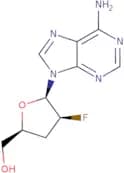
CAS:<p>6-Amino-9-(2',3'-dideoxy-2'-fluoro-β-D-arabinofuranosyl)purine is a nucleoside analog that is used to treat HIV. It is a prodrug that undergoes phosphorylation by host cell kinases to form its active form, 2'-deoxycytidine monophosphate (2'DCPM). This drug has been shown to inhibit the replication of HIV in vitro and in vivo. 6-Amino-9-(2',3'-dideoxy-2'-fluoro-β-D-arabinofuranosyl)purine has antiviral potency against both group M and N HIV isolates. It also enhances polymerase chain reaction amplification of HIV DNA and can be used in tissue culture experiments to study the effects of drugs on the virus. Clinical trials have shown that 6-amino 9-(2',3'-dideoxy-2</p>Formula:C10H12FN5O2Purity:Min. 95%Color and Shape:White PowderMolecular weight:253.24 g/mol5’-O-DMT-2’-O-methoxyethyluridine
<p>5’-O-DMT-2’-O-methoxyethyluridine is a novel phosphoramidite monophosphate, which can be used for the synthesis of DNA and RNA. This monophosphate is synthesized by reacting 5’-O-dimethoxytritylthymidine with 2’-O-methoxyethylchloride to produce a modified nucleoside. The modification of this nucleoside leads to improved stability against degradation and increased resistance to nucleases. It has been shown that 5’-O-DMT-2’-O-methoxyethyluridine has antiviral activity against Herpes Simplex Virus type 1 (HSV1) and other viruses in vitro.</p>Purity:Min. 95%2’,3’-Bis-O-tert-butyldimethylsilyluridine
CAS:<p>2’,3’-Bis-O-tert-butyldimethylsilyluridine is a modified nucleoside that is used as an antiviral and anticancer agent. It inhibits the RNA polymerase of human immunodeficiency virus (HIV) and prevents the synthesis of viral DNA. It also inhibits tumor growth by inhibiting the enzyme ribonucleotide reductase. 2’,3’-Bis-O-tert-butyldimethylsilyluridine is synthesized by reacting 2′,3′-dideoxyribonucleosides with tertiary butyl dimethylchlorosilane in aqueous media.</p>Purity:Min. 95%5'-O-DMT-N2-isobutyryl-2'-O-(2-methoxyethyl)guanosine
CAS:<p>5'-O-DMT-N2-isobutyryl-2'-O-(2-methoxyethyl)guanosine is an antiviral monophosphate nucleoside. It has been shown to be a novel, high purity, and CAS No. 251647-50-4. It is a modified nucleic acid analogue that acts as an activator of ribonucleotide reductase and DNA polymerase. The anticancer activity of this product may be due to its ability to inhibit the synthesis of diphosphate nucleotides.</p>Formula:C38H43N5O9Purity:Min. 98 Area-%Color and Shape:White PowderMolecular weight:713.78 g/mol