Nucleosides
Nucleosides are fundamental building blocks of nucleic acids, composed of a nitrogenous base attached to a sugar molecule. In this section, you can find a wide variety of nucleosides essential for research in molecular biology, biochemistry, and pharmacology. These compounds play crucial roles in the synthesis of DNA and RNA, and are also vital in various metabolic processes. Nucleosides are used in studying genetic material, developing antiviral and anticancer therapies, and understanding cellular mechanisms. At CymitQuimica, we provide high-quality nucleosides to support your research and development needs, ensuring purity and reliability for your experimental applications.
Found 3567 products of "Nucleosides"
Sort by
Purity (%)
0
100
|
0
|
50
|
90
|
95
|
100
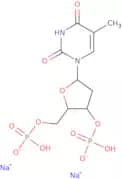
Thymidine-3',5'-diphosphate disodium salt
CAS:<p>Thymidine-3',5'-diphosphate disodium salt is an antiviral and anticancer drug. It is a modified nucleoside which is synthesized from thymidine-3',5'-diphosphate and sodium bicarbonate (NaHCO3). This drug inhibits the synthesis of DNA and RNA, thereby inhibiting viral replication. Thymidine-3',5'-diphosphate disodium salt also has an antitumor effect by preventing the production of DNA in tumor cells.</p>Formula:C10H14N2Na2O11P2Purity:Min. 95%Color and Shape:PowderMolecular weight:446.15 g/molN6-Benzyladenosine 5'-diphosphate sodium salt - 10 mM aqueous solution
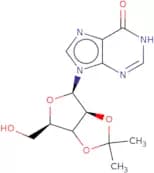
CAS:<p>N6-Benzyladenosine 5'-diphosphate sodium salt is a modified nucleoside that has a high purity, which is suitable for synthesis of DNA or RNA. It can be used in the modification of deoxyribonucleosides, ribonucleosides, and phosphoramidites. N6-Benzyladenosine 5'-diphosphate sodium salt has been shown to have anticancer effects and antiviral effects. This drug also has novel properties such as an ability to inhibit the proliferation of cancer cells.</p>Formula:C17H21N5O10P2Purity:Min. 95%Color and Shape:Colorless PowderMolecular weight:517.32 g/mol2',3'-O-Isopropylideneinosine
CAS:<p>2',3'-O-Isopropylideneinosineis a nucleoside for use in research applications</p>Formula:C13H16N4O5Purity:Min. 95%Color and Shape:PowderMolecular weight:308.3 g/mol5’-O-DMT-2’-O,4’-C-methylene-5-methyluridine
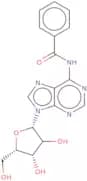
CAS:<p>5’-O-DMT-2’-O,4’-C-methylene-5-methyluridine is a nucleoside that is used as an antiviral and anticancer agent. It is a novel compound that has not been previously described in the literature. 5’-O-DMT-2’-O,4’-C methylene 5 methyluridine has been shown to inhibit the replication of the herpes virus in vitro (in cell culture) and in vivo (in animals). This compound also inhibits the proliferation of cancer cells by inhibiting DNA synthesis. It may be used as an anticancer agent or an antiviral agent.</p>Purity:Min. 95%N6-Benzoyl-L-adenosine
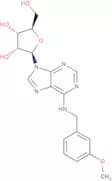
CAS:<p>N6-Benzoyl-L-adenosine is a novel nucleoside that has been shown to have antiviral and anticancer activity. It is synthesized by the reaction of L-adenosine with benzoyl chloride in the presence of a base. The drug inhibits the growth of cancer cells by interfering with DNA synthesis. N6-Benzoyl-L-adenosine also inhibits viral replication, especially HIV, herpes simplex virus type 1, and human cytomegalovirus (HCMV). It can be used as an antiviral agent in combination with other drugs or as an anticancer agent alone. N6 Benzoyl L adenosine is a nucleoside that has been shown to have antiviral and anticancer activity. It is synthesized by the reaction of L adenosine with benzoyl chloride in the presence of a base. The drug inhibits the growth of cancer cells by interfering with DNA synthesis. N6</p>Formula:C17H17N5O5Purity:Min. 95%Color and Shape:White to off-white solid.Molecular weight:371.35 g/molm-Methoxytopolin riboside
CAS:<p>m-Methoxytopolin riboside is a nucleoside that is a phosphoramidite derivative of the natural nucleoside, topolin riboside. This compound has antiviral and anticancer activities. It inhibits viral DNA synthesis and also induces apoptosis in cancer cells. m-Methoxytopolin riboside is modified with a methoxy group at the 3' position of the sugar moiety. This modification prevents incorporation into DNA and RNA, thereby inhibiting viral replication and inducing apoptosis in cancer cells.</p>Formula:C18H21N5O5Purity:Min. 95%Color and Shape:PowderMolecular weight:387.39 g/molN6-(6-Aminohexyl)-2'-deoxyadenosine
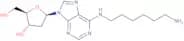
CAS:<p>N6-(6-Aminohexyl)-2'-deoxyadenosine is a novel nucleoside that is structurally related to the natural nucleosides, dATP and dGTP. It has been shown to be an activator of ribonucleosides and phosphoramidites, which are used in the synthesis of DNA and RNA. N6-(6-Aminohexyl)-2'-deoxyadenosine has also been shown to inhibit cancer cells as well as antiviral activity against HIV-1.</p>Formula:C16H26N6O3Purity:Min. 95%Color and Shape:Slightly Yellow PowderMolecular weight:350.43 g/mol2'-Deoxy-N2-methylguanosine
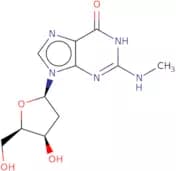
CAS:<p>2'-Deoxy-N2-methylguanosine is a nucleoside with anticancer properties. It is a phosphoramidite, which is an analog of the natural nucleotide guanosine, where the 2'-hydroxyl group has been replaced by a methylene group. This compound is used in DNA synthesis and RNA synthesis. It can be used as a monophosphate or diphosphate. It also has antiviral and anti-inflammatory activities, as well as N2-methylamino moiety that can be used for the treatment of cancer and inflammatory diseases such as arthritis.</p>Formula:C11H15N5O4Purity:Min. 95%Color and Shape:White PowderMolecular weight:281.27 g/mol6-Methyluridine
CAS:<p>Methyluridine is a derivative of uridine that is used in the synthesis of pyrimidine nucleotides. This drug is also an inhibitor of orotidine 5′-monophosphate decarboxylase, which converts orotic acid to uracil. The conformational properties of methyluridine have been studied and found to be similar to those of other purine derivatives, such as adenine and guanine. In addition, methyluridine has been shown to inhibit the growth of typhimurium and increase the production of uracil in human lymphocytes. Methyluridine is metabolized by hydroxylation in liver microsomes, yielding 6-carboxylic acid.</p>Formula:C10H14N2O6Purity:Min. 95%Color and Shape:PowderMolecular weight:258.23 g/mol5-Methoxyuridine-5'-triphosphate sodium, 100mM aqueous solution
CAS:<p>5-Methoxyuridine-5'-triphosphate is a monophosphate nucleoside that serves as a precursor for the synthesis of 5-methoxyuridine (5MU) and other nucleosides. It has antiviral effects, and is used in the treatment of herpes zoster infection. 5-Methoxyuridine-5'-triphosphate is an analog of uridine and deoxyribonucleosides with antiviral activity, which can be used to treat herpes zoster infection. This drug also has anticancer properties, which may be due to its ability to inhibit DNA synthesis by inhibiting ribonucleotide reductase and DNA polymerase, leading to cell death.</p>Formula:C10H17N2O16P3•NaxPurity:Min. 95%Color and Shape:Clear LiquidMolecular weight:514.17 g/mol2'-Deoxyuridine-5'-monophosphate disodium salt
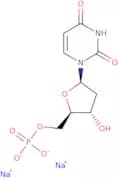
CAS:<p>2'-Deoxyuridine-5'-monophosphate disodium salt (2DUMP) is a nucleoside analog that inhibits the synthesis of DNA and RNA by inhibiting the enzyme thymidylate synthase. 2DUMP is a covalent inhibitor of thymidylate synthase, which prevents the formation of dTMP from deoxyuridine 5'-triphosphate. This compound has been shown to be effective in treating squamous cell cancer and hyperproliferative diseases such as chronic myelogenous leukemia. 2DUMP is also used as an antiviral agent against HIV, herpes simplex virus, and varicella zoster virus. It has been shown to bind to benzalkonium chloride (BAK) in biological samples such as serum or plasma.<br>2DUMP binds to BAK through a covalent linkage between the 3' hydroxyl group on BAK and the phosphate group on 2DUMP</p>Formula:C9H11N2O8PNa2Purity:Min. 95%Color and Shape:PowderMolecular weight:352.15 g/mol3'-Deoxyadenosine-5'-triphosphate sodium salt - 10mM aqueous solution
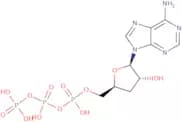
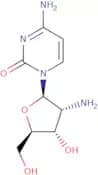
CAS:<p>3'-Deoxyadenosine-5'-triphosphate sodium salt is a nucleotide that has been shown to be effective in chemotherapy. It is a substrate for the synthesis of DNA, RNA, and ATP. 3'-Deoxyadenosine-5'-triphosphate sodium salt is also a building block for DNA polymerase, which is an enzyme that synthesizes DNA from a template. It has been shown to have anticancer activity in drug-resistant cells and can be used as an alternative to purine analogs such as 6-mercaptopurine or cladribine. 3'-Deoxyadenosine-5'-triphosphate sodium salt has been shown to inhibit the production of nucleotides by blocking their conversion into triphosphates, which are necessary for DNA replication and repair. This inhibition leads to apoptosis in cells with high levels of nucleotide turnover such as cardiac and myeloid cells. The drug interactions may depend on the</p>Formula:C10H16N5O12P3Purity:Min. 95%Color and Shape:Colorless PowderMolecular weight:491.18 g/mol2'-Amino-2'-deoxycytidine
CAS:<p>2'-Amino-2'-deoxycytidine is a modified nucleoside, based on cytidine. In this compound 2'-hydroxyl group has been replaced by an amino group, which can change hydrogen bonding patterns potentially affecting how it interacts with biomolecules.</p>Formula:C9H14N4O4Purity:Min. 95%Color and Shape:PowderMolecular weight:242.24 g/mol8-Nitroguanosine
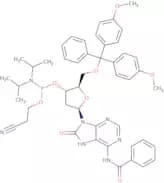
CAS:<p>8-Nitroguanosine is a nucleotide analogue that inhibits the activity of cyclic GMP in cells. It has been found to inhibit the growth of bacteria and cancer cells, as well as to stimulate the production of reactive oxygen species in brain cells. 8-Nitroguanosine has also been shown to inhibit the activity of cyclase enzymes in liver cells, which may be useful for treating liver disease. 8-Nitroguanosine is used as a chemical base for monoclonal antibodies that are used to study brain functions and pathogenic mechanisms.</p>Formula:C10H12N6O7Purity:Min. 95%Molecular weight:328.24 g/molN6-Benzoyl-2'-deoxy-5'-O-DMT-8-oxoadenosine 3'-CE phosphoramidite
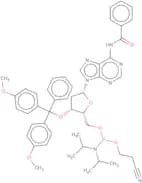
CAS:<p>N6-Benzoyl-2'-deoxy-5'-O-DMT-8-oxoadenosine 3'-CE phosphoramidite is an 8-oxo modified amidite</p>Formula:C47H52N7O8PPurity:Min. 95%Molecular weight:873.95 g/molN6-Benzoyl-2'-deoxy-3'-O-DMT-adenosine 5'-CE phosphoramidite
CAS:<p>A 5'-3’ “reverse” (or “inverse”) amidites</p>Formula:C47H52N7O7PPurity:Min. 95%Molecular weight:857.93 g/mol2-Phenylaminoadenosine
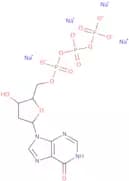
CAS:<p>2-Phenylaminoadenosine (2-PA) is a potent and selective inhibitor of the P2Y receptor. 2-PA has been shown to reduce myocardial infarct size in vivo in mice, which may be due to its ability to inhibit the release of dopamine from the brain. In addition, 2-PA binds to LPS receptors on endothelial cells, reducing the production of proinflammatory cytokines and preventing platelet aggregation. 2-PA also inhibits the activation of toll-like receptor 4 (TLR4) in human monocytes, leading to reduced expression of proinflammatory cytokines and increased expression of anti-inflammatory cytokines.<br>2-PA is an agonist that binds with high affinity to P2Y receptors on erythrocytes. This binding results in decreased adenosine triphosphate (ATP) production by adenosine deaminase, which leads to decreased intracellular calcium levels and inhibition of neutroph</p>Formula:C16H18N6O4Purity:Min. 95%Color and Shape:PowderMolecular weight:358.35 g/mol2'-Deoxyinosine-5'-triphosphate sodium,100mM aqueous solution
CAS:<p>2'-Deoxyinosine-5'-triphosphate sodium (2'-dITP) is a modified nucleotide that has antiviral and anticancer properties. It has been shown to be an activator for ribonucleosides, deoxyribonucleosides, and DNA. 2'-DITP has also been shown to inhibit the growth of human breast cancer cells in vitro.</p>Formula:C10H11N4Na4O13P3Purity:Min. 95%Color and Shape:Clear LiquidMolecular weight:580.09 g/molN6-Dibenzoyl-3-deaza-2'-deoxy-5'-O-DMT-3-methyladenosine 3'-CE phosphoramidite
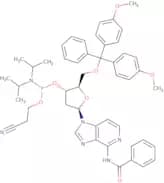
CAS:<p>N6-Benzoyl-3-deaza-2'-deoxy-5'-O-DMT-3-methyladenosine 3' is a nucleoside that has been modified to be resistant to the enzymatic degradation by ribonucleases. The phosphoramidite is used in the synthesis of DNA and can be used as an antiviral or anticancer drug. It also acts as a competitive inhibitor of adenosine deaminase, which is an enzyme involved in the metabolism of purines. N6-Benzoyl-3-deaza-2'-deoxy-5'-O-DMT-3 methyladenosine 3' can inhibit viral replication by inhibiting RNA polymerase activity, and it has been shown to have antifungal properties.</p>Formula:C56H59N6O8PPurity:Min. 95%Molecular weight:870.99 g/molSpacer-c3 cep
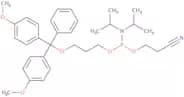
CAS:<p>Spacer-C3 Cep is a novel modified nucleoside phosphoramidite. It has been chemically modified with a spacer arm and 3-Cep (1,2-diaminoethane). Spacer-C3 Cep is an activator for DNA polymerases, which are enzymes that synthesize DNA from deoxyribonucleosides. The modified nucleoside phosphoramidite has antiviral and anticancer activities. It can be used in the synthesis of oligodeoxyribonucleotides for gene therapy or as a monophosphate for the preparation of DNA probes. Spacer-C3 Cep can also be used to synthesize ribonucleotide analogs that inhibit viral replication by inhibiting RNA synthesis.</p>Formula:C33H43N2O5PPurity:Min. 95%Molecular weight:578.7 g/mol