Polysaccharides
Found 498 products for "Polysaccharides".
- Lower prices
- Higher prices
- Lower purities
- Higher purities
- Faster estimated delivery
Apiogalacturonan polysaccharides sodium
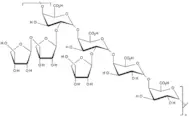
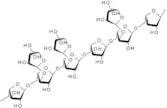
CAS:An apiose-rich pectic polysaccharide zosterin is found in the sea grass Zostera marina and is typical of similar structures occurring in higher plants. The structure consists of an α-1,4-D-galactopyranosyluronan backbone substituted by 1,2-linked apiofuranose oligosaccharides and single apiose residues. The average molecular mass of the polysaccharide has been shown to be about 4100 Da with a low polydispersity.Purity:Min. 60%Color and Shape:PowderKephir gum
CAS:‘Water kefir’ is a home-made beverage, which was thought to contain significant amounts of bacterial exopolysaccharides. It has now been reported that the exopolysaccharide fraction of this material contains dextrans with similar structures, having a number of (1,3) linkages, branched at positions O3 and position O2 and with a wide range of molecular weights. In addition, it was shown that a small amount of levan is also present.Purity:Min. 95%Color and Shape:PowderFucoidan, macrocystis pyrifera
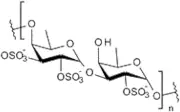
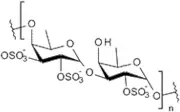
CAS:A fucan sulphate found in brown marine algae (Phaeophyta-typically Fucus vesiculotus, Ascophyllum nodosum, Alaria and Macrocystis pyrifyra (illustrated) and has been shown to have anticoagulant activity. The main constituents are α-1,4 and α-1,2 linked L-fucose sulphates, although galactose also occurs and there are many variations of the basic structure found in different species of Phaeophyta.
The fucose content of this fucan is approx. 31% and it also contains galactose (approx. 2.2%), uronic acid (approx. 12.4%) and sulfate (approx. 32.5%).
The image was kindly provided by Prof Mike Guiry from Cork who runs ‘The Seaweed Site’.Purity:Min. 95%Color and Shape:White PowderPectic acid
CAS:Pectic acid is non water-soluble β (1,4)-linked polygalacturonic acid. In its gel form, is water-soluble, transparent and gelatinous, and exists in ripe fruit and some vegetables. It is a product of pectin degradation in plants, and is produced via the interaction between pectinase and pectin (the latter being common in the wine-making industry).Purity:Min. 95%Color and Shape:PowderDextran sulfate sodium, MW 20,000
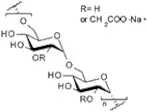
CAS:Sodium carboxymethyl dextran (CM-dextran) is a white, odourless and tasteless powder, which is freely soluble in water or electrolyte solutions. The product has a pronounced polyanionic character, due to the high degree of carboxyl substitution. Applications that have been described for CM-dextran include carriers of paramagnetic contrast agents, preparation of conjugates of pharmacologically active compounds and CM-dextrans in biosensors. A number of other uses in cosmetics, agriculture, foods, paints and textiles have been the subject of patent applications.Color and Shape:PowderArabinan
CAS:Sugar beet arabinan consists of a 1,5 α-linked arabinose backbone to which 1,3 α-linked (and possibly some 1,2 α-linked) L-arabinofuranosyl residues are attached. Approximately 60% of the main-chain arabinofuranosyl residues are substituted by single 1,3-linked arabinofuranosyl groups. The reducing terminal arabinosyl residue is attached through rhamnose to fragments of the rhamnogalacturonan backbone of the native pectin molecule.
Color and Shape:White PowderFucoidan, fucus vesiculosus
CAS:A fucan sulphate found in brown marine algae (Phaeophyta-typically fucus vesiculosus (illustrated), Ascophyllum nodosum, Alaria and Macrocystis pyrifyra and has been shown to have anticoagulant activity. The main constituents are α-1,4 and α-1,2 linked L-fucose sulphates although galactose also occurs and there are many variations of the basic structure found in different species of Phaeophyta. The image was kindly provided by Prof Mike Guiry from Cork who runs ‘The Seaweed Site’.Purity:Min. 95%Color and Shape:White PowderHyaluronate fluorescein - MW - 800kDa
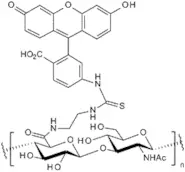
Hyaluronic acid, a polysaccharide with alternating β (1,3) glucuronide and β (1,4) glucosamine residues labelled with 5-amino-fluorescein gives a yellow fibrous product, which is soluble in both water and electrolytes. Fluorescein-labelled hyaluronic acid can be used as a probe to follow the fate of hyaluronan in vitro and greatly enhances the visualisation of the permeation of substrates through skin and other tissues. Other applications of fluorescein-labelled hyaluronic acid have been reported in cancer research.Purity:(%) Min. 95%Color and Shape:Yellow Orange PowderDextran sulfate potassium salt
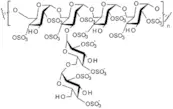
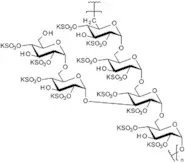
CAS:Dextran sulphate is a dextran derivative whose ulcer (colitis) -causing properties were first reported in hamsters and extrapolated a few years later to mice and rats. The exact mechanisms through which dextran sulphate induces intestinal inflammation are unclear but may be the result of direct damage of the monolayer of epithelial cells in the colon, leading to the crossing of intestinal contents (for e.g. commensal bacteria and their products) into underlying tissue and therefore induction of inflammation. The dextran sulphate sodium-induced ulceration model in laboratory animals has some advantages when compared to other animal models of colitis due to its simplicity and similarities to human inflammatory bowel disease.
MW is in the range of 40,000DaPurity:Min. 95%Color and Shape:White PowderDe-N-sulfated heparin sodium
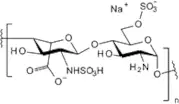
CAS:Porcine mucosal heparin derivative; no anti-coagulant activityColor and Shape:PowderCarboxymethyl-dextran sodium salt - Average MW 10,000 - 20,000Da
CAS:Sodium carboxymethyl dextran is a white, odourless and tasteless powder, which is freely soluble in water or electrolyte solutions. Applications that have been described for carboxymethyl dextran include carriers of paramagnetic contrast agents, preparation of conjugates of pharmacologically active compounds and carboxymethyl dextrans in biosensors. A number of other uses in cosmetics, agriculture, foods, paints and textiles have been the subject of patent applications.Color and Shape:White PowderDermatan sulphate sodium
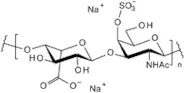
CAS:Dermatan sulphate is a glycosaminoglycan found in skin, blood vessels, heart valves, tendons, aorta, spleen and brain and is usually isolated from pig skin or beef lung tissue. The disaccharide repeat unit is composed of L-iduronic acid and N-acetyl-galactosamine-4-sulphate linked β-(1,3) and β-(1,4). There are also small amounts of D-glucuronic acid.
Color and Shape:PowderMolecular weight:1,526.03 g/molGlycogen - from rabbit liver
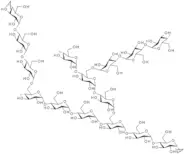
CAS:Glycogen is a highly branched polysaccharide of glucose that serves as a form of energy storage in animals and fungi. It is the main storage form of glucose in the body. In humans, glycogen is made and stored primarily in liver and muscle cells and functions as the second most important energy storage molecule to fat, which is held in adipose tissue. Glycogen is analogous to starch and has a structure similar to amylopectin, but is more extensively branched and compact than starch. It occurs as granules in the cytosol/cytoplasm in many cell types, and plays an important role in the glucose cycle.Formula:C24H42O21Purity:Min. 85%Color and Shape:White PowderMolecular weight:666.6 g/molRhodamine B isothiocyanate-dextran - Average MW 70,000
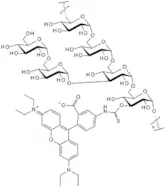
The fluorescence intensity of these Rhodamine B isothiocyanate-dextrans varies much less than with FITC-dextrans.Color and Shape:PowderMolecular weight:7,000 g/molChitin
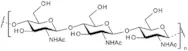
CAS:Chitin forms the tough fibrous exoskeletons of insects, crustaceans and other arthropods, and, in addition to its presence in some fungi, it occurs in at least one alga. The structure of chitin is similar to that of cellulose but with glucose replaced with N-acetyl-D-glucosaminyl units linked β-D-(1,4) in a linear chain. Chitin is normally produced from the shells of lobster, crab or shrimp.
Formula:(C8H13NO5)nColor and Shape:PowderMaltodextrin oligosaccharides - DP10 to DP40
Produced from starch; white hygroscopic spray-dried powder; easily digestibleColor and Shape:Powderb-D-glucan-from oat
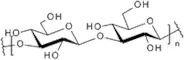
CAS:Oat β-glucans are water-soluble β-glucans derived from the endosperm of oat kernels, which contain β-1,3 and β-1,4 linkages. They are known for cholesterol lowering and hypoglycemic properties, as well as their use in various cosmetic applications. Recent research has shown their potential application in immunomodulation and wound healing.
Purity:Min. 90%Color and Shape:White PowderDextran 3 - MW 2500 - 4000
CAS:Dextran is α-(1,6)-linked α-D-glucan produced by fermentation of Leuconostoc mesenteroides via the action of the enzyme dextransucrase on sucrose. The main use for native dextran is as a blood plasma extender in blood transfusions. A complex of iron with dextran, known as iron dextran, is used as a source of iron to baby piglets which are often anaemic at birth.
Color and Shape:White Off-White PowderMannan (ex Ivory nut)
CAS:Ivory nut mannan occurs in members of the custard apple, ebony and palm families - Ivory nut. The polysaccharide contains more than 95% mannose units linked β-(1,4) with a few a-D-galactopyranosyl units linked (1,6). It is widely used in foods, pharmaceuticals paints and explosives.Purity:Min. 95%Color and Shape:White Powderb-D-Glucan-from piptoporus betulinus
CAS:This β-glucan contain D-glucose residues with β-1,3 links and b-1-6 side branches. The frequency, location, and length of the sidechains may play a role in immunomodulation. Differences in molecular weight, shape, and structure of β-glucans can also affect the differences in biological activity. The water-soluble β-D-glucan is extracted from fruiting bodies of Piptoporus betulinus by hot aqueous extraction, followed by freeze-thawing and dialysis. Methylation analysis and NMR spectroscopy, indicated the presence of a β-D-glucan with a main chain (1,3)-linked, substituted at O-6 by single glucose residues. The image was kindly provided by Dr. Chris Lawson.Purity:Min. 95%Color and Shape:White Powder