Polysaccharides
Found 498 products for "Polysaccharides".
- Lower prices
- Higher prices
- Lower purities
- Higher purities
- Faster estimated delivery
Starch from potato
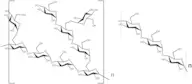
CAS:Starch is an energy storing polysaccharide produced by higher plants and some algae. Pure starch is a white, tasteless and odorless powder that is insoluble in cold water or alcohol. It consists of two types of polysaccharide: the linear and helical amylose (α-1,4-linked glucose) and the branched amylopectin (α-1,4 and α-1,6-linked glucose). Depending on the plant, starch generally contains 20 to 25% amylose and 75 to 80% amylopectin by weight.Color and Shape:White PowderEthyl cellulose
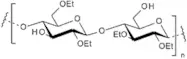
CAS:Ethyl cellulose is similar in structure to methyl cellulose with ethyl replacing the methyl groups. It is approved for use in regulated markets such as food and pharmaceuticals. In pharmaceuticals it can mask the taste of bitter actives, enhance the strength and appearance of tablets and capsules, and enable controlled release formulations. In food products it functions as a binder, film former and flavour fixative.Purity:Min. 95%Color and Shape:White Yellow PowderChitosan - Molecular weight 50,000-190,000
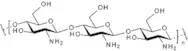
CAS:Chitosan is the deacetylated form of chitin. The polysaccharide is deacetylated in order to render it soluble, which is then possible at pH values of less than 7 (normally in dilute acid). This then allows the material to be used in a number of industrial applications as a binder and film former.Color and Shape:PowderTara gum
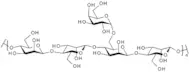
CAS:Tara gum is a galactomannan that is obtained from the seeds of the tara shrub Caesalpinia spinosa which is a native of the northern regions of Africa and South America. The gum is described as having a backbone of (1,4)-linked β-D-mannopyranosyl units one third of which possess a single unit side chain of (1,6)-linked α-D-galactopyranose. The gum forms gels with carrageenan and xanthan in a similar manner to guar and locust bean gum. Currently, only small quantities of tara gum are sold for use as food thickeners and stabilisers.Purity:Min. 95%Color and Shape:PowderBacterial alginate - from fermentation of Azotobacter vinelandii or Pseudomonas mendocina
An alginate-like polysaccharide produced by the fermentation of Azotobacter vinelandii or Pseudomonas mendocina. The chemical structure consists of blocks of (1,4) linked-β-D-polymannuronic acid (poly M), (1,4) linked-α-L-polyguluronic acid (poly G) and alternating blocks of the two uronic acids (poly MG). Unlike the alginate from seaweed, this polysaccharide is partially acetylated.Color and Shape:PowderMolecular weight:~100KDaDextran 5 - MW 4,000 to 6,000
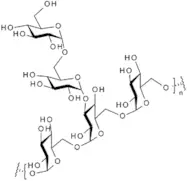
CAS:Dextran is α-(1,6)-linked α-D-glucan with α-(1,3)-linked glucose branch points produced by fermentation of Leuconostoc mesenteroides via the action of the enzyme dextransucrase on sucrose. The main use for native dextran is as an extender in blood transfusions and products having a range of sharp cut-off molecular weights are produced commercially for this and other applications. A complex of iron with dextran, known as iron dextran, is used as a source of iron for baby piglets which are often anaemic at birth.
Color and Shape:White PowderChondroitin sulfate A sodium salt - Average MW 10,000 - 50,000
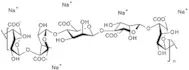
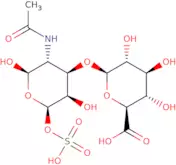
CAS:Chondroitin sulfate A sodium salt is a glycosaminoglycan that is derived from chondroitin. It is a complex carbohydrate with a high molecular weight and an average MW of 10,000 to 50,000 Da. The synthesis of the monosaccharide units in chondroitin sulfate A sodium salt occurs by Methylation, Click modification, Polysaccharide, or Fluorination. Chondroitin sulfate A sodium salt can be custom synthesized according to customer specifications and can be ordered as a CAS No. 39455-18-0 with high purity.Purity:Min. 95%Color and Shape:White Off-White PowderD-Aminogalacturonic Acid Hydrochloride
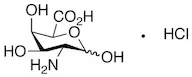
CAS:Controlled ProductApplications 2-Amino-2-deoxygalacturonic acid was a component of the lipopolysaccharide from P. aeruginosa NCTC 8505 and probably occurs in the region of polysaccharide responsible for O-antigenic specificity.
References Wilkinson, S.G., et al.: Biochem. J., 149, 783 (1975),Formula:C6H12ClNO6Color and Shape:NeatMolecular weight:229.62Tetrandrine
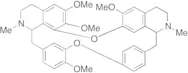
CAS:Controlled ProductApplications Tetrandrine is a lipopolysaccharide-induced microglial suppressor, effectively reducing the production of bacterial inflammatory mediators. Anti-inflammatory, anti-nociceptive. Tetrandrine is used in China to treat high blood pressure. This drug blocked the TPC2 calcium channel required for the Ebola infection process (Robert A. Davey et al., Science 2015, DOI: 10.1126/science.1258758).
References Yalong, D. et al.: PLoS One. 9, e102522 (2014); Westra, I. et al.: PLoS One., 9, e95462 (2014); Chem. and Eng. News, 93 (9) 8 Mar.2 (2015)Formula:C38H42N2O6Color and Shape:NeatMolecular weight:622.75Isomaltopentaose
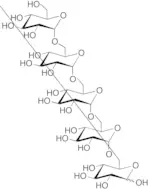
CAS:Applications Isomaltopentaose, is an isomalto-oligosaccharides (IMO) compound, used as functional food ingredients.
References Hu, Y., et al.: Lett. App. Microbio., 57, 108 (2013);Formula:C30H52O26Color and Shape:NeatMolecular weight:828.72Isomaltotetraose
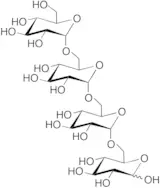
CAS:Controlled ProductApplications Isomaltotetraose, can be used for immunizication of hybridoma antibodies. the use of synthetic glycolipids as antigens enables one to study the gene control of antibody responses to glycolipids and to investigate the combining-site specificities of antibodies to a single antigenic determinant.
References Lai, E., et al.: Mol. Immunology, 22(9), 1021 (1985); Chen, H. T., et al.: Mol. Immunology, 24(4), 333 (1987);Formula:C24H42O21Color and Shape:NeatMolecular weight:666.58Sucrose-1,1,6,6,6’,6’-d6 (Major)
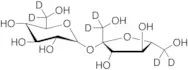
CAS:Controlled ProductApplications Labelled Sucrose (S697000). Yuanzhen sugar is a polysaccharide polymer, containing a certain amount of fructooligosaccharides.
References Watanabe, T., et al.: Biosci. Biotech. Biochem., 72, 3167 (2008), You, Y., et al.: J. Agric. Food Chem., 57, 709 (2009),Formula:C12H16D6O11Color and Shape:NeatMolecular weight:348.33Hydroxypropyl cellulose - Average MW 80,000
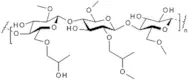
CAS:In water, hydroxypropyl cellulose forms liquid crystals with many mesophases depending on concentration. These mesophases include isotropic, anisotropic, nematic and cholesteric, the latter resulting in many colors such as violet, green and red. Pharmaceutical applications include treatments for medical conditions such as dry eye syndrome (keratoconjunctivitis sicca), recurrent corneal erosions, decreased corneal sensitivity, exposure and neuroparalytic keratitis. It is also used as a binder in tablets. Hydroxypropylcellulose is also used as a thickener, a binder and emulsion stabiliser in foods with E number E463. HPC is used as a support matrix for DNA separations by capillary and microchip electrophoresis.Purity:Min. 95%Fluorescein isothiocyanate-dextran - Average MW 70,000
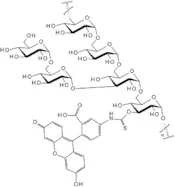
CAS:Anterograde and retrograde tracer in neurons; biologically inertPurity:Min. 95%Glycogen - from oyster for molecular biology
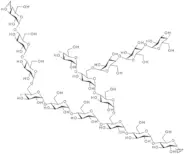
CAS:Glycogen is a highly branched polysaccharide of glucose that serves as a form of energy storage in animals and fungi. It is the main storage form of glucose in the body. In humans, glycogen is made and stored primarily in liver and muscle cells and functions as the second most important energy storage molecule to fat which is held in adipose tissue. Glycogen is analogous to starch and has a structure similar to amylopectin, but is more extensively branched and compact than starch. It occurs as granules in the cytosol/cytoplasm in many cell types, and plays an important role in the glucose cycle.
Purity:Min. 95%Cellulose acetate hydrogen phthalate
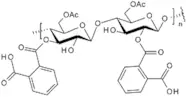
CAS:Cellulose acetate phthalate (CAP) finds use in the formulation of pharmaceuticals, such as the enteric coating of tablets or capsules and for controlled release formulations, where it is often used with other coating agents such as ethyl cellulose. It contains about 50% acetate and 25% as the phthalate ester with the rest as free hydroxyl groups. Enteric coatings based on CAP are resistant to acidic gastric fluids, but easily soluble in mildly basic medium of the intestine. The pH-sensitive solubility of CAP is mainly determined (as are other properties of this mixed ester) by the degree of substitution and by the molar ratio (acetyl and phthaloyl groups).Purity:Min. 95%Fluorescein isothiocyanate-carboxymethyl-dextran - Average MW 4,000
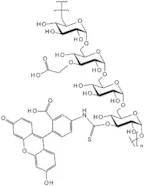
Fluorescein isothiocyanate carboxymethyl dextran (FITC-CM Dextran) has been reported to provide a valuable carrier for nanoparticles of iron oxide. These products provide a potent tool for contrast enhancement in magnetic resonance imaging.Purity:Min. 95%Color and Shape:PowderFluorescein isothiocyanate-carboxymethyl-dextran - Average MW 20,000
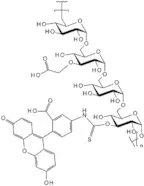
Fluorescein isothiocyanate carboxymethyl dextran (FITC-CM Dextran) has been reported to provide a valuable carrier for nanoparticles of iron oxide. These products provide a potent tool for contrast enhancement in magnetic resonance imaging.Purity:Min. 95%Methyl cellulose - USP testing specifications, viscosity: 1,500 cP
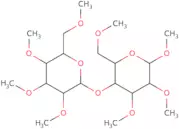
CAS:Methyl cellulose is a synthetic polymer of cellulose. It is prepared by treating the natural polymer with a methylating agent, such as dimethyl sulfate. Methylation is carried out in the presence of an acid catalyst to produce mainly methyl ethers and methyl esters. The degree of substitution may be controlled by the amount of catalyst. Methyl cellulose is used as a thickener, emulsifier, or stabilizer in many food products, including ice cream and toothpaste.Purity:Min. 95%Teichuronic acid
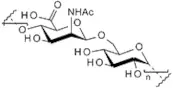
CAS:Teichuronic acid is isolated from the cell walls of Micrococcus luteus. The structure has been elucidated as [ManNAcUAp-(β-1,6)-Glcp-(α -1,4)]n.Purity:Min. 95%