Carbohydrates and glycoconjugates
Carbohydrates are organic compounds composed of carbon, hydrogen, and oxygen, with a basic structure formed by monosaccharides. These can combine to form disaccharides, oligosaccharides, or polysaccharides, depending on the number of monomeric units. Carbohydrates play a fundamental role in energy storage, cell structure, and cellular communication. Their derivatives are used in pharmaceutical products, such as sweeteners and excipients.
At CymitQuimica, we offer a wide range of carbohydrates and their derivatives for research and industrial applications.
Found 5010 products of "Carbohydrates and glycoconjugates"
Sort by
Purity (%)
0
100
|
0
|
50
|
90
|
95
|
100
Heparin disaccharide IV-S disodium salt
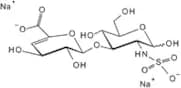
CAS:<p>Heparin is a complex carbohydrate that has been modified by the addition of a sugar and a sulfate group. It is used in the treatment of thrombosis, deep vein thrombosis, pulmonary embolism, and other blood clots. Heparin disaccharide IV-S disodium salt (HDS) is an intravenous form of heparin that consists of sodium salts of two saccharides: heparin disaccharide and sodium disulfate. HDS has been shown to be more potent than unfractionated heparin in animal models, as well as being more effective in preventing clot formation in humans. This drug also exhibits less frequent side effects such as skin rash, itching, or hives.</p>Formula:C12H17NO13S·2NaPurity:Min. 95%Color and Shape:White PowderMolecular weight:461.31 g/molGalactosyl isomaltol
CAS:<p>Galactosyl isomaltol is a sugar molecule that is produced by the enzymatic hydrolysis of lactose. It has been shown to have antimicrobial activity against human pathogens and can be used as an antioxidant. Galactosyl isomaltol binds to lysine residues on bacterial cell walls, preventing the formation of new cells and causing cell death by interfering with protein synthesis. The addition of galactosyl isomaltol to food decreases the levels of phycocyanin, which are a type of fluorescent pigment found in blue green algae. This compound also has magnetic resonance analysis properties that could be used for diagnosis.</p>Formula:C12H16O8Purity:Min. 95%Color and Shape:PowderMolecular weight:288.25 g/molLewis Y-O-(CH2)8-biotin
<p>Lewis Y-O-(CH2)8-biotin is a carbohydrate with the chemical formula (CHO)(CO)3OH. It is a methylated and glycosylated oligosaccharide that has been custom synthesized for use in biotechnology applications. Lewis Y-O-(CH2)8-biotin has been fluorinated at the C5 position to improve its stability and prevent hydrolysis, which may be due to its high purity. This carbohydrate is not commercially available and must be custom synthesized.</p>Purity:Min. 95%Lacto-N-fucopentaose II
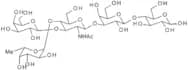
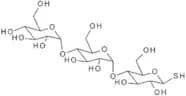
CAS:<p>Major milk pentasaccharide; reduces respiratory and gastrointestinal pathologies</p>Formula:C32H55NO25Purity:Min. 95 Area-%Color and Shape:White PowderMolecular weight:853.77 g/mol4-O-(4-O-(α-D-Glucopyranosyl)-α-D-glucopyranosyl)-β-D-thioglucopyranose
<p>4-O-(4-O-(a-D-Glucopyranosyl)-a-D-glucopyranosyl)-b-D-thioglucopyranose is a glycosylation product of the sugar 4-O-(4-O-(a-D-glucopyranosyl)-a-D-glucopyranosyl) b -D -thioglucopyranose. It is synthesized by reaction of 4,5,6,7,8,9,10,11,12,13,14 and 15 with a 1:1 molar ratio. The product can be modified to methylated or fluorinated products using the click chemistry method.</p>Formula:C18H32O15SPurity:Min. 95%Molecular weight:520.5 g/molGD2-Oligosaccharide-sp-biotin
<p>The structure of GD2-oligosaccharide-sp-biotin (sodium salt) comprises (GalNAcβ1,4Galβ1,4Glc) with two sialic acids linked (β-2,3/β-2,8) to the central galactose residue and biotin attached to position 1 of the reducing glucose moiety. GD2 ganglioside is expressed at a low concentration in the central nervous system, nerves, skin melanocytes and stem cells in healthy adults. On the other hand, GD2 ganglioside is overexpressed in a number of tumors, including: neuroblastoma, melanoma, small cell lung carcinoma and brain tumors. Recently, it has been found in low concentrations on breast cancer stem cells (CSC) that possess: self-renewal properties (division without disrupting the undifferentiated state) and tumor-initiating capabilities. It has been suggested that GD2 ganglioside may be developed as an effective target antigen for CSC immunotherapy.</p>Formula:C65H104N10O37S·2NaPurity:One SpotColor and Shape:White PowderMolecular weight:1,695.61 g/molBlood Group B trisaccharide butylamine formate salt
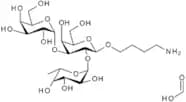
<p>Blood group antigen derivative for biochemical research</p>Formula:C22H41NO15·xCH2O2Purity:Min. 95%Color and Shape:White SolidMolecular weight:559.56 g/molGala1-3Galb1-4GlcNAc-O-L-serine
<p>Gala1-3Galb1-4GlcNAc-O-L-serine is a Custom synthesis, Modification, Fluorination, Methylation, Monosaccharide, Synthetic, Click modification, Oligosaccharide, saccharide. The CAS number for this product is . It has been created by the process of Glycosylation. This product is a Carbohydrate and a Polysaccharide. The molecular weight of this product is .</p>Purity:Min. 95%Forssman antigen pentaose
CAS:<p>Tumor associated antigen and target for the development of anti-cancer vaccines</p>Formula:C34H58N2O26Purity:Min. 90 Area-%Color and Shape:White PowderMolecular weight:910.82 g/molBenzyl 4- O- b- D- galactopyranosyl-b- D- xylopyranoside
CAS:<p>Benzyl 4-O-b-D-galactopyranosyl-b-D-xylopyranoside is a glycoside that is used in the synthesis of antibiotics. It can be found in the leaves of "Ajania cordata" and "Chenopodium ambrosioides".</p>Formula:C18H26O10Purity:Min. 95%Molecular weight:402.39 g/mol5-(Dimethylamino)naphthalene-1-sulfonamidooctyl-O-(a-D-galactopyranosyl)-1,4-(b-D-galactopyranosyl)-1,4-b-D-glucopyranose
<p>The compound is an oligosaccharide with a complex carbohydrate. The product is custom synthesized and has been modified by fluorination. It is a high purity, synthetic monosaccharide sugar that is methylated.</p>Purity:Min. 95%2-Acetamido-4-O-(2-acetamido-2-deoxy-β-D-glucopyranosyl)-2-deoxy-D-muramic acid
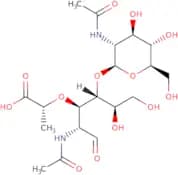
CAS:<p>A MurNAc disaccharide</p>Formula:C19H32N2O13Purity:Min. 95 Area-%Color and Shape:PowderMolecular weight:496.46 g/molD-Cellobiose
CAS:<p>Cellobiose is a reducing disaccharide consisting of two β(1-4)-linked glucopyranose units. It is produced by the hydrolysis of cellulose, a homopolysaccharide of glucose with β(1-4)-linkages. Cellobiose constitutes the polar part of cellobiose lipids (CLs) that are secreted by yeasts and mycelia fungi. Their various biological activities have led to a range of applications in the food industry, pharmaceutical industry and in medicine. Cellobiose itself has been used as an indicator carbohydrate for Crohns disease and malabsorption syndrome. In biotechnology, cellobiose is one of the sugars explored for the synthesis of biotensides.</p>Formula:C12H22O11Purity:Min. 98.0 Area-%Molecular weight:342.30 g/molD-Lactose monohydrate
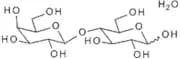
CAS:<p>Lactose is the principal sugar in human and most other mammalian milks, ( 4-O-(β-d-galactopyranosyl)-d-glucopyranose) (Collins, 2006). Lactose undergoes mutarotation; it is a reducing sugar and is significantly less soluble in water than sucrose. Lactose is much less sweet than sucrose (at ~1% about 0.15 (sucrose=1). The enzyme lactase (β-galactosidase), which is present in the small intestine, catalyzes hydrolysis of lactose to form glucose and galactose. Anhydrous lactose is an excipient, filler, diluent, and bulking agent in a wide variety of pharmaceutical tablets, capsules, powders and other preparations. Lactose also has applications as a nutrient and multi-functional ingredient in infant formulae, geriatric, dietetic and health foods (Linko, 1982).</p>Formula:C12H22O11·H2OPurity:Min. 96 Area-%Color and Shape:White Off-White PowderMolecular weight:360.31 g/mol2,3,6,2',3',4',6'-Hepta-O-acetyl-a-D-lactosyl bromide
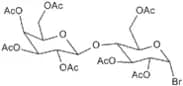
CAS:<p>2,3,6,2',3',4',6'-Hepta-O-acetyl-a-D-lactosyl bromide is a chemical substance that absorbs infrared radiation and reflects light. It is used as an infrared reflector in India to improve the efficiency of solar panels.</p>Formula:C26H35BrO17Color and Shape:White Off-White PowderMolecular weight:699.45 g/mol3-(b-D-Mannopyranosyl)-D-rhamnose
<p>3-(b-D-Mannopyranosyl)-D-rhamnose is a custom synthesized carbohydrate that is modified by fluorination. It is also a complex carbohydrate with an Oligosaccharide, sugar, and a Monosaccharide. 3-(b-D-Mannopyranosyl)-D-rhamnose has high purity and can be used for methylation, glycosylation, or Click modifications. Click modification is an organic chemistry technique that uses a copper ion to add chemical groups to the surface of molecules. This provides access to new functionalities, such as increased solubility or stability in organic solvents.</p>Purity:Min. 95%1-(3'-Azidopropyl)-2-deoxy-4-O-[3-O-(p-phenoxybenzyl)-b-D-galactopyranosyl]-2-phthalimido-b-D-glucopyranoside
<p>1-(3'-Azidopropyl)-2-deoxy-4-O-[3-O-(p-phenoxybenzyl)-b-D-galactopyranosyl]-2-phthalimido-b-D-glucopyranoside is a modification of an oligosaccharide. It is synthesized by the methylation and glycosylation of a monosaccharide, then fluorinated and saccharified. 1-(3'-Azidopropyl)-2-deoxy-4-O-[3-O-(p-phenoxybenzyl)-b -D -galactopyranosyl]-2 -phthalimido b -D -glucopyranoside is a white powder that can be used in the synthesis of complex carbohydrates.</p>Purity:Min. 95%3'-Sialyl Lewis X, sodium salt
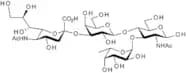
CAS:<p>Sialyl Lewis X (SLeX) is a carbohydrate antigen, related to cell adhesion and it has been shown that inhibition of SLeX synthesis leads to decreased adhesion of trophoblast cells to endometrial epithelial cells (Collins, 2006). Sialyl Lewis X is displayed on the terminus of glycolipids that are present on the surface of white blood cells and it has been shown that SLeX has an important role in inflamation processes. The inital adhesion of white blood cells to a site of injury is mediated by E-selectins which are specific for SLeX. Cell-cell recognition between leukocytes and endothelial cells in blood is believed to occur in part through interactions between lectins and oligosaccharide ligands. SLeX is frequently expressed in human cancer cells and primary tumors. It has been demonstrated that SLeX was involved in the adhesion of tumor cells to vascular endothelium. The potential role of SLeX in the tumor metastatic process has been supported by several clinical studies (Liang, 2016).</p>Formula:C31H51N2NaO23Purity:Min. 95%Color and Shape:White PowderMolecular weight:842.73 g/mola,a-D-Trehalose dihydrate - high purity
CAS:<p>Non-reducing disaccharide; mildly sweet energy source; protein stabilizer</p>Formula:C12H22O11·2H2OPurity:Min. 99 Area-%Color and Shape:PowderMolecular weight:378.33 g/molBenzyl 4-O-{4-O-[[2,4-di-O-acetyl-3-O-[2,4-di-O-(3,4,6-tri-O-acetyl-2-deoxy-2-phthalimido-b-D-glucopyranosyl)-3,6-di-O-benzyl-a-D-ma nnopyranosyl]-6-O-[3,4-di-O-acetyl-2,6-di-O-(3,4,6-tri-O-acetyl-2-deoxy-2-phthalimido-b-D-glucopyranosyl)-a-D-mannopyr
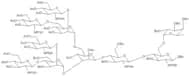
CAS:<p>The benzyl group is a type of organic group in which the hydrogen atom at the alpha position is replaced with a phenyl group. In this compound, the benzyl group is attached to a sugar molecule through an ether bond. The benzyl group can be modified to produce different compounds. For example, it can be fluorinated to produce fluoro-benzyl compounds that are used as anti-cancer agents.</p>Formula:C203H206N6O71SPurity:Min. 95%Molecular weight:3,897.87 g/mol






![1-(3'-Azidopropyl)-2-deoxy-4-O-[3-O-(p-phenoxybenzyl)-b-D-galactopyranosyl]-2-phthalimido-b-D-gluc…](/_next/image/?url=https%3A%2Fstatic.cymitquimica.com%2Fproducts%2F3D%2Fthumb-webp%2FOA74915.webp&w=3840&q=75)