Fatty Acid Methyl Ester (FAME) Standards
Fatty Acid Methyl Ester (FAME) standards are essential for the analysis and identification of fatty acids in biodiesel, food, and environmental samples. FAME standards allow for the accurate calibration of gas chromatographic systems used to quantify fatty acid composition. At CymitQuimica, we offer high-purity FAME standards to ensure precise and reproducible results for your research and industrial applications.
Found 605 products of "Fatty Acid Methyl Ester (FAME) Standards"
Sort by
Purity (%)
0
100
|
0
|
50
|
90
|
95
|
100
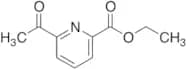
6-Acetyl-picolinic Acid Ethyl Ester
CAS:Controlled Product<p>Applications 6-ACETYL-PICOLINIC ACID ETHYL ESTER (cas# 114578-70-0) is a useful research chemical.<br></p>Formula:C10H11NO3Color and Shape:NeatMolecular weight:193.19Propargyl Sulfide
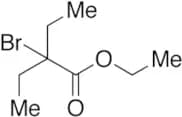
CAS:Controlled Product<p>Stability Air Sensitive, Light Sensitive<br>Applications Propargyl Sulfide (cas# 13702-09-5) is a useful research chemical.<br> Not a dangerous good if item is equal to or less than 1g/ml and there is less than 100g/ml in the package<br></p>Formula:C6H6SColor and Shape:NeatMolecular weight:110.18α-Bromodiethylacetic Acid Ethyl Ester
CAS:Controlled ProductFormula:C8H15BrO2Color and Shape:NeatMolecular weight:223.107Tuberculostearic Acid Ethyl Ester
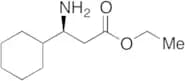
CAS:Controlled ProductFormula:C21H42O2Color and Shape:NeatMolecular weight:811.87(betaS)-β-Aminocyclohexanepropanoic Acid Ethyl Ester
CAS:Controlled ProductFormula:C11H21NO2Color and Shape:NeatMolecular weight:199.296-Bromo-1,4-dioxa-8-azaspiro[4.5]decane-8-carboxylic Acid Ethyl Ester
CAS:Controlled Product<p>Applications 6-Bromo-1,4-dioxa-8-azaspiro[4.5]decane-8-carboxylic Acid Ethyl Ester is an intermediate in the synthesis of loratadine (L469575) related compounds.<br>References Bruttmann, G., et al.: J. Allergy Clin. Immunol., 83, 411 (1989), Haria, M., et al.: Drugs, 48, 617 (1994)<br></p>Formula:C10H16BrNO4Color and Shape:NeatMolecular weight:294.14tert-Butyl (1-Chloro-2-oxo-7,10,13-trioxa-3-azahexadecan-16-yl)carbamate
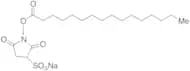
CAS:Controlled ProductFormula:C17H33ClN2O6Color and Shape:NeatMolecular weight:396.907Sulfosuccinimidyl Palmitate Sodium
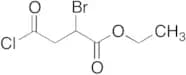
CAS:Controlled Product<p>Applications Sulfosuccinimidyl Palmitate Sodium is an analog of Sulfosuccinimidyl Oleate Sodium (S689200).<br></p>Formula:C20H34NNaO7SColor and Shape:NeatMolecular weight:455.5412-Bromo-4-chloro-4-oxo-butanoic Acid Ethyl Ester
CAS:Controlled ProductFormula:C6H8BrClO3Color and Shape:NeatMolecular weight:243.4835-Acetyl-2H-pyrazole-3-carboxylic Acid Ethyl Ester
CAS:Controlled Product<p>Applications 5-Acetyl-2H-pyrazole-3-carboxylic Acid Ethyl Ester (cas# 37622-89-2) is a useful research chemical.<br></p>Formula:C8H10N2O3Color and Shape:NeatMolecular weight:182.18Elaidic Acid Ethyl Ester
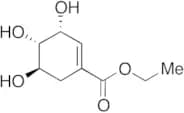
CAS:Controlled ProductFormula:C20H38O2Color and Shape:NeatMolecular weight:545.535Shikimic Acid Ethyl Ester
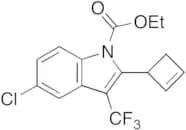
CAS:Controlled ProductFormula:C9H14O5Color and Shape:NeatMolecular weight:202.22-Cyclobutenyl-3-trifluoromethyl-5-chloro-1H-indole-1-carboxylic Acid Ethyl Ester
CAS:Controlled Product<p>Applications 2-Cyclobutenyl-3-trifluoromethyl-5-chloro-1H-indole-1-carboxylic acid ethyl ester is synthesized from 5-chloro-2-oxindole (C375030), which is used in the preparation of novel GSK-3β inhibitors as anticancer agents.<br>References Choi, M.J., et al.: Bull. Korean. Chem. Soc., 32, 2015 (2011); Otani, M., et al.: Bioorg. Med. Chem. Lett.. 20, 4259 (2010); Jhan, Y.H., et al.: Tetrahedron. Lett., 54, 1155 (2013); Hsieh, J.C., et al.: Org. Biomolec. Chem., 10, 6404 (2012);<br></p>Formula:C16H13ClF3NO2Color and Shape:NeatMolecular weight:343.732-Amino-6-chloro-α-cyano-3-(ethoxycarbonyl)-4H-1-benzopyran-4-acetic Acid Ethyl Ester
CAS:Controlled ProductFormula:C17H17ClN2O5Color and Shape:NeatMolecular weight:364.78Glycidyl palmitate
CAS:<p>Glycidyl palmitate is a synthetic fatty acid ester that has reactive hydroxyl groups. It is used in the production of polylactic acid, a biodegradable polymer. Glycidyl palmitate can be prepared by reacting a fatty acid with glycerol and an epichlorohydrin. The elimination rate of glycidyl palmitate from the body has been shown to be activated by surface methodology such as chemical ionization mass spectrometry. Glycidyl palmitate can also be analyzed using gas chromatography with flame ionization detection (GC-FID) or gas chromatography-mass spectrometry (GC-MS). A sample preparation technique for glycidyl palmitate is to dissolve it in sodium salts and use filtration as the final step before analysis. The most common fatty acids present in glycidyl palmitate are oleic acid and linoleic acid.</p>Formula:C19H36O3Purity:Min. 95%Molecular weight:312.49 g/molPropargylaldehyde diethyl acetal
CAS:<p>Propargylaldehyde diethyl acetal is a chemical compound that is used as an intermediate in the synthesis of other compounds. It is a white crystal or crystalline powder that is soluble in organic solvents such as ether, alcohols, and benzene. Propargylaldehyde diethyl acetal has been shown to be potent inhibitors of HSV-1, HSV-2, and HCMV. Furthermore, it has been reported that propargylaldehyde diethyl acetal inhibits the growth of cancer cells in vitro. In addition, propargylaldehyde diethyl acetal has been shown to inhibit the production of autoimmune diseases such as rheumatoid arthritis and multiple sclerosis.</p>Formula:C7H12O2Purity:Min. 95%Color and Shape:Colorless Clear LiquidMolecular weight:128.17 g/molRac 1,2-bis-palmitoyl-3-chloropropanediol
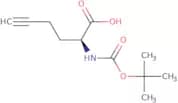
CAS:<p>Rac-1,2-bis-palmitoyl-3-chloropropanediol is a dispersive molecule that is composed of a fatty acid and a chlorinated derivative of palmitic acid. It is used to calibrate the mass spectrometer and as an internal standard in quantitative analysis. Rac-1,2-bis-palmitoyl-3-chloropropanediol reacts with electrospray ionization with a dose-dependent response. It has been shown to be toxic to kidney cells at high doses but not at low doses. This chemical has been detected in food samples after being absorbed from the gastrointestinal tract. Rac 1,2-bis-palmitoyl 3 chloropropanediol can be found in the dipalmitate form or as formic acid.</p>Formula:C35H67ClO4Purity:95%NmrColor and Shape:PowderMolecular weight:587.36 g/molBoc-HomoGly(Propargyl)-OH
CAS:<p>Please enquire for more information about Boc-HomoGly(Propargyl)-OH including the price, delivery time and more detailed product information at the technical inquiry form on this page</p>Formula:C11H17NO4Purity:Min. 95%Molecular weight:227.26 g/molrac-3-hexadecanamido-2-methoxypropan-1-ol phosphocholine monohydrate
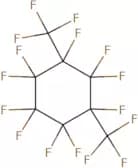
CAS:<p>Please enquire for more information about rac-3-hexadecanamido-2-methoxypropan-1-ol phosphocholine monohydrate including the price, delivery time and more detailed product information at the technical inquiry form on this page</p>Formula:C25H55N2O7PPurity:Min. 95%Molecular weight:526.69 g/molHexadecafluoro(1,3-dimethylcyclohexane)
CAS:Controlled Product<p>Ternary mixtures of hexadecafluoro(1,3-dimethylcyclohexane) with fluorine and hydrogen fluoride are stable compounds. The proton is a constant, which is the only variable in the equation. The analytical method for determining the amount of hexadecafluoro(1,3-dimethylcyclohexane) in a mixture can be found in reference 1. This reference also discusses the matrix effect on this compound's stability and optical properties. Reference 2 discusses transfer reactions that are present when hexadecafluoro(1,3-dimethylcyclohexane) is heated to temperatures of 400°C or above. Reference 3 discusses how polymer films can be formed by heating hexadecafluoro(1,3-dimethylcyclohexane) with a solvent such as pentane. Reference 4 discusses how covid-19 pandemic has been shown to be effective against the H2 strain of subt</p>Formula:C8F16Purity:Min. 95%Molecular weight:400.06 g/mol



![6-Bromo-1,4-dioxa-8-azaspiro[4.5]decane-8-carboxylic Acid Ethyl Ester](/_next/image/?url=https%3A%2Fstatic.cymitquimica.com%2Fproducts%2FTR%2Fthumb-webp%2FB688715.webp&w=3840&q=75)