APIs for research and impurities
Subcategories of "APIs for research and impurities"
- Aminoacids and derivatives(12,335 products)
- Anthraquinones and derivatives(405 products)
- Benzimidazole and Imidazole Derivatives(10,451 products)
- Benzodiazepine Derivatives(334 products)
- Carbohydrates and glycoconjugates(5,048 products)
- Esters and Derivatives(42,251 products)
- Fatty Acids and Lypidic Derivatives(32,417 products)
- Flavonoids and Polyphenols(17,084 products)
- Free Radicals and Oxidant/Reducing Agents(213 products)
- Ketones and derivatives(2,402 products)
- Natural and semi-synthetic antibiotics(6,387 products)
- Nitriles and Cyano Derivatives(3,068 products)
- Nitrosamines and Derivatives(55 products)
- Nucleosides and Nucleotides(3,484 products)
- Organic Phosphates and Phosphonates(1,201 products)
- Organic Sulphonates and Sulphates(10,435 products)
- Organometallics(4,421 products)
- Others(6,307 products)
- Peptides and Proteins(3,148 products)
- Polymers and Derivatives(100 products)
- Purines and Pyrimidine Derivatives(8,948 products)
- Quinazoline and Quinoline Derivatives(66,045 products)
- Quinones and Derivatives(24,363 products)
- Salts and Derivatives of Active Pharmaceutical Ingredients (API)(80,490 products)
- Steroids and Derivatives(4,958 products)
- Sulfonamides and Derivatives(2,600 products)
- Terpenoids and Derivatives(3,849 products)
- Thiazolidinediones and Thiopyrans(2,754 products)
- β-Adrenergic Compounds(231 products)
Found 57768 products of "APIs for research and impurities"
(S)-Rabeprazole sodium
CAS:(S)-Rabeprazole sodium is an anticancer drug that acts as a kinase inhibitor. It is an analog of Rabeprazole and has been shown to inhibit the growth of cancer cells in vitro and in vivo. (S)-Rabeprazole sodium inhibits the activity of kinases, which are enzymes that play a key role in cell signaling pathways. This inhibition leads to apoptosis, or programmed cell death, in cancer cells. (S)-Rabeprazole sodium has been tested against various types of cancer, including Chinese hamster ovary cells and tumor xenografts in mice. It has also been shown to inhibit elastin degradation, which is important for preventing metastasis of cancer cells. (S)-Rabeprazole sodium may be a promising candidate for the development of new anticancer drugs that target specific kinases and proteins involved in cancer cell growth and survival.
Formula:C18H21N3O3S•NaPurity:Min. 95%Molecular weight:382.43 g/molRef: 3D-IR183125
Discontinued productDicyclopropylamine hydrochloride
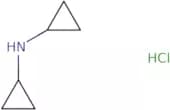
CAS:Dicyclopropylamine hydrochloride is a tyrosine kinase inhibitor that blocks the activity of jak2. It is an innovative molecule with the potential to be used in cancer treatment. Dicyclopropylamine hydrochloride has been shown to inhibit activation of tyrosine kinases, which are involved in cell signaling and proliferation. Dicyclopropylamine hydrochloride also has anti-inflammatory properties, which may be due to its ability to inhibit prostaglandin synthesis. This drug is not expected to have any toxicity or side effects because it can be easily metabolized by the liver.br>br> Dicyclopropylamine hydrochloride is a white solid with a melting point of 175°C. It has no detectable odor, and it is soluble in water and ethanol. The impurities found in this compound include myristic acid and amines, which can cause inflammatory diseases.br>br> D
Formula:C6H11N•HClPurity:Min. 95%Color and Shape:PowderMolecular weight:133.62 g/molRef: 3D-FD141573
Discontinued product3-Dimethylaminopropyl-2-benzylaminobenzoate hydrochloride
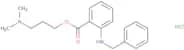
CAS:3-Dimethylaminopropyl-2-benzylaminobenzoate hydrochloride is a versatile compound with various characteristics and applications. It has been found to have diverse effects on different biological processes. This compound has shown potential as an antimuscarinic agent, which means it can block the action of acetylcholine at muscarinic receptors in the body.
Formula:C19H25ClN2O2Purity:Min. 95%Molecular weight:348.9 g/molRef: 3D-WMD18565
Discontinued productLinagliptin impurity G
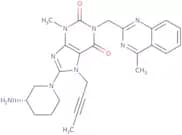
CAS:Linagliptin impurity G is an impurity in the drug product Linagliptin. It is a natural substance and its CAS number is 668270-11-9. Impurity G can be synthesized from L-phenylalanine and cyclohexane carboxaldehyde in a two step process. The first step involves the reaction of L-phenylalanine with cyclohexane carboxaldehyde to yield methylcyclohexanecarboxylate, which then undergoes hydrolysis to give phenylcyclohexanol. In the second step, phenylcyclohexanol reacts with hydrochloric acid to produce phenylcyclohexanone, which is then oxidized with hydrogen peroxide to yield impurity G. Impurity G can also be found in the pharmacopoeia as a high purity HPLC standard for linagliptin.
Formula:C25H28N8O2Purity:Min. 95%Color and Shape:PowderMolecular weight:472.54 g/molEmpagliflozin S-furanose
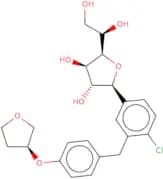
CAS:Empagliflozin S-furanose is a Custom synthesis drug product. It is an analytical standard with CAS No. 1620758-32-8, and it is used in research and development of new drugs. Empagliflozin S-furanose has been found to be a metabolite of empagliflozin, a drug that is used to treat type 2 diabetes mellitus. It is also used as an impurity standard for HPLC analysis of empagliflozin because it does not have any biological activity.
Formula:C23H27ClO7Purity:Min. 95%Color and Shape:PowderMolecular weight:450.91 g/molRef: 3D-IE181148
Discontinued productTofacitinib dihydro impurity
CAS:Tofacitinib dihydro impurity is a research and development impurity standard for the synthesis of Tofacitinib. It is a custom synthesis with high purity, pharmacopoeia grade, and synthetic. This product is also used in drug development for metabolism studies and analytical applications.
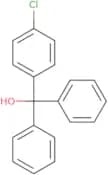
Formula:C16H22N6OPurity:Min. 95%Molecular weight:314.39 g/mol(4-Chlorophenyl)diphenylmethanol
CAS:Please enquire for more information about (4-Chlorophenyl)diphenylmethanol including the price, delivery time and more detailed product information at the technical inquiry form on this page
Formula:C19H15ClOPurity:Min. 95%Molecular weight:294.8 g/molRef: 3D-GAA92289
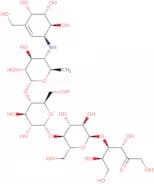
Discontinued productAcarbose Impurity E
CAS:Acarbose Impurity E is an impurity found in acarbose. It is a natural, API impurity and is a synthetic impurity standard. Acarbose Impurity E has been used in drug development research and development, as well as in the HPLC analysis of acarbose to generate a pharmacopoeia-grade purity standard.
Purity:Min. 95%N-Hydroxymethyl Sumatriptan
CAS:N-Hydroxymethyl Sumatriptan is an analytical standard and a research and development impurity. It is also used as an API impurity in drug product manufacturing. N-Hydroxymethyl Sumatriptan can be synthesized by reacting the parent drug with hydroxyl radicals, which is a process that yields no side products. N-Hydroxymethyl Sumatriptan can be found in the following pharmacopoeia: United States Pharmacopoeia (USP) 11>, European Pharmacopoeia (EP), Japanese Pharmacopoeia (JP)13>, British Pharmacopoeia (BP), and Chinese Pharmacopiae (CPC).
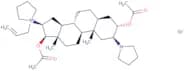
Formula:C15H23N3O3SPurity:Min. 95%Molecular weight:325.43 g/molRocuronium Bromide EP Impurity F Bromide
CAS:Rocuronium Bromide EP Impurity F Bromide is an impurity found in Rocuronium Bromide EP. It is a natural component of the drug product, which is a synthetic drug. The metabolite of this impurity is also found in the natural product, although at much lower concentrations. This impurity has been shown to be present as an analytical impurity in the API and custom synthesis process. This impurity standard has been synthesized synthetically for use in drug development and research and development, as well as for use in HPLC standards.Formula:C34H55N2O4·BrPurity:Min. 95%Molecular weight:635.72 g/molSacubitril Impurity 2
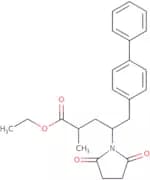
CAS:Sacubitril Impurity 2 is a drug product that is an analytical impurity in Sacubitril. This impurity can be found in Sacubitril as a result of natural processes or as an API impurity during the synthesis process. Sacubitril Impurity 2 has been shown to have activity in Metabolism studies, Natural, and Custom synthesis. It has been shown to be a Synthetic impurity standard and HPLC standard. Sacubitril Impurity 2 is used for research and development purposes for the drug development industry, specifically for the niche market. It is also used as an analytical standard for pharmacopoeia methods.
Formula:C24H27NO4Purity:Min. 95%Molecular weight:393.48 g/molChlorthalidone impurity E
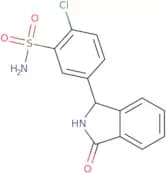
CAS:Chlorthalidone impurity E is an analytical standard for the HPLC analysis of chlorthalidone in pharmaceutical drug products and is a metabolite of chlorthalidone. Chlorthalidone impurity E is an API impurity that can be found in the synthesis of chlorthalidone, and it has been detected as a minor component in certain drug products. It is important to have an accurate specification for this compound, since it can affect the pharmacological properties of the drug product. The purity level of this compound must be at least 98% or greater to ensure that there are no contaminants present. This compound is also a metabolite of chlorthalidone and is used as a pharmacopoeia reference substance for testing equipment calibration.END>
Formula:C14H11ClN2O3SPurity:Min. 95%Molecular weight:322.77 g/molRef: 3D-IC76330
Discontinued productTriethylene glycol flufenamate
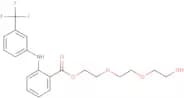
CAS:Etofenamate impurity
Formula:C20H22F3NO5Purity:Min. 95%Color and Shape:Clear LiquidMolecular weight:413.39 g/molRef: 3D-IT58094
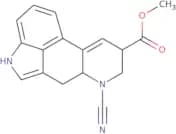
Discontinued productD-6-Cyano-6-norlysergic acid methyl ester
CAS:Please enquire for more information about D-6-Cyano-6-norlysergic acid methyl ester including the price, delivery time and more detailed product information at the technical inquiry form on this page
Formula:C17H15N3O2Purity:Min. 95%Molecular weight:293.32 g/molRef: 3D-FBA33404
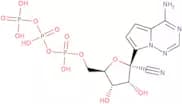
Discontinued productGS 441524 triphosphate
CAS:Triphosphorylated form of an antiviral nucleoside analog with activity against zoonotic feline infectious peritonitis virus (FIPV) and severe acute respiratory syndrome (SARS) virus from Coronaviridae family. The compound is the biologically active form of the GS 441524 prodrug and being triphosphorylated, it competes with natural nucleoside triphosphates in cells and interferes with viral RNA synthesis. Made to order.
Formula:C12H12N5O13P3·4NaPurity:(31P-Nmr) Min. 95 Area-%Color and Shape:White PowderMolecular weight:531.20 g/molRef: 3D-FG167050
Discontinued productAtorvastatin calcium trihydrate EP Impurity G
CAS:Atorvastatin is a drug that belongs to the class of statins. It is used for the treatment of high cholesterol levels and other related diseases, such as cardiovascular disease. Atorvastatin calcium trihydrate EP Impurity G is an impurity that may be present in atorvastatin calcium trihydrate. This compound has not been found to have any pharmacological activity.
Formula:C34H37FN2O5Purity:Min. 95%Color and Shape:PowderMolecular weight:572.67 g/mol


![[Trp(O)25]-Semaglutide](/_next/image/?url=https%3A%2Fstatic.cymitquimica.com%2Fproducts%2F3D%2Fthumb-webp%2FIS27853.webp&w=3840&q=75)