Amino Acids (AA)
Amino acids (AAs) are the fundamental building blocks of proteins, playing a crucial role in various biological processes. These organic compounds are essential for protein synthesis, metabolic pathways, and cell signaling. In this category, you will find a comprehensive range of amino acids, including essential, non-essential, and modified forms, which are vital for research in biochemistry, molecular biology, and nutritional sciences. At CymitQuimica, we provide high-quality amino acids to support your research and development needs, ensuring accuracy and reliability in your experimental outcomes.
Subcategories of "Amino Acids (AA)"
- Amino Acid Derivatives(3,955 products)
- Amino Acid and Amino Acid Related Compounds(3,436 products)
- Amino Acids with Oxygen or Sulphur(168 products)
- Boc- Amino Acids(351 products)
- Fmoc Amino Acids(1,710 products)
Found 38216 products of "Amino Acids (AA)"
Sort by
Purity (%)
0
100
|
0
|
50
|
90
|
95
|
100
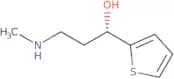
(S)-3-Methylamino-1-(2-thienyl)-1-propanol
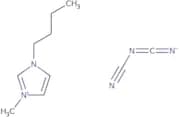
CAS:<p>(S)-3-Methylamino-1-(2-thienyl)-1-propanol is a chiral molecule with two stereogenic centers. It is synthesized by the demethylation of acetylthiophene and the crystallization of the reaction mixture. The class of compounds to which (S)-3-Methylamino-1-(2-thienyl)-1-propanol belongs includes those that have hydroxy groups or diastereomeric salts. The hydroxy group on (S)-3-Methylamino-1-(2-thienyl)-1-propanol can be removed by demethylation, which leads to a mixture of products, including hydroxy and demethylated compounds.</p>Formula:C8H13NOSPurity:Min. 95%Color and Shape:White PowderMolecular weight:171.26 g/mol1-Butyl-3-methylimidazolium dicyanamide
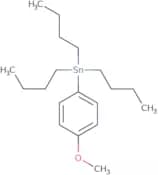
CAS:<p>1-Butyl-3-methylimidazolium dicyanamide is an ionic liquid that is a colorless, volatile liquid. It is a hydrophobic compound that has been shown to have a high thermal expansion coefficient and a low viscosity. This compound has been shown to form stable complexes with many metals and nonmetals, such as lithium, sodium, silver, copper, gold, palladium, nickel, cobalt and zinc. 1-Butyl-3-methylimidazolium dicyanamide has been used for solvent extraction of metals and as an electrolyte in electrochemical studies. The solubility of this compound in water has been found to be dependent on the concentration of the hydrogen bond acceptor sites on the surface of the solute molecule.</p>Formula:C10H15N5Purity:Min. 95%Color and Shape:Red Clear LiquidMolecular weight:205.26 g/molTributyl-(4-methoxy-phenyl)-stannane
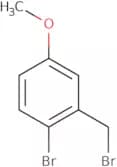
CAS:Controlled Product<p>Tributyl-(4-methoxy-phenyl)-stannane is a nucleophilic compound that can be used to synthesize 5-HT1A receptor agonists. It has been shown to have biochemical, positron and chloride properties. This chemical is synthesised by introducing a sulfur atom into the molecule. The sulfur atom reacts with the chlorine atom in chlorobenzene to form the sulfonation bond. This reaction is efficient and can be used as a method for cleaving bonds and cross-coupling carbon atoms.</p>Formula:C19H34OSnPurity:Min. 95%Color and Shape:PowderMolecular weight:397.18 g/mol2-Bromo-5-methoxybenzyl bromide
CAS:<p>2-Bromo-5-methoxybenzyl bromide is a ligand in organic chemistry. It is used as a reaction partner for the synthesis of heterocycles, such as 2-pyridone, which are biologically relevant. This ligand can be prepared by refluxing anhydrous potassium carbonate with chloroform and phenol. Macrocyclic compounds can be synthesized from this product through the Witting reaction. The efficiency of this method makes it suitable for use in biological studies.</p>Formula:C8H8Br2OPurity:Min. 95%Color and Shape:White PowderMolecular weight:279.96 g/mol2-Methyl-4-propyl-1,3 oxathiane
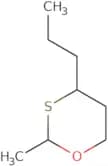
CAS:<p>2-Methyl-4-propyl-1,3 oxathiane is a terpene. It has been shown to have significant effects on acetaldehyde levels in the brain and liver after consumption of alcohol. 2-Methyl-4-propyl-1,3 oxathiane is also able to increase the levels of acetaldehyde in blood plasma. It does this by inhibiting an enzyme that breaks down acetaldehyde called alcohol dehydrogenase. This means that alcohol will stay in the system for longer, resulting in higher blood alcohol levels. 2-Methyl-4-propyl-1,3 oxathiane may be used as a biomarker for alcohol consumption. It can be detected by analytical methods such as high performance liquid chromatography (HPLC).</p>Formula:C8H16OSPurity:Min. 95%Color and Shape:Colourless To Light (Or Pale) Yellow Or Pink LiquidMolecular weight:160.28 g/molFmoc-Cys(3-(t-butoxycarbonyl)-propyl)-OH
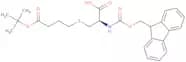
CAS:<p>Fmoc-Cys(3-(t-butoxycarbonyl)-propyl)-OH is a cysteine derivative that has been shown to be effective in the treatment of ulcers. It is a competitive inhibitor of the enzyme cyclooxygenase, which is responsible for the production of prostaglandins, and can be used to decrease inflammation. Fmoc-Cys(3-(t-butoxycarbonyl)-propyl)-OH has been shown to inhibit carassius erythrocyte meiosis, with an effective dose of 0.02 mM. The drug also has a conformation that can bind to the hydroxamic acid moiety, which is thought to be responsible for its anti-inflammatory properties. This drug also inhibits genotype 3a2 and 5b2 of Cyprinus carpio and may have potential as a chemotherapeutic agent for these genotypes.END></p>Formula:C26H31NO6SPurity:Min. 95%Color and Shape:PowderMolecular weight:485.59 g/molBoc-N-Ethylglycine
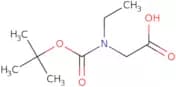
CAS:<p>Building block</p>Formula:C9H17NO4Purity:Min. 95%Color and Shape:White PowderMolecular weight:203.24 g/mol4-Methyl-5,7-dimethoxycoumarin
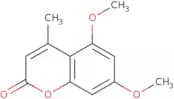
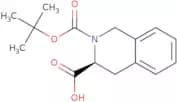
CAS:<p>4-Methyl-5,7-dimethoxycoumarin is a coumarin derivative that has been synthesized from acetonitrile and aluminium. It is used as an antiplatelet drug in the treatment of cardiovascular diseases such as unstable angina, myocardial infarction, and transient ischemic attack. 4-Methyl-5,7-dimethoxycoumarin reversibly inhibits platelet aggregation by blocking the platelet receptor P2Y12 on the surface of platelets. This drug also has antioxidant effects and can be used to identify markers associated with cardiovascular disease.</p>Formula:C12H12O4Purity:Min. 95%Molecular weight:220.22 g/molBoc-(3S)-1,2,3,4-Tetrahydroisoquinoline-3-carboxylic acid
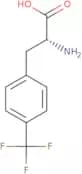
CAS:<p>Boc-(3S)-1,2,3,4-Tetrahydroisoquinoline-3-carboxylic acid is an amino acid that has the δ-opioid receptor antagonist activity. It can be synthesized by a stepwise synthesis with an asymmetric center. The δ-opioid receptor antagonist activity of Boc-(3S)-1,2,3,4-Tetrahydroisoquinoline-3-carboxylic acid was found to be comparable to naloxone in terms of affinity constants and functional groups.</p>Formula:C15H19NO4Purity:Min. 95%Color and Shape:SolidMolecular weight:277.32 g/molp-Trifluoromethyl-D-phenylalanine
CAS:<p>p-Trifluoromethyl-D-phenylalanine is a versatile building block that is used in the synthesis of complex compounds. It can be used as a reactive intermediate or as a scaffold for the synthesis of biologically active compounds. p-Trifluoromethyl-D-phenylalanine has been shown to be useful in research, and it is also used as a reagent in organic synthesis. This chemical has a CAS number of 114872-99-0 and is listed on the European Inventory of Existing Chemical Substances (EINECS).</p>Formula:C10H10F3NO2Purity:Min. 95%Color and Shape:SolidMolecular weight:233.19 g/molFmoc-Pro-Pro-Gly-OH
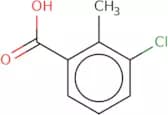
<p>Fmoc-Pro-Pro-Gly-OH is an activating reagent that has been used in the synthesis of peptides with a C-terminal carboxyl group. It is typically used as a chloroformate ester and reacts with amino groups to form amide bonds. The activation of this reagent can be performed either by reaction with isobutyl or by reaction with piperidine. This product may also be used for the synthesis of tripeptides, pentafluorophenyl esters, and mimetic peptides. Fmoc-Pro-Pro-Gly-OH is typically purified by trituration, followed by evaporation in vacuum and then recrystallization from methanol or ethanol.</p>Formula:C27H29N3O6Purity:Min. 95%Color and Shape:PowderMolecular weight:491.54 g/mol3-Chloro-2-methylbenzoic acid
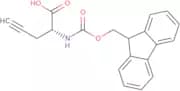
CAS:<p>3-Chloro-2-methylbenzoic acid is a fine chemical, useful building block and versatile compound. It is a reagent for the production of other chemicals, such as pharmaceuticals and cosmetics. 3-Chloro-2-methylbenzoic acid is also used in research, where it can be used as a building block or scaffold for the synthesis of complex molecules. This chemical has many industrial applications, including use in manufacturing pesticides and herbicides.</p>Formula:C8H7ClO2Purity:Min. 95%Color and Shape:PowderMolecular weight:170.59 g/molFmoc-D-propargylglycine
CAS:<p>D-propargylglycine is a chemical compound that belongs to the group of valency modifiers. It is a modulator that can be used in cancer research and as an anti-inflammatory agent. It has been shown to have protein–protein interaction by binding to casein kinase, which may lead to its use in cancer therapy. D-propargylglycine can also interact with other proteins and inflammatory agents, leading to potential applications in the treatment of inflammatory conditions such as arthritis.</p>Formula:C20H17NO4Purity:Min. 95%Color and Shape:PowderMolecular weight:335.35 g/molFmoc-PNA-C(Bhoc)-OH
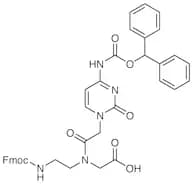
CAS:Formula:C39H35N5O8Purity:>98.0%(HPLC)(qNMR)Color and Shape:White to Light yellow powder to crystalMolecular weight:701.74Z-Phe-Tyr(tBu)-diazomethylketone
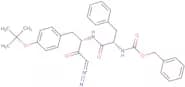
CAS:<p>Z-Phe-Tyr(tBu)-diazomethylketone is a compound that is used in the treatment of cancer and HIV. It was developed as an antiviral therapy for HIV, but it has been found to be ineffective against HIV. Z-Phe-Tyr(tBu)-diazomethylketone has been shown to produce attenuating effects on syncytial virus and may be a potential antiviral drug. This compound is not active against regulatory sequences or tissues, but it does inhibit endoproteolytic processing of n6-methyladenosine, which leads to modifications in rna binding.</p>Formula:C31H34N4O5Purity:Min. 95%Color and Shape:Off-White PowderMolecular weight:542.63 g/mol2,9-Diphenyl-1,10-phenanthroline
CAS:<p>2,9-Diphenyl-1,10-phenanthroline is a yellow crystalline compound. This molecule has been shown to be an effective anticancer drug and is used in the study of ultrafast electron reduction. It exhibits photophysical properties that are dependent on its coordination geometry and the surrounding environment.<br>2,9-Diphenyl-1,10-phenanthroline is a coordination complex that can be synthesized by electropolymerization of copper complexes with phenanthrolines. The polymer film has been shown to have high stability constants and is resistant to water or organic solvents.</p>Formula:C24H16N2Purity:Min. 95%Color and Shape:White PowderMolecular weight:332.4 g/mol1-Methyl-1,2,3,4-tetrahydroquinolin-7-amine hydrochloride
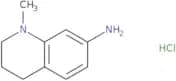
CAS:<p>1-Methyl-1,2,3,4-tetrahydroquinolin-7-amine hydrochloride (MQ) is a fluorescent probe that has been used to study the photostability of cisplatin in real time. MQ was synthesized by reacting 3-(2'-bromoacetyl)-7-methoxy-1,2,3,4-tetrahydroquinolin with 7-aminoquinaldine. The emission spectrum of MQ peaks at 615 nm and has an extinction coefficient at 615 nm of 12.5 mM/cm. This probe has been shown to be photostable for long periods of time and can be used to visualize DNA polymerase activity in living cells.</p>Formula:C10H15ClN2Purity:Min. 95%Color and Shape:Off-White PowderMolecular weight:198.69 g/mol2-Amino-4-(2,4-dichlorophenyl)-5-methylthiophene-3-carbonitrile
CAS:<p>The frequency range of 2-Amino-4-(2,4-dichlorophenyl)-5-methylthiophene-3-carbonitrile is between 0.1 and 1.0 GHz. The channel is between 1 and 10 MHz. The algorithm used for this frequency is the Gaussian algorithm. This frequency has been shown to have a frequency range of 0.1 to 1.0 GHz with a channel of 1 to 10 MHz and an algorithm of the Gaussian algorithm.</p>Formula:C12H8Cl2N2SPurity:Min. 95%Color and Shape:Brown PowderMolecular weight:283.18 g/mol6-Methoxy-1H-indol-5-ol
CAS:<p>6-Methoxy-1H-indol-5-ol, also known as 5-hydroxytryptophan (5HTP) is a natural amino acid that is found in the human body. It is converted into serotonin by the enzyme tryptophan hydroxylase and becomes an intermediate in the metabolic pathway of serotonin (5HT). Serotonin affects mood and behavior and is used to treat depression. 6-Methoxy-1H-indol-5-ol has been shown to be effective in treating depression and obesity. This drug has a number of side effects, including nausea, vomiting, diarrhea, dizziness, anxiety, agitation, headache, insomnia, tachycardia (fast heartbeat), high blood pressure, mania or psychosis.</p>Formula:C9H9NO2Purity:Min. 95%Molecular weight:163.17 g/molEthyl (2R,4R)-4-methylpipecolate
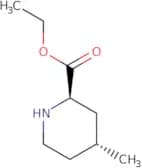
CAS:<p>Ethyl (2R,4R)-4-methylpipecolate is an organic compound that can be synthesized from the reaction of ethyl 2-bromoacetate and 4-methylphenol. It has been used as a precursor to medicines and intermediates. The reaction can be carried out in an alkaline environment at high temperature with a transfer catalyst, such as palladium on charcoal. The reaction time is dependent on the efficiency of the transfer and microreactor. Ethyl (2R,4R)-4-methylpipecolate is hydrolyzed to give 2-(ethoxycarbonyl)propionic acid by hydrolysis with water or base.</p>Formula:C9H17NO2Purity:Min. 95%Color and Shape:Colourless to light yellow liquid.Molecular weight:171.24 g/mol