Amino Acids (AA)
Subcategories of "Amino Acids (AA)"
- Amino Acid Derivatives(4,015 products)
- Amino Acid and Amino Acid Related Compounds(3,490 products)
- Amino Acids with Oxygen or Sulphur(168 products)
- Boc- Amino Acids(351 products)
- Fmoc Amino Acids(1,710 products)
Found 38368 products of "Amino Acids (AA)"
Fmoc-Met-Wang resin (200-400 mesh)
Please enquire for more information about Fmoc-Met-Wang resin (200-400 mesh) including the price, delivery time and more detailed product information at the technical inquiry form on this page
Purity:Min. 95%FA-Ala-OSu
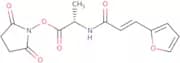
CAS:Please enquire for more information about FA-Ala-OSu including the price, delivery time and more detailed product information at the technical inquiry form on this pageFormula:C14H14N2O6Purity:Min. 95%Molecular weight:306.27 g/molH-His-His-OH trifluoroacetate salt
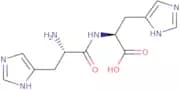
CAS:H-His-His-OH trifluoroacetate salt is a compound that has been extensively studied for its potential use in antimicrobial peptides. It is a small molecule that inhibits the activity of enzymes by binding to a specific region on the enzyme's surface, thereby preventing the progression of an essential chemical reaction. H-His-His-OH trifluoroacetate salt has been shown to inhibit protein synthesis in bacteria and yeast cells, as well as in model systems. The inhibition of protein synthesis may be due to hydrogen bonding between the hydroxyl group on His and the amino groups on His. H-His-His-OH trifluoroacetate salt also has an inhibitory effect on enzymes catalysis and can enhance their activity when used with another substrate.Formula:C12H16N6O3Purity:Min. 95%Molecular weight:292.29 g/molH-Glu-Glu-Glu-OH
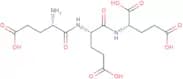
CAS:H-Glu-Glu-Glu-OH is an amino acid sequence that has been shown to have low toxicity and a high therapeutic index. It is a carboxyl group containing oligopeptide, which can be used as a treatment agent for various conditions. H-Glu-Glu-Glu-OH has an amino group and acidic side chain at the COOH terminus, which is responsible for its protonated form. This protonated form of H-Glu-Glu-Glu-OH binds to the follicle cells in the ovaries, inhibiting them from releasing eggs. The carboxyl terminus of H-Glu-Glu-Glgol OH is deprotonated, which allows it to bind to the cell membrane surface of cancer cells and inhibit their growth by interfering with protein synthesis.
Formula:C15H23N3O10Purity:Min. 95%Molecular weight:405.36 g/molSomatostatin-14 (7-14) trifluoroacetate salt
CAS:Please enquire for more information about Somatostatin-14 (7-14) trifluoroacetate salt including the price, delivery time and more detailed product information at the technical inquiry form on this pageFormula:C49H66N10O12SPurity:Min. 95%Molecular weight:1,019.17 g/mol(Nle 35)-Amyloid b-Protein (1-42) ammonium salt
CAS:Please enquire for more information about (Nle 35)-Amyloid b-Protein (1-42) ammonium salt including the price, delivery time and more detailed product information at the technical inquiry form on this pageFormula:C204H313N55O60Purity:Min. 95%Molecular weight:4,496 g/molH-Gly-Glu-Gly-OH trifluoroacetic acid
CAS:H-Gly-Glu-Gly-OH trifluoroacetic acid is a dilute buffer solution of amino acids. It has been used to study the thermodynamic stability of polypeptides and their sensitivity to acidic conditions. Experiments have shown that H-Gly-Glu-Gly-OH trifluoroacetic acid is more stable than glycine, glutamic acid, histidine, aspartic acid, or aspartyl. This compound is an amino acid with a high concentration of glutamic acid.Formula:C9H15N3O6•(CF3CO2H)xPurity:Min. 95%Molecular weight:261.23 g/molSomatostatin-14 (reduced)
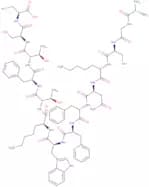
CAS:Somatostatin-14 (reduced) H-Ala-Gly-Cys-Lys-Asn-Phe-Phe-Trp-Lys-Thr-Phe-Thr-Ser-Cys is a synthetic peptide that is an adjuvant for vaccines. It induces a biphasic response by increasing the humoral immune response and decreasing the cellular immune response. Somatostatin has been shown to decrease the severity of symptoms in patients with psychiatric disorders and can be used as a long term treatment for these conditions. Somatostatin also has effects on the pancreas, such as inhibiting insulin release, leading to decreased blood glucose levels. Its disulfide bond in its structure may be important for its activity and stability.Formula:C76H106N18O19S2Purity:Min. 95%Molecular weight:1,639.9 g/molH-D-Ala-Gln-OH
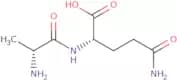
CAS:H-D-Ala-Gln-OH is a modified structural analog of l-fucose that has been shown to be a potent immunostimulant in vitro. The hydrocarbon chain on this molecule is substituted with an H-D-Ala moiety, which provides the molecule with a hydroxyl group. This modification increases the solubility of the molecule, thereby making it more suitable for in vivo administration. Additionally, modifications to the hydrocarbon chain may have functional consequences on the molecule's activity (e.g., substitutions may increase or decrease its ability to induce interleukin).Formula:C8H15N3O4Purity:Min. 95%Molecular weight:217.22 g/mol(D-Leu6,Pro-NHEt 9)-LHRH (4-9)
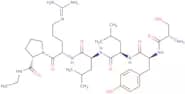
CAS:Please enquire for more information about (D-Leu6,Pro-NHEt 9)-LHRH (4-9) including the price, delivery time and more detailed product information at the technical inquiry form on this pageFormula:C37H62N10O8Purity:Min. 95%Molecular weight:774.95 g/molH-Arg-Arg-OH acetate salt
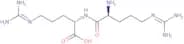
CAS:H-Arg-Arg-OH acetate salt is a protease inhibitor. It has been shown to inhibit the activity of serine proteases, such as trypsin and chymotrypsin, in vitro. H-Arg-Arg-OH acetate salt binds to the active site of the enzyme and prevents substrate binding. The acidity of the environment where this inhibitor is active can be used to control its activity. At acidic pH, H-Arg-Arg-OH acetate salt is more potent than at neutral pH. When it comes into contact with a protein substrate, H-Arg-Arg-OH acetate salt will bind to a hydroxyl group on the protein molecule and prevent it from hydrolyzing its substrate. This process can be reversed by adding an alkaline buffer to increase the pH of the system or by adding an acid buffer to decrease it.br>br> H-Arg-Arg-OH acetate salt is found in cyanobFormula:C12H26N8O3Purity:Min. 95%Molecular weight:330.39 g/molFor-Met-Phe-OH
CAS:For-Met-Phe-OH is a synthetic peptide that mimics the amino acid sequence of the human body's natural collagen. It is used as a building block for developing collagen gels, which are used in clinical pathology to identify and quantify cells. For-Met-Phe-OH has been shown to stimulate colony-stimulating factor, which regulates cell proliferation and differentiation. This peptide also plays a role in cell signaling pathways that regulate cell growth and differentiation. For-Met-Phe-OH has been shown to have anti-inflammatory effects by inhibiting the production of inflammatory cytokines.Formula:C15H20N2O4SPurity:Min. 95%Molecular weight:324.4 g/molGastric Inhibitory Polypeptide (1-30) amide (porcine)
CAS:Please enquire for more information about Gastric Inhibitory Polypeptide (1-30) amide (porcine) including the price, delivery time and more detailed product information at the technical inquiry form on this pageFormula:C162H245N41O47SPurity:Min. 95%Molecular weight:3,550.99 g/molFmoc-His(Boc)-OPfp
CAS:The Fmoc-His(Boc)-OPfp is a synthetic peptide that has been shown to bind to angiotensin. It is chemically reactive and can be used in diagnostic assays for the detection of angiotensin. The Fmoc-His(Boc)-OPfp can also be used as a feedback control for sequence analysis, where it monitors the reaction sequence by binding to the last amino acid in the peptide. This binding prevents the formation of an enzyme with the enzyme reaction necessary for cell wall biosynthesis, inhibiting protein synthesis and cell division.Formula:C32H26F5N3O6Purity:Min. 95%Molecular weight:643.56 g/molBoc-D-Cys(NPys)-OH
CAS:Please enquire for more information about Boc-D-Cys(NPys)-OH including the price, delivery time and more detailed product information at the technical inquiry form on this pageFormula:C13H17N3O6S2Purity:Min. 95%Molecular weight:375.42 g/molAc-Ser-Gln-Asn-Tyr-OH
CAS:Ac-Ser-Gln-Asn-Tyr-OH is an oligopeptide that is a substrate for enzymes that catalyze the hydrolysis of peptides. Ac-Ser-Gln-Asn-Tyr-OH has been shown to be an effective inhibitor of elastase and other proteases, with a kinetic mechanism involving a serine residue at position 1 as the nucleophile. This inhibitor binds to the active site of elastase and prevents access by the substrate. Acetylation at the C terminus may increase solubility, while substitution of tyrosine with a phenylalanine or tryptophan residue increases inhibitory activity. The optimum pH for this enzyme is around 7, while it’s inorganic nature makes it less sensitive to organic solvents.
Formula:C23H32N6O10Purity:Min. 95%Molecular weight:552.53 g/molH-Gly-Arg-Gly-Asp-Ser-Cys-OH trifluoroacetate salt
CAS:H-Gly-Arg-Gly-Asp-Ser-Cys-OH trifluoroacetate salt is a photoelectron that binds to the integrin receptor. It has been shown that H-Gly-Arg-Gly-Asp-Ser-Cys-OH trifluoroacetate salt can inhibit protein synthesis in mesenchymal stromal cells. H Gly Arg Gly Asp Ser Cys OH trifluoroacetate salt can also be used as a reagent to determine the presence of amide bonds and to identify proteins. This compound may have biotechnological applications due to its biochemical properties.Formula:C20H35N9O10SPurity:Min. 95%Molecular weight:593.61 g/mol(p-Iodo-Phe7)-ACTH (4-10)
CAS:Please enquire for more information about (p-Iodo-Phe7)-ACTH (4-10) including the price, delivery time and more detailed product information at the technical inquiry form on this page
Formula:C44H58IN13O10SPurity:Min. 95%Molecular weight:1,087.98 g/molH-Lys-Cys-Thr-Cys-Cys-Ala-OH trifluoroacetate salt
CAS:H-Lys-Cys-Thr-Cys-Cys-Ala-OH trifluoroacetate salt (KCTA) is a peptide that belongs to the group of thioneins and is characterized by a high content of lysine, cysteine and histidine residues. This peptide has been shown to be effective in treating subcutaneous tumors in mice. KCTA binds to metallothionein and gamma amino butyric acid (GABA), which are proteins that regulate energy metabolism in cells. KCTA has also been shown to have antimicrobial effects against human serum, which may be due to its ability to bind with thionein.
Formula:C22H41N7O8S3Purity:Min. 95%Molecular weight:627.8 g/molNazumamide A
CAS:Nazumamide A is a cyclic peptide with inhibitory activity against serine proteases. It binds to the active site of thrombin and inhibits its action, thereby inhibiting the fibrinogen degradation in blood. Nazumamide A is also found to have neuroprotective properties, which may be due to its ability to inhibit nitric oxide production by binding to the enzyme nitric oxide synthase. It has been shown to have anti-inflammatory activities and can be used for the treatment of inflammation-associated diseases such as asthma and arthritis. Nazumamide A is a nonribosomal peptide that does not require any cofactors for synthesis.
Formula:C28H43N7O8Purity:Min. 95%Molecular weight:605.68 g/mol