


Amino Acids (AA)
Amino acids (AAs) are the fundamental building blocks of proteins, playing a crucial role in various biological processes. These organic compounds are essential for protein synthesis, metabolic pathways, and cell signaling. In this category, you will find a comprehensive range of amino acids, including essential, non-essential, and modified forms, which are vital for research in biochemistry, molecular biology, and nutritional sciences. At CymitQuimica, we provide high-quality amino acids to support your research and development needs, ensuring accuracy and reliability in your experimental outcomes.
Subcategories of "Amino Acids (AA)"
- Amino Acid Derivatives(4,015 products)
- Amino Acid and Amino Acid Related Compounds(3,490 products)
- Amino Acids with Oxygen or Sulphur(168 products)
- Boc- Amino Acids(351 products)
- Fmoc Amino Acids(1,710 products)
Found 38369 products of "Amino Acids (AA)"
Sort by
Purity (%)
0
100
|
0
|
50
|
90
|
95
|
100
H-Gly-Arg-Ala-Asp-Ser-Pro-Lys-OH acetate salt
CAS:Glycine-arginine-aspartate (GAA) is a mimic of the endothelium-derived vasoactive peptide, nitric oxide (NO). It has been shown to attenuate the inflammatory response by decreasing leukocyte adhesion and migration. GAA is also a potent inhibitor of vascular permeability and can attenuate edema in animal models. Studies have shown that GAA prevents microvascular damage following brain infarction. The mechanism of action for GAA is not fully understood, but it may be due to its ability to inhibit fibronectin breakdown, which leads to cerebral edema. GAA's activity on the endothelium may be due to its ability to mimic NO or inhibit sulfate synthesis.Formula:C29H51N11O11Purity:Min. 95%Molecular weight:729.78 g/mol(Lys22)-Amyloid b-Protein (1-40) trifluoroacetate salt
CAS:Please enquire for more information about (Lys22)-Amyloid b-Protein (1-40) trifluoroacetate salt including the price, delivery time and more detailed product information at the technical inquiry form on this pageFormula:C195H300N54O56SPurity:Min. 95%Molecular weight:4,328.86 g/molAc-Glu-Asp(EDANS)-Lys-Pro-Ile-Leu-Phe-Phe-Arg-Leu-Gly-Lys(DABCYL)-Glu-NH2 trifluoroacetate salt
CAS:Please enquire for more information about Ac-Glu-Asp(EDANS)-Lys-Pro-Ile-Leu-Phe-Phe-Arg-Leu-Gly-Lys(DABCYL)-Glu-NH2 trifluoroacetate salt including the price, delivery time and more detailed product information at the technical inquiry form on this pageFormula:C104H146N24O23SPurity:Min. 95%Molecular weight:2,132.49 g/molAdrenomedullin (16-31) (human, pig)
CAS:Please enquire for more information about Adrenomedullin (16-31) (human, pig) including the price, delivery time and more detailed product information at the technical inquiry form on this pageFormula:C82H129N25O21S2Purity:Min. 95%Molecular weight:1,865.19 g/molPAR-2 (6-1) amide (mouse, rat) trifluoroacetate salt
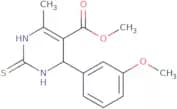
CAS:PAR-2 (6-1) amide is a proteolytic enzyme that is activated by inflammatory stimuli. It has been shown to be a major contributor to the pathogenesis of inflammatory bowel disease, and is found in neurons, the bowel, and pancreatic acinar cells. PAR-2 (6-1) amide activates proteases such as trypsin and chymotrypsin and also functions as an antimicrobial peptide. Activation of PAR-2 (6-1) amide leads to the cleavage of proteins at specific sites on their amino acid chains. This cleavage can lead to changes in protein conformation or function. PAR-2 (6-1) amide has been shown to increase endothelial cell proliferation and inhibit bacterial growth, but does not have any effect on cultured normal human skin fibroblasts.Formula:C29H56N10O7Purity:Min. 95%Molecular weight:656.82 g/molMethyl 4-(3-methoxyphenyl)-6-methyl-2-thioxo-1,2,3,4-tetrahydropyrimidine-5-carboxylate
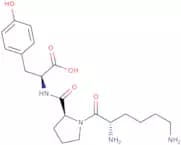
CAS:Please enquire for more information about Methyl 4-(3-methoxyphenyl)-6-methyl-2-thioxo-1,2,3,4-tetrahydropyrimidine-5-carboxylate including the price, delivery time and more detailed product information at the technical inquiry form on this pageFormula:C14H16N2O3SPurity:85%MinMolecular weight:292.35 g/molH-Lys-Pro-Tyr-OH acetate salt
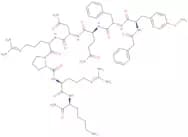
CAS:Please enquire for more information about H-Lys-Pro-Tyr-OH acetate salt including the price, delivery time and more detailed product information at the technical inquiry form on this pageFormula:C20H30N4O5Purity:Min. 95%Molecular weight:406.48 g/mol(Phenylac 1,D-Tyr(Me)2,Arg6·8,Lys-NH29)-Vasopressin
CAS:Please enquire for more information about (Phenylac 1,D-Tyr(Me)2,Arg6·8,Lys-NH29)-Vasopressin including the price, delivery time and more detailed product information at the technical inquiry form on this pageFormula:C59H86N18O12Purity:Min. 95%Molecular weight:1,239.43 g/mol(Trp11,D-Phe15·16)-SDF-1 (7-16) (Dimer) (human, cat, mouse) trifluoroacetate salt
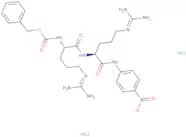
Please enquire for more information about (Trp11,D-Phe15·16)-SDF-1 (7-16) (Dimer) (human, cat, mouse) trifluoroacetate salt including the price, delivery time and more detailed product information at the technical inquiry form on this pageFormula:C134H180N34O26S2Purity:Min. 95%Molecular weight:2,747.21 g/molZ-Arg-Arg-pNA·2 HCl
CAS:Please enquire for more information about Z-Arg-Arg-pNA·2 HCl including the price, delivery time and more detailed product information at the technical inquiry form on this pageFormula:C26H36N10O6·2HClPurity:Min. 95%Molecular weight:657.55 g/molRF9 trifluoroacetate salt
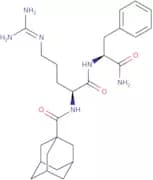
CAS:RF9 is a dipeptide that is structurally similar to the endogenous neuropeptides kisspeptin and arginine-vasopressin. RF9 binds to the GPR54 receptor, which is a G protein-coupled receptor that regulates secretion of luteinizing hormone in the anterior pituitary gland, as well as sexual desire and function. RF9 has been shown to be an antagonist of the GPR54 receptor and has been shown to inhibit the secretion of luteinizing hormone in primates.Formula:C26H38N6O3Purity:Min. 95%Molecular weight:482.62 g/molAdipokinetic Hormone (Apis mellifera ligustica) TFA salt
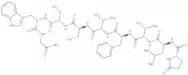
CAS:Adipokinetic hormone is a peptide hormone that has been shown to stimulate the metabolism of fat cells in laboratory animals. This peptide is produced by the gland cells of honeybees and is used to regulate the energy metabolism of honeybees and other insects. Adipokinetic hormone has been shown to increase locomotor activity, inhibit the growth of human pathogens, activate transfer reactions, and inhibit receptor activity. The biological properties of this hormone have not yet been fully elucidated.Formula:C47H65N11O14•C2HF3O2Purity:Min. 95 Area-%Color and Shape:PowderMolecular weight:1,122.10 g/molH-Leu-Val-Leu-Ala-pNA
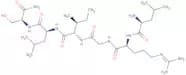
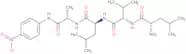
CAS:Please enquire for more information about H-Leu-Val-Leu-Ala-pNA including the price, delivery time and more detailed product information at the technical inquiry form on this pageFormula:C26H42N6O6Purity:Min. 95%Molecular weight:534.65 g/molMca-Gly-Ala-Lys(Ac)-Arg-His-Arg-Lys-Val-NH2 trifluoroacetate salt
CAS:Please enquire for more information about Mca-Gly-Ala-Lys(Ac)-Arg-His-Arg-Lys-Val-NH2 trifluoroacetate salt including the price, delivery time and more detailed product information at the technical inquiry form on this pageFormula:C54H85N19O13Purity:Min. 95%Molecular weight:1,208.37 g/molCionin
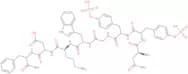
CAS:Cionin is a synthetic peptide that binds to the pancreatic enzyme receptor. It has been shown to inhibit the growth of ascidian and stimulates the secretion of growth factors in vitro. Cionin also has a physiological effect on inflammatory diseases, such as ovary. Cionin is composed of three amino acids: H-Asn-Tyr(SO3H)-Tyr(SO3H)-Gly-Trp-Met-Asp-Phe-NH2. The first two amino acids are sulfated tyrosine residues, which may be responsible for its biological activity.Formula:C53H63N11O19S3Purity:Min. 95%Molecular weight:1,254.33 g/molUrechistachykinin I
CAS:Urechistachykinin I is a diagnostic agent that has been used to detect the presence of bacteria in human serum. It is a peptide analog that is derived from the amino acid sequence of urechistachykinin and has been shown to have receptor activity for inflammatory diseases. The urechistachykinin I molecule can be conjugated with an antibody or other reactive molecule, which allows for its detection in biological fluids. Urechistachykinin I has been shown to inhibit the growth of stenotrophomonas maltophilia, and can be used as a diagnostic agent for this bacterial infection.Formula:C50H85N19O14Purity:Min. 95%Molecular weight:1,176.33 g/molFmoc-4,5-dehydro-L-leucine
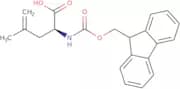
CAS:Please enquire for more information about Fmoc-4,5-dehydro-L-leucine including the price, delivery time and more detailed product information at the technical inquiry form on this pageFormula:C21H21NO4Purity:Min. 95%Color and Shape:PowderMolecular weight:351.4 g/molH-Ile-2-chlorotrityl resin (200-400 mesh)
Please enquire for more information about H-Ile-2-chlorotrityl resin (200-400 mesh) including the price, delivery time and more detailed product information at the technical inquiry form on this pagePurity:Min. 95%H-Lys-Lys-Glu-Asp-Val-Val-Abu-Cys-Ser-Abu-Ser-Tyr-Lys-Lys-NH2
CAS:Please enquire for more information about H-Lys-Lys-Glu-Asp-Val-Val-Abu-Cys-Ser-Abu-Ser-Tyr-Lys-Lys-NH2 including the price, delivery time and more detailed product information at the technical inquiry form on this page
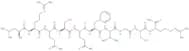
Formula:C69H119N19O21SPurity:Min. 95%Molecular weight:1,582.86 g/molN-Acetyl-[Cys4,10, D-Phe7]-alpha-Melanocyte Stimulating Hormone Fragment 4-13
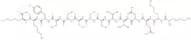
CAS:Please enquire for more information about N-Acetyl-[Cys4,10, D-Phe7]-alpha-Melanocyte Stimulating Hormone Fragment 4-13 including the price, delivery time and more detailed product information at the technical inquiry form on this pageFormula:C61H86N18O13S2Purity:Min. 95%Molecular weight:1,343.58 g/mol



![N-Acetyl-[Cys4,10, D-Phe7]-alpha-Melanocyte Stimulating Hormone Fragment 4-13](/_next/image/?url=https%3A%2Fstatic.cymitquimica.com%2Fproducts%2F3D%2Fthumb-webp%2FFA110402.webp&w=3840&q=75)