Amino Acids (AA)
Subcategories of "Amino Acids (AA)"
- Amino Acid Derivatives(4,017 products)
- Amino Acid and Amino Acid Related Compounds(3,491 products)
- Amino Acids with Oxygen or Sulphur(168 products)
- Boc- Amino Acids(351 products)
- Fmoc Amino Acids(1,710 products)
Found 38387 products of "Amino Acids (AA)"
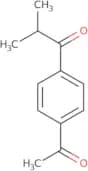
1-(4-Acetylphenyl)-2-methyl-1-propanone
CAS:1-(4-Acetylphenyl)-2-methyl-1-propanone (AMP) is a synthetic analgesic that has been evaluated for the treatment of pain. It is primarily used in pharmaceuticals and medicinal preparations, as well as being a common solvent in chemical syntheses. AMP has been shown to be an effective treatment for joint pain, muscle pain, and other types of pain. The mechanism of action for this compound is unknown but may involve the inhibition of an enzyme called hydratropic acid group. This molecule also has a carboxylic acid group that undergoes detoxification through elemental analysis or mechanochemistry.
Formula:C12H14O2Purity:Min. 95%Molecular weight:190.24 g/molRef: 3D-FA17159
Discontinued productNeurokinin B trifluoroacetate salt
CAS:Neurokinin B trifluoroacetate salt H-Asp-Met-His-Asp-Phe-Phe-Val-Gly-Leu-Met-NH2 trifluoroacetate salt is a synthetic peptide that is a potent and selective antagonist of the NMDA receptor. Neurokinin B trifluoroacetate salt H-Asp-Met-His-Asp-Phe-Phe-Val-Gly-Leu-Met NH2 trifluoroacetate salt has been shown to be effective in animal models of chronic pain, neuropathic pain, and bone age delay. This synthetic peptide has also been shown to be effective in the treatment of squamous cell carcinoma and acid lesions in human subjects. The molecular weight of this compound is 624.6 g/mol.br> Neurokinin B trifluoroacetate salt H Asp Met His Asp PFormula:C55H79N13O14S2Purity:Min. 95%Molecular weight:1,210.43 g/molRef: 3D-FN108584
Discontinued productH-[15N]Tyr-OH
CAS:H-[15N]Tyr-OH is a metabolite of tyrosine. It is the conjugate acid of propionic acid, and the conjugate base of 4-hydroxybenzyl. H-[15N]Tyr-OH is a phenylalanine and aromatic amino acid that has an aromatic ring with a phenyl substituent. This metabolite is hydroxy, which means it has one hydroxyl group on the phenyl ring. H-[15N]Tyr-OH binds to daphnia in vivo, causing death. The cause for this may be due to its ability to react with oxygen, forming reactive oxygen species (ROS).
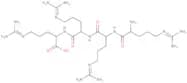
Purity:Min. 95%H-Arg-Arg-Arg-Arg-OH trifluoroacetate salt
CAS:Trifluoroacetate salt
Formula:C24H50N16O5Purity:Min. 95%Molecular weight:642.76 g/molRef: 3D-FA109279
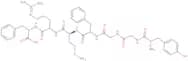
Discontinued productMet-Enkephalin-Arg-Phe
CAS:Met-enkephalin is a 5-hydroxytryptamine (serotonin) agonist. It has been shown to have anesthetic properties and to be active in cardiac, pulmonary, and renal functions. Met-enkephalin has also been found to have a delta-opioid receptor activity. This molecule has been shown to inhibit noradrenaline release from the locus coeruleus, as well as immunohistochemically demonstrating its presence at the atrium of the heart. Met-enkephalin also exhibits hydroxylase activity and has been shown to inhibit dopamine release from the substantia nigra pars compacta and sinoatrial node in rats. This drug can be used for treatment of pain, hypertension, angina pectoris, myocardial infarction, unstable angina, cardiogenic shock, congestive heart failure due to left ventricular dysfunction or ischemia of the coronary artery, acute pulmonary edemaFormula:C42H56N10O9SPurity:Min. 95%Molecular weight:877.02 g/molRef: 3D-FM108789
Discontinued productNecrostatin-1 5-(1
CAS:Necrostatin-1 is a small molecule inhibitor that blocks the NF-κB signaling pathway. Necrostatin-1 is a potent inducer of apoptosis and has been shown to inhibit necroptosis in cell culture. It also blocks the Toll-like receptor 4 (TLR4), which is an important death receptor that causes inflammation. Necrostatin-1 has been found to be effective in reducing injury and death in low doses, but has not been tested for long periods of time or at high doses.
Formula:C13H13N3OSPurity:Min. 95%Molecular weight:259.33 g/molRef: 3D-FN111188
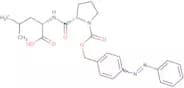
Discontinued productPz-Pro-Leu-OH
CAS:Pz-Pro-Leu-OH is a proteolytic enzyme that cleaves proteins by hydrolysis at the peptide bond. It has been shown to be active against Clostridium and has been used in colorimetric methods for the measurement of this bacterium. Pz-Pro-Leu-OH is produced by subtilisin, which is expressed in Escherichia coli. The amount of this enzyme can be monitored and optimized by cloning. Thermolysin, another protease, also cleaves proteins at the peptide bond and has been used to measure the activity of Pz-Pro-Leu-OH.
Formula:C25H30N4O5Purity:Min. 95%Molecular weight:466.53 g/molRef: 3D-FP108150
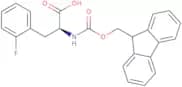
Discontinued productFmoc-2-fluoro-L-phenylalanine
CAS:Please enquire for more information about Fmoc-2-fluoro-L-phenylalanine including the price, delivery time and more detailed product information at the technical inquiry form on this page
Formula:C24H20FNO4Purity:Min. 95%Color and Shape:PowderMolecular weight:405.42 g/molL-Tyrosine dipotassium
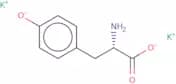
CAS:L-Tyrosine dipotassium salt is a high quality, reagent, complex compound, useful intermediate and fine chemical. It is a useful scaffold that can be used in the synthesis of various important natural products. L-Tyrosine dipotassium salt is a versatile building block that has been widely applied in research on the development of new drugs, such as antiviral agents and antibiotics. L-Tyrosine dipotassium salt can act as a reaction component for many organic reactions. It also has applications in many areas such as medicine, food production, and environmental protection.
Formula:C9H11NO3•K2Purity:Min. 95%Molecular weight:259.39 g/molFmoc-Gln(Trt)-Wang resin (200-400 mesh)
Please enquire for more information about Fmoc-Gln(Trt)-Wang resin (200-400 mesh) including the price, delivery time and more detailed product information at the technical inquiry form on this page
Purity:Min. 95%Ref: 3D-FF111667
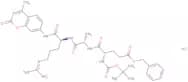
Discontinued productBoc-Glu(OBzl)-Ala-Arg-AMC·HCl
CAS:Please enquire for more information about Boc-Glu(OBzl)-Ala-Arg-AMC·HCl including the price, delivery time and more detailed product information at the technical inquiry form on this page
Formula:C36H47N7O9·HClPurity:Min. 95%Molecular weight:758.26 g/molRef: 3D-FB110555
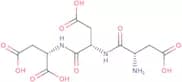
Discontinued productH-Asp-Asp-Asp-OH
CAS:H-Asp-Asp-Asp-OH is a peptide that has been shown to disrupt the cytosol and cause apoptosis. It can also induce proteolytic maturation and modulate autocatalytic functions. H-Asp-Asp-Asp-OH induces apoptosis by activating caspase 9 and caspase 3, which cleaves poly (ADP ribose) polymerase (PARP). This leads to DNA fragmentation, chromatin condensation, nuclear fragmentation, cell shrinkage, membrane blebbing, and nuclear pyknosis. H-Asp-Asp-Asp-OH binds to the regulatory domain of caspase 9 and prevents it from being activated. The peptide also activates caspase 8 by binding to its regulatory domain, which then activates caspases 3 and 7. H-Asp-Asp-Asp-OH also stimulates the release of granzyme B from cytot
Formula:C12H17N3O10Purity:Min. 95%Molecular weight:363.28 g/molRef: 3D-FA110342
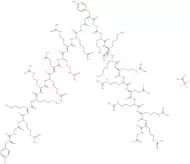
Discontinued productTAT 2-4 trifluoroacetate salt
CAS:Trifluoroacetate saltFormula:C132H240N66O29Purity:Min. 95%Molecular weight:3,215.75 g/molRef: 3D-FT110195
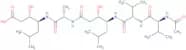
Discontinued productAcetyl-Pepstatin Ac-Val-Val-Sta-Ala-Sta-OH
CAS:Acetyl-Pepstatin is a protein data inhibitor that binds to the active site of enzymes, inhibiting their function. Acetyl-pepstatin has been shown to inhibit cathepsin D, chymotrypsin, and trypsin. It also inhibits the activity of proteases in the stomach and intestinal tract. Acetyl-Pepstatin is used as an anti-inflammatory drug for the treatment of chronic obstructive pulmonary disease (COPD) and congestive heart failure (CHF). The inhibition of these enzymes reduces inflammation by preventing the activation of inflammatory cytokines. It also prevents collagen from being degraded by proteases, which leads to decreased degradation of cartilage by chondrocytes. This drug's mechanism is similar to that of acetylsalicylic acid (aspirin), in that it inhibits prostaglandin synthesis.br>
Formula:C31H57N5O9Purity:Min. 95%Molecular weight:643.81 g/molRef: 3D-FA111026
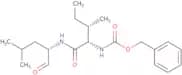
Discontinued productZ-Ile-Leu-aldehyde
CAS:Please enquire for more information about Z-Ile-Leu-aldehyde including the price, delivery time and more detailed product information at the technical inquiry form on this page
Formula:C20H30N2O4Purity:Min. 95%Molecular weight:362.46 g/molRef: 3D-FI111102
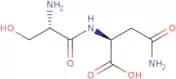
Discontinued productH-Ser-Asn-OH
CAS:H-Ser-Asn-OH is a fatty acid that belongs to the amide group. It has an inhibitory effect on bacterial membranes, which can be seen in the x-ray crystal structures of H-Ser-Asn-OH cocrystallized with lipids from the bacterial membrane. The inhibition of bacterial membranes is due to its ability to bind strongly to the phospholipid head group and reduce the fluidity of the membrane. H-Ser-Asn-OH has also been shown to have a diagnostic effect on tissues and monolayers in vitro.
Formula:C7H13N3O5Purity:Min. 95%Molecular weight:219.2 g/molRef: 3D-FS108169
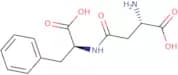
Discontinued productH-Asp(Phe-OH)-OH
CAS:Aspartame is a synthetic, sweetener that is used as a sugar substitute in diet products. It was discovered by accident in 1965 when James Schlatter, a chemist of G.D. Searle Company, was testing an anti-ulcer drug and l-phenylalanine methyl ester on his finger and tasted the sweetness on his fingers. Aspartame is composed of two amino acids: aspartic acid and phenylalanine. The aspartic acid is made up of a carboxylic acid group with an amide functional group. Aspartame can be found in many foods including chewing gum and diet sodas. It has been shown to have no carcinogenic effects or adverse effects on reproduction function in animal studies.
Formula:C13H16N2O5Purity:Min. 95%Color and Shape:White To Off-White SolidMolecular weight:280.28 g/molRef: 3D-FA108328
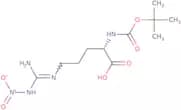
Discontinued productBoc-L-Nitroarginine
CAS:Boc-L-Nitroarginine is a nitric oxide synthase inhibitor that belongs to the class of drugs called nitric oxide inhibitors. It is a potent inhibitor of nitric oxide synthase, preventing the production of nitric oxide from arginine. The drug has been shown to have therapeutic effects in the treatment of cancer, diabetes mellitus, and other diseases. Boc-L-Nitroarginine inhibits tumor angiogenesis by blocking endothelial cell proliferation and migration. It also inhibits insulin secretion, leading to an improved glycemic control in diabetic patients. Boc-L-Nitroarginine can be used as a hydrogenation reducing agent for the synthesis of imatinib and palladium catalysts for hydrogenation reactions.
Formula:C11H21N5O6Purity:Min. 95%Color and Shape:PowderMolecular weight:319.31 g/molRef: 3D-FB39246
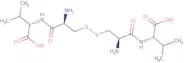
Discontinued product(H-Cys-Val-OH)2 (Disulfide bond)
CAS:Please enquire for more information about (H-Cys-Val-OH)2 (Disulfide bond) including the price, delivery time and more detailed product information at the technical inquiry form on this page
Formula:C16H30N4O6S2Purity:Min. 95%Molecular weight:438.56 g/molRef: 3D-FC108021
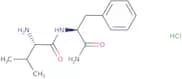
Discontinued productH-Val-Phe-NH2·HCl
CAS:Please enquire for more information about H-Val-Phe-NH2·HCl including the price, delivery time and more detailed product information at the technical inquiry form on this page
Formula:C14H21N3O2·HClPurity:Min. 95%Molecular weight:299.8 g/molRef: 3D-FV108232
Discontinued product


![H-[15N]Tyr-OH](/_next/image/?url=https%3A%2Fstatic.cymitquimica.com%2Fproducts%2F3D%2Fthumb-webp%2FFT107850.webp&w=3840&q=75)