Peptides
Subcategories of "Peptides"
Found 29634 products of "Peptides"
TNF-α(71-82), human
Catalogue peptide; min. 95% purity
Formula:C51H91N19O18Molecular weight:1,258.41 g/molBiotin-Angiotensin I, human
Catalogue peptide; min. 95% purity
Formula:C72H103N19O16SMolecular weight:1,522.81 g/molγ-TAC4 (32-50)
Catalogue peptide; min. 95% purity
Formula:C92H146N24O31Molecular weight:2,084.33 g/molLeucopyrokinin (LPK)
Catalogue peptide; min. 95% purity
Formula:C42H66N12O12Molecular weight:931.06 g/molMARCKS Protein (151-175)
Catalogue peptide; min. 95% purity
Formula:C147H243N41O31Molecular weight:3,080.83 g/molMelanotan II, MT-Ⅱ
Catalogue peptide; min. 95% purity
Formula:C50H69N15O9Molecular weight:1,024.2 g/molCecropin A (1-7)-Melittin A (2-9) amide
Catalogue peptide; min. 95% purity
Formula:C89H152N22O15Molecular weight:1,770.34 g/molAmyloid Bri Protein (1-34)
Catalogue peptide; min. 95% purity
Formula:C173H273N49O52S2Molecular weight:3,935.55 g/molDok-5 (263-275)
Catalogue peptide; min. 95% purity
Formula:C75H114N24O19Molecular weight:1,655.89 g/molHIV-gp41-Antigenic Peptide 5
Catalogue peptide; min. 95% purity
Formula:C184H282N56O53S2Molecular weight:4,190.77 g/molα-Gliadin (57-73)
Catalogue peptide; min. 95% purity
Formula:C93H136N22O27Molecular weight:1,994.25 g/mol[Leu144, Arg147]-PLP (139-151), [L144, R147-PLP(139-151)]
Catalogue peptide; min. 95% purity
Formula:C67H110N20O17Molecular weight:1,467.75 g/mol[Gln22]-25359-Amyloid (6-40)
Catalogue peptide; min. 95% purity
Formula:C167H258N46O48SMolecular weight:3,710.26 g/molBiotin-VIP (human, bovine, porcine, rat)
Catalogue peptide; min. 95% purity
Formula:C157H252N46O44S2Molecular weight:3,552.17 g/molGrowth Hormone Releasing Factor, GRF (1-40), amide, human
Catalogue peptide; min. 95% purity
Formula:C194H318N62O62SMolecular weight:4,543.14 g/molPGC-1α (205-216), Proliferator-activated Receptor Coactivator-1 α (205-216)
Catalogue peptide; min. 95% purity
Formula:C65H109N17O19SMolecular weight:1,464.75 g/molParathyroid Hormone (1-34)-Lys(Biotin), human
Catalogue peptide; min. 95% purity
Formula:C197H317N59O54S3Molecular weight:4,472.26 g/molPACAP-27 (6-27) (human, chicken, mouse, ovine, porcine, rat)
CAS:Catalogue peptide; min. 95% purity
Formula:C121H193N33O30SMolecular weight:2,638.15 g/molp3K truncated, (Lys 58 Lys 60 Lys 63) Ea(54-68)
Catalogue peptide; min. 95% purity
Formula:C59H97N17O19Molecular weight:1,348.53 g/molα-Bag Cell Peptide (1-8)
Catalogue peptide; min. 95% purity
Formula:C47H72N14O11Molecular weight:1,009.19 g/molTyr-Leptin (26-39) (human)
CAS:Please enquire for more information about Tyr-Leptin (26-39) (human) including the price, delivery time and more detailed product information at the technical inquiry form on this pageFormula:C80H137N19O25Purity:Min. 95%Molecular weight:1,765.06 g/molRef: 3D-FT109022
Discontinued productbeta-Casomorphin (1-3) amide
Catalogue peptide; min. 95% purity
Formula:C23H28N4O4Molecular weight:424.50 g/molFas C-Terminal Tripeptide
Catalogue peptide; min. 95% purity
Formula:C16H29N3O6Molecular weight:359.43 g/molBAD (103-127), human
Catalogue peptide; min. 95% purity
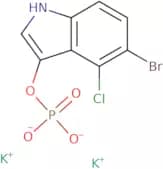
Formula:C137H212N42O39SMolecular weight:3,103.54 g/molBCIP dipotassium
CAS:BCIP (5-bromo-4-chloro-3-indolyl phosphate) dipotassium is a chromogenic substrate commonly used for the detection of the enzymatic activity of alkaline phosphatase. Upon dephosphorylation by alkaline phosphatase, BCIP produces a blue precipitate, which can be easily visualized. This substrate has various uses, including the detection of gene expression in molecular biology, the identification of alkaline phosphatase activity in clinical pathology, and the detection of protein-protein interactions in biochemistry. Its long-term stability in solution makes it a common choice for many applications.
Formula:C8H4BrClK2NO4PPurity:Min. 98 Area-%Color and Shape:PowderMolecular weight:402.65 g/molRef: 3D-EB110885
Discontinued productCalcineurin Autoinhibitory Fragment
Catalogue peptide; min. 95% purity
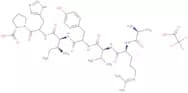
Formula:C124H205N39O39S2Molecular weight:2,930.38 g/molAngiotensin A (1-7) trifluoroacetate
CAS:Endogenous heptapetide which causes vasodilation and has anti-hypertensive properties.
Formula:C40H62N12O9•(C2HF3O2)xPurity:Min. 95%Color and Shape:PowderMolecular weight:855 g/molCerebellin trifluoroacetate
CAS:Please enquire for more information about Cerebellin trifluoroacetate including the price, delivery time and more detailed product information at the technical inquiry form on this page
Formula:C69H113N23O23•(C2HF3O2)4Purity:Min. 95%Molecular weight:2,088.86 g/molRef: 3D-BC184180
Discontinued productH-ASCLYGQLPK-OH
Peptide H-ASCLYGQLPK-OH is a Research Peptide with significant interest within the field academic and medical research. This peptide is available for purchase at Cymit Quimica in multiple sizes and with a specification of your choice.
Formula:C48H76N12O13SMolecular weight:1,079.27 g/molH-GILGFVFTL-OH
CAS:FluM1 (58-66) is a short part of the matrix protein of Influenza A virus which is the most abundant component of this enveloped virus localized under the viral lipid envelope. The GILGFVFTL epitope is highly conserved in Influenza A virus strains at a rate of 93% for 69 strains tested. Human Influenza epitopes may bind MHC molecules and then may be recognized by CD8+ cytotoxic T cells. Applications of FluM1 (58-66): FluM1 (58-66) is used to stimulate CTL responses in peripheral blood mononuclear cells (PBMCs). Then, ELISPOT assay is used to quantify peptide epitope specificity and IFN-γ releasing effector cells. FluM1 (58-66) has shown CTL responses qualified of immunodominant with restriction by HLA-A*02:01. It has also been detected CTL responses when FluM1 (58-66) is restricted by all HLA-C. Therefore, FluM1 (58-66) may help to understand the reaction of immune system against Influenza virus of each populations having different HLA type. FluM1 (58-66) has indeed prompted research to develop T-cell vaccine strategies capable of inducing specific CTL responses in patients upon immunization with Influenza M1 antigenic epitope. MVA-NP+M1 vaccine use GILGFVFTL epitope and is tested in clinical trial. Potential cross-reactivity with HIV-1 p17 Gag (77-85): Moreover, FluM1 (58-66) share similarities with HIV-1 p17 Gag (77-85) which can potentially show a cross-reactivity between these epitopes. It has been demonstrated a cross-reactivity and results suggest that immunity following infection by Influenza virus causes specific immune response to HIV-1 p17 Gag (77-85).
Formula:C49H75N9O11Molecular weight:966.18 g/molCoibamide A
CAS:Please enquire for more information about Coibamide A including the price, delivery time and more detailed product information at the technical inquiry form on this page
Formula:C65H110N10O16Purity:Min. 95%Molecular weight:1,287.65 g/molRef: 3D-BC183236
Discontinued product



![[Leu144, Arg147]-PLP (139-151), [L144, R147-PLP(139-151)]](/_next/image/?url=https%3A%2Fstatic.cymitquimica.com%2Fproducts%2F3D%2Fthumb-webp%2FVAC-00495.webp&w=3840&q=75)
![[Gln22]-25359-Amyloid (6-40)](/_next/image/?url=https%3A%2Fstatic.cymitquimica.com%2Fproducts%2F3D%2Fthumb-webp%2FVAC-00470.webp&w=3840&q=75)






![[Cit5]-TRAP-5](/_next/image/?url=https%3A%2Fstatic.cymitquimica.com%2Fproducts%2F3D%2Fthumb-webp%2FVAC-00717.webp&w=3840&q=75)