Peptides
Peptides are short chains of amino acids linked by peptide bonds, serving as important biological molecules that play key roles in cellular processes. They function as hormones, neurotransmitters, and signaling molecules, and are widely used in therapeutic and diagnostic applications. Peptides are also crucial in research for studying protein interactions, enzyme activities, and cell signaling pathways. At CymitQuimica, we provide a diverse selection of high-quality peptides to support your research and development needs in biotechnology and pharmaceuticals.
Subcategories of "Peptides"
Found 30311 products of "Peptides"
Sort by
Purity (%)
0
100
|
0
|
50
|
90
|
95
|
100
Fmoc-D-Ser(BSi)-OH
CAS:<p>Please enquire for more information about Fmoc-D-Ser(BSi)-OH including the price, delivery time and more detailed product information at the technical inquiry form on this page</p>Formula:C24H31NO5SiPurity:Min. 95%Molecular weight:441.59 g/molZ-N-Me-Ser(tBu)-OH·DCHA
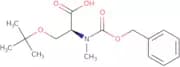
CAS:Please enquire for more information about Z-N-Me-Ser(tBu)-OH·DCHA including the price, delivery time and more detailed product information at the technical inquiry form on this pageFormula:C16H23NO5·C12H23NPurity:Min. 95%Molecular weight:490.68 g/molFmoc-Glu(OtBu)-Thr(psi(Me,Me)pro)-OH
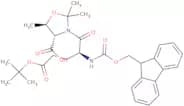
CAS:Fmoc-glu(otbu)-thr(psi(Me,Me)pro)-OH is a c1-6 alkoxy, expressed, alkenyl, linker, c1-6 alkyl, efficiency, sequence that can be used for peptide synthesis. It is an efficient linker for the synthesis of peptides and has been shown to yield high yields with few side products. The hydroxyl group on the side chain of the amino acid residue provides an additional site for acylation. This product also contains an aralkyl and alkoxy group that can be used in further reactions.Formula:C31H38N2O8Purity:Min. 95%Color and Shape:PowderMolecular weight:566.64 g/molGAP 26 trifluoroacetate salt
CAS:13-mer connexin mimetic peptide, composed of residue numbers 63-75 of the first extracellular loop of connexin 43 (gap junction blocker), containing the SHVR amino acid motif.Formula:C70H107N19O19SPurity:Min. 95%Molecular weight:1,550.78 g/molWRW4
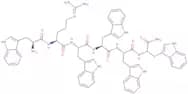
CAS:Please enquire for more information about WRW4 including the price, delivery time and more detailed product information at the technical inquiry form on this pageFormula:C61H65N15O6Purity:Min. 95%Molecular weight:1,104.27 g/molAmyloid beta-Protein (25-35) trifluoroacetate salt
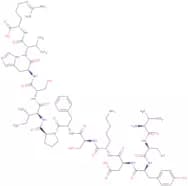
CAS:<p>Amyloid beta-protein (Aβ) is a protein that is a major component of amyloid plaques in the brains of people with Alzheimer's disease. Aβ-Protein (25-35) trifluoroacetate salt, also known as Aβ(25-35), is an amyloid beta protein fragment that has been shown to inhibit neuronal death and increase antioxidative properties in human serum. It has been shown to have anti-apoptotic effects by inhibiting the activation of caspases and the release of cytochrome C from mitochondria. This drug may have physiological effects on the central nervous system due to its ability to induce apoptosis through mitochondrial membrane depolarization and cytosolic calcium levels. It has been shown to be active against Chinese herb Pueraria lobata and cell lysis, as well as granule neurons in culture. It may also stimulate phosphorylation of p38mapk and induce logarithmic growth</p>Formula:C45H81N13O14SPurity:Min. 95%Color and Shape:PowderMolecular weight:1,060.27 g/molHuman ACTH(18-39) trifluoroacetate
CAS:<p>Please enquire for more information about Human ACTH(18-39) trifluoroacetate including the price, delivery time and more detailed product information at the technical inquiry form on this page</p>Formula:C112H165N27O36•(C2HF3O2)xH-Pro-Thr-Glu-Phe-p-nitro-Phe-Arg-Leu-OH
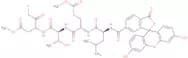
CAS:H-Pro-Thr-Glu-Phe-p-nitro-Phe-Arg-Leu-OH is a proteolytic inhibitor that inhibits the aspartic and hydrolytic enzymes. It has been shown to inhibit the activity of trypsin, pepsin, and elastase in human serum. This inhibitor also inactivates fibronectin by proteolysis. H-Pro-Thr-Glu-Phe-p-nitro-Phe-Arg-Leu OH has been shown to be specific for acidic proteases such as pepsin. The natural inhibitors of this peptide are Pro, Thr, Glu, Phe, Arg and Leu.Formula:C44H63N11O13Purity:Min. 95%Color and Shape:PowderMolecular weight:954.04 g/molFluorescein-6-carbonyl-Leu-Glu(OMe)-Thr-DL-Asp(OMe)-fluoromethylketone
CAS:<p>Please enquire for more information about Fluorescein-6-carbonyl-Leu-Glu(OMe)-Thr-DL-Asp(OMe)-fluoromethylketone including the price, delivery time and more detailed product information at the technical inquiry form on this page</p>Formula:C43H47FN4O15Purity:Min. 95%Molecular weight:878.85 g/molH-Gly-2-chlorotrityl resin (200-400 mesh) (Low Substitution)
CAS:<p>Please enquire for more information about H-Gly-2-chlorotrityl resin (200-400 mesh) (Low Substitution) including the price, delivery time and more detailed product information at the technical inquiry form on this page</p>Purity:Min. 95%Fluorescein-6-carbonyl-Leu-Glu(OMe)-His-DL-Asp(OMe)-fluoromethylketone
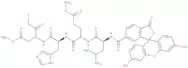
CAS:<p>Please enquire for more information about Fluorescein-6-carbonyl-Leu-Glu(OMe)-His-DL-Asp(OMe)-fluoromethylketone including the price, delivery time and more detailed product information at the technical inquiry form on this page</p>Formula:C45H47FN6O14Purity:Min. 95%Molecular weight:914.89 g/molProcollagen Type I (212-216) H-Lys-Thr-Thr-Lys-Ser-OH
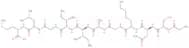
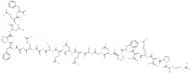
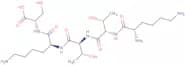
CAS:<p>Procollagen type I (212-216) H-Lys-Thr-Thr-Lys-Ser-OH is a tetrapeptide that is the most abundant component of human skin. It has been shown to have biological properties and can be synthesized in vitro. Procollagen type I (212-216) H-Lys-Thr-Thr-Lys-Ser-OH has an absorption maximum at 265 nm, which makes it suitable for use in uv protection creams. It also has a high chemical stability and can be stored for up to two years without degradation. Procollagen type I (212-216) H-Lys-Thr-Thr-Lys-Ser-OH is used as a substrate in cell culture to study protein synthesis and transcription, or polymerase chain reaction, technique. This peptide also inhibits the activity of proteases such as trypsin and chymotrypsin, making</p>Formula:C23H45N7O9Purity:Min. 95%Color and Shape:White Off-White PowderMolecular weight:563.65 g/molDABCYL-Lys-HCoV-SARS Replicase Polyprotein 1ab (3235-3246)-Glu-EDANS trifluoroacetate salt
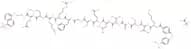
CAS:DABCYL-Lys-HCoV-SARS Replicase Polyprotein 1ab (3235-3246)-Glu-EDANS trifluoroacetate salt is a fluorescent substrate for the SARS coronavirus. This compound is an inhibitor of the enzyme that is the target of a drug candidate that inhibits the replication of this virus. Molecular docking studies have shown that DABCYL-Lys-HCoV-SARS Replicase Polyprotein 1ab (3235-3246)-Glu-EDANS trifluoroacetate salt binds to 3clpro, which is part of the active site of the enzyme’s catalytic pocket. Inhibition activity was seen in experiments using recombinant proteins, and kinetic analysis showed this inhibitor has a Ki value of 0.7 mM.Formula:C95H141N25O24S2·C2HF3O2Purity:Min. 95 Area-%Color and Shape:PowderMolecular weight:2,195.47 g/molL-Lysyl-L-lysyl-L-lysyl-L-lysyl-L-lysine
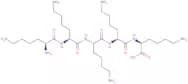
CAS:L-Lysyl-L-lysyl-L-lysyl-L-lysyl-L-lysine (LLLLLL) is an antibacterial agent that belongs to the class of pharmacological agents. LLLLLL has been shown to have antibacterial efficacy against oral pathogens, such as Streptococcus mutans and Porphyromonas gingivalis. LLLLLL binds to the bacterial cell wall by forming a covalent disulfide bond with cysteine residues on the peptidoglycan layer. This prevents cell wall synthesis, leading to cell death by inhibiting protein synthesis. LLLLLL has also been shown to have low toxicity in animal models for long periods of time, with high values in human serum.Formula:C30H62N10O6Purity:Min. 95%Molecular weight:658.88 g/mol1,4-Diazabicyclo[2.2.2]octane bis(sulfur dioxide) adduct
CAS:1,4-Diazabicyclo[2.2.2]octane bis(sulfur dioxide) adduct is a catalyst that can be used for the reduction of various functional groups. It is typically used to synthesize aziridines from amines and diazo compounds, or from halides and organometallic reagents. 1,4-Diazabicyclo[2.2.2]octane bis(sulfur dioxide) adduct has been shown to inhibit the production of sulfoxides by sulfide-reducing bacteria such as Desulfovibrio desulfuricans and Desulfobulbus propionicus.Formula:C6H12N2O4S2Purity:Min. 95%Molecular weight:240.3 g/molActh (1-4)
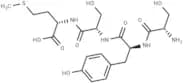
CAS:Acth (1-4) is the ACTH N-terminal tetrapeptide.Formula:C20H30N4O8SPurity:98%Color and Shape:SolidMolecular weight:486.54Angiotensin A (1-7) trifluoroacetate
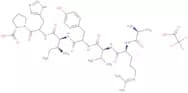
CAS:<p>Endogenous heptapetide which causes vasodilation and has anti-hypertensive properties.</p>Formula:C40H62N12O9•(C2HF3O2)xPurity:Min. 95%Color and Shape:PowderMolecular weight:855 g/molH-GILGFVFTL-OH
CAS:<p>FluM1 (58-66) is a short part of the matrix protein of Influenza A virus which is the most abundant component of this enveloped virus localized under the viral lipid envelope. The GILGFVFTL epitope is highly conserved in Influenza A virus strains at a rate of 93% for 69 strains tested. Human Influenza epitopes may bind MHC molecules and then may be recognized by CD8+ cytotoxic T cells. Applications of FluM1 (58-66): FluM1 (58-66) is used to stimulate CTL responses in peripheral blood mononuclear cells (PBMCs). Then, ELISPOT assay is used to quantify peptide epitope specificity and IFN-γ releasing effector cells. FluM1 (58-66) has shown CTL responses qualified of immunodominant with restriction by HLA-A*02:01. It has also been detected CTL responses when FluM1 (58-66) is restricted by all HLA-C. Therefore, FluM1 (58-66) may help to understand the reaction of immune system against Influenza virus of each populations having different HLA type. FluM1 (58-66) has indeed prompted research to develop T-cell vaccine strategies capable of inducing specific CTL responses in patients upon immunization with Influenza M1 antigenic epitope. MVA-NP+M1 vaccine use GILGFVFTL epitope and is tested in clinical trial. Potential cross-reactivity with HIV-1 p17 Gag (77-85): Moreover, FluM1 (58-66) share similarities with HIV-1 p17 Gag (77-85) which can potentially show a cross-reactivity between these epitopes. It has been demonstrated a cross-reactivity and results suggest that immunity following infection by Influenza virus causes specific immune response to HIV-1 p17 Gag (77-85).</p>Formula:C49H75N9O11Molecular weight:966.18 g/molSermorelin acetate
CAS:Controlled Product<p>Sermorelin acetate is a synthetic peptide, which is an analogue of the naturally occurring growth hormone-releasing hormone (GHRH). It is derived from recombinant DNA technology, representing the first 29 amino acids (1-29) of endogenous GHRH. Its mode of action involves binding to and activating the GHRH receptor on the anterior pituitary gland, which subsequently stimulates the release of growth hormone (GH) into the bloodstream.</p>Formula:C149H246N44O42S·C2H4O2Purity:Min. 95%Molecular weight:3,417.94 g/molH-Gly-Leu-Gly-OH trifluroacetate
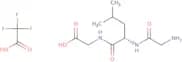
CAS:Please enquire for more information about H-Gly-Leu-Gly-OH trifluroacetate including the price, delivery time and more detailed product information at the technical inquiry form on this pageFormula:C10H19N3O4•C2HF3O2Purity:Min. 95%Molecular weight:359.3 g/mol



![1,4-Diazabicyclo[2.2.2]octane bis(sulfur dioxide) adduct](/_next/image/?url=https%3A%2Fstatic.cymitquimica.com%2Fproducts%2F3D%2Fthumb-webp%2FFD111193.webp&w=3840&q=75)