Enzyme Substrates
Enzyme substrates are molecules upon which enzymes act to catalyze chemical reactions. The substrate binds to the active site of the enzyme, where it undergoes a specific transformation to form the product of the reaction. Enzyme substrates are essential tools in research for studying enzyme kinetics, specificity, and mechanism of action. They are also used in diagnostic assays and biochemical studies. At CymitQuimica, we provide a diverse selection of high-quality enzyme substrates to support your research in enzymology and biochemistry.
Subcategories of "Enzyme Substrates"
Found 1527 products of "Enzyme Substrates"
Sort by
Purity (%)
0
100
|
0
|
50
|
90
|
95
|
100
Aldol® 458 β-D-galactopyranoside, Biosynth Patent: EP 2427431 and US 8940909
CAS:<p>Aldol® 458 beta-D-galactopyranoside is a chromogenic and fluorogenic enzyme substrate used for detection of beta-galactosidase activity. The colorless enzyme substrate is cleaved by lactose utilizing bacteria grown in liquid or solid media, yielding yellow coloration and green fluorescence. Aldol® 458 beta-D-galactopyranoside can also be used in beta-galactosidase gene reporter assays or immunoassay applications (ELISA). Aldol® 458 beta-D-galactopyranoside can be used under aerobic and anaerobic conditions.</p>Formula:C22H23NO8Purity:Min. 95 Area-%Color and Shape:PowderMolecular weight:429.42 g/mol4-Nitrophenyl-β-L-fucopyranoside
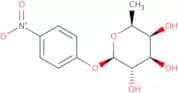
CAS:<p>4-Nitrophenyl-beta-L-fucopyranoside is a high-quality pNP enzyme substrate developed for the sensitive detection and quantification of Beta-L-fucosidase activity. The enzymatic hydrolysis of the substrate generates 4-nitrophenol, a yellow chromogenic component that can be conveniently measured spectrophotometrically, allowing for accurate determination of enzyme concentration and kinetics. This substrate finds applications in various research fields, diagnostics, and industrial enzyme production.</p>Formula:C12H15NO7Purity:Min. 95%Color and Shape:White PowderMolecular weight:285.25 g/mol4-Methylumbelliferyl phosphate bis(cyclohexylammonium) salt
CAS:<p>Sensitive fluorogenic substrate for fluorometric and UV-spectrophotometric assays of phosphatases. This may also be used for in-gel assays</p>Formula:C22H35N2O6PPurity:Min 99%Color and Shape:White to off-white solid.Molecular weight:454.50 g/mol3,4-Cyclohexenoesculetin β-D-galactopyranoside
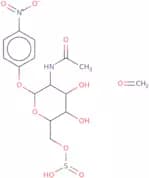
CAS:<p>Chromogenic substrate for beta-galactosidase</p>Formula:C19H22O9Purity:Min. 95 Area-%Molecular weight:394.37 g/mol4-Nitrophenyl 2-acetamido-2-deoxy-b-D-glucopyranoside-6-sulfate
<p>4-Nitrophenyl 2-acetamido-2-deoxy-b-D-glucopyranoside is a chemiluminescent substrate that can be used in the detection of various enzymes. This product has been tested for sterility and purity, and it has passed all tests. It is also free of any detectable levels of heavy metals or other contaminants. 4NP2AG6S is a high quality bioluminescent substrate with CAS No. 71498-92-5. It is a fluorescent compound that reacts with an enzyme to produce light. The reaction can be detected by measuring the emitted light intensity at 680 nm (max).</p>Purity:Min. 95%3,4-Cyclohexenoesculetine β-D-glucopyranoside
CAS:<p>Chromogenic substrate for beta-glucosidase</p>Formula:C19H22O9Purity:Min. 95%Color and Shape:PowderMolecular weight:394.37 g/molL-Arginyl-L-arginine 7-amido-4-methylcoumarin trihydrochloride
CAS:<p>Fluorogenic substrate for cathepsin B or aminopeptidase III. Yields a blue fluorescent solution upon cleavage.</p>Formula:C22H36Cl3N9O4Purity:Min. 98 Area-%Molecular weight:596.95 g/mol4-Nitrophenyl-α-D-maltopyranoside
CAS:<p>Chromogenic α-maltosidase substrate yielding a yellow solution upon cleavage.</p>Formula:C18H25NO13Purity:Min. 98.0 Area-%Molecular weight:463.40 g/mol3-Indolyl β-D-galactopyranoside
CAS:<p>Chromogenic substrate for β-D-galactosidase, yielding a blue precipitate upon cleavage.</p>Formula:C14H17NO6Purity:Min. 95%Color and Shape:PowderMolecular weight:295.29 g/mol2-O-(4-Nitrophenyl)-a-D-N-acetylneuraminic acid sodium salt
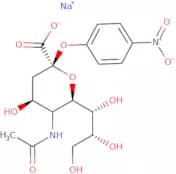
CAS:<p>2-O-(4-Nitrophenyl)-alpha-D-N-acetylneuraminic acid sodium salt is a chromogenic substrate used to detect the enzymatic activity of neuraminidase or sialidase. After cleavage, the nitrophenyl moiety is released exhibiting a light yellowish color. 2-O-(4-Nitrophenyl)-alpha-D-N-acetylneuraminic acid sodium salt is used in bacterial neuraminidase activity assays.</p>Purity:Min. 95%Color and Shape:Yellow PowderMolecular weight:452.35 g/molN-α-CBZ-L-Arginine 7-amido-4-methylcoumarin hydrochloride
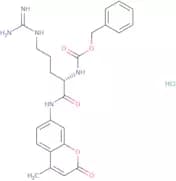
CAS:<p>N-alpha-CBZ-L-Arginine 7-amido-4-methylcoumarin hydrochloride is a high quality and highly purified substrate for enzymes that catalyze the release of light when they react with their specific substrates. It is used in a variety of applications, including diagnostics and food testing. NACBZLAMC hydrochloride is an excellent ligand for chemiluminescence reactions and can be used to detect the presence of various analytes. It can also be used as a staining agent to detect proteins on Western blots or to stain bacterial cultures for identification. This product has been shown to be effective against numerous bacteria, including Staphylococcus aureus and Pseudomonas aeruginosa, as well as fungi like Candida albicans.</p>Formula:C24H28ClN5O5Purity:Min. 99 Area-%Molecular weight:501.97 g/molNaphthol AS-MX acetate
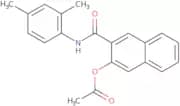
CAS:<p>Modified naphtol AS substrate used in histochemical and cytochemical staining</p>Formula:C21H19NO3Purity:Min. 80%Color and Shape:White Off-White PowderMolecular weight:333.38 g/mol6-Chloro-3-indoxyl nonanoate
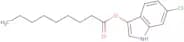
CAS:<p>6-Chloro-3-indoxyl nonanoate is a fluorescent substrate that is used in the detection of beta-galactosidase activity. It has been used to detect the enzyme levels in various culture media and as a high quality, food testing, and environmental testing. The product is also used as a ligand for enzyme inhibition studies. 6-Chloro-3-indoxyl nonanoate has shown to be an excellent fluoroquinolone substrate for chemiluminescence assays. This product is CAS No. 133950-72-8 and is of high purity and high quality.</p>Purity:Min. 95%Molecular weight:307.81 g/molAldol® 467 β-D-galactopyranoside, Biosynth Patent: EP 2427431 and US 8940909
CAS:<p>Aldol® 467 beta-D-galactopyranoside is a chromogenic and fluorogenic enzyme substrate used for detection of beta-galactosidase activity. The colorless product is cleaved by lactose-utilizing bacteria grown in liquid or solid media, yielding yellow coloration and green fluorescence. Aldol® 467 beta-D-galactopyranoside can also be used in beta-galactosidase gene reporter assays or immunoassay applications (ELISA). Aldol® 467 beta-D-galactopyranoside can be used under aerobic and anaerobic conditions.</p>Formula:C29H28ClNO9Purity:Min. 95%Color and Shape:PowderMolecular weight:570 g/molLuc-coliforms Na
CAS:<p>Luc-coliforms Na is a fluorogenic substrate that is used in the diagnosis of bacterial contamination. It is a conjugate of the enzyme luciferase and the substrate coelenterazine, which are combined in a buffer solution. Luc-coliforms Na is used to detect bacteria by adding it to a culture broth or other growth media. The bacteria will emit light as they break down the luc-coliforms Na and produce ATP, which can then be measured with an appropriate detector. Luc-coliforms Na can also be used as a stain for gram-negative rods, such as coliforms, e.g., Escherichia coli, Enterobacter aerogenes, Klebsiella pneumoniae, Proteus mirabilis.</p>Formula:C17H17NaN2O8S2Purity:Min. 95 Area-%Molecular weight:464.44 g/molRef: 3D-L-8263
5mgTo inquire10mgTo inquire25mgTo inquire50mgTo inquire100mgTo inquire-Unit-mgmgTo inquireIsopropyl-β-D-thiogalactopyranoside
CAS:<p>A non-metabolizable allolactose analogue, widely used in molecular biology for overexpression of recombinant proteins from inducible systems under the control of lac promoter. IPTG binds to the LacI repressor and causes its release from the lac operator, allowing gene expression to take place. Present in vectors of pGEX, pGEM-T, pET, pRSET, pMAL class and others.</p>Formula:C9H18O5SPurity:Min. 99 Area-%Molecular weight:238.3 g/molRef: 3D-I-8020
25gTo inquire50gTo inquire100gTo inquire250gTo inquire500gTo inquire-Unit-ggTo inquire4-Methylumbelliferyl a-L-idopyranosiduronic acid 2-sulphate disodium salt - Moscerdam™ biochemical purity
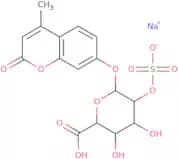
CAS:<p>PAIRED PRODUCT AVAILABLE: alpha-L-iduronidase Enzyme, FI1793834MU-alpha-L-iduronide-2-sulphate (M2) is a fluorogenic substrate of iduronate-2-sulphatase (IDS), used in a 2-step assay coupled with alpha-L-iduronidase. The assay is used in biochemical testing for Hunter syndrome (mucopolysaccharidosis II / MPS II). In a first step, IDS from biological samples cleaves the sulphate group from M2. In a second step, exogeneous alpha-L-iduronidase which cleaves the 4-MU moiety is added to the reaction, resulting in release of a fluorescent signal (Ex 360 nm / Em 455 nm). The reaction is stopped by the addition of sodium carbonate.</p>Formula:C16H14Na2O12SPurity:Min. 99 Area-%Color and Shape:White PowderMolecular weight:476.32 g/molResorufin N-acetyl-b-D-glucosamine
CAS:<p>Resorufin N-acetyl-b-D-glucosamine is fluorogenic substrate for N-acetyl-beta-D-glucosaminidase (NAG).</p>Formula:C20H20N2O8Purity:Min. 98 Area-%Color and Shape:Orange PowderMolecular weight:416.38 g/mol4-Nitrophenyl b-L-arabinofuranoside
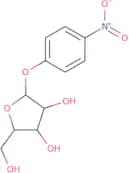
CAS:<p>Chromogenic substrate targeting alpha-L-arabinofuranosidase</p>Purity:Min. 95%Color and Shape:White/Off-White SolidMolecular weight:271.22 g/molAldol® 484 acetate, Biosynth Patent: EP 2427431 and US 8940909
CAS:Controlled Product<p>Aldol® 484 acetate is a chromogenic substrate for carboxylesterases yielding a red precipitate. In contrast to classical indoxyl substrates, Aldol® substrates can be used under aerobic and anaerobic conditions.</p>Formula:C22H16ClFN2O3Purity:Min. 95%Color and Shape:PowderMolecular weight:410.83 g/mol