Enzyme Substrates
Enzyme substrates are molecules upon which enzymes act to catalyze chemical reactions. The substrate binds to the active site of the enzyme, where it undergoes a specific transformation to form the product of the reaction. Enzyme substrates are essential tools in research for studying enzyme kinetics, specificity, and mechanism of action. They are also used in diagnostic assays and biochemical studies. At CymitQuimica, we provide a diverse selection of high-quality enzyme substrates to support your research in enzymology and biochemistry.
Subcategories of "Enzyme Substrates"
Found 1527 products of "Enzyme Substrates"
Sort by
Purity (%)
0
100
|
0
|
50
|
90
|
95
|
100
Ostazin brilliant red H-3B galactomannan
<p>Ostazin Brilliant Red H-3B Galactomannan is a chemiluminescent substrate used for the detection of β-1,4-galactomannans. It reacts with the glucose residues on the mannan backbone to produce a red fluorescent product. This product can be detected by spectrophotometry at an excitation wavelength of 395 nm and emission wavelength of 510 nm. The Ostazin Brilliant Red H-3B Galactomannan substrate is useful in detecting Staphylococcus aureus, Streptococcus pyogenes, Streptococcus pneumoniae, Group A streptococci, Group B streptococci, Group D streptococci, Group G streptococci, and Group C streptococci.</p>Purity:Min. 95%L-Lysine 7-amido-4-methylcoumarin, acetate salt
CAS:Controlled ProductL-Lysine 7-amido-4-methylcoumarin, acetate salt is a fluorogenic peptide substrate for aminopeptidase. This AMC peptide substrate is normally used to rapidly profile the N-terminal specificity of proteases.Formula:C18H25N3O5Molecular weight:363.42 g/mol4-Methylumbelliferyl 2-acetamido-2-deoxy-β-D-glucopyranoside-6-sulfate potassium salt
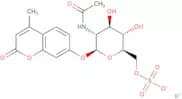
CAS:<p>4-Methylumbelliferyl 2-acetamido-2-deoxy-beta-D-glucopyranoside-6-sulfate potassium salt is a fluorogenic substrate for beta-N-acetylglucosaminidase. After enzymatic cleaveage, free 4-methylumbelliferone (also known as hymecromone) is released, exhibiting blue fluorescence upon excitation with UV light. The strongest fluorescence of 4-methylumbelliferone requires deprotonation of the hydroxyl group (thus requires alkaline pH), with a maximal fluorescence intensity obtained with excitation at 350 to 370 nm and emission at 440 to 470 nm. The use of 4-methylumbelliferyl 2-acetamido-2-deoxy-beta-D-glucopyranoside-6-sulfate potassium saltas a substrate for measuring the beta-N-acetylglucosaminidase activity is used for diagnosis of Mucopolysaccharidosis IIIB (MPS IIIB) (a rare lysosomal storage disorder) and Sanfilippo B syndrome screening.</p>Formula:C18H20KNO11SPurity:Min. 95%Color and Shape:White Off-White PowderMolecular weight:497.52 g/molLuciferin-alpha-D-galactoside, sodium salt
<p>Luciferin-alpha-D-galactoside, sodium salt is a fluorogenic substrate for use in food testing and environmental testing. It can be used as a chromogenic substrate for the detection of conjugates of bile acids and cholesterol. This product is also used in diagnostic medical tests, such as ligand binding assays, chemiluminescence, and bioluminescence.</p>Purity:Min. 95%8-Hydroxyquinoline-beta-D-glucuronic acid, sodium salt
CAS:<p>8-Hydroxyquinoline-beta-D-glucuronic acid, sodium salt is a fluorogenic substrate that can be used for enzymatic detection of peroxidase. The substrate is available in a variety of forms, including powder and liquid. This product has been tested for environmental and bioluminescence activity, as well as food safety. It has also been shown to be a useful ligand in immunoassays.</p>Formula:C15H14NNaO7Purity:Min. 98 Area-%Color and Shape:White PowderMolecular weight:343.26 g/mol5-Nitro-3-indoxyl-β-D-galactopyranoside
<p>For the detection of beta-galactosidase activity</p>Formula:C14H16N2O8Molecular weight:340.29 g/mol6-Nitro-3-indoxyl-β-D-galactopyranoside
<p>For the detection of beta-galactosidase activity</p>Formula:C14H16N2O8Molecular weight:340.29 g/mol6-Nitro-3-indolyl-b-D-galactopyranoside
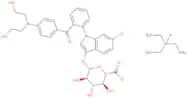
<p>6-Nitro-3-indolyl-b-D-galactopyranoside is a chemiluminescent substrate that reacts with horseradish peroxidase to produce light. 6NIGP is used in the diagnostic field as a fluorogenic or chromogenic substrate for enzymes such as alkaline phosphatase, and as a staining agent for cells, tissues, and other biological materials. 6NIGP has been used in the detection of bacteria, fungi, parasites, and viruses. It is also used in food testing as an enzyme substrate. 6NIGP is purified by recrystallization from water or acetone and can be stored at −20°C.</p>Purity:Min. 95%Aldol® 584 β-D-glucuronic acid, triethylammonium salt, Biosynth Patent: EP 2427431 and US 8940909
CAS:Aldol 584 is a chromogenic substrate that is used in enzymatic assays to detect the presence of an enzyme. It is a triethylammonium salt with beta-D-glucuronic acid. Aldol 584 is used in diagnostic procedures and can be used as a substrate for fluorogenic substrates and chemiluminescent substrates. This product has been shown to be effective in detecting the presence of bile in feces, erythrocyte hemolysis, and the presence of proteinases in human urine. It can also be used as a food testing agent or to measure bacterial activity in culture media.Formula:C37H46ClN3O10Purity:Min. 95%Color and Shape:PowderMolecular weight:728.2 g/molChlorophenol red-β-D-cellotrioside
CAS:<p>Chromogenic substrate for cellulases; red color</p>Formula:C37H42Cl2O20SPurity:Min. 95%Color and Shape:Orange to red solid.Molecular weight:909.69 g/mol5-Bromo-6-chloro-3-indolyl α-D-glucopyranoside
CAS:<p>5-Bromo-6-chloro-3-indolyl α-D-glucopyranoside is a chromogenic substrate that yields a magenta-colored product after cleavage. The chromophore 5-bromo-6-chloro-indoxyl is released, generating the observable color. It is used in Pompe disease diagnostics, a glycogen storage disorder, that measures the deffiency of alpha-glucosidase (GAA) that could lead to the accumulation of glycogen in lysosomes.</p>Formula:C14H15BrClNO6Purity:Min. 95%Color and Shape:PowderMolecular weight:408.63 g/molNaphthol AS-E phosphate, 60%
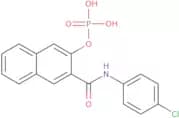
CAS:<p>Histochemical substrate for alkaline phosphatase</p>Formula:C17H13ClNO5PPurity:(%) Min. 60%Color and Shape:SolidMolecular weight:377.72 g/mol4-Nitrophenyl α-L-rhamnopyranoside
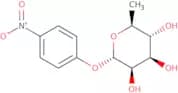
CAS:<p>Chromogenic substrate for alpha-L-rhamnosidase</p>Formula:C12H15NO7Purity:Min. 99 Area-%Color and Shape:White Slightly Yellow PowderMolecular weight:285.25 g/molBCM® O157:H7(+)
<p>BIOSYNTH Culture Medium for the isolation andidentification of Escherichia coli O157:H7</p>N-(6-Hydroxyhexyl)trifluoroacetamide
CAS:<p>Please enquire for more information about N-(6-Hydroxyhexyl)trifluoroacetamide including the price, delivery time and more detailed product information at the technical inquiry form on this page</p>Formula:C8H14F3NO2Molecular weight:213.2 g/molL-Histidine 7-amido-4-methylcoumarin hydrochloride
CAS:L-Histidine 7-amido-4-methylcoumarin hydrochloride is a fluorogenic substrate, which is a synthetic chemical that is used as a substitute for natural substrates. It reacts with enzymes in the presence of hydrogen peroxide to produce light. This product has been used as an enzyme substrate, a diagnostic tool and has been used to detect bacterial growth in culture media. L-Histidine 7-amido-4-methylcoumarin hydrochloride is also used for food testing and environmental testing, where it can be used as a chromogenic substrate or conjugate respectively. This product has CAS number 5981-00-6 and molecular weight of 254.27 g/mol.Formula:C16H17ClN4O3Molecular weight:348.79 g/mol2-Nitrophenyl b-L-fucopyranoside
CAS:<p>2-Nitrophenyl beta-L-fucopyranoside is a chromogenic substrate used to detect the enzymatic activity of beta-L-fucosidase. After cleavage, the nitrophenyl moiety is released exhibiting a light yellowish color. 2-Nitrophenyl beta-L-fucopyranoside is used in bacterial fucose metabolism studies to identify and quantify the enzymatic activity in, for example, Bacteroides spp..</p>Purity:Min. 98 Area-%Color and Shape:PowderMolecular weight:285.25 g/molAldol® 515 caprylate solution, 0.50 M in DMSO, Biosynth Patent: EP 2427431 and US 8940909
CAS:Aldol® 515 caprylate is a chromogenic and fluorogenic enzyme substrate used for detection of lipase activity. The colorless enzyme substrate is cleaved by C8 esterases, yielding development of red coloration. In addition, red fluorescence is generated when Aldol® 355 fluorescence enhancer or a suitable matrix is present. Aldol® 515 caprylate can be used in enzyme assays and live bacterial cultures. Aldol® 515 caprylate is suitable for use in liquid and solid media, under aerobic as well as anaerobic conditions.Formula:C31H34N2O3Purity:Min. 95%Color and Shape:Clear Liquid PowderMolecular weight:482.62 g/mol2-Nitrophenyl b-D-xylobioside
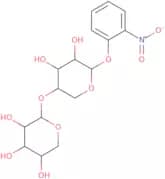
CAS:<p>2-Nitrophenyl b-D-xylobioside is a chromogenic substrate for the enzyme xylanase.</p>Purity:Min. 95%Color and Shape:PowderMolecular weight:403.34 g/mol4-Methylumbelliferyl lignocerate
CAS:<p>This botanical is a download for the Floral Database.</p>Formula:C34H54O4Purity:Min. 95 Area-%Molecular weight:526.81 g/molRef: 3D-M-5720
1gTo inquire5gTo inquire250mgTo inquire500mgTo inquire2500mgTo inquire-Unit-ggTo inquire