Enzyme Substrates
Enzyme substrates are molecules upon which enzymes act to catalyze chemical reactions. The substrate binds to the active site of the enzyme, where it undergoes a specific transformation to form the product of the reaction. Enzyme substrates are essential tools in research for studying enzyme kinetics, specificity, and mechanism of action. They are also used in diagnostic assays and biochemical studies. At CymitQuimica, we provide a diverse selection of high-quality enzyme substrates to support your research in enzymology and biochemistry.
Subcategories of "Enzyme Substrates"
Found 1527 products of "Enzyme Substrates"
Sort by
Purity (%)
0
100
|
0
|
50
|
90
|
95
|
100
4-Methylumbelliferyl phosphate, free acid
CAS:<p>A sensitive fluorogenic substrate for fluorometric and UV-spectrophotometric assays of phosphatases. It is used for the detection of C. perfringens because acid phosphatase is a highly specific indicator for C. perfringens.</p>Formula:C10H9O6PMolecular weight:256.15 g/mol1-Naphthyl β-D-mannopyranoside
CAS:<p>1-Naphthyl β-D-mannopyranoside is a chromogenic (also fluorogenic) substrate. After cleavage, 1-naphthol is released and is used to quantify beta-mannosidase activity.</p>Formula:C16H18O6Purity:Min. 95%Color and Shape:PowderMolecular weight:306.31 g/molIsopropyl-β-D-thiogalactopyranoside - non-animal origin
CAS:A non-metabolizable allolactose analogue, widely used in molecular biology for overexpression of recombinant proteins from inducible systems under the control of lac promoter. IPTG binds to the LacI repressor and causes its release from the lac operator, allowing gene expression to take place. Present in vectors of pGEX, pGEM-T, pET, pRSET, pMAL class and others.Formula:C9H18O5SPurity:Min. 99.0 Area-%Molecular weight:238.3 g/mol3-Nitrophenyl b-D-galactopyranoside
CAS:<p>Chromogenic substrate targeting beta-galactosidase</p>Formula:C12H15NO8Color and Shape:PowderMolecular weight:301.25 g/molL-Pyroglutamic acid 7-amido-4-methylcoumarin
CAS:<p>Fluorogenic substrate for proglutamyl peptidase 1 yielding a blue fluorescent solution upon cleavage. Used in identification of Enterococcus spp. and group A streptococci (Streptococcus pyogenes).</p>Formula:C15H14N2O4Purity:Min. 98 Area-%Molecular weight:286.29 g/mol2-Nitrophenyl b-D-arabinopyranoside
<p>2-Nitrophenyl b-D-arabinopyranoside is a chemical compound that is used in the detection of ATP by chemiluminescence. It acts as a substrate for enzymes such as luciferase and catalase, which catalyze the oxidation of 2-nitrophenyl b-D-arabinopyranoside to phenol and carbon dioxide with the release of light. This reaction can be used in diagnostic applications such as detecting bacteria in culture media or diagnosing food spoilage. 2-Nitrophenyl b-D-arabinopyranoside can also be used as a conjugate to detect proteins or nucleic acids by fluorescence spectroscopy. The CAS number for this compound is 107772-06-1.</p>Purity:Min. 95%Molecular weight:271.22 g/mol5-Bromo-4-chloro-3-indolyl a-L-rhamnoside
<p>5-Bromo-4-chloro-3-indolyl a-L-rhamnoside is a chromogenic substrate used to detect the specific enzymatic activity of alpha-L-rhamnosidase. After cleavage, 5-bromo-4-chloro-indoxyl is released, resulting in a blue to blue-green color change in bacterial colonies or media. 5-Bromo-4-chloro-3-indolyl a-L-rhamnoside is used in bacterial rhamnose metabolism studies (e.g. E. coli).</p>Formula:C14H15BrClNO5Purity:Min. 95%Color and Shape:SolidMolecular weight:392.63 g/mol4-Nitrophenyl phosphate, bis(cyclohexylammonium) salt
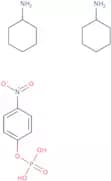
CAS:<p>Chromogenic substrate yielding a soluble yellow chromophor for the colorimetric assay of phosphatases.</p>Formula:C18H32N3O6PPurity:97.0 To 103.0%Molecular weight:417.45 g/mol2-Naphthyl-beta-D-galactopyranoside
CAS:<p>2-Naphthyl-β-D-galactopyranoside is a substrate for β-galactosidase. 2-Naphthol is released upon hydrolyzation. By simultaneous coupling with a suitable staining reagent, such as hexazonium p-rosaniline, the corresponding reddish-brown azo-dye is formed. Naphthols can also be detected by fluorescence analysis.</p>Formula:C16H18O6Purity:Min. 99 Area-%Molecular weight:306.32 g/mol4-Nitrophenyl 2-acetamido-2-deoxy-3-O-(b-D-galactopyranosyl)-a-D-galactopyranoside
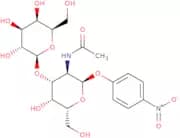
CAS:<p>4-Nitrophenyl 2-acetamido-2-deoxy-3-O-(b-D-galactopyranosyl)-a-D-galactopyranoside is a superior chromogenic pNP enzyme substrate designed to deliver enhanced enzyme detection and outstanding assay performance. This cutting-edge substrate boasts excellent specificity, sensitivity, and stability, making it a powerful tool in the measurement of enzyme activity, substrate profiles, and inhibitor characterization. This premium substrate is perfect for researchers and professionals seeking reliable and efficient results for their enzyme-based investigations.</p>Formula:C20H28N2O13Purity:Min. 98 Area-%Color and Shape:White PowderMolecular weight:504.44 g/mol2-Chloro-4-nitrophenyl-β-D-cellotetraoside
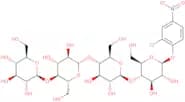
CAS:<p>2-chloro-4-nitrophenyl-beta-D-cellotetraoside is a chromogenic substrate for measuring cellulase activity and other glycosyl hydrolases. The release of 2-chloro-4-nitrophenol can be detected at 405 nm.</p>Formula:C30H44ClNO23Purity:Min. 95%Color and Shape:PowderMolecular weight:822.12 g/mol5-Bromo-4-chloro-3-indolyl b-D-galactofuranoside
<p>5-Bromo-4-chloro-3-indolyl b-D-galactofuranoside is a chromogenic substrate used to detect the specific enzymatic activity of beta-D-galactofuranosidase. After cleavage, 5-bromo-4-chloro-indoxyl is released, resulting in a blue to blue-green color change in bacterial colonies or media. 5-Bromo-4-chloro-3-indolyl b-D-galactofuranoside is used in assays for detecting bacterial pathogens (e.g., Mycobacterium tuberculosis).</p>Formula:C14H15BrClNO6Purity:Min. 95%Color and Shape:PowderMolecular weight:408.63 g/mol4-Methylumbelliferyl phosphate, free acid
CAS:A sensitive fluorogenic substrate for fluorometric and UV-spectrophotometric assays of phosphatases. It is used for the detection of C. perfringens because acid phosphatase is a highly specific indicator for C. perfringens.Formula:C10H9O6PMolecular weight:256.15 g/mol5-Bromo-3-indolyl-beta-D-galactopyranoside-6-sulfate sodium salt
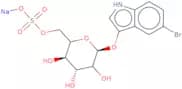
CAS:<p>5-Bromo-3-indolyl-beta-D-galactopyranoside-6-sulfate sodium salt is a lapis substrate, a chromogenic substrate that yields a deep blue color after cleavage. It is used in sulfatase activity assays and for the diagnosis of Mucopolysaccharidosis IVA (Morquio A).</p>Formula:C14H15BrNNaO9SPurity:Min. 95%Color and Shape:PowderMolecular weight:476.23 g/mol4-Methylumbelliferyl N,N',N''-triacetyl-b-D-chitotrioside
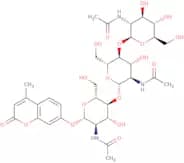
CAS:<p>4-Methylumbelliferyl N,N',N''-triacetyl-beta-D-chitotrioside is a fluorogenic substrate for chitinase. After enzymatic cleaveage, free 4-methylumbelliferone (also known as hymecromone) is released, exhibiting blue fluorescence upon excitation with UV light. The strongest fluorescence of 4-methylumbelliferone requires deprotonation of the hydroxyl group (thus requires alkaline pH), with a maximal fluorescence intensity obtained with excitation at 350 to 370 nm and emission at 440 to 470 nm. The use of 4-methylumbelliferyl N,N',N''-triacetyl-beta-D-chitotriosideas a substrate for measuring the chitinase activity is used for fungal infection assays.</p>Formula:C34H47N3O18Purity:Min. 95.0 Area-%Color and Shape:White Off-White PowderMolecular weight:785.75 g/mol4-Methylumbelliferyl-β-L-fucopyranoside
CAS:<p>4-Methylumbelliferyl-beta-L-fucopyranoside is a fluorogenic substrate that is used in food testing. It also has uses as a chromogenic substrate and a ligand for biological studies. 4-Methylumbelliferyl-beta-L-fucopyranoside is a conjugate of 4-methylumbelliferone and beta-D-fucopyranosyl ester, which is an enzyme substrate for the detection of phosphatases. This product can be used to detect the activity of phosphatase enzymes in various media, including culture media, environmental testing, and staining. 4MUFBPY also has chemiluminescent properties that can be used for bioluminescence assays.</p>Formula:C16H18O7Molecular weight:322.31 g/molRef: 3D-M-5541
1gTo inquire5gTo inquire250mgTo inquire500mgTo inquire2500mgTo inquire-Unit-ggTo inquire4-Methylumbelliferyl-beta-D-glucopyranoside
CAS:<p>Fluorogenic substrate for beta-glucosidase yielding a blue fluorescent solution. Used for the detection of beta-glucosidase as an indicator of Enterococci.</p>Formula:C16H18O8Purity:Min. 99 Area-%Molecular weight:338.32 g/mol4-Nitrophenyl-N-acetyl-α-D-glucosaminide
CAS:4-Nitrophenyl-N-acetyl-α-D-glucosaminide is a chromogenic substrate for N-acetyl-β-D-glucosaminidase yielding a yellow solution upon cleavage.Formula:C14H18N2O8Molecular weight:342.31 g/molRef: 3D-N-4030
1gTo inquire100mgTo inquire250mgTo inquire500mgTo inquire2500mgTo inquire-Unit-ggTo inquireL-Lysyl-L-alanine 7-amido-4-methylcoumarin dihydrochloride
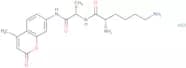
CAS:<p>L-Lysyl-L-alanine 7-amido-4-methylcoumarin dihydrochloride is a fluorogenic peptide substrate for aminopeptidase. This AMC peptide substrate is normally used to rapidly profile the N-terminal specificity of proteases.</p>Purity:Min. 98.0 Area-%Color and Shape:PowderHippurate hydrolase from Campylobacter jejuni, aqueous solution with glycerol
<p>Hippurate hydrolase is an enzyme that catalyzes the hydrolysis of hippurate to glycine and taurine. It is a fluorogenic substrate with high purity, ligand, and high quality. Hippurate hydrolase is used as a diagnostic enzyme for detecting the presence of hippuric acid in urine. This enzyme can be conjugated to a variety of molecules, including fluorophores, biotin or haptens, for use in immunoassay or other applications.</p>Formula:C1944H3000N516O573S18Purity:Min. 95%Molecular weight:24,542 g/mol