Enzyme Substrates
Enzyme substrates are molecules upon which enzymes act to catalyze chemical reactions. The substrate binds to the active site of the enzyme, where it undergoes a specific transformation to form the product of the reaction. Enzyme substrates are essential tools in research for studying enzyme kinetics, specificity, and mechanism of action. They are also used in diagnostic assays and biochemical studies. At CymitQuimica, we provide a diverse selection of high-quality enzyme substrates to support your research in enzymology and biochemistry.
Subcategories of "Enzyme Substrates"
Found 1527 products of "Enzyme Substrates"
Sort by
Purity (%)
0
100
|
0
|
50
|
90
|
95
|
100
Aldol® 518 α-D-galactopyranoside, Biosynth Patent: EP 2427431 and US 8940909
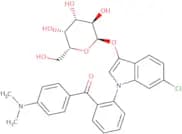
CAS:Aldol® 518 alpha-D-galactopyranoside is a chromogenic and fluorogenic enzyme substrate used for detection of alpha-galactosidase activity. The enzyme substrate is cleaved by alpha-galactosidase positive bacteria and yeasts in liquid or solid media, yielding red color and red fluorescence signal. Aldol® 518 alpha-D-galactopyranoside can also be used to detect alpha-galactosidase (encoded by the Mel1 gene) in yeast gene reporter assays or for identification of alpha-gal positive transformants on agar plates. Aldol® 518 alpha-D-galactopyranoside can be used under aerobic and anaerobic conditions.Formula:C29H29ClN2O7Purity:Min. 95.0 Area-%Molecular weight:553.01 g/mol3-Indoxyl-beta-D-glucopyranoside anhydrous
CAS:<p>The maunfacturing of blue jeans started 150 years ago as workwear, and are found nowadays in almost every wardrobe. Their renowned indigo color tone is truly unique; nevertheless, the high demand for the dye poses serious sustainability and environmental problems connected with its manufacturing process. Recently, a group of scientists presented an alternative indigo dyeing method inspired by the indoxyl glucoconjugate present in the plant P.tinctorium. The researchers proposed as an alternative approach a biocatalytic process using recombinant E.coli to access water soluble β-gluco-indoxyl (indican). At the point of coloring, indican gets hydrolyzed by β-glucosidase enzymes forming indoxyl, which suddenly undergoes oxidation to leucoindigo and further crystallizes to indigo giving the typical blue denim its signature character.</p>Formula:C14H17NO6Purity:Min. 99.0 Area-%Molecular weight:295.29 g/molL-Lysine 7-amido-4-methylcoumarin, acetate salt
CAS:Controlled ProductL-Lysine 7-amido-4-methylcoumarin, acetate salt is a fluorogenic peptide substrate for aminopeptidase. This AMC peptide substrate is normally used to rapidly profile the N-terminal specificity of proteases.Formula:C18H25N3O5Molecular weight:363.42 g/mol3,4-Cyclohexenoesculetin β-D-glucuronide
<p>Chromogenic substrate for beta-glucuronidase</p>Purity:Min. 95%8-Hydroxyquinoline-beta-D-glucuronic acid, sodium salt
CAS:<p>8-Hydroxyquinoline-beta-D-glucuronic acid, sodium salt is a fluorogenic substrate that can be used for enzymatic detection of peroxidase. The substrate is available in a variety of forms, including powder and liquid. This product has been tested for environmental and bioluminescence activity, as well as food safety. It has also been shown to be a useful ligand in immunoassays.</p>Formula:C15H14NNaO7Purity:Min. 98 Area-%Color and Shape:White PowderMolecular weight:343.26 g/mol4-Nitrophenyl 2-acetamido-3-O-[2-O-a-L-fucopyranosyl-b-D-galactopyranosyl)-2-deoxy-b-D-galactopyranoside
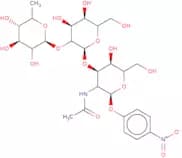
CAS:<p>4-Nitrophenyl 2-acetamido-3-O-[2-O-a-L-fucopyranosyl-b-D-galactopyranosyl)-2-deoxyb-D-galactopyranoside is a water soluble, fluorescent probe that can be used for detecting the presence of β-(1→4) -linked galactosaminoglycans. The dye is a substrate for enzymes such as α--mannosidase, β--glucuronidase and β--galactosidase. The dye is also an excellent ligand for lectins such as concanavalin A and wheat germ agglutinin. This product is a diagnostic reagent that has been shown to have high purity and quality. It has CAS No. 93496-53-8 and can be used in food testing, bioluminescence, environmental testing, or high purity applications.</p>Formula:C26H38N2O17Purity:Min. 95%Molecular weight:650.58 g/mol5-Bromo-4-chloro-3-indolyl a-L-rhamnoside
<p>5-Bromo-4-chloro-3-indolyl a-L-rhamnoside is a chromogenic substrate used to detect the specific enzymatic activity of alpha-L-rhamnosidase. After cleavage, 5-bromo-4-chloro-indoxyl is released, resulting in a blue to blue-green color change in bacterial colonies or media. 5-Bromo-4-chloro-3-indolyl a-L-rhamnoside is used in bacterial rhamnose metabolism studies (e.g. E. coli).</p>Formula:C14H15BrClNO5Purity:Min. 95%Color and Shape:SolidMolecular weight:392.63 g/mol2-Chloro-4-nitrophenyl-β-D-cellotetraoside
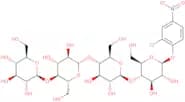
CAS:<p>2-chloro-4-nitrophenyl-beta-D-cellotetraoside is a chromogenic substrate for measuring cellulase activity and other glycosyl hydrolases. The release of 2-chloro-4-nitrophenol can be detected at 405 nm.</p>Formula:C30H44ClNO23Purity:Min. 95%Color and Shape:PowderMolecular weight:822.12 g/mol5-Bromo-4-chloro-3-indolyl b-D-galactofuranoside
<p>5-Bromo-4-chloro-3-indolyl b-D-galactofuranoside is a chromogenic substrate used to detect the specific enzymatic activity of beta-D-galactofuranosidase. After cleavage, 5-bromo-4-chloro-indoxyl is released, resulting in a blue to blue-green color change in bacterial colonies or media. 5-Bromo-4-chloro-3-indolyl b-D-galactofuranoside is used in assays for detecting bacterial pathogens (e.g., Mycobacterium tuberculosis).</p>Formula:C14H15BrClNO6Purity:Min. 95%Color and Shape:PowderMolecular weight:408.63 g/molL-Lysyl-L-alanine 7-amido-4-methylcoumarin dihydrochloride
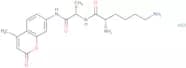
CAS:<p>L-Lysyl-L-alanine 7-amido-4-methylcoumarin dihydrochloride is a fluorogenic peptide substrate for aminopeptidase. This AMC peptide substrate is normally used to rapidly profile the N-terminal specificity of proteases.</p>Purity:Min. 98.0 Area-%Color and Shape:PowderHippurate hydrolase from Campylobacter jejuni, aqueous solution with glycerol
<p>Hippurate hydrolase is an enzyme that catalyzes the hydrolysis of hippurate to glycine and taurine. It is a fluorogenic substrate with high purity, ligand, and high quality. Hippurate hydrolase is used as a diagnostic enzyme for detecting the presence of hippuric acid in urine. This enzyme can be conjugated to a variety of molecules, including fluorophores, biotin or haptens, for use in immunoassay or other applications.</p>Formula:C1944H3000N516O573S18Purity:Min. 95%Molecular weight:24,542 g/molIPTG - non animal origin
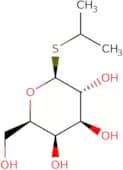
CAS:<p>Isopropyl-beta-D-thiogalactopyranoside (IPTG) is a non-metabolizable allolactose analogue, widely used in molecular biology for overexpression of recombinant proteins from inducible systems under the control of lac promoter. IPTG binds to the LacI repressor and causes its release from the lac operator, allowing gene expression of lac operon to take place. IPTG is present in vectors of pGEX, pGEM-T, pET, pRSET, pMAL class and others.</p>Formula:C9H18O5SPurity:Min. 99 Area-%Color and Shape:White PowderMolecular weight:238.3 g/mol4-Methylumbelliferyl a-L-fucopyranoside
CAS:<p>Fluorogenic substrate for fucosidase</p>Formula:C16H18O7Purity:Min. 95%Color and Shape:White PowderMolecular weight:322.31 g/mol2-Chloro-4-nitrophenyl α-D-mannopyranoside
CAS:<p>2-Chloro-4-nitrophenyl alpha-D-mannopyranoside is a substrate used to measure the alpha-mannosidase activity. This enzyme plays a crucial role in the lysosomal degradation of asparagine-linked carbohydrate cores of glycoproteinsis. The use of 2-Chloro-4-nitrophenyl alpha-D-mannopyranoside in diagnostic assays is important as a deficiency in alpha-mannosidase leads to the accumulation of mannose-rich oligosaccharides in lysosomes, causing a range of health problems collectively known as alpha-mannosidosis.</p>Formula:C12H14ClNO8Purity:Min. 98 Area-%Color and Shape:White PowderMolecular weight:335.69 g/mol5-Bromo-6-chloro-3-indolyl a-D-galactopyranoside
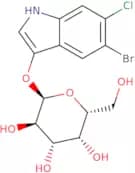
CAS:<p>5-Bromo-6-chloro-3-indolyl a-D-galactopyranoside is a chromogenic substrate that yields a magenta-colored product after cleavage. The chromophore 5-bromo-6-chloro-indoxyl is released, generating the observable color. It is used in glycolipid metabolism studies.</p>Formula:C14H15BrClNO6Color and Shape:White to off-white solid.Molecular weight:408.63 g/mol4-Methylumbelliferyl 2-acetamido-2-deoxy-α-D-glucopyranoside-6-sulfate potassium
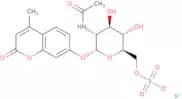
CAS:<p>4-Methylumbelliferyl 2-acetamido-2-deoxy-alpha-D-glucopyranoside-6-sulfate potassium is a fluorogenic substrate for N-acetylglucosamine-6-sulfatase. After enzymatic cleaveage, free 4-methylumbelliferone (also known as hymecromone) is released, exhibiting blue fluorescence upon excitation with UV light. The strongest fluorescence of 4-methylumbelliferone requires deprotonation of the hydroxyl group (thus requires alkaline pH), with a maximal fluorescence intensity obtained with excitation at 350 to 370 nm and emission at 440 to 470 nm. The use of 4-methylumbelliferyl 2-acetamido-2-deoxy-alpha-D-glucopyranoside-6-sulfate potassiumas a substrate for measuring the N-acetylglucosamine-6-sulfatase activity is used for screening of Mucopolysaccharidosis IIID (MPS IIID) (a rare lysosomal storage disorder) and Sanfilippo D syndrome diagnosis.</p>Formula:C18H20KNO11SPurity:Min. 95%Color and Shape:White PowderMolecular weight:497.52 g/molResorufin-β-D-glucuronic acid, sodium salt
CAS:<p>Resorufin-beta-D-glucuronic acid, sodium salt is a fluorogenic substrate that can be used in diagnostic applications. It is a conjugate of resorufin and beta-D-glucuronic acid. The enzyme substrate reacts with the enzyme luciferase to produce light. The high purity and quality of this product make it ideal for use in the detection of the presence of glucose in urine, which can be used to diagnose diabetes mellitus.</p>Formula:C18H14NNaO9Purity:Min. 90.0 Area-%Molecular weight:411.30 g/molRef: 3D-R-2150
2mgTo inquire5mgTo inquire10mgTo inquire25mgTo inquire50mgTo inquire-Unit-ggTo inquire4-Nitrophenyl-alpha-D-maltopyranoside
CAS:<p>Chromogenic α-maltosidase substrate yielding a yellow solution upon cleavage.</p>Formula:C18H25NO13Purity:Min. 98.0 Area-%Molecular weight:463.40 g/molGlutaryl-glycyl-L-arginine 7-amido-4-methylcoumarin hydrochloride
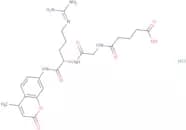
CAS:<p>Glutaryl-glycyl-L-arginine 7-amido-4-methylcoumarin hydrochloride is a synthetic peptide substrate used as a fluorogenic substrate for aminopeptidase.</p>Formula:C23H30N6O7·HClPurity:Min. 95%Color and Shape:PowderMolecular weight:538.98 g/molResorufin b-D-xylobioside
<p>Resorufin b-D-xylobioside is a fluorogenic substrate for xylanases useful for xylanase activity assays.</p>Purity:Min. 95%Color and Shape:PowderMolecular weight:477.42 g/mol