Enzyme Substrates
Enzyme substrates are molecules upon which enzymes act to catalyze chemical reactions. The substrate binds to the active site of the enzyme, where it undergoes a specific transformation to form the product of the reaction. Enzyme substrates are essential tools in research for studying enzyme kinetics, specificity, and mechanism of action. They are also used in diagnostic assays and biochemical studies. At CymitQuimica, we provide a diverse selection of high-quality enzyme substrates to support your research in enzymology and biochemistry.
Subcategories of "Enzyme Substrates"
Found 1527 products of "Enzyme Substrates"
Sort by
Purity (%)
0
100
|
0
|
50
|
90
|
95
|
100
5-Bromo-4-chloro-3-indolyl b-D-galactofuranoside
5-Bromo-4-chloro-3-indolyl b-D-galactofuranoside is a chromogenic substrate used to detect the specific enzymatic activity of beta-D-galactofuranosidase. After cleavage, 5-bromo-4-chloro-indoxyl is released, resulting in a blue to blue-green color change in bacterial colonies or media. 5-Bromo-4-chloro-3-indolyl b-D-galactofuranoside is used in assays for detecting bacterial pathogens (e.g., Mycobacterium tuberculosis).Formula:C14H15BrClNO6Purity:Min. 95%Color and Shape:PowderMolecular weight:408.63 g/molOstazin brilliant red H-3B starch
Ostazin Brilliant Red H-3B is a water soluble, non-toxic, and non-hazardous substrate for enzymes that catalyze reactions involving the cleavage of β-D-glucosides. It is used as a chromogenic or fluorogenic substrate in diagnostic tests. Ostazin Brilliant Red H-3B can also be used in bioluminescence reaction with luciferase to measure ATP levels in living cells.Purity:Min. 95%L-Lysyl-L-alanine 7-amido-4-methylcoumarin dihydrochloride
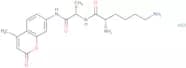
CAS:L-Lysyl-L-alanine 7-amido-4-methylcoumarin dihydrochloride is a fluorogenic peptide substrate for aminopeptidase. This AMC peptide substrate is normally used to rapidly profile the N-terminal specificity of proteases.Purity:Min. 98.0 Area-%Color and Shape:Powder4-Nitrophenyl b-D-cellotetraoside
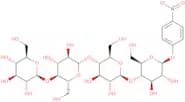
CAS:4-Nitrophenyl b-D-cellotetraoside is a chromogenic substrate utilized for the detection and quantification of cellulase enzyme activity. Cellulase enzymes hydrolyze the beta-1,4-glycosidic bonds of cellulose, a major component of plant cell walls. Upon cleavage by cellulase, it releases 4-nitrophenol, a compound that exhibits a yellow color and absorbs strongly at 405 nm, allowing for easy spectrophotometric measurements of cellulase activity levels in various sample types, including bacterial and fungal cultures, environmental samples, and industrial applications.Formula:C30H45NO23Purity:Min. 95%Color and Shape:PowderMolecular weight:787.67 g/mol4-Methylumbelliferyl 2-deoxy-2-sulfamino-a-D-glucopyranoside sodium salt - Moscerdam™ biochemical purity
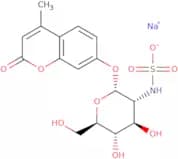
CAS:4-Methylumbelliferyl 2-deoxy-2-sulfamino-a-D-glucopyranoside sodium salt (M3A or MU-GlcNS) is a fluorogenic substrate of heparin sulfamidase, used in the diagnosis of Mucopolysaccharidosis III type A (MPS III A). MPS III A, also known as Sanfilippo syndrome type A, is caused by the deficiency of heparan N-sulfatase. Heparin sulfamidase in the assay desulfates MU-GlcNS to 4-methylumbelliferyl 2-amino-2-deoxy-α-D-glucopyranoside (MU-GlcNH2). To release fluorometrically measurable 4-methylumbelliferone (MU) and by-product glucosamine, MU-GlcNH2 is further hydrolysed by an enzyme such as yeast α-glucosidase during a second incubation.Formula:C16H18NO10SNaPurity:Min. 95 Area-%Color and Shape:White PowderMolecular weight:439.37 g/molAldol® 458 phosphate, disodium salt, Biosynth Patent: EP 2427431 and US 8940909
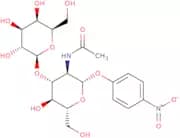
CAS:Aldol® 458 phosphate is a chromogenic and fluorogenic enzyme substrate used for detection of phosphatase activity. The colorless enzyme substrate is cleaved by phosphatases secreted by bacteria grown in liquid media, yielding yellow color and green fluorescence. Aldol® 458 phosphate can also be used in assays involving phosphatase-coupled antibodies in immunoassay applications (ELISA). Aldol® 458 phosphate can be used under aerobic and anaerobic conditions.Formula:C16H12NNa2O6PPurity:Min. 95%Color and Shape:PowderMolecular weight:391.22 g/mol4-Nitrophenyl 2-acetamido-2-deoxy-3-O-(b-D-galactopyranosyl)-b-D-glucopyranoside
CAS:Chromogenic substrate for fucosyltransferasesFormula:C20H28N2O13Purity:Min. 98 Area-%Color and Shape:White PowderMolecular weight:504.44 g/mol2-Nitrophenyl-beta-D-cellobioside
CAS:Chromogenic substrate for β-D-Cellobiosidase yielding a yellow solution upon cleavage.
Formula:C18H25NO13Purity:Min. 98.0 Area-%Molecular weight:463.4 g/mol4-Methylumbelliferyl a-D-glucosaminide
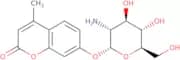
CAS:4-Methylumbelliferyl alpha-D-glucosaminide is a fluorogenic substrate for alpha-N-acetylglucosaminidase. After enzymatic cleaveage, free 4-methylumbelliferone (also known as hymecromone) is released, exhibiting blue fluorescence upon excitation with UV light. The strongest fluorescence of 4-methylumbelliferone requires deprotonation of the hydroxyl group (thus requires alkaline pH), with a maximal fluorescence intensity obtained with excitation at 350 to 370 nm and emission at 440 to 470 nm. The use of 4-methylumbelliferyl alpha-D-glucosaminideas a substrate for measuring the alpha-N-acetylglucosaminidase activity is used for Sanfilippo syndrome B and Mucopolysaccharidosis IIIB (MPS IIIB) diagnosis.Formula:C16H19NO7Purity:Min. 90 Area-%Color and Shape:White PowderMolecular weight:337.32 g/mol5-Bromo-4-chloro-3-indoxyl oleate
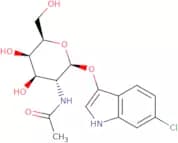
CAS:5-Bromo-4-chloro-3-indoxyl oleate is a chromogenic substrate used to detect the specific enzymatic activity of lipase. After cleavage, 5-bromo-4-chloro-indoxyl is released, resulting in a blue to blue-green color change in bacterial colonies or media. 5-Bromo-4-chloro-3-indoxyl oleate is used in lipid metabolism disorder screening.Formula:C26H37BrClNO2Purity:Min. 95%Color and Shape:PowderMolecular weight:510.93 g/mol6-Chloro-3-indolyl 2-acetamido-2-deoxy-b-D-galactopyranoside
CAS:6-Chloro-3-indolyl 2-acetamido-2-deoxy-b-D-galactopyranoside is a chromogenic substrate for N-acetyl-beta-galactosaminidase. It produces a salmon-pink color after enzymatic cleavage.
Purity:Min. 95%Color and Shape:White PowderMolecular weight:370.78 g/mol6'-(Diethylamino)spiro[isobenzofuran-1(3H),9'-[9H]xanthen]-3'-yl b-D-glucopyranoside
6'-(Diethylamino)spiro[isobenzofuran-1(3H),9'-[9H]xanthen]-3'-yl b-D-glucopyranoside is a fluorogenic substrate that is used in diagnostic applications. It has been shown to be a useful ligand for the determination of enzyme activity, and it can also be used to detect bacterial culture media contaminants. 6'-(Diethylamino)spiro[isobenzofuran-1(3H),9'-[9H]xanthen]-3'-yl b-D-glucopyranoside is used as an enzyme substrate in chemiluminescent assays, and with other reagents, it can be used for the detection of environmental contaminants. This product has a CAS number of 55426-02-8 and can be found on the website www.sigmaaldrich.com/catalog/productPurity:Min. 95%Molecular weight:494.49 g/mol5-Bromo-6-chloro-3-indolyl a-D-galactopyranoside
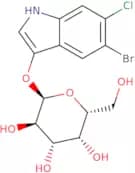
CAS:5-Bromo-6-chloro-3-indolyl a-D-galactopyranoside is a chromogenic substrate that yields a magenta-colored product after cleavage. The chromophore 5-bromo-6-chloro-indoxyl is released, generating the observable color. It is used in glycolipid metabolism studies.Formula:C14H15BrClNO6Color and Shape:White to off-white solid.Molecular weight:408.63 g/molResorufin b-D-xylobioside
Resorufin b-D-xylobioside is a fluorogenic substrate for xylanases useful for xylanase activity assays.Purity:Min. 95%Color and Shape:PowderMolecular weight:477.42 g/mol4-Methylumbelliferyl palmitate
CAS:Fluorogenic substrate for esterase yielding a blue fluorescent solution upon cleavage.Formula:C26H38O4Purity:Min. 99 Area-%Molecular weight:414.59 g/molRef: 3D-M-5750
1gTo inquire5gTo inquire250mgTo inquire500mgTo inquire2500mgTo inquire-Unit-ggTo inquire5-Bromo-4-chloro-3-indolyl a-D-mannopyranoside
CAS:5-Bromo-4-chloro-3-indolyl a-D-mannopyranoside is a chromogenic substrate used to detect the specific enzymatic activity of alpha-mannosidase. After cleavage, 5-bromo-4-chloro-indoxyl is released, resulting in a blue to blue-green color change in bacterial colonies or media. 5-Bromo-4-chloro-3-indolyl a-D-mannopyranoside is used in alpha-mannosidosis diagnosis and other lysosomal storage disorder.Formula:C14H15BrClNO6Purity:Min. 95 Area-%Color and Shape:PowderMolecular weight:408.63 g/mol4-Nitrophenylphosphorylcholine
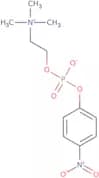
CAS:Chromogenic substrate used to measure phospholipase C (PLC) activity
Formula:C11H17N2O6PPurity:Min. 95 Area-%Color and Shape:PowderMolecular weight:304.24 g/molAquaSpark® inositol-phosphate, Ramot at Tel-Aviv University Ltd. Patent family WO 2017/130191
Fluorescent reagent for the detection of phospholipids. Previously under code EA179480.
Formula:C34H40ClO15PPurity:Min. 90 Area-%Molecular weight:755.1 g/molDL-Luciferin 1-(4,5-dimethoxy-2-nitrophenyl)ethyl ester
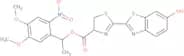
CAS:DMNPE-caged form of luciferinFormula:C21H19N3O7S2Purity:Min. 95%Color and Shape:PowderMolecular weight:489.52 g/molAc-Abu-Tle-Leu-Gln-AMC TFA salt
A fluorogenic substrate for detection of enzymatic activity of the SARS-CoV-2 Mpro protease. The fluorophore 7-Amino-4-methylcoumarin (AMC) is linked to the tetrapeptide via a peptide bond at the C-terminal of the glutamine residue. Following the hydrolytic activity of the Mpro protease, the fluorogenic AMC group get released from the substrate, generating a fluorescent signal (Ex 380 nm / Em 455 nm).Formula:C33H48N6O8(freebase)Purity:Min. 95.0 Area-%Molecular weight:656.77 g/mol






![6'-(Diethylamino)spiro[isobenzofuran-1(3H),9'-[9H]xanthen]-3'-yl b-D-glucopyranoside](/_next/image/?url=https%3A%2Fstatic.cymitquimica.com%2Fproducts%2F3D%2Fthumb-webp%2FED139090.webp&w=3840&q=75)