Enzyme Substrates
Enzyme substrates are molecules upon which enzymes act to catalyze chemical reactions. The substrate binds to the active site of the enzyme, where it undergoes a specific transformation to form the product of the reaction. Enzyme substrates are essential tools in research for studying enzyme kinetics, specificity, and mechanism of action. They are also used in diagnostic assays and biochemical studies. At CymitQuimica, we provide a diverse selection of high-quality enzyme substrates to support your research in enzymology and biochemistry.
Subcategories of "Enzyme Substrates"
Found 1527 products of "Enzyme Substrates"
Sort by
Purity (%)
0
100
|
0
|
50
|
90
|
95
|
100
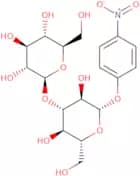
4-Nitrophenyl 3-O-(β-D-glucopyranosyl)-β-D-glucopyranoside
CAS:Chromogenic substrate for beta-glucanaseFormula:C18H25NO13Purity:Min. 95 Area-%Color and Shape:PowderMolecular weight:463.39 g/mol4-Nitrophenyl-alpha-D-glucopyranoside
CAS:Chromogenic substrate for α-D-glucosidase yielding a yellow solution upon cleavage. Also used for the detection of glucansucrases and for yeast α-D-glucosidase and for studies of the crystal structure of the complexes of concanavalin A.
Formula:C12H15NO8Purity:Min. 98.0 Area-%Molecular weight:301.26 g/mol4-Methylumbelliferyl-beta-D-cellobioside
CAS:Fluorogenic substrate for β-D-Cellobiosidase yielding a blue fluorescent solution upon cleavage.Formula:C22H28O13Purity:Min. 98.0 Area-%Molecular weight:500.46 g/mol5-Bromo-6-chloro-3-indoxyl-beta-D-galactopyranoside
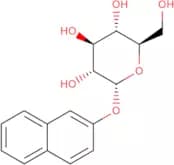
CAS:5-Bromo-6-chloro-3-indoxyl-beta-D-galactopyranoside is a chromogenic substrate for beta-D-galactosidase, yielding a magenta precipitate and contained in a chromogenic culture media. It is an indolyl carbohydrate that is the alpha-D-mannoside of indoxyl, in which the indole moiety is substituted at positions 4 and 5 by chlorine and bromine, respectively.Formula:C14H15BrClNO6Purity:Min. 99.0 Area-%Molecular weight:408.64 g/mol2-Naphthyl a-D-glucopyranoside
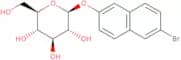
CAS:2-Naphthyl-lpha-D-glucopyranoside is a substrate for α-glucosidase. 2-Naphthol is released upon hydrolyzation. By simultaneous coupling with a suitable staining reagent, such as hexazonium p-rosaniline, the corresponding reddish-brown azo-dye is formed. Naphthols can also be detected by fluorescence analysis.Formula:C16H18O6Purity:Min. 98 Area-%Color and Shape:PowderMolecular weight:306.31 g/mol6-Bromo-2-naphthyl b-D-glucopyranoside
CAS:6-Bromo-2-naphthyl b-D-glucopyranoside is an enzyme substrate used in chromogenic assays with beta-glucosidases. It has been used in culture media for the identification of Legionella pneumophila.Formula:C16H17BrO6Purity:Min. 98 Area-%Color and Shape:PowderMolecular weight:385.21 g/molAldol® 484 beta-D-glucopyranoside, Biosynth Patent: EP 2427431 and US 8940909
CAS:Aldol® 484 beta-D-glucopyranoside is a chromogenic and fluorogenic enzyme substrate used for detection of beta-glucosidase activity. The colorless enzyme substrate is cleaved by bacteria producing beta-glucosidase in liquid or solid media, yielding intense red color and green fluorescent signal. Aldol® 484 beta-D-glucopyranoside can be used under aerobic and anaerobic conditions.Formula:C26H24ClFN2O7Purity:Min. 95%Color and Shape:PowderMolecular weight:530.93 g/mol4-Chloro-1-naphthol
CAS:Substrate for horseradish peroxidase
Formula:C10H7ClOPurity:Min. 96.0 Area-%Color and Shape:Brown PowderMolecular weight:178.61 g/molAldol® 515 nonanoate hydrochloride, Biosynth Patent: EP 2427431 and US 8940909
CAS:Aldol® 515 nonanoate hydrochloride is a chromogenic and fluorogenic enzyme substrate for detection of lipase activity. The colorless product is cleaved by C9 esterases produced by bacteria in liquid or solid media, yielding a red color and red fluorescence when Aldol® 355 fluorescence enhancer or a suitable matrix is present. Aldol® 515 nonanoate can be used under aerobic and anaerobic conditions. Well detectable color/fluorescence of bacterial colonies or liquid cultures is obtained within 24-48 h. In the presence of a purified lipase, color and fluorescence develops within minutes to few hours.Formula:C32H36ClN2O3Purity:Min. 95 Area-%Molecular weight:533.1 g/molMonofluoresceinated mannitol
Monofluoresceinated mannitol is a fluorescently labeled form of mannitol. It is used as a tracer for metabolism studies.Formula:C27H24O12Purity:Min. 95%Color and Shape:PowderMolecular weight:540.46 g/molNaphthol AS-E acetate
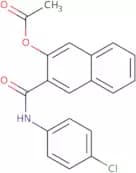
CAS:Modified naphtol AS substrate used in histochemical and cytochemical staining
Formula:C19H14ClNO3Purity:Min. 95%Molecular weight:339.77 g/mol5-Bromo-6-chloro-3-indoxylphosphat, disodium salt trihydrate
5-Bromo-6-chloro-3-indoxylphosphate, disodium salt trihydrate is a bioluminescent substrate that can be used in a variety of diagnostic applications. This compound reacts with luciferase to yield light and can serve as an indicator for various enzymes and chemical reactions. 5-Bromo-6-chloro-3-indoxylphosphate, disodium salt trihydrate has been shown to be compatible with both culture media and food testing.Purity:Min. 95%5-Bromo-4-chloro-3-indoxyl-β-D-glucuronic acid, sodium salt anhydrous
CAS:5-Bromo-4-chloro-3-indoxyl-beta-D-glucuronic acid, sodium salt anhydrous is a potent inhibitor of histidine decarboxylase (HDC). It is used in the histochemical staining of dehydrogenase and effector proteins in urine samples. This compound has been shown to inhibit the growth of macroalgae and can be used as a selective agent for phylogenetic tree construction. 5BDG,Sr with its high specificity for HDC, also inhibits cell proliferation in plant cells and ovules.Formula:C14H12BrClNNaO7Purity:Min. 98.0 Area-%Molecular weight:444.60 g/mol4-Nitrophenyl α-L-fucopyranoside
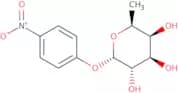
CAS:Chromogenic substrate for alpha-L-fucosidaseFormula:C12H15NO7Purity:(%) Min. 98.0%Color and Shape:PowderMolecular weight:285.25 g/mol4-Nitrophenyl b-D-thiogalactopyranoside
CAS:4-Nitrophenyl b-D-thiogalactopyranoside is a specialized chromogenic substrate designed for measuring the activity of thio-β-galactosidase enzymes. Upon cleavage by thio-β-galactosidase, it releases the intensely colored 4-nitrophenolate ion, providing a straightforward, sensitive, and quantitative detection method. This substrate is easily incorporated into enzyme-coupled assays, making it a reliable and convenient choice for research and diagnostic applications. With its rapid color development and high signal-to-background ratio, 4-Nitrophenyl b-D-thiogalactopyranoside is ideal for monitoring enzyme kinetics, substrate specificity evaluation, and inhibitor screening in a range of scientific and biotechnological settings.Formula:C12H15NO7SPurity:Min. 98 Area-%Color and Shape:PowderMolecular weight:317.32 g/molAldol® 515 4-acetoxybutyrate solution, 0.75 M in DMSO, Biosynth Patent: EP 2427431 and US 8940909
CAS:Controlled ProductAldol® 515 4-acetoxybutyrate solution, 0.75 M in DMSO, is a chromogenic substrate that can be used to measure the activity of aldolase. It is a liquid at room temperature and has a pH of 7.2. The Aldol® 515 4-acetoxybutyrate solution, 0.75 M in DMSO, is soluble in water and organic solvents such as DMSO and ethanol. This product does not contain any preservatives or additives and is suitable for use with humans and animals. Aldol® 515 4-acetoxybutyrate solution, 0.75 M in DMSO, is manufactured by Cymit Quimica under patents EP 2427431 and US 8940909.br>br> Aldolase catalyzes the conversion of dihydroxyacetone phosphate (DHAP) to glyceraldehyde 3-phosphateFormula:C29H28N2O5Purity:Min. 95 Area-%Molecular weight:484.54 g/molL-Serine 7-amido-4-methylcoumarin hydrochloride
CAS:L-Serine 7-amido-4-methylcoumarin hydrochloride is a fluorogenic peptide substrate for peptidases. This AMC peptide substrate is normally used to rapidly profile the N-terminal specificity of proteases.
Formula:C13H15ClN2O4Molecular weight:298.72 g/molIPTG - non animal origin
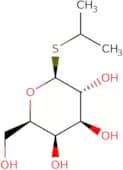
CAS:Isopropyl-beta-D-thiogalactopyranoside (IPTG) is a non-metabolizable allolactose analogue, widely used in molecular biology for overexpression of recombinant proteins from inducible systems under the control of lac promoter. IPTG binds to the LacI repressor and causes its release from the lac operator, allowing gene expression of lac operon to take place. IPTG is present in vectors of pGEX, pGEM-T, pET, pRSET, pMAL class and others.Formula:C9H18O5SPurity:Min. 99 Area-%Color and Shape:White PowderMolecular weight:238.3 g/mol5-Bromo-6-chloro-3-indolyl sulfate potassium salt
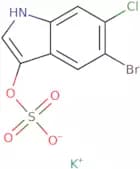
CAS:5-Bromo-6-chloro-3-indolyl sulfate potassium salt is a fluorogenic substrate that can be used for food testing. It is a conjugate of 5-bromo-6-chloroindolylsulfate and potassium, which is dissolved in buffer solution. This product can also be used as a chromogenic substrate in environmental testing, an enzyme substrate in diagnostics, and a ligand for bioluminescence. It has high purity and quality, and can be used for chemiluminescence or bioluminescence. The CAS number for this product is 6581-24-4.Formula:C8H4BrClNO4S·KPurity:Min. 95%Color and Shape:PowderMolecular weight:364.64 g/mol5-Bromo-4-chloro-3-indolyl nonanoate
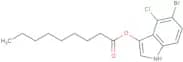
CAS:5-Bromo-4-chloro-3-indolyl nonanoate is a fluorogenic substrate that is used in the detection of enzymes. The substrate reacts with various enzymes and produces a fluorescent product, which can be detected using a fluorimeter or luminometer. It has been shown to be active against β-galactosidase, α-chymotrypsin, and β-glucuronidase. This compound may also be used as an enzyme substrate for the detection of bacteria in culture media or for food testing. 5-Bromo-4-chloro-3 indolyl nonanoate is not mutagenic or genotoxic when tested on bacterial cells.Formula:C17H21BrClNO2Purity:Min. 95%Molecular weight:386.71 g/mol