Enzyme Substrates
Subcategories of "Enzyme Substrates"
Found 1528 products of "Enzyme Substrates"
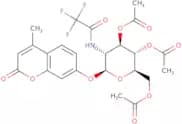
4-Methylumbelliferyl 3,4,6-tri-O-acetyl-2-deoxy-2-trifluoroacetamido-b-D-glucopyranoside
CAS:4-Methylumbelliferyl 3,4,6-tri-O-acetyl-2-deoxy-2-trifluoroacetamido-b-D-glucopyranoside is a fluorogenic substrate specifically designed for the detection and quantification of hexosaminidase enzymes. Upon cleavage by the target enzyme, it generates a bright fluorescent signal facilitating the investigation of enzyme activity, screening of inhibitors, and diagnostics.
Purity:Min. 95%Molecular weight:559.44 g/mol4-Methylumbelliferyl b-D-gentiotrioside
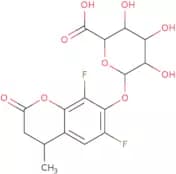
CAS:4-Methylumbelliferyl beta-D-gentiotrioside is a fluorogenic substrate for beta-glucosidase. After enzymatic cleaveage, free 4-methylumbelliferone (also known as hymecromone) is released, exhibiting blue fluorescence upon excitation with UV light. The strongest fluorescence of 4-methylumbelliferone requires deprotonation of the hydroxyl group (thus requires alkaline pH), with a maximal fluorescence intensity obtained with excitation at 350 to 370 nm and emission at 440 to 470 nm. The use of 4-methylumbelliferyl beta-D-gentiotriosideas a substrate for measuring the beta-glucosidase activity is used for Gaucher disease screening.Formula:C28H38O18Purity:Min. 98 Area-%Color and Shape:PowderMolecular weight:662.59 g/mol6,8-Difluoro-4-methylumbelliferyl b-D-glucuronide
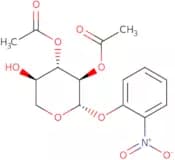
CAS:6,8-Difluoro-4-methylumbelliferyl b-D-glucuronide is a chemiluminescent substrate for the enzyme glucuronidase. The compound has been shown to be stable in the presence of a wide range of pHs and temperatures. It can be used in applications such as diagnostics, culture media and food testing. 6,8-Difluoro-4-methylumbelliferyl b-D-glucuronide has a high purity level and can be used as an indicator for other compounds such as acetaminophen or ibuprofen.Purity:Min. 95%Color and Shape:White To Off-White SolidMolecular weight:388.27 g/mol2-Nitrophenyl 2,3-di-O-acetyl-b-D-xylopyranoside
CAS:2-Nitrophenyl 2,3-di-O-acetyl-b-D-xylopyranoside is a chromogenic substrate used to assay the activity of xylosidase enzymes. It is hydrolyzed by xylosidase to yield a yellow-colored product, 2-nitrophenol, which absorbs light at 405 and 410 nm. This substrate is used in research to study the function of xylosidase enzymes and their role in various biological processes. It is also used in diagnostic tests for the detection of xylosidase activity in different microorganisms, including bacteria and fungi.
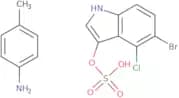
Purity:Min. 95%Molecular weight:355.3 g/mol5-Bromo-4-chloro-3-indoxyl sulfate p-toluidine salt
CAS:5-Bromo-4-chloro-3-indoxyl sulfate p-toluidine salt is a staining agent used for the detection of glucose in urine and tissues. It is also an enzyme substrate that can be used to detect the presence of lipases, amylases, esterases, phosphatases, and proteases. This product has a CAS number of 6581-23-3 and comes in high quality.
Purity:Min. 95%Molecular weight:433.71 g/mol2,4-Dinitrophenyl 2-deoxy-2-fluoro-b-xylobioside
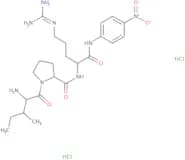
CAS:2,4-Dinitrophenyl 2-deoxy-2-fluoro-beta-xylobioside, also known as DNFPX, is a substrate to study the activity of glycosidases. It is a derivative of xylobiose, which is a disaccharide composed of two xylose units. The 2-deoxy-2-fluoro modification on one of the xylose units makes the compound resistant to further hydrolysis by the enzyme, allowing it to be used as a reporter of enzyme activity. The 2,4-Dinitrophenyl group is used as a chromogenic group that enables rapid detection and measurement of the enzyme activity that can be quantitatively measured by monitoring the appearance of the yellow 2,4-dinitrophenyl group when cleavage of the glycosidic bond.Purity:Min. 95%Molecular weight:450.33 g/molD-Ile-Pro-Arg p-nitroanilide dihydrochloride
CAS:D-Ile-Pro-Arg p-nitroanilide dihydrochloride is a chromogenic substrate commonly used in research to assess the activity of various enzymes. It has been utilized in studies related to thrombin inhibition, enzyme assays of protease enzymes, activation and enzymatic activity analysis of Factor VII-activating protease, and as a substrate for measuring glandular kallikrein activity. This substrate has been employed in assays to study the amidolytic activity of enzymes such as thrombin, plasma kallikrein, plasmin, and other proteases.Formula:C23H38Cl2N8O5Purity:Min. 95%Molecular weight:577.5 g/molEspresso-Gal
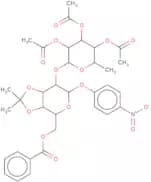
Espresso-Gal (Espresso-beta-D-galactopyranoside) is a chromogenic indicator for beta-galactosidase activity. The colorless product is cleaved by lactose-utilizing bacteria in liquid media or on agar plates and yields an espresso brown colored precipitate. Espresso-Gal can also be used as detecting agent for beta-galactosidase activity in reporter gene assays or for identification of positive transformants on agar plates when using the α-complementation approach. Read more in the Application Notes.Molecular weight:495.6 g/mol4-Nitrophenyl 2-O-(2,3,4-tri-O-acetyl-a-L-fucopyranosyl)-6-O-benzoyl-3,4-O-isopropylidene-a-D-galactopyranoside
CAS:4-Nitrophenyl 2-O-(2,3,4-tri-O-acetyl-a-L-fucopyranosyl)-6-O-benzoyl-3,4-O-isopropylidene a D galactopyranoside is an analog of galactose that binds to the DNA and regulates gene expression. This compound has been shown to be able to regulate gene expression levels in cells. 4NP2B6OB was used as a probe for microarray analysis of gene expression profiles from environmental samples. It was found that 4NP2B6OB could be used as a probe for the identification of genes in high density arrays.Purity:Min. 95%Molecular weight:717.67 g/molPhosphoric acid, mono(4-nitrophenyl) ester
CAS:Phosphoric acid, mono(4-nitrophenyl) ester is an inhibitor that binds to the human serum albumin (HSA), thereby preventing it from binding to the transcriptional regulatory protein. This leads to a decrease in the activity of this protein and consequently less inhibition of gene expression. The structural analysis of this inhibitor has shown that it forms hydrogen bonding interactions with basic proteins, while its reactivity is mainly dependent on Michaelis–Menten kinetics. The inhibitor also inhibits enzyme activities by binding to their active sites, reducing the enzyme's ability to catalyze reactions.Formula:C6H6NO6PMolecular weight:219.09 g/molRef: 3D-P-6460
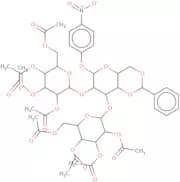
-Unit-kgkgTo inquire1kgTo inquire50gTo inquire100gTo inquire250gTo inquire500gTo inquire4-Nitrophenyl 2,3-di-O-(2,3,4,6-tetra-O-acetyl-b-D-glucopyranosyl)-4,6-benzylidene-b-D-glucopyranoside
4-Nitrophenyl 2,3-di-O-(2,3,4,6-tetra-O-acetyl-b-D-glucopyranosyl)-4,6-benzylidene-b-D-glucopyranoside is a high purity, high quality 4nitrophenol derivative that is used as a food testing substrate. It is also used for the detection of fluorescence in environmental testing. This product can be conjugated with ligands for use in diagnostic assays.Purity:Min. 95%Molecular weight:1,049.93 g/mol3-Nitrophenyl 2-acetamido-2-deoxy-b-D-glucopyranoside
CAS:3-Nitrophenyl 2-acetamido-2-deoxy-b-D-glucopyranoside is a chemiluminescent substrate that is used for the detection of glycosidases. It has been shown to be a good ligand for the study of nucleic acid hybridization, and it can also be used in enzyme assays. 3NPPAG is available in high purity and high quality. This product has been tested for use in culture media, environmental testing, bioluminescence, staining, fluorogenic substrate, CAS No. 61894-63-1, diagnostics, chromogenic substrate, enzyme substrate, food testing and conjugate applications.Purity:Min. 95%4-Nitrophenyl 2,3-di-O-(b-D-glucopyranosyl)-b-D-glucopyranoside
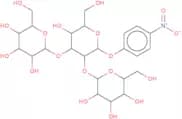
4-Nitrophenyl 2,3-di-O-(b-D-glucopyranosyl)-b-D-glucopyranoside is a chromogenic substrate that can be used to detect the presence of β-glucuronidase in human and animal tissue. The compound is also a fluoroquinolone substrate for the detection of β-lactamase activity. 4NPBG is used in diagnostics as well as food testing, due to its ability to detect bacteria in both food and water samples. 4NPBG is a chemiluminescent substrate that emits light upon hydrolysis by β-glucuronidase or β-lactamase. The compound has been shown to be an excellent ligand for binding to protein A or protein G and can be used for immunoassays such as ELISA or Western blotting.Purity:Min. 95%Molecular weight:625.53 g/mol5-Bromo-4-chloro-1H-indol-3-yl-b-D-glucuronide
CAS:5-Bromo-4-chloro-3-indolyl β-D-glucuronide (BCIG) is an chromogenic enzyme substrate used to detect the presence of glucuronidase enzyme activity. The reaction occurs when BCIG reacts with the enzyme beta-glucuronidase yielding an intense blue color. It is used in a variety of biochemical and biomedical applications, such as the detection of pathogenic bacteria, the diagnosis of genetic disorders, and the isolation of recombinant proteins.Formula:C14H13BrClNO7Purity:Min. 95%Molecular weight:422.61 g/mol4-Nitrophenyl 4-O-(b-D-mannopyranosyl)-b-D-glucopyranoside
4-Nitrophenyl 4-O-(b-D-mannopyranosyl)-b-D-glucopyranoside is a fluorogenic substrate that can be used for the detection of β-glucosidase activity in biological samples. It is an excellent substrate for the enzyme β-glucosidase, which catalyzes the hydrolysis of ester bonds in glycosides with release of glucose and formation of a phenolic product. The 4-nitrophenol group reacts with oxygen to produce light, making it useful as a chemiluminescent or bioluminescent substrate. The conjugate may also be used to detect β-glucosidase activity in culture media by adding the substrate to the culture medium and measuring its fluorescence. 4NP4OBG has been shown to have high purity, with only trace amounts of impurities detected such as benzaldehyde and 2,6-dinitroPurity:Min. 95%Molecular weight:463.39 g/mol4-Bromo-2-nitrophenyl b-D-galactopyranoside
4-Bromo-2-nitrophenyl b-D-galactopyranoside is a chemiluminescent substrate that reacts with an excess of luciferase to produce light. It is used as a reagent in the detection of ATP, NADH, and other compounds in biochemistry and biology. 4-Bromo-2-nitrophenyl b-D-galactopyranoside is also used in diagnostic kits for detecting bacterial or fungal contamination in food.
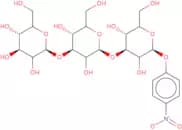
Formula:C12H14BrNO8Purity:Min. 95%Molecular weight:380.15 g/mol4-Nitrophenyl b-laminaritrioside
CAS:4-Nitrophenyl b-laminaritrioside is a chemiluminescent substrate that reacts with hydrogen peroxide to produce light. It is used in the detection of bacteria and other microorganisms in culture media, food testing, and diagnostics. 4-Nitrophenyl b-laminaritrioside is also used as a chromogenic or fluorogenic substrate in enzyme assays.Purity:Min. 95%Molecular weight:625.53 g/molZ-Gly-Pro-Arg-pNA acetate
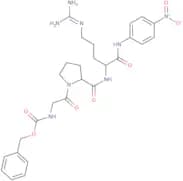
CAS:Z-Gly-Pro-Arg-pnaacetate is a substrate commonly used in enzyme research, particularly in the study of proteases. Proteases are enzymes responsible for catalyzing the hydrolysis of peptide bonds in proteins. In a study investigating the activation of protein C in blood plasma by a protease from Aspergillus ochraceus, the enzyme activity was qualitatively assessed using chromogenic peptide substrates, such as pGlu-Pro-Arg-pNA.Formula:C27H34N8O7Purity:Min. 95%Molecular weight:582.6 g/mol5-Bromo-3-indolyl β-D-glucuronide cyclohexylammonium
CAS:chromogenic substrate for beta-glucuronidaseFormula:C14H14BrNO7•C6H13NPurity:Min. 95%Color and Shape:PowderMolecular weight:487.34 g/mol