Enzyme Substrates
Enzyme substrates are molecules upon which enzymes act to catalyze chemical reactions. The substrate binds to the active site of the enzyme, where it undergoes a specific transformation to form the product of the reaction. Enzyme substrates are essential tools in research for studying enzyme kinetics, specificity, and mechanism of action. They are also used in diagnostic assays and biochemical studies. At CymitQuimica, we provide a diverse selection of high-quality enzyme substrates to support your research in enzymology and biochemistry.
Subcategories of "Enzyme Substrates"
Found 1527 products of "Enzyme Substrates"
Sort by
Purity (%)
0
100
|
0
|
50
|
90
|
95
|
100
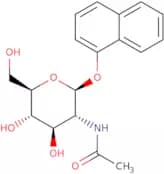
1-Naphthyl 2-acetamido-2-deoxy-b-D-glucopyranoside
CAS:<p>1-Naphthyl 2-acetamido-2-deoxy-b-D-glucopyranoside is a chromogenic substrate commonly used to assay the activity of enzymes that cleave N-acetyl-beta-D-glucosaminide, such as beta-N-acetylglucosaminidase. Upon cleavage by the enzyme of interest, the substrate releases a yellow-colored 1-naphthylamine, which can be measured spectrophotometrically. This substrate is widely used in biomedical research and drug discovery for studying lysosomal storage disorders, bacterial infections, and neurological diseases.</p>Purity:Min. 95%Molecular weight:347.36 g/molrac-7-(3',4'-Dihydroxybutyloxy)coumarin-4'-phosphate disodium salt
CAS:This Clips-O substrate rac-7-(3',4'-Dihydroxybutyloxy)coumarin-4'-phosphate allows the detection of single and dual enzymatic activity (phosphatase and oxidation of 4-amino-3-hydroxybutyloxy spacer either enzymatically or by exposure to sodium periodate) with a single substrate resulting in a fluorescent signal. The main virtues of Clips-O substrates are an increased stability towards non-enzymatic hydrolysis that results in a reduced background and high sensitivity.Formula:C13H13Na2O8PPurity:Min. 95.0 Area-%Molecular weight:374.2 g/mol4-Methylumbelliferyl 3,4,6-tri-O-acetyl-b-D-galactopyranoside
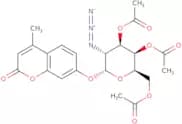
<p>4-Methylumbelliferyl 3,4,6-tri-O-acetyl-b-D-galactopyranoside is a fluorescent compound that can be used as a substrate for the following enzymes: β-galactosidase, α-galactosidase, and β-glucuronidase. This product is used in diagnostics to measure the activity of these enzymes. It can also be used to detect bacteria in culture media and food testing. 4MUF3,4,6TABG is a high quality product that has been shown to have a high purity level by liquid chromatography. CAS number: 61440-03-2</p>Purity:Min. 95%Molecular weight:464.42 g/mol4-Methylumbelliferyl 3,4,6-tri-O-acetyl-2-azido-2-deoxy-a-D-galactopyranoside
CAS:4-Methylumbelliferyl 3,4,6-tri-O-acetyl-2-azido-2-deoxy-a-D-galactopyranoside is a fluorogenic substrate for the enzyme beta galactosidase. It is used in food testing, environmental testing, and diagnostics. 4MUF3A2DGAL is an enzyme substrate that provides high quality chemiluminescence and bioluminescence signals. This product has a CAS number of 124167-43-7 and is available in both high purity and conjugate forms.Purity:Min. 95%Molecular weight:489.43 g/molAldol® 515 β-D-xylopyranoside, Biosynth Patent: EP 2427431 and US 8940909
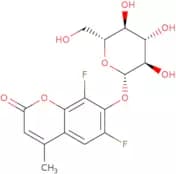
CAS:<p>Aldol® 515 beta-D-xylopyranoside is a chromogenic substrate that is used in food testing. It is an alternative to the more common glucose and sucrose, which are not suitable for some types of assays. Aldol® 515 beta-D-xylopyranoside is also used in diagnostics as a ligand for fluorescent antibody staining and chemiluminescence assays. It has been shown to increase the sensitivity of these tests by up to 10 times. The substrate has been tested extensively and is safe for use with a wide range of bacteria including E. coli, S. typhimurium, M. tuberculosis, and C. albicans at concentrations up to 100 mM without any inhibitory effects on growth or viability.<br>END>.</p>Formula:C28H34N2O6Purity:Min. 95.0 Area-%Molecular weight:494.59 g/mol6,8-Difluoro-4-methylumbelliferyl b-D-glucopyranoside
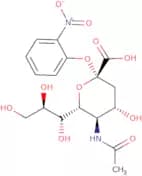
CAS:<p>6,8-Difluoro-4-methylumbelliferyl b-D-glucopyranoside is a versatile fluorogenic substrate suitable for the measurement of various glycosidase enzymes. Its unique structure allows for enhanced sensitivity and selectivity in enzyme assays, making it ideal for studying enzyme kinetics and screening of potential enzyme inhibitors.</p>Purity:Min. 95%Molecular weight:374.29 g/mol2-O-(2-Nitrophenyl)-a-D-N-acetylneuraminic acid
CAS:<p>2-O-(2-Nitrophenyl)-a-D-N-acetylneuraminic acid is a chromogenic substrate specifically designed for the detection and quantification of sialidase (neuraminidase) enzyme activity. Neuraminidases are enzymes that cleave sialic acid residues from glycoconjugates, and are produced by many microorganisms, including influenza viruses. Upon cleavage by sialidase, this substrate releases a yellow-colored 2-nitrophenol product, which can be easily monitored spectrophotometrically. This substrate is widely used in various applications, including enzyme kinetics studies, inhibitor screening, and the detection of bacterial and viral neuraminidases in clinical and environmental samples.</p>Purity:Min. 95%Color and Shape:SolidMolecular weight:430.36 g/molLuc-B.cereus Na
<p>Luc-B.cereus Na is a chemiluminescent substrate that is used for diagnostic purposes. This substrate emits light in the presence of peroxide and can be detected by a luminometer or photomultiplier tube. Luc-B.cereus Na is a high purity, high quality, and chemically stable product that can be stored at room temperature for up to one year. It has been tested for use with a wide variety of organisms such as bacteria, fungi, parasites, and viruses. Luc-B.cereus Na reacts with peroxide to produce light and is an excellent choice for use in diagnostics because it does not require any additional chemicals.</p>Purity:Min. 95%L-Glutamic acid γ-(7-amido-4-methylcoumarin)
CAS:Substrate for aminopeptidase a or the assay of γ-glutamyl transferase yielding a blue fluorescent solution upon cleavage.Formula:C15H16N2O5Purity:Min. 99 Area-%Molecular weight:304.31 g/molRef: 3D-G-3850
1gTo inquire50mgTo inquire250mgTo inquire500mgTo inquire2500mgTo inquire-Unit-ggTo inquire2-Nitrophenyl hexyl ether
CAS:<p>2-Nitrophenyl hexyl ether is a chromogenic substrate commonly used to assay the activity of esterases. Upon cleavage of the ester bond by esterases, the released 2-nitrophenyl group yields a yellow color detectable by spectrophotometry. This substrate has been used in a variety of applications, including environmental monitoring and studies of insecticide resistance. It is particularly useful for screening large numbers of samples because of its rapid reaction rate and high sensitivity. However, it should be noted that some non-specific hydrolysis may occur with this substrate, particularly at high concentrations or in the presence of strong nucleophiles.</p>Purity:Min. 95%Molecular weight:223.27 g/molD-Luciferin-6-O N-acetylneuraminic acid
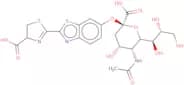
<p>Chemiluminescent substrate for neuraminidase</p>Purity:Min. 95%Molecular weight:571.58 g/molCENTA ²-Lactamase Substrate
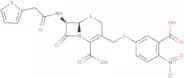
CAS:<p>CENTA²-Lactamase Substrate is a purified peptide that has been shown to be an effective inhibitor of lactamase enzymes. It is used as a signal peptide in the detection of pro-apoptotic proteins and peptide hormones, for the diagnosis of infectious diseases, and for the study of lactogenic hormones. The CENTA²-Lactamase Substrate can also be used in the polymerase chain reaction (PCR) to identify the presence of DNA from human serum. In addition, it is often used as a basic protein to detect antibodies in human serum or other biological samples by ELISA or Western blotting.</p>Formula:C21H17N3O8S3Purity:Min. 95%Molecular weight:535.57 g/molLuciferin-choline phosphate, sodium salt
<p>Luciferin-choline phosphate, sodium salt is a fluorescent substrate for the enzyme luciferase that can be used in a variety of applications. It is a conjugate of luciferin and choline phosphate, which provides high purity and high quality. This substrate is typically used as a chemiluminescent or bioluminescent indicator in various diagnostic assays, such as food testing, staining, fluorogenic substrate, and environmental testing. The CAS number for this product is [CAS].</p>Purity:Min. 95%4-Nitrophenyl b-D-cellobioside heptaacetate
<p>4-Nitrophenyl b-D-cellobioside heptaacetate is a chromogenic substrate for enzymes that catalyze the hydrolysis of glycosidic bonds. This product is used as a diagnostic tool for identifying and characterizing glycosidases and other enzymes that degrade glycosidic bonds. 4-Nitrophenyl b-D-cellobioside heptaacetate is also used in culture media to measure the activity of cellulase enzymes by measuring the release of reducing sugars. The color change of this substrate can be detected at 405 nm, 490 nm, or 550 nm.</p>Purity:Min. 95%Molecular weight:757.65 g/molJalapeno green-Gal
<p>Jalapeno green-Gal (Jalapeno green-beta-D-galactopyranoside) is a chromogenic indicator for beta-galactosidase activity. The colorless product is cleaved by lactose-utilizing bacteria in liquid media or on agar plates and yields a Jalapeno green colored precipitate. Jalapeno green-Gal can also be used as detecting agent for beta-galactosidase activity in reporter gene assays or for identification of positive transformants on agar plates when using the α-complementation approach.</p>Molecular weight:472.1 g/mol5-Bromo-6-chloro-3-indolyl b-D-glucuronide
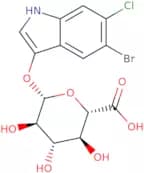
CAS:<p>5-Bromo-6-chloro-3-indolyl b-D-glucuronide (5BCIG) is an antibiotic that inhibits bacterial growth by binding to the DNA gyrase and topoisomerase IV, which are enzymes that maintain the integrity of bacterial DNA. 5BCIG is detectable in tissues, and quantified in blood. It encodes a protein to the cell cytoplasm. The sensitivity of 5BCIG against clostridium perfringens was found to be 10 times higher than that of penicillin G or erythromycin. 5BCIG has optimal activity against clostridium perfringens when expressed functionally as a polypeptide.</p>Formula:C14H13BrClNO7Purity:Min. 95%Molecular weight:422.61 g/mol5-Bromo-6-chloro-3-indolyl b-D-cellobiopyranoside
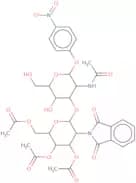
<p>5-Bromo-6-chloro-3-indolyl b-D-cellobiopyranoside is a fluorogenic substrate for the enzyme β-glucuronidase. It is used in diagnostic applications such as food testing, bacterial culture media and environmental testing. The product has CAS number: 123591-77-0.</p>Purity:Min. 95%4-Nitrophenyl 2-acetamido-3-O-(3,4,6-tri-O-acetyl-2-deoxy-2-phthalimido-b-D-glucopyranosyl)-2-deoxy-a-D-galactopyranoside
<p>4-Nitrophenyl 2-acetamido-3-O-(3,4,6-tri-O-acetyl-2-deoxy-2-phthalimido-b-D-glucopyranosyl)-2-deoxy -a -D -galactopyranoside is a Fluorogenic substrate that is used in the detection of beta glucuronidase activity. It can be used for food testing, staining, environmental testing and chromogenic substrate for diagnostic purposes. It has a CAS number of 184840–55–9 and is available in high purity and quality. 4NPPAG is an enzyme substrate that is used to measure the amount of beta glucuronidase activity in culture media by chemiluminescence or bioluminescence.</p>Purity:Min. 95%Molecular weight:759.67 g/molLuc-Enterobacteria K
<p>Please enquire for more information about Luc-Enterobacteria K including the price, delivery time and more detailed product information at the technical inquiry form on this page</p>Formula:C17H17KN2O8S2Purity:Min. 94 Area-%Molecular weight:480.55 g/mol7-((4'-L-Alaninamido)-rac-(3'-octanoyloxy)butyloxy) coumarin trifluoroacetate salt
CAS:<p>This Clips-O substrate 7-(4'-L-Alaninamido)-rac-(3'-octanoyloxy)butyloxy) coumarin allows the detection of three enzymatic activities (L-alanine aminopeptidase, C8-esterase and oxidation of 4-amino-3-hydroxybutyloxy either enzymatically or by exposure to sodium periodate) with one single substrate and give a positive fluorescent signal only in presence of all activities. The main virtues of Clips-O substrates are an increased stability towards non-enzymatic hydrolysis that results in a reduced background and high sensitivity.</p>Formula:C26H35F3N2O8Purity:Min. 95.0 Area-%Molecular weight:560.56 g/mol