Chromogenic Substrates
Found 712 products of "Chromogenic Substrates"
5-Bromo-6-chloro-3-indoxyl-beta-D-glucuronic acid, cyclohexylammonium salt
CAS:Chromogenic substrate for β-D-glucuronidase (GUS) yielding a magenta precipitate. It is used fordetection of GUS+ bacterial colonies as analternative to 5-bromo-4-chloro-3-indoxyl-β-D-glucuronide (X-GlcA).
Formula:C20H26BrClN2O7Purity:Min. 99 Area-%Molecular weight:521.80 g/molBCM® Histamine-producing bacteria Broth
Growth medium for the detection of histamine-producing bacteria in food and water samples. The medium contains an indicator that turns orange/red (absorbance at 555 nm) due to metabolites released by histidine decarboxylase. The BCM® Histamine-producing bacteria Broth contains tryptone (FT09555) and yeast extract, together with the chromogenic agent. High-level histamine-producing bacteria yield orange to red coloration in less than 2 days and even after 24 hours, while cultures of other bacteria remain yellow.Purity:Min. 95%6-Chloro-3-indoxyl-beta-D-galactopyranoside, plant origin
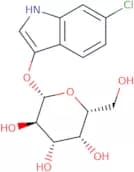
CAS:6-Chloro-3-indoxyl-beta-D-galactopyranoside is a chromogenic substrate for beta-galactosidase that yields a salmon or rose-coloured precipitate and hence is also known as Salmon-Gal. It can be used in conjunction with isopropyl-beta-D-thiogalactopyranoside (IPTG) as an alternative to the chromogenic substrate 5-bromo-4-chloro-3-indolyl beta-D-galactopyranoside (X-Gal) for detection of beta-galactosidase activity in bacterial colonies in colorimetric assays. Where beta-galactosidase expressed from a reporter gene in molecular biology experiments, recombinant colonies on growth plates are salmon-coloured while non-recombinants appear as white. Use of nitroblue tetrazolium salt (NBT) with Salmon-Gal may provide faster results, yielding a clear, purple precipitate, than for Salmon-Gal alone. In conjunction with 5-bromo-4-chloro-3-indolyl-beta-D-glucoside (X-Glc), Salmon-Gal is useful for simultaneous detection of GUS and Lac activities in the same medium.Formula:C14H16ClNO6Purity:Min. 98.0 Area-%Molecular weight:329.74 g/mol5-Bromo-6-chloro-3-indoxyl phosphate, disodium salt monohydrate
CAS:5-Bromo-6-chloro-3-indoxyl phosphate, disodium salt monohydrate is a substrate used to visualize phosphatase activity via showing magenta colored end product when used with Nitroblue Tetrazolium.Formula:C8H6BrClNNa2O5PPurity:Min. 99.0 Area-%Molecular weight:388.45 g/mol3-Indoxyl myo-inositol-1-phosphate, ammonium salt
Please enquire for more information about 3-Indoxyl myo-inositol-1-phosphate, ammonium salt including the price, delivery time and more detailed product information at the technical inquiry form on this pageFormula:C14H21N2O9PMolecular weight:392.30 g/mol5-Bromo-4-chloro-1-methyl-3-indolyl-β-D-glucopyranoside
CAS:5-Bromo-4-chloro-1-methyl-3-indolyl-β-D-glucopyranoside is a fluorescent substrate used for the detection of β-glucuronidase. It can be used in several enzyme substrates, such as 5,5'-dithiobis(2-nitrobenzoic acid), 5,5'-dithiobis(3,4,5,-trimethoxybenzoic acid), and 4-(p-[N-(7-(2,7'-dimethyl -2H -chromenyl)-2H -indazolium)]phenylazo)benzoic acid. This product is used for diagnostics and culture media as well as food testing. The product has an extremely high purity and a CAS number.Formula:C15H17BrClNO6Purity:Min. 99.0 Area-%Molecular weight:422.66 g/mol4-Nitrophenyl a-D-mannopyranoside
CAS:4-Nitrophenyl a-D-mannopyranoside is a chromogenic pNP enzyme substrate that enables the detection and quantification of a-D-mannosidase activity in various biological samples through a colorimetric assay. The hydrolysis of the substrate by the enzyme releases 4-nitrophenol, a yellow compound whose absorption can be measured spectrophotometrically. Applications for this substrate span biomedical research, disease diagnostics, and industrial enzyme production.
Formula:C12H15NO8Purity:Min. 98.0 Area-%Color and Shape:Off-White PowderMolecular weight:301.25 g/mol6-Chloro-3-indoxyl caprylate
CAS:6-Chloro-3-indoxyl caprylate is a high quality, enzyme substrate, chromogenic substrate, bioluminescence, chemiluminescence ligand, staining and diagnostics reagent. It has CAS No. 159954-35-5 and is used in food testing, culture media and environmental testing. 6-Chloro-3-indoxyl caprylate is also a fluorogenic substrate that is used for high purity applications such as conjugation with other molecules.
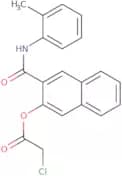
Formula:C16H20ClNO2Molecular weight:293.80 g/molNaphthol AS-D chloroacetate
CAS:Histochemical substrate for esteraseFormula:C20H16ClNO3Purity:Min. 98 Area-%Color and Shape:PowderMolecular weight:353.8 g/mol5-Nitro-3-indoxyl-β-D-galactopyranoside
For the detection of beta-galactosidase activityFormula:C14H16N2O8Molecular weight:340.29 g/molPhenolphthalein b-D-glucuronide sodium salt monohydrate
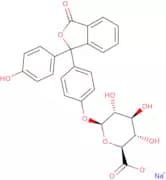
CAS:Monohydrate; beta-glucuronidase substrate; yellow/pink color Beta-glucuronidase activity can be measured in a colorimetric assay with phenolphthalein beta-D-glucuronide as substrate. Starting assay conditions can include 30 µg of enzyme-containing material, 0.6 mM phenolphthalein beta-D-glucuronide in 100 mM sodium phosphate buffer in a total volume of 100 µL and monitoring absorbance changes at 540 nm. Temperature incubation can be used to promote the enzymatic activity (Galindo, 2012).Formula:C26H23NaO11Purity:Min. 95%Color and Shape:Off-White PowderMolecular weight:534.45 g/molOstazin brilliant red H-3B galactomannan
Ostazin Brilliant Red H-3B Galactomannan is a chemiluminescent substrate used for the detection of β-1,4-galactomannans. It reacts with the glucose residues on the mannan backbone to produce a red fluorescent product. This product can be detected by spectrophotometry at an excitation wavelength of 395 nm and emission wavelength of 510 nm. The Ostazin Brilliant Red H-3B Galactomannan substrate is useful in detecting Staphylococcus aureus, Streptococcus pyogenes, Streptococcus pneumoniae, Group A streptococci, Group B streptococci, Group D streptococci, Group G streptococci, and Group C streptococci.
Purity:Min. 95%4-Nitrophenyl-beta-D-glucopyranoside
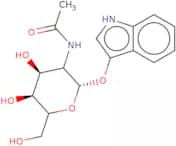
CAS:Chromogenic β-glucosidase substrate yielding a yellow solution upon cleavage.Formula:C12H15NO8Purity:Min. 99.0 Area-%Molecular weight:301.25 g/mol3-Indolyl 2-acetamido-2-deoxy-b-D-glucopyranoside
CAS:3-Indolyl 2-acetamido-2-deoxy-b-D-glucopyranoside is a substrate used for the detection of the enzyme N-acetylglucosaminidase (NAG). The enzyme hydrolyzes the NAG conjugate, releasing indole that can be detected through a colorimetric assay. This method is commonly used in clinical chemistry to evaluate kidney function, as NAG is excreted in urine and increased levels may indicate renal injury or disease. The indole NAG assay is also used in microbiology to detect the presence of NAG-producing bacteria.Purity:Min. 95%Molecular weight:336.34 g/mol6-Nitro-3-indolyl-b-D-galactopyranoside
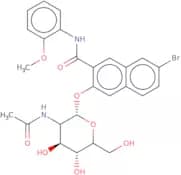
6-Nitro-3-indolyl-b-D-galactopyranoside is a chemiluminescent substrate that reacts with horseradish peroxidase to produce light. 6NIGP is used in the diagnostic field as a fluorogenic or chromogenic substrate for enzymes such as alkaline phosphatase, and as a staining agent for cells, tissues, and other biological materials. 6NIGP has been used in the detection of bacteria, fungi, parasites, and viruses. It is also used in food testing as an enzyme substrate. 6NIGP is purified by recrystallization from water or acetone and can be stored at −20°C.Purity:Min. 95%Naphthol AS-BI N-acetyl-b-D-galactosaminide
CAS:Modified naphtol AS substrate used in histochemical and cytochemical stainingFormula:C26H27BrN2O8Purity:Min. 95%Color and Shape:PowderMolecular weight:575.41 g/mol2-Naphthyl caprylate
CAS:Chromogenic substrate for carboxylesterase and lipase. 2-naphthol is released upon hydrolyzation. By simultaneous coupling with a diazonium salt, the corresponding azo-dye is formed. Naphthols can also be detected by fluorescence analysis. Used in an colorimetric assay for the extracellular lipase of Pseudomonas fluorescens B52.
Formula:C18H22O2Purity:Min. 98.0 Area-%Molecular weight:270.37 g/molRef: 3D-N-2220
1gTo inquire5gTo inquire250mgTo inquire500mgTo inquire2500mgTo inquire-Unit-ggTo inquire5-Bromo-3-indoxyl caprylate
CAS:5-Bromo-3-indoxyl caprylate is a fluorogenic substrate that can be used for the detection of β-galactosidase. It is an enzyme substrate that can be used to measure β-galactosidase activity in cell culture media. It has a high purity and high quality. 5-Bromo-3-indoxyl caprylate is also used as a chromogenic substrate for the detection of β-galactosidase. This product has a CAS number of 133950-69-3.
Formula:C16H20BrNO2Purity:Min. 99 Area-%Molecular weight:338.24 g/mol4-Chloro-1-naphthol
CAS:Substrate for horseradish peroxidase (HRP). HRP catalyzes oxidation of 4-chloro-1-naphthol in the presence of peroxide to the blue insoluble product 4-chloro-1-naphthon. It is used for both blotting and immunohistochemical staining but is less sensitive than other precipitating HRP substrates.Formula:C10H7ClOPurity:Min. 97.0 Area-%Molecular weight:178.62 g/molRef: 3D-C-5180
1kgTo inquire100gTo inquire250gTo inquire500gTo inquire2500gTo inquire-Unit-ggTo inquire