Chromogenic Substrates
Chromogenic substrates are compounds that produce a visible color change when acted upon by specific enzymes. These substrates are widely used in diagnostic assays, biochemical research, and enzyme-linked immunosorbent assays (ELISAs) to detect and quantify enzyme activity. The color change allows for easy and rapid visual identification of enzyme reactions, making chromogenic substrates essential tools in laboratory analysis. At CymitQuimica, we provide a diverse selection of high-quality chromogenic substrates to support your research and diagnostic applications.
Found 712 products of "Chromogenic Substrates"
Sort by
Purity (%)
0
100
|
0
|
50
|
90
|
95
|
100
Aldol® 458 nonanoate solution, 0.75 M in DMSO, Biosynth Patent: EP 2427431 and US 8940909
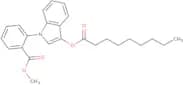
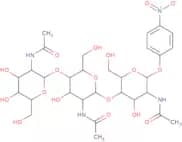
CAS:Controlled ProductAldol 458 nonanoate solution (0.75 M) is a substrate for enzymes and ligands, which is used in various applications such as food testing, staining, fluorogenic substrate, environmental testing, chromogenic substrate and conjugate. Aldol 458 nonanoate solution (0.75 M) has high purity and is highly stable at pH 2-12. This product can be used as a chemiluminescence or bioluminescence substrate. The CAS number for this product is 2484873-15-4.Formula:C25H29NO4Purity:Min. 95%Color and Shape:Clear LiquidMolecular weight:407.51 g/mol4-Nitrophenyl N,N',N''-triacetyl-b-D-chitotriose
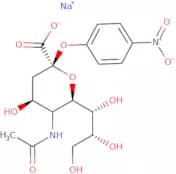
CAS:Substrate for determining hydrolytic activity of chitinasePurity:Min. 95%Color and Shape:White PowderMolecular weight:748.69 g/mol2-O-(4-Nitrophenyl)-a-D-N-acetylneuraminic acid sodium salt
CAS:2-O-(4-Nitrophenyl)-alpha-D-N-acetylneuraminic acid sodium salt is a chromogenic substrate used to detect the enzymatic activity of neuraminidase or sialidase. After cleavage, the nitrophenyl moiety is released exhibiting a light yellowish color. 2-O-(4-Nitrophenyl)-alpha-D-N-acetylneuraminic acid sodium salt is used in bacterial neuraminidase activity assays.Purity:Min. 95%Color and Shape:Yellow PowderMolecular weight:452.35 g/molAldol® 470 acetate, Biosynth Patent: EP 2427431 and US 8940909
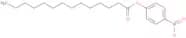
CAS:Controlled Product<p>Aldol® 470 acetate is a Fluorogenic substrate that is used in enzymatic reactions to produce a fluorescent product. Aldol® 470 acetate can be used as a ligand or a chromogenic substrate. This product is also used in diagnostic tests, such as conjugates and chemiluminescence, to detect the presence of certain enzymes or microorganisms. It can be used in culture media to measure the amount of certain enzymes, such as phosphatases or proteases, and has been shown to have high purity and quality. This product has CAS No. 1318785-37-3, 1318785-38-4, 1318785-39-5, 1318785-40-6 and 1318785-41-7.</p>Formula:C25H21NO5Purity:Min. 95%Color and Shape:PowderMolecular weight:415.44 g/mol4-Nitrophenyl myristate
CAS:4-Nitrophenyl myristate (NphOMy) is a chromogenic enzyme substrate used as a diagnosis tool for detection of β-lactamase hydrolysis activities. In the presence of certain drugs, 4-nitrophenyl myristate HSA-Tyr411-catalyzed hydrolysis seems to be inhibited.Formula:C20H31NO4Purity:Min. 95 Area-%Color and Shape:White PowderMolecular weight:349.46 g/mol8-Hydroxyquinoline b-D-glucopyranoside
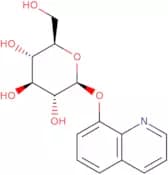
CAS:<p>8-Hydroxyquinoline b-D-glucopyranoside (8-OHG-glu) is a chromogenic enzyme substrate commonly used to detect the presence of beta-glucosidase in biological samples. When hydrolyzed by beta-glucosidase, 8-OHG-glu produces a yellow-orange color, indicating the presence of the enzyme. This substrate is particularly useful for measuring beta-glucosidase activity in soil and plant samples.</p>Formula:C15H17NO6Purity:Min. 95%Color and Shape:PowderMolecular weight:307.3 g/mol8-Hydroxyquinoline b-D-galactopyranoside
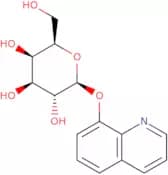
CAS:<p>Chromogenic substrate targeting the beta-galactosidase enzyme</p>Formula:C15H17NO6Purity:Min. 98 Area-%Color and Shape:PowderMolecular weight:307.3 g/mol5-Bromo-3-indolyl b-D-glucopyranoside
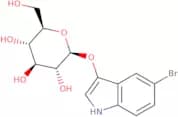
CAS:5-bromo-3-indolyl-b-d-glucopyranoside, also known as 5BIG, is an enzyme substrate for beta-glucosidase. It is used in bacterial assays for the identifcation of Gram-positive bacteria such as Staphylococcus aureus and Bacillus subtilis. After cleavege, it gives an intense blue color.Formula:C14H16BrNO6Purity:Min. 98 Area-%Color and Shape:PowderMolecular weight:374.18 g/molAldol® 467 N-acetyl-beta-D-glucosaminide, Biosynth Patent: EP 2427431 and US 8940909
CAS:<p>Aldol® 467 N-acetyl-beta-D-glucosaminide is a chromogenic and fluorogenic enzyme substrate used for detection of ?-N-acetyl-glucosaminidase activity. The colorless enzyme substrate is cleaved in the presence of ?-N-acetyl-glucosaminidase yielding development of a yellow product. In addition, green fluorescence is generated when a suitable matrix or Aldol® 355 fluorescence enhancer is present. Aldol® 467 N-acetyl-beta-D-glucosaminide amide can be used in enzymatic assays or in live bacterial cultures. Aldol® 467 N-acetyl-beta-D-glucosaminide is suitable for use in liquid and solid media, under aerobic as well as anaerobic conditions.</p>Formula:C31H31ClN2O9Purity:Min. 92.0 Area-%Molecular weight:611.04 g/mol4-Nitrophenyl 2-acetamido-6-O-(2-acetamido-2-deoxy-b-D-glucopyranosyl)-2-deoxy-a-D-galactopyranoside
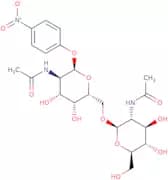
CAS:<p>4-Nitrophenyl 2-acetamido-6-O-(2-acetamido-2-deoxy-b-D-glucopyranosyl)-2-deoxy-a-D-galactopyranoside is a chromogenic pNP glycoside substrate designed for the detection and assay of specific enzymes, particularly glycosidases. Upon enzymatic hydrolysis, this substrate releases a quantifiable 4-nitrophenol moiety enabling straightforward colorimetric measurement. This pNP-linked substrate is versatile and can be efficiently employed in enzyme activity assays, screening enzyme inhibitors, and assessing enzyme mechanisms, enhancing research and development processes in the field of glycobiology.</p>Purity:Min. 95%Color and Shape:White PowderMolecular weight:545.49 g/mol5-Bromo-6-chloro-3-indoxyl choline phosphate
CAS:5-Bromo-6-chloro-3-indoxyl choline phosphate is a chemiluminescent substrate for the detection of bacterial activity. It reacts with an enzyme, luciferase, which is present in a variety of living cells. The reaction produces light. This product has been tested for environmental and food safety by the manufacturer. 5-Bromo-6-chloro-3-indoxyl choline phosphate is used as a diagnostic tool to determine the presence of bacteria in humans, animals, and plants. It can be used to measure levels of bacteria in culture media, water samples, and food products. 5-Bromo-6-chloro-3-indoxyl choline phosphate can also be used as a substrate for enzymes such as phosphatases or esterases that catalyze reactions with substrates with brominated or chlorinated groups.Formula:C13H17BrClN2O4PPurity:Min. 95%Molecular weight:411.63 g/molN-Benzoyl-DL-arginine 4-nitroanilide hydrochloride
CAS:<p>N-α-benzoyl-DL-arginine-4-nitroanilide hydrochloride is commonly used as a substrate in various enzymatic assays, particularly for studying proteases like trypsin and chymotrypsin. It serves as a synthetic substrate to measure the activity of these enzymes. For instance, it has been used to determine trypsin activity in different organisms and tissues. The substrate has also been employed in studying the enzymatic properties of various proteases, including those found in latex, snake venoms, and plant seeds. Additionally, it has been utilized to assess the effects of different compounds on trypsin activity, such as condensed tannins and wine.</p>Formula:C19H22N6O4•HClPurity:Min. 95%Color and Shape:PowderMolecular weight:434.88 g/mol4-Nitrophenyl 5-O-trans-feruloyl-a-L-arabinofuranoside
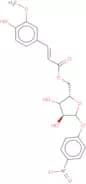
CAS:<p>4-Nitrophenyl 5-O-trans-feruloyl-alpha-L-arabinofuranoside is a chromogenic substrate for alpha-L-arabinofuranosidase. Upon hydrolysis, para-nitrophenol is released yielding a yellowish colour. 4-Nitrophenyl 5-O-trans-feruloyl-alpha-L-arabinofuranoside is used in different applications such as the Plant cell wall degradation assays, bacterial enzyme profiling</p>Formula:C21H21NO10Purity:Min. 95%Color and Shape:PowderMolecular weight:447.4 g/mol4-Nitrophenyl caprylate
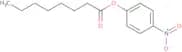
CAS:<p>Chromogenic substrate targeting lipase, C8 esterase</p>Formula:C14H19NO4Purity:Min. 95 Area-%Color and Shape:Slightly Brown Yellow Clear LiquidMolecular weight:265.31 g/molCrimson-Gal
Crimson-Gal (Crimson-beta-D-galactopyranoside) is a chromogenic indicator for beta-galactosidase activity. The colorless product is cleaved by lactose-utilizing bacteria in liquid media or on agar plates and yields a crimson colored precipitate. Crimson-Gal can also be used as detecting agent for beta-galactosidase activity in reporter gene assays or for identification of positive transformants on agar plates when using the α-complementation approach. Read more in the Application Notes.Molecular weight:360.96 g/mol5-Bromo-4-chloro-3-indoxyl sulfate p-toluidine salt
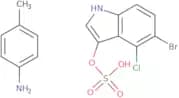
CAS:<p>5-Bromo-4-chloro-3-indoxyl sulfate p-toluidine salt is a staining agent used for the detection of glucose in urine and tissues. It is also an enzyme substrate that can be used to detect the presence of lipases, amylases, esterases, phosphatases, and proteases. This product has a CAS number of 6581-23-3 and comes in high quality.</p>Purity:Min. 95%Molecular weight:433.71 g/mol4-Nitrophenyl b-D-galactopyranosiduronic acid
CAS:<p>4-Nitrophenyl b-D-galactopyranosiduronic acid is a chemiluminescent substrate for the detection of β-galactosidase. It is used for the determination of α-galactosidase activity in urine, feces, and blood. This product can be used as a chromogenic substrate for the detection of β-galactosidase in tissue culture medium. 4-Nitrophenyl b-D-galactopyranosiduronic acid is also a fluorogenic substrate which can be conjugated to an enzyme such as horseradish peroxidase or alkaline phosphatase.</p>Purity:Min. 95%Molecular weight:315.23 g/mol5-Bromo-6-chloro-3-indolyl b-D-cellobiopyranoside
<p>5-Bromo-6-chloro-3-indolyl b-D-cellobiopyranoside is a fluorogenic substrate for the enzyme β-glucuronidase. It is used in diagnostic applications such as food testing, bacterial culture media and environmental testing. The product has CAS number: 123591-77-0.</p>Purity:Min. 95%2-Naphthyl 2,3,4,6-tetra-O-acetyl-b-D-glucopyranoside
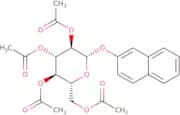
CAS:<p>2-Naphthyl 2,3,4,6-tetra-O-acetyl-b-D-glucopyranoside (NAG tetra acetate) is a chromogenic enzyme substrate commonly used in the detection of β-galactosidase activity. Upon hydrolysis by the enzyme, it produces a yellow product that can be detected by spectrophotometry or visually. It is frequently used in bacterial assays to monitor gene expression or as a tool for screening potential inhibitors of the enzyme.</p>Purity:Min. 95%Molecular weight:474.47 g/mol4-Nitrophenyl 2-acetamido-3-O-[2-O-(2,3,4-tri-O-benzoyl-a-L-fucopyranosyl)-3,4,6-tri-O-acetyl-D-galactopyranosyl]-2-deoxy-6-O-trityl -b-D-glucopyranoside
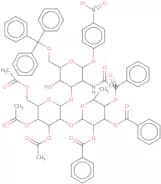
<p>4-nitrophenyl 2-acetamido-3-O-[2-O-(2,3,4-tri-O-benzoyl-a-L-fucopyranosyl)-3,4,6-tri-O-acetyl -D -galactopyranosyl]-2 deoxy 6 O trityl b D glucopyranoside is a chemiluminescent substrate that can be used in biochemical assays. It reacts with oxygen to produce light when it is excited by a UV or blue light source. This product has been tested for purity and quality by HPLC analysis and spectroscopy.</p>Purity:Min. 95%Molecular weight:1,331.33 g/mol