Chromogenic Substrates
Found 667 products for "Chromogenic Substrates". Showing the first 500.
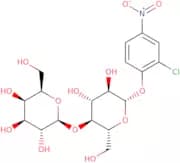
2-Chloro-4-nitrophenyl b-D-lactoside
CAS:2-Chloro-4-nitrophenyl b-D-galactopyranoside is a chromogenic enzyme substrate used to study the activity of beta-lactoside. It produces a yellow color when cleaved by the enzyme, making it a useful tool in enzyme assays and screening experiments.Purity:Min. 95%Color and Shape:PowderMolecular weight:497.83 g/molS-(4-Nitrophenyl)mercapturic acid
CAS:S-(4-Nitrophenyl)mercapturic acid (S-NPMA) is the major metabolite of 4-nitrophenol, which is a precursor to dyes and pharmaceuticals. S-NPMA has been detected in urine samples from humans, rats, and mice. The main metabolic pathway for S-NPMA is an oxidative conversion by cytochrome P450 enzymes. S-NPMA has been found to be a useful biomarker for the presence of polycyclic aromatic hydrocarbons in wastewater and human urine. The levels of this compound have also been shown to increase with age in humans.
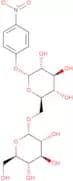
Purity:Min. 95%Molecular weight:284.29 g/mol4-Nitrophenyl 6-O-(a-D-glucopyranosyl)-a-D-glucopyranoside
CAS:4-Nitrophenyl 6-O-(a-D-glucopyranosyl)-a-D-glucopyranoside is an advanced chromogenic pNP enzyme substrate that delivers unparalleled performance in enzymatic assays. This high-quality substrate is specifically designed for studying glycosidases and other enzymes involved in carbohydrate metabolism. Our 4-Nitrophenyl 6-O-(a-D-glucopyranosyl)-a-D-glucopyranoside is synthesized with the highest quality materials to provide incredible accuracy and reliability in your research applications.
Purity:Min. 95%Molecular weight:463.39 g/mol4-Nitrophenyl 2-acetamido-3-O-(2-O-a-L-fucopyranosyl-b-D-galactopyranosyl)-2-deoxy-a-D-galactopyranoside
CAS:4-Nitrophenyl 2-acetamido-3-O-(2-O-a-L-fucopyranosyl-b-D-galactopyranosyl)-2,6,8,10,12-pentaoxoheptaacetic acid is a chemiluminescent substrate that is used for the detection of peroxidase and other enzymes. The reaction product is a yellow fluorescent product which can be measured using a fluorometer. It is sold as an aqueous solution at 1mg/mL in phosphate buffer at pH 7.4.
Purity:Min. 95%Molecular weight:650.58 g/mol4-Nitrophenyl 2-acetamido-2-deoxy-4-O-[2-O-(a-L-fucopyranosyl)-b-D-galactopyranosyl]-b-D-glucopyranoside
CAS:The 4-Nitrophenyl 2-acetamido-2-deoxy-4-O-[2-O-(a-L-fucopyranosyl)-b-D-galactopyranosyl]-b-D-glucopyranoside is a specialized pNP enzyme substrate designed to study fucosyl-galactose-dependent enzymes. This chromogenic substrate is valuable for researchers investigating glycosyltransferase activity, structure-function relationships of glycan-binding proteins, and regulation of cellular signaling pathways involving fucose modifications. Its high specificity and sensitivity ensure accurate measurements in diverse experimental setups, and its chromogenic detection system facilitates rapid and reliable analysis.Purity:Min. 95%Molecular weight:650.58 g/mol2,4-Dinitrophenyl b-D-cellobioside
CAS:2,4-Dinitrophenyl b-D-cellobioside is a chemiluminescent substrate that is used to detect the activity of enzymes and other proteins. It can be conjugated with an antibody or other ligand for use in diagnostic purposes. 2,4-DNPBC is a pure compound with a high quality that does not contain any other impurities. Its CAS number is 157956-96-2.Purity:Min. 95%4-Nitrophenyl 4,6-O-benzylidene-a-D-mannopyranoside
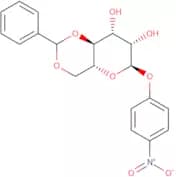
CAS:4-Nitrophenyl 4,6-O-benzylidene-a-D-mannopyranoside is a chromogenic substrate for alpha-mannosidase and beta-glucosidase. It is used as a diagnostic tool for identifying the presence of these enzymes in certain bacteria. This product is also used in food testing, environmental testing, and bioluminescence.Purity:Min. 95%Molecular weight:389.36 g/mol6-Chloro-3-indolyl phosphate disodium salt
CAS:6-Chloro-3-indolyl phosphate disodium salt is a substrate for visualising alkaline phosphatase activity. It produces a red colored insoluble end product that is detected visually, when used together with nitroblue tetrazolium. The substrate system is versatile and functions in a variety of applications, including Northern, Southern, and Western blotting, in situ hybridization, ELISAs and immunohistochemistry. DMF soluble.Formula:C8H5ClNNa2O4PPurity:Min. 98 Area-%Color and Shape:PowderMolecular weight:291.54 g/mol4-Nitrophenyl 2-acetamido-2-deoxy-4-O-(a-L-fucopyranosyl)-b-D-glucopyranoside
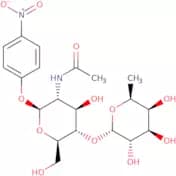
CAS:4-Nitrophenyl 2-acetamido-2-deoxy-4-O-(a-L-fucopyranosyl)-b-D-glucopyranoside is a fluorescent substrate for beta-galactosidase that is used in diagnostics and research. The product has been shown to be an excellent substrate for beta-galactosidase and beta-glucuronidase, as well as other glycosidases. It can be used to detect the presence of these enzymes in any sample containing glycosides. This product is also used in food testing, environmental testing, and bioluminescence experiments. 4NPAFG is available in high purity with a conjugate group at the C4 position.Purity:Min. 95%Molecular weight:488.44 g/mol2-Chloro-4-nitrophenyl 2,3,4,6-tetra-O-acetyl-b-D-glucopyranoside
CAS:2-Chloro-4-nitrophenyl 2,3,4,6-tetra-O-acetyl-b-D-glucopyranoside is a chromogenic enzyme substrate used in the biochemical characterization of various enzymes. It produces a yellow color when cleaved by enzymes and is commonly used in assays to study enzyme kinetics and activity. It is commonly used is used to study the biochemical and physiological effects of glycosylation and acts as a substrate for glycosylation-dependent enzymes involved in carbohydrate metabolism. Glycosidases hydrolyse 2-Chloro-4-nitrophenyl-2,3,4,6-tetra-O-acetyl-beta-D-glucopyranoside, releasing 2-chloro-4-nitrophenyl moiety, and the substrate can then be further metabolized by other enzymes. It is also used in the investigate the effects and activity on glycoproteins and glycolipids.Purity:Min. 95%Molecular weight:503.84 g/mol4-Nitrophenyl 2-O-(2,3,4-tri-O-acetyl-a-L-fucopyranosyl)-6-O-benzoyl-3,4-O-isopropylidene-a-D-galactopyranoside
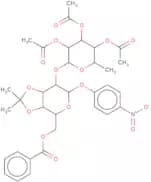
CAS:4-Nitrophenyl 2-O-(2,3,4-tri-O-acetyl-a-L-fucopyranosyl)-6-O-benzoyl-3,4-O-isopropylidene a D galactopyranoside is an analog of galactose that binds to the DNA and regulates gene expression. This compound has been shown to be able to regulate gene expression levels in cells. 4NP2B6OB was used as a probe for microarray analysis of gene expression profiles from environmental samples. It was found that 4NP2B6OB could be used as a probe for the identification of genes in high density arrays.Purity:Min. 95%Molecular weight:717.67 g/molb-Naphthyl-b-maltotrioside
b-Naphthyl-b-maltotrioside is a fluorogenic substrate that is used in enzymatic and chromogenic assays. It is a bifunctional substrate that reacts with enzymes to produce light. b-Naphthyl-b-maltotrioside can be used as a conjugate for immunoassays, such as ELISA. This substrate is also suitable for use in diagnostics, food testing, and environmental testing.Purity:Min. 95%Molecular weight:630.59 g/mol4-Nitrophenyl 2-acetamido-3-O-acetyl-4,6-O-benzylidene-2-deoxy-a-D-glucopyranoside
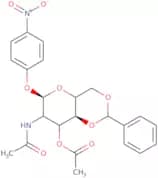
CAS:4-Nitrophenyl 2-acetamido-3-O-acetyl-4,6-O-benzylidene-2-deoxy-aDglucopyranoside is a fluorogenic substrate that can be used for the detection of β-glucosidase activity. It is a water soluble substrate with an extinction coefficient of approximately 10,000 M−1 cm−1 at 420 nm. 4NPAABGDG is a chromogenic substrate that can be used to detect β-galactosidase activity. It has an extinction coefficient of approximately 1,700 M−1 cm−1 at 420 nm. The CAS number for 4NPAABGDG is 23262–56–8 and it is sold by Sigma Aldrich under catalog number L4959.Purity:Min. 95%Molecular weight:472.44 g/mol2-Nitrophenyl 2,3,4,6-tetra-O-acetyl-b-D-galactopyranoside
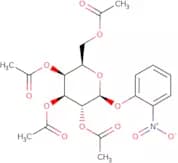
CAS:2-Nitrophenyl 2,3,4,6-tetra-O-acetyl-b-D-galactopyranoside is a fluorescent substrate for β-galactosidase. It is used in food testing, environmental testing and diagnostics. This substrate is also used to detect the presence of β-galactosidase activity in cells and tissues. 2NPTABG provides a fluorescence signal that can be detected with an ultraviolet light or a luminometer. The luminescence intensity decreases when it reacts with β-galactosidase enzyme. This product has a CAS number of 3053-17-6 and is available at high purity levels.Purity:Min. 95%Molecular weight:469.4 g/mol4-Nitrophenyl 6'-deoxy-6'-(2-pyridylamino)-a-D-penta-(1-4)-glucopyranoside
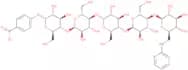
CAS:4-Nitrophenyl 6'-deoxy-6'-(2-pyridylamino)-a-D-penta-(1-4)-glucopyranoside is a fluorescent substrate for the enzyme beta glucosidase. It is a chemiluminescent reagent that can be used to measure beta glucosidase activity. The substrate is an excellent high quality chemical and has been tested for environmental safety, heavy metal content and staining. 4-Nitrophenyl 6'-deoxy-6'-(2-pyridylamino)-a-D-penta-(1-4)-glucopyranoside is a chromogenic substrate that can be used in diagnostic testing, such as bioluminescence or fluorogenic assay. This product can also be used as a culture media additive or food testing agent.Purity:Min. 95%Molecular weight:1,025.91 g/mol4-Nitrophenyl 4-O-(b-D-mannopyranosyl)-b-D-glucopyranoside
4-Nitrophenyl 4-O-(b-D-mannopyranosyl)-b-D-glucopyranoside is a fluorogenic substrate that can be used for the detection of β-glucosidase activity in biological samples. It is an excellent substrate for the enzyme β-glucosidase, which catalyzes the hydrolysis of ester bonds in glycosides with release of glucose and formation of a phenolic product. The 4-nitrophenol group reacts with oxygen to produce light, making it useful as a chemiluminescent or bioluminescent substrate. The conjugate may also be used to detect β-glucosidase activity in culture media by adding the substrate to the culture medium and measuring its fluorescence. 4NP4OBG has been shown to have high purity, with only trace amounts of impurities detected such as benzaldehyde and 2,6-dinitroPurity:Min. 95%Molecular weight:463.39 g/mol4-Nitrophenyl 4,6-benzylidene-3-O-(2,3,4,6-tetra-O-[4-methoxybenzyl]-a-D-glucopyranosyl)-a-D-glucopyranoside
4-Nitrophenyl 4,6-benzylidene-3-O-(2,3,4,6-tetra-O-[4-methoxybenzyl]-a-D-glucopyranosyl)-a-D-glucopyranoside is a chemiluminescent substrate used for the detection of various enzymes. This substrate is commonly used in enzyme assays to measure the activity of β-galactosidase, α-amylase, and β-lactamase. The product can be used in diagnostic applications such as food testing and bacterial identification.Purity:Min. 95%Molecular weight:1,088.02 g/mol5-Bromo-4-chloro-1H-indol-3-yl-b-D-glucuronide
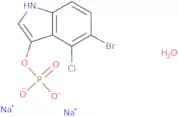
CAS:5-Bromo-4-chloro-3-indolyl β-D-glucuronide (BCIG) is an chromogenic enzyme substrate used to detect the presence of glucuronidase enzyme activity. The reaction occurs when BCIG reacts with the enzyme beta-glucuronidase yielding an intense blue color. It is used in a variety of biochemical and biomedical applications, such as the detection of pathogenic bacteria, the diagnosis of genetic disorders, and the isolation of recombinant proteins.Formula:C14H13BrClNO7Purity:Min. 95%Molecular weight:422.61 g/molBCIP disodium salt sesquihydrate
CAS:BCIP is a dye that can be used as a substrate in a fluorometric assay to detect the presence of effector proteins. It is also used in analytical chemistry to detect phosphate, and as a reagent in diagnostic tests for mucin gene expression. BCIP has been shown to have transcriptional regulatory effects on genes encoding for proteins involved in antibody production. BCIP has been shown to act as an effector protein, which influences the amount of mRNA produced by the gene encoding for tissue culture cells. BCIP can also be used as a model system to study the regulation of transcription in vitro.
A hybridization technique using BCIP with DNA-dependent RNA polymerase II has been demonstrated and applied to analyze the mechanism of transcriptional control at the level of individual genes. The use of this technique allows for analysis at a single gene level and may allow for better understanding of transcriptional regulation.Purity:Min. 95%Molecular weight:388.45 g/mol4-Nitrophenyl b-lacto-N-neotetraoside
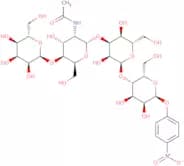
CAS:4-Nitrophenyl b-lacto-N-neotetraoside is a potent antibiotic that inhibits bacterial growth by binding to the beta subunit of DNA gyrase. This drug has been shown to be effective against methicillin resistant Staphylococcus aureus (MRSA) and Clostridium perfringens, although is not active against acid-fast bacteria such as Mycobacterium tuberculosis or Mycobacterium avium complex. Gatifloxacin has shown anti-inflammatory properties, which may be due to its inhibition of prostaglandin synthesis.Purity:Min. 95%Molecular weight:828.72 g/mol



![4-Nitrophenyl 2-acetamido-2-deoxy-4-O-[2-O-(a-L-fucopyranosyl)-b-D-galactopyranosyl]-b-D-glucopyra…](/_next/image/?url=https%3A%2Fstatic.cymitquimica.com%2Fproducts%2F3D%2Fthumb-webp%2FEN04931.webp&w=3840&q=75)





![4-Nitrophenyl 4,6-benzylidene-3-O-(2,3,4,6-tetra-O-[4-methoxybenzyl]-a-D-glucopyranosyl)-a-D-gluco…](/_next/image/?url=https%3A%2Fstatic.cymitquimica.com%2Fproducts%2F3D%2Fthumb-webp%2FEN04840.webp&w=3840&q=75)