Chromogenic Substrates
Found 667 products for "Chromogenic Substrates". Showing the first 500.
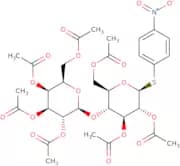
4-Nitrophenyl 4-O-(2,3,4,6-tetra-O-acetyl-b-D-galactopyranosyl)-2,3,6-tri-O-acetyl-b-D-thioglucopyranoside
CAS:4-Nitrophenyl 4-O-(2,3,4,6-tetra-O-acetyl-b-D-galactopyranosyl)-2,3,6-tri-O-acetyl-b-D-thioglucopyranoside is a superior chromogenic substrate for the detection of enzymes. Specifically designed for optimal performance, it provides exquisite sensitivity and definitive results in enzyme assays. Its exceptional properties make it a top choice among researchers and professionals in biochemistry, enabling accurate analysis and quantification of enzymatic activities.Purity:Min. 95%Molecular weight:773.71 g/mol2,4-Dinitrophenyl 2-deoxy-2-fluoro-b-xylobioside
CAS:2,4-Dinitrophenyl 2-deoxy-2-fluoro-beta-xylobioside, also known as DNFPX, is a substrate to study the activity of glycosidases. It is a derivative of xylobiose, which is a disaccharide composed of two xylose units. The 2-deoxy-2-fluoro modification on one of the xylose units makes the compound resistant to further hydrolysis by the enzyme, allowing it to be used as a reporter of enzyme activity. The 2,4-Dinitrophenyl group is used as a chromogenic group that enables rapid detection and measurement of the enzyme activity that can be quantitatively measured by monitoring the appearance of the yellow 2,4-dinitrophenyl group when cleavage of the glycosidic bond.Purity:Min. 95%Molecular weight:450.33 g/mol5-Bromo-6-chloro-3-indolyl palmitate
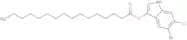
CAS:5-Bromo-6-chloro-3-indolyl palmitate is a magenta enzyme substrate that is widely used in the study of lipase and esterase enzymes. This compound consists of an indole ring with bromine and chlorine atoms at positions 5 and 6, respectively, and a palmitate moiety esterified to the indolyl ring. The palmitate group is a long-chain fatty acid, making this substrate particularly useful for investigating enzymes that hydrolyze ester bonds in lipids. Upon cleavage by lipases or esterases, 5-Bromo-6-chloro-3-indolyl palmitate releases a magenta-colored product, which can be easily detected and quantified to measure enzyme activity.
Purity:Min. 95%Molecular weight:484.9 g/mol2-Nitrophenyl 2-acetamido-2-deoxy-a-D-galactopyranoside
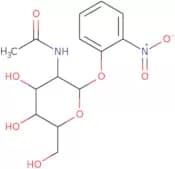
CAS:2-Nitrophenyl 2-acetamido-2-deoxy-a-D-galactopyranoside is a fluorogenic substrate that is used in enzyme assays. It can be used as a chromogenic substrate or conjugate with an enzyme to detect the presence of glucose.Purity:Min. 95%Molecular weight:342.3 g/mol2-(5'-Chloro-2'-hydroxyphenyl)-6-chloro-4(3H)-quinazolinonyl a-D-N-acetylgalactosamine
2-(5'-Chloro-2'-hydroxyphenyl)-6-chloro-4(3H)-quinazolinonyl a-D-N-acetylgalactosamine is an inhibitor of bacterial cell wall synthesis. It has been shown to inhibit the enzymatic activity of beta-lactamase, which is an enzyme that breaks down beta-lactam antibiotics. 2-(5'-Chloro-2'-hydroxyphenyl)-6-chloro-4(3H)-quinazolinonyl a-D-N-acetylgalactosamine can be used for the treatment of infections caused by bacteria such as methicillin resistant Staphylococcus aureus. This compound has been shown to have low toxicity and does not cause any significant side effects in animals.Purity:Min. 95%Molecular weight:510.32 g/molAldol® 450 acetate, Biosynth Patent: EP 2427431 and US 8940909
CAS:Aldol® 450 acetate is an enzyme substrate that is used in the detection of aldolase activity. Aldol® 450 acetate has been shown to be a useful alternative to the traditional bioluminescence and chemiluminescence methods for detecting aldolase activity. It has also been shown to be effective as a fluorogenic substrate for detecting aldolase activity in food products. Aldol® 450 acetate can be conjugated with other compounds, such as ligands and dyes, to enable it to detect different enzymes.
Aldol® 450 acetate has an absorption maximum at 450 nm and fluoresces blue-green under longwave UV light excitation. It is soluble in water and exhibits excellent stability at high temperatures (up to 50°C) and pH (1-14).Formula:C27H19NO3Purity:Min. 95.0 Area-%Molecular weight:405.44 g/mol2-Nitrophenyl 2,3-di-O-acetyl-b-D-xylopyranoside
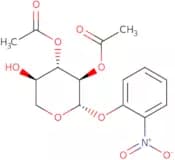
CAS:2-Nitrophenyl 2,3-di-O-acetyl-b-D-xylopyranoside is a chromogenic substrate used to assay the activity of xylosidase enzymes. It is hydrolyzed by xylosidase to yield a yellow-colored product, 2-nitrophenol, which absorbs light at 405 and 410 nm. This substrate is used in research to study the function of xylosidase enzymes and their role in various biological processes. It is also used in diagnostic tests for the detection of xylosidase activity in different microorganisms, including bacteria and fungi.
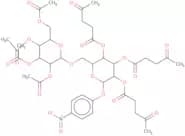
Purity:Min. 95%Molecular weight:355.3 g/mol4-Nitrophenyl 6-O-(2,3,4,6-tetra-O-acetyl-a-D-mannopyranosyl)-2,3,4-tri-O-levulinoyl-a-D-mannopyranoside
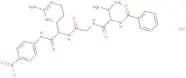
4-Nitrophenyl 6-O-(2,3,4,6-tetra-O-acetyl-a-D-mannopyranosyl)-2,3,4-tri-O-levulinoyl-a-D-mannopyranoside is a fluorogenic substrate that is used in assays for detecting nitrates. This compound reacts with 4-(methylnitrosamino)pyridine (MNAP) to produce an intense light that can be detected by a luminometer. It has been shown to react with the enzyme nitrate reductase and is used in food testing and environmental testing as a means of measuring the amount of nitrates present.Purity:Min. 95%Molecular weight:925.84 g/molN-Benzoyl-Val-Gly-Arg p-nitroanilide hydrochloride
CAS:N-Benzoyl-Val-Gly-Arg p-nitroanilide hydrochloride is a fluorogenic substrate that can be used for the detection of β-glucuronidase. It has been shown to have high purity and quality, which makes it an excellent choice for use in food testing and staining.
Formula:C26H34N8O6•HClPurity:Min. 95%Molecular weight:591.06 g/mol5-Bromo-4-chloro-3-indolyl b-D-galactopyranoside-6-sulphate
CAS:5-Bromo-4-chloro-3-indolyl b-D-galactopyranoside 6-sulphate (BCIGS) is a chemiluminescent substrate that reacts with an enzyme to produce light. It has been used for the detection of various substances, including 5'-nucleotidase, 5'-adenosine monophosphate phosphohydrolases, and alkaline phosphatase. BCIGS can be used as a chromogenic substrate in the fluorometric assay of glucose oxidase and galactose oxidase. BCIGS is also used as a ligand in immunological reactions such as immunodiffusion, immunoelectrophoresis, and radioimmunoassay.Formula:C14H15BrClNO9SPurity:Min. 95%Molecular weight:488.69 g/molAldol® 515 propionate, Biosynth Patent: EP 2427431 and US 8940909
CAS:Aldol® 515 propionate is a chromogenic substrate that is used as a reagent in food testing, diagnostics, and environmental testing. It reacts with an enzyme to form a fluorescent product that can be detected with a spectrophotometer. The substrate has been shown to have high purity and high quality.Formula:C26H24N2O3Purity:Min. 95.0 Area-%Molecular weight:412.48 g/molAldol® 515 β-D-xylopyranoside, Biosynth Patent: EP 2427431 and US 8940909
CAS:Aldol® 515 beta-D-xylopyranoside is a chromogenic substrate that is used in food testing. It is an alternative to the more common glucose and sucrose, which are not suitable for some types of assays. Aldol® 515 beta-D-xylopyranoside is also used in diagnostics as a ligand for fluorescent antibody staining and chemiluminescence assays. It has been shown to increase the sensitivity of these tests by up to 10 times. The substrate has been tested extensively and is safe for use with a wide range of bacteria including E. coli, S. typhimurium, M. tuberculosis, and C. albicans at concentrations up to 100 mM without any inhibitory effects on growth or viability.
END>.Formula:C28H34N2O6Purity:Min. 95.0 Area-%Molecular weight:494.59 g/molAldol® 495 phosphate, disodium salt, Biosynth Patent: EP 2427431 and US 8940909
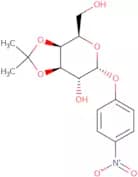
CAS:Aldol® 495 phosphate is a chromogenic and fluorogenic enzyme substrate used for detection of phosphatase activity. The colorless enzyme substrate is cleaved by acid and alkaline phosphatases secreted by bacteria in liquid or solid media, yielding orange color and green fluorescence. Aldol® 495 phosphate can also be used in Western blots and other immunoassay applications with phosphatase-coupled secondary antibodies. Aldol® 495 phosphate can be used under aerobic and anaerobic conditions.Formula:C20H14ClN2Na2O5PPurity:Min. 98.0 Area-%Molecular weight:474.74 g/mol4-Nitrophenyl 3,4-O-isopropylidene-a-D-galactopyranoside
CAS:4-Nitrophenyl 3,4-O-isopropylidene-a-D-galactopyranoside is a chemiluminescent substrate for detecting beta-galactosidase activity in bacteria. This product is a high purity, high quality compound that can be used as a culture media and environmental testing agent. It has been shown to be effective in diagnostics, chromogenic substrate, and enzyme substrate reactions. 4NPPG has been shown to be a fluorogenic substrate for beta-galactosidase assay and can be used as food testing agent with conjugate.
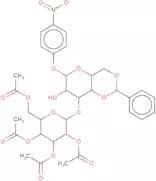
Purity:Min. 95%Molecular weight:341.31 g/mol4-Nitrophenyl 4,6-O-benzylidene-3-O-(2,3,4,6-tetra-O-acetyl-b-D-glucopyranosyl)-b-D-glucopyranoside
4-Nitrophenyl 4,6-O-benzylidene-3-O-(2,3,4,6-tetra-O-acetyl-b-D-glucopyranosyl)-b-D-glucopyranoside is a high purity fluorescent reagent that can be used as a substrate for many enzymes. It is also used in environmental testing and to detect the presence of nitrophenols in food. This product has CAS number 545414.
Purity:Min. 95%Molecular weight:719.64 g/molAldol® 515 palmitate, Biosynth Patent: EP 2427431 and US 8940909
CAS:Aldol® 515 palmitate is a high quality, non-toxic and water soluble chromogenic substrate for enzymes. It is used to detect the presence of lipase activity due to yielding a red color.
Formula:C39H50N2O3Purity:Min. 95%Color and Shape:PowderMolecular weight:594.83 g/mol4-Nitrophenyl 2,3,4,6-tetra-O-acetyl-a-D-glucopyranoside
CAS:4-Nitrophenyl 2,3,4,6-tetra-O-acetyl-a-D-glucopyranoside is a useful substrate for enzymatic assays. This high-sensitivity chromogenic pNP substrate offers enhanced selectivity and increased detection ability, allowing for a broad range of applications in the field of glycosidase research. Featuring rapid colorimetric readouts with easily detectable endpoint determination, this substrate delivers clear and accurate results every time.
Purity:Min. 95%Molecular weight:469.4 g/mol4-Nitrophenyl b-D-thiomannopyranoside
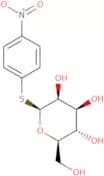
CAS:4-Nitrophenyl b-D-thiomannopyranoside acts as a substrate for β-mannosidase and thioglycoligase. Upon enzymatic cleavage, these substrates release 4-nitrophenol, a yellow chromophore that can be detected spectrophotometrically at 405 nm, facilitating quantitative measurements of enzymatic activity. Consequently, these substrates are widely used in biochemical research, clinical diagnostics, and drug discovery for evaluating the function of specific enzymes in various biological processes.
Purity:Min. 95%Molecular weight:317.32 g/mol4-Nitrophenyl 2-acetamido-3-O-[2-O-(2,3,4-tri-O-benzoyl-a-L-fucopyranosyl)-3,4,6-tri-O-acetyl-2-deoxy-D-galactopyranosyl]-b-D-glucop yranoside
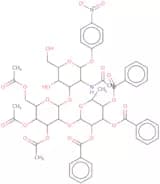
4-Nitrophenyl 2-acetamido-3-O-[2-O-(2,3,4-tri-O-benzoyl-a-L-fucopyranosyl)-3,4,6-tri-O-acetyl-2 deoxy -D-galactopyranosyl]-b D glucopyranoside is a fluorescent substrate for the enzyme β galactosidase. It can be used to test for β galactosidase activity in food products, environmental samples and diagnostics. 4NPFAPG is a conjugate of 4 nitrophenol and 2 acetamido 3 O-[2 O-(2,3,4 tri O benzoyl a L fucopyranosyl) 3,4 6 tri O acetyl 2 deoxy D galactopyranosyl] b D glucopyranose. 4NPFAPG is water soluble and hasPurity:Min. 95%Molecular weight:1,089.01 g/mol8-Hydroxyquinoline-β-D-galactopyranoside
CAS:Chromogenic substrate for beta-D-galactosidase yielding a brown precipitate upon cleavage.Formula:C15H17NO6Molecular weight:307.30 g/mol