Angiogénesis
Los inhibidores de la angiogénesis son compuestos que interfieren con la formación de nuevos vasos sanguíneos, un proceso crucial en el crecimiento y la metástasis del cáncer. Al inhibir la angiogénesis, estos compuestos pueden restringir el suministro de sangre a los tumores, ralentizando o deteniendo su crecimiento. Los inhibidores de la angiogénesis son esenciales en la investigación del cáncer y en el desarrollo terapéutico, proporcionando información sobre los mecanismos de progresión tumoral y ofreciendo posibles tratamientos para el cáncer y otras enfermedades relacionadas con la angiogénesis. En CymitQuimica, ofrecemos una amplia gama de inhibidores de la angiogénesis de alta calidad para apoyar su investigación en oncología y biología vascular.
Subcategorías de "Angiogénesis"
- BTK(165 productos)
- Bcr-Abl(117 productos)
- EGFR(562 productos)
- FAK(72 productos)
- FLT(89 productos)
- Receptor del factor de crecimiento de fibroblastos (FGFR)(177 productos)
- JAK(245 productos)
- PDGFR(127 productos)
- RAAS(86 productos)
- Src(82 productos)
- Syk(37 productos)
- Trombina(52 productos)
- VDA(2 productos)
- VEGFR(239 productos)
Mostrar 6 subcategorías más
Se han encontrado 2243 productos de "Angiogénesis"
Ordenar por
Pureza (%)
0
100
|
0
|
50
|
90
|
95
|
100
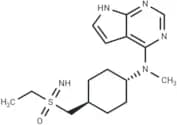
lirucitinib
CAS:Lirucitinib is a JAK inhibitor known for its anti-inflammatory properties.Fórmula:C16H25N5OSForma y color:SolidPeso molecular:335.468JAK3 covalent inhibitor-1
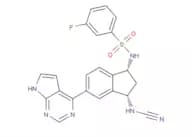
CAS:JAK3 Covalent Inhibitor-1 is a compound characterized by its potent and selective inhibition of Janus kinase 3 (JAK3), possessing an IC50 of 11 nM andFórmula:C22H17FN6O2SPureza:98%Forma y color:SolidPeso molecular:448.47LNK01004
CAS:LNK01004 is a JAK inhibitor that exhibits potent inhibitory effects on JAK1 (IC50: 10 nM), JAK2 (IC50: <0.51 nM), and TYK2 (IC50: 1.0 nM). It can concurrently inhibit multiple cytokine-induced p-STAT signaling pathways and is applicable for research on diseases such as atopic dermatitis.Fórmula:C26H31N7O2Forma y color:SolidPeso molecular:473.57Siphonaxanthin
CAS:Siphonaxanthin is a carotenoid found in green algae, known for targeting the death receptor 5 (DR5) on cancer cells to induce apoptosis. In human leukemia HL-60 cells, it increases DR5 expression, reduces Bcl-2 levels, and activates caspase-3. It also inhibits fibroblast growth factor receptor-1 (FGFR-1) signaling in endothelial cells. Siphonaxanthin suppresses the proliferation, migration, and tubular formation of human umbilical vein endothelial cells (HUVECs), as well as the growth of microvessels in rat aorta rings. Additionally, it has anti-inflammatory properties by blocking the translocation of high-affinity IgE receptors (FcεRI) to lipid rafts in mast cells. Siphonaxanthin shows potential for research into diseases such as cancer, diabetic retinopathy, and rheumatoid arthritis.Fórmula:C40H56O4Forma y color:SolidPeso molecular:600.87JAK3-IN-7
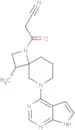
CAS:JAK3-IN-7 is a potent and selective JAK3 inhibitor (IC50<0.01 μM) for the treatment of rejection in organ transplantation, graft-versus-host reaction afterFórmula:C17H20N6OPureza:98.81%Forma y color:SolidPeso molecular:324.38TQ-3959
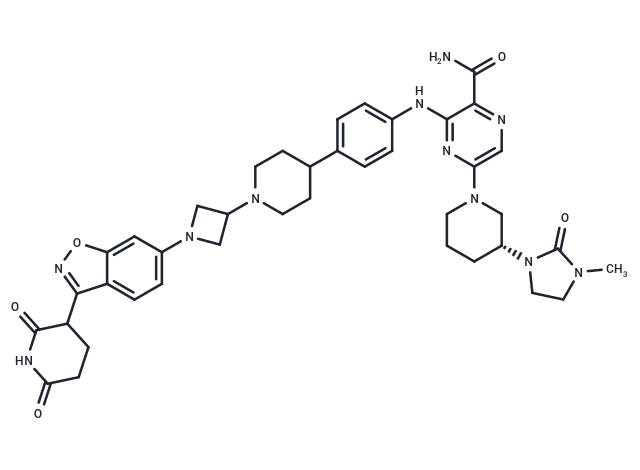
CAS:TQ-3959 is an orally active BTKPROTAC degrader, with a DC50 of 14.6 nM. It exhibits antiproliferative activity against both wild-type BTK and BTK C481S mutant cell lines. TQ-3959 demonstrates tumor growth inhibition in female NOD-SCID mice with TMD-8 xenografts. This compound is applicable in the study of B-cell malignancies, such as lymphoma.Fórmula:C40H47N11O5Forma y color:SolidPeso molecular:761.87mG2N001
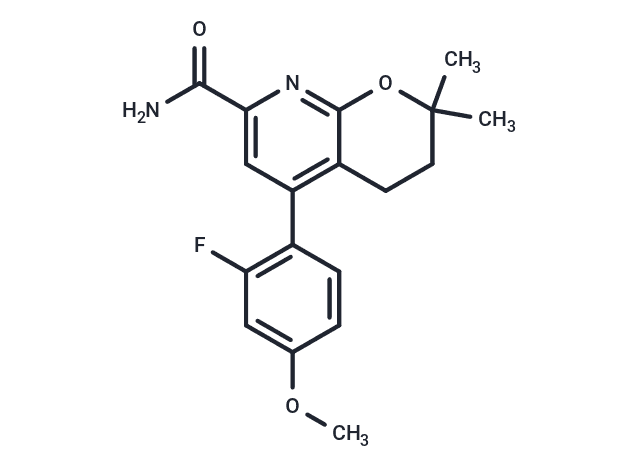
CAS:mG2N001, a negative allosteric modulator (NAM) of the metabotropic glutamate receptor mGluR2, has an IC50 of 93 nM and binds to mGluR2 as an antagonist with a Ki of 63 nM. This compound is microparticle- and plasma-stable, and its radioisotope [11C] mG2N001 can be utilized in PET imaging. [11C] mG2N001 exhibits good brain heterogeneity and penetration, selectively accumulating in mGluR2-rich regions to produce high-contrast brain images [1].Fórmula:C18H19FN2O3Forma y color:SolidPeso molecular:330.35DHFR-IN-4
CAS:DHFR-IN-4 is a potent dihydrofolate reductase (DHFR) inhibitor with anti-tumour activity, inhibits EGFR and HER2 and can be used to study pancreatic cancer.Fórmula:C18H21N5O2SPureza:99.41%Forma y color:SolidPeso molecular:371.46VEGFR-2-IN-38
CAS:VEGFR-2-IN-38 (compound 3) acts as a potential inhibitor of the vascular endothelial growth factor receptor-2 [1].Fórmula:C17H12N4SForma y color:SolidPeso molecular:304.37WS-11
CAS:WS-11 is a non-covalent reversible inhibitor of BTK, with IC50 values of 3.9 nM for the wild-type and 2.2 nM for the C481S mutant BTK. In addition to strong hydrogen bonding, WS-11 also forms robust π-π interactions with PHE540, and p-π interactions with LYS430 within the active pocket.Fórmula:C26H22FN9O2Forma y color:SolidPeso molecular:511.51EGFR-IN-125
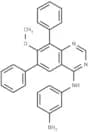
CAS:EGFR-IN-125 (example 37) is a potent EGFR inhibitor with IC50 values of <0.3 nM for EGFR(d746-750/T790M/C797S), 0.52 nM for EGFR(L858R/T790M/C797S), 0.5 nM for EGFR(d746-750/C797S), 0.69 nM for EGFR(L858R/C797S), and 0.92 nM for EGFR (wild type).Fórmula:C30H26N8OForma y color:SolidPeso molecular:514.58Tuspetinib dihydrochloride
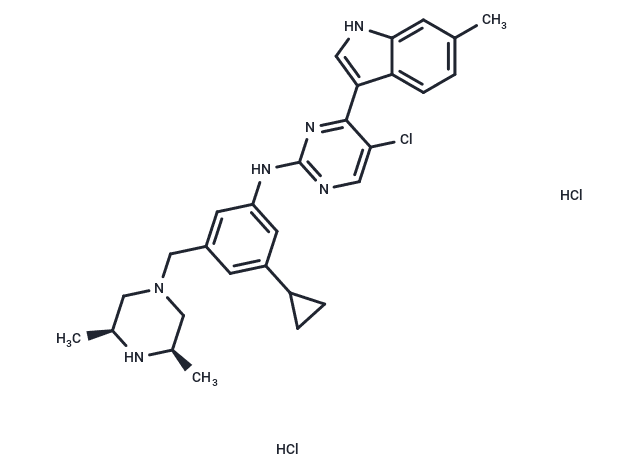
CAS:Tuspetinib (HM43239) dihydrochloride is a selective FLT3 inhibitor with oral bioactivity, exhibiting IC50 values of 1.1 nM for FLT3 wild type, 1.8 nM for FLT3ITD mutant type, and 1.0 nM for FLT3D835Y mutant type. As a reversible type I inhibitor, it directly suppresses FLT3 kinase activity and modulates p-STAT5, p-ERK, SYK, JAK1/2, and TAK1. Tuspetinib dihydrochloride inhibits the proliferation of leukemia cells and induces apoptosis (apoptosis).Fórmula:C29H35Cl3N6Forma y color:SolidPeso molecular:573.99(Rac)-Ibrutinib alkyne
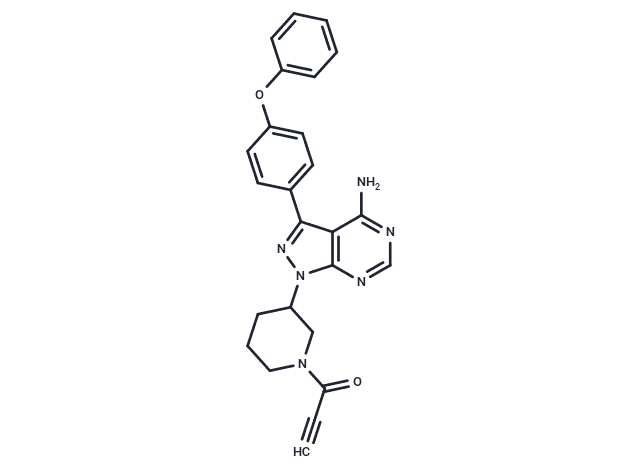
CAS:(Rac)-Ibrutinib alkyne (Compound 8) is a Btk inhibitor with an IC50 of 0.72 nM. This compound effectively inhibits B cell receptor signaling functions, with an IC50 of 9 nM for calcium flux inhibition in Ramos cells. (Rac)-Ibrutinib alkyne is applicable in research on diseases such as rheumatoid arthritis.Fórmula:C25H22N6O2Forma y color:SolidPeso molecular:438.48FLT3-IN-32
CAS:FLT3-IN-32 is a potent FLT3 inhibitor with high selectivity, effectively suppressing FLT3 activating mutations and inducing apoptosis. It demonstrates good tolerance in non-tumor-bearing mice. In NOD/SCID mice loaded with MV4-11 cells, FLT3-IN-32 exhibits outstanding antitumor efficacy, significantly extending mouse survival. FLT3-IN-32 is applicable for acute myeloid leukemia research.Fórmula:C28H29N5O5Forma y color:SolidPeso molecular:515.56Pred17
Pred17 is an effective EGFR inhibitor with potential applications in lung cancer research.Fórmula:C27H22BN3OForma y color:SolidPeso molecular:415.297PPD-Q
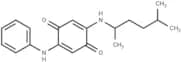
CAS:7PPD-Q is a substituted p-phenylenediamine antioxidant derivative. It exhibits toxicity towards the bacterium V. fischeri (EC50= 14.9 mg/L).Fórmula:C19H24N2O2Forma y color:SolidPeso molecular:312.41D-69491 hydrochloride
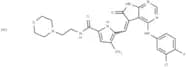
CAS:D-69491 hydrochloride is an inhibitor of HER-2 tyrosine kinase activity, blocking the phosphorylation of HER-2 and inhibiting the proliferation of SKOV-3 cells. It exhibits antitumor activity.Fórmula:C25H26Cl2FN7O3Forma y color:SolidPeso molecular:562.42ALK ligand-Linker Conjugate 1
CAS:ALK ligand-Linker Conjugate 1 is an ALK ligand-connector conjugate used for the synthesis of PROTACALK degrader-4.Fórmula:C36H45N5O3Forma y color:SolidPeso molecular:595.77RET-IN-14
CAS:RET-IN-14 inhibits RET (IC50: <0.51-9.3 nM) & BTK (C481S) (IC50: 9.2-15 nM), promising for tumor research.Fórmula:C24H23FN8O4Forma y color:SolidPeso molecular:506.49UNC9750
CAS:UNC9750 is an inhibitor of inositol phosphate multikinase (IPMK), with IC50 values of 31.6 nM for IPMK and 374 nM for IP6K2. It effectively suppresses the accumulation of InsP5, a direct product of IPMK kinase activity, without affecting InsP6 or InsP7 levels. Additionally, UNC9750 inhibits over 75% of the activity of four kinases: DAPK1, DYRK1B, PDGFR, and KDR. This compound is applicable in glioblastoma research.Fórmula:C23H24N6OForma y color:SolidPeso molecular:400.48