Oligosacáridos
Los oligosacáridos son carbohidratos compuestos por un pequeño número de unidades de monosacáridos unidas por enlaces glucosídicos. Estas moléculas juegan roles significativos en varios procesos biológicos, incluyendo el reconocimiento celular, la señalización y las respuestas inmunitarias. En esta sección, encontrará una amplia selección de oligosacáridos esenciales para la investigación en glicociencia, bioquímica y biología molecular. Estos compuestos son vitales para estudiar estructuras complejas de carbohidratos, sus funciones y sus interacciones con otras biomoléculas. En CymitQuimica, proporcionamos oligosacáridos de alta calidad para apoyar sus necesidades de investigación y desarrollo, asegurando resultados precisos y fiables en sus experimentos.
Subcategorías de "Oligosacáridos"
- Glicósidos de aminoetilo, glicósidos de aminopropilo(14 productos)
- Glicanos enlazantes de Asn(33 productos)
- Oligosacáridos biotinados(13 productos)
- Grupos sanguíneos y antígenos de Lewis(11 productos)
- Oligosacáridos de tipo sanguíneo(13 productos)
- Celooligosacáridos(1 productos)
- Ciclodextrinas(183 productos)
- Disacáridos(192 productos)
- Oligosacáridos de epítopo(19 productos)
- Fructooligosacáridos(2 productos)
- Oligosacáridos funcionales(554 productos)
- Oligosacáridos funcionalizados(1 productos)
- Galactosamina(41 productos)
- Galactosa(261 productos)
- Galb (1-3) GalNAc(21 productos)
- Serie Ganglio(11 productos)
- Serie Globo e Isoglobo(17 productos)
- Glucosamina(128 productos)
- Ácidos glucurónicos(51 productos)
- Glicoproteínas, Glicopéptidos(59 productos)
- Glicosaminoglicano(26 productos)
- Oligosacáridos de la leche materna(21 productos)
- O-glicanos marcados(9 productos)
- Oligosacáridos marcados(36 productos)
- LacNAc(53 productos)
- Series Lacto y Neolacto(14 productos)
- Lacto-N-biosa(10 productos)
- Lactooligosacáridos(7 productos)
- Oligosacáridos unidos al linker(19 productos)
- Maltooligosacáridos(6 productos)
- Oligosacáridos de leche(31 productos)
- N-glicanos(149 productos)
- Glucósidos naturales(177 productos)
- Oligosacáridos naturales(103 productos)
- O-glicano(18 productos)
- Building Blocks de Oligosacáridos(7 productos)
- Reemplazo de oligosacáridos(2 productos)
- Oligosacáridos por componente de azúcar(225 productos)
- Oligosis(24 productos)
- Otros Oligosacáridos(14 productos)
- Oligómeros de PEG(33 productos)
- Azúcares fosfatados(17 productos)
- Azúcares protegidos(526 productos)
- Reactivos para la síntesis de oligosacáridos(254 productos)
- Ser, Thr Glucanos de unión(9 productos)
- Oligosacáridos sialilados(3 productos)
- Esfingoglucolípidos(42 productos)
- Aminoácidos de azúcar, péptidos de azúcar(20 productos)
- Antígenos de azúcar(31 productos)
- Building Blocks de Azúcares por Oligosacáridos objetivo(225 productos)
- Conjugados de azúcar(100 productos)
- Azúcares sulfatados(16 productos)
- Tetrasacáridos(34 productos)
- Trisacáridos y superiores(95 productos)
- Xilooligosacáridos(5 productos)
Mostrar 47 subcategorías más
Se han encontrado 2278 productos de "Oligosacáridos"
Ordenar por
Pureza (%)
0
100
|
0
|
50
|
90
|
95
|
100
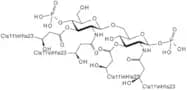
Lipid IVa
CAS:<p>Lipid IVA is a tetra-acylated precursor molecule of lipid A which is a component of lipopolysaccharides (LPS) on the outer membrane of gram-negative bacteria. On the innate immune cells of hosts there are toll-like receptor 4 (TLR4) and MD-2 which recognize LPS. This recognition event ultimately leads to the activation of NFκB which in turn results in pro-inflammatory cytokine production. Studies have suggested lipid A in Escherichia coli to be an agonist for both mouse and human TLR4, while lipid IVA can induce species specific TLR4 responses. For example for horse and mouse TLR4 and MD-2, Lipid IVA is an agonist where as it is an antagonist for TLR4 and MD-2 in humans.</p>Fórmula:C68H130N2O23P2Pureza:One Main SpotForma y color:White PowderPeso molecular:1,405.7 g/molLacto-N-neodifucohexaose
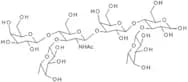
Neutral difucosylated hexasasaccharide naturally present in human breast milkFórmula:C38H65NO29Pureza:Min. 75%Forma y color:PowderPeso molecular:999.93 g/molNeoagarooctaose
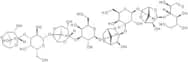
CAS:<p>Agarose is a polysaccharide found in red algae, typically Gelidium and Gracilaria. It is a strictly alternating polysaccharide of α-1,3 linked D-galactose and β-1,4 linked L-3,6 anhydrogalactose with occasional sulfation at position 6 of the anhydrogalactose residue. Agaro-oligosaccharides result from cleavage at galactose residues and neoagaro-oligosaccharides from cleavage at 3,6-anhydro residues. Neoagarooctaose is reported to have potential for novel cosmeceuticals.</p>Fórmula:C48H74O37Pureza:Min. 98 Area-%Forma y color:White PowderPeso molecular:1,243.08 g/mol1,2,4,6-Tetra-O-acetyl-3-O-(2,3,4,6-tetra-O-acetyl-a-D-galactopyranosyl)-D-galactopyranose
CAS:<p>1,2,4,6-Tetra-O-acetyl-3-O-(2,3,4,6-tetra-O-acetyl-aDgalactopyranosyl)-Dgalactopyranose is a modified sugar that can be synthesized by the Click chemistry reaction. It has been used in the modification of saccharides and polysaccharides. This product is CAS No. 123809-61-0 and is available for custom synthesis. 1,2,4,6 tetra O acetyl 3 O-(2 3 4 6 tetra O acetyl a D galactopyranosyl) D galactopyranose is a high purity carbohydrate with glycosylation and fluorination.<br>END> END></p>Fórmula:C28H38O19Pureza:Min. 95%Peso molecular:678.59 g/molSucrose cocoate
CAS:<p>Blend of sucrose esters with fatty acid esters from coconut oil used in Cosmetic industry applications.</p>Pureza:Min. 95%2-Acetamido-3-O-(2-acetamido-2-deoxy-b-D-glucopyranosyl)-2-deoxy-D-galactopyranose
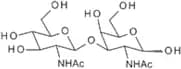
CAS:<p>2-Acetamido-3-O-(2-acetamido-2-deoxy-b-D-glucopyranosyl)-2-deoxy-D-galactopyranose is a methylated, saccharide, Polysaccharide. It is a custom synthesis of a carbohydrate sugar. It is fluorinated to increase its bioavailability. 2 Acetamido 3 O 2 acetamido 2 deoxy b D glucopyranosyl 2 deoxy D galactopyranose has CAS No. 95673 98 6 and the molecular weight is 524.87 g/mol. It has a purity of >99% and comes in powder form.</p>Fórmula:C16H28N2O11Pureza:Min. 95%Forma y color:White PowderPeso molecular:424.4 g/molSodium alginate, viscosity 300 - 600 mPa.s
CAS:<p>Sodium alginate is the sodium salt of a polysaccharide obtained from brown seaweeds. The main use for alginate is in textile printing as a thickener in the printing of cottons with reactive dyes. In the food industry it is used as a thickener and gelling agent. The chemical structure consists of blocks of (1,4) linked-β-D-polymannuronic acid (poly M), (1,4) linked-α-L-polyguluronic acid (poly G) and alternating blocks of the two uronic acids (poly MG).</p>Forma y color:PowderBlood Group H type II trisaccharide-PAA-biotin
<p>Blood group antigen conjugated to spacer and biotin</p>Pureza:Min. 95 Area-%Forma y color:PowderPeso molecular:586.6 g/molD-Maltose monohydrate
CAS:Please enquire for more information about D-Maltose monohydrate including the price, delivery time and more detailed product information at the technical inquiry form on this pageFórmula:C12H24O12Pureza:Min. 98 Area-%Forma y color:White PowderPeso molecular:360.31 g/molGT3-Oligosaccharide
<p>GT3 oligosaccharide (free acid) is a disaccharide (Galβ1,4Glc) with three sialic acid residues (NeuAc) linked α2,8/α2,8/α2,3 to the galactose residue (Ledeen, 2009). The GT3 ganglioside is the carbohydrate moiety in the GT3 ganglioside, which is implicated in type 1 diabetes. GT3 ganglioside is expressed on pancreatic cells and is the target antigen of anti-GM3-antibodies, which contribute to the autoimmune destruction of pancreatic beta cells (Misasi, 1997). GT3 ganglioside is also abundant in lung tissues and the nervous system.</p>Fórmula:C45H70N3O35Na3Pureza:Min. 90%Forma y color:PowderPeso molecular:1,282.01 g/molL-Hexaguluronic acid hexasodium
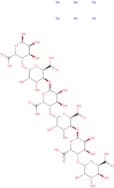
CAS:Please enquire for more information about L-Hexaguluronic acid hexasodium including the price, delivery time and more detailed product information at the technical inquiry form on this pageFórmula:C36H50O37•Na6Pureza:Min. 95%Peso molecular:1,212.7 g/molL-Heptaguluronic acid heptasodium
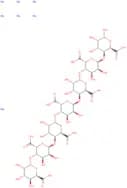
CAS:Please enquire for more information about L-Heptaguluronic acid heptasodium including the price, delivery time and more detailed product information at the technical inquiry form on this pageFórmula:C42H58O43•Na7Pureza:Min. 95%Peso molecular:1,411.81 g/molHyaluronic acid disaccharide sodium salt
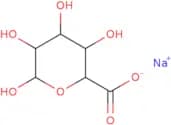
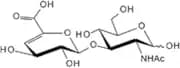
CAS:<p>The hyaluronic acid discaccharide and other enzymatically produced polymer homologs from hyaluronic acid have been of value in the study of hyaluronic acid metabolism in healthy and diseased tissues (Hascall, 2019). Hyaluronic acid is a polysaccharide containing repeating disaccharide units of β-1,3-N-acetyl glucosamine and β-1, 4-glucuronic acid. The unsaturated disaccharide hyalobiuronic acid is released from hyaluronic acid by the action of hyaluronidase on umbilical cord (Weissman, 1954).</p>Fórmula:C14H20NNaO11Pureza:Min. 95 Area-%Forma y color:PowderPeso molecular:401.3 g/molHeparin derived dp6 saccharide ammonium salt
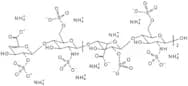
<p>Heparin derived dp6 saccharide ammonium salt is a glycosylation product of heparin. It is a synthetic glycosaminoglycan consisting of alternating units of N-acetylglucosamine and glucuronic acid. This compound is highly water soluble and has been shown to be stable at pH 3-7 for up to 6 hours. The compound has also been subjected to a number of modifications, including methylation, click modification, fluorination, saccharide modification, sugar modification, and oligosaccharide synthesis. The structural formula of this compound can be found in the Chemical Abstracts Service (CAS) number: 234764-56-2 with a molecular weight of 735.81 g/mol. Custom synthesis is available on request.</p>Pureza:Approx.75%Forma y color:PowderPeso molecular:~1800 (Average)N-Acetylneuraminic acid hexamer disodium salt
<p>N-Acetylneuraminic acid hexamer disodium salt is a custom synthesis of a fluorinated, methylated and acetylated N-acetylneuraminic acid. This molecule is an oligosaccharide with three sugar rings. It has been modified by click chemistry and glycosylation to create a complex carbohydrate. The CAS number for this compound is 156587-48-2.</p>Fórmula:C66H98N6O49Na6Pureza:Min. 95%Forma y color:White PowderPeso molecular:1,897.43 g/molLactose-PAA-biotin
<p>Lactose-PAA-biotin is a biotin linked to lactose by a polyacrylamide linker</p>Pureza:Min. 95%Forma y color:PowderChondroitin sulphate
CAS:Chondroitin sulphate is an inhibitor that has been extensively studied in human and animal models. This active agent has been shown to have a protein inhibitory effect on epithelial cells, as well as an inhibitory effect on cell growth in Chinese medicine and Chinese medicinal plants. Chondroitin sulphate has been found to exhibit inhibitory activity against endothelial cells, which may be due to its ability to inhibit the nuclear translocation of NF-κB. This compound can be detected by liquid chromatography and has been shown to have a significant inhibitory effect on the proliferation of HepG2 cells. Overall, chondroitin sulphate shows great potential for use in healthcare products aimed at regulating cell growth and inflammation.Pureza:ReportedForma y color:PowderChondroitin disaccharide di-6S
CAS:<p>Chondroitin disaccharide di-6S (CDD6S) is a synthetic, fluorinated oligosaccharide that is used for glycosylation and modification of proteins, polysaccharides, and other biomolecules. It has been shown to be effective in inhibiting the growth of cancer cells by targeting the sugar moiety on cell surface receptors. CDD6S has been modified with methyl groups at various positions on the sugar chain to increase its activity against certain cancers.</p>Fórmula:C14H21NO15SPureza:Min. 95%Peso molecular:475.38 g/molD-Melibiose anhydrous
CAS:<p>D-Melibiose anhydrous is a disaccharide that is used as an excipient in the pharmaceutical industry. It has been shown to be an active enzyme, which may be due to its ability to sequester galactose. D-Melibiose anhydrous has a redox potential of -0.2 V, indicating that it has a high number of oxidizable groups. The molecular weight of this sugar is 324.14 g/mol, and it has a polarizability of 0.16 D, which classifies it as a polyol with hydrogen bonding properties. This sugar is not soluble in water but can be dissolved in ethanol or propylene glycol. D-Melibiose anhydrous also has carbohydrate properties and may be considered a sugar alcohol because it contains six carbon atoms and one oxygen atom.</p>Fórmula:C12H22O11Pureza:Min. 95%Forma y color:PowderPeso molecular:342.3 g/molMethyl 2-hydroxyethyl cellulose
CAS:Producto controlado<p>Methyl 2-hydroxyethyl cellulose (MEC) is a synthetic substance that is used as a thickening and emulsifying agent in many products, including foods, pharmaceuticals, and cosmetics. MEC has been shown to inhibit the activity of certain enzymes, such as amylase, lipase, and protease. In addition to these properties, MEC is also known for its high degree of thermal stability and light resistance. This product can be used in a wide range of applications due to its versatility and low cost.</p>Fórmula:C34H66O24Pureza:Min. 95%Forma y color:White/Off-White SolidPeso molecular:858.87 g/mol