


APIs para investigación e impurezas
Subcategorías de "APIs para investigación e impurezas"
- Aminoácidos y derivados(12.440 productos)
- Antraquinonas y derivados(407 productos)
- Derivados de Benzimidazol e Imidazol(10.464 productos)
- Derivados de Benzodiazepinas(335 productos)
- Carbohidratos y glucoconjugados(5.388 productos)
- Ésteres y derivados(42.306 productos)
- Ácidos Grasos y Derivados Lipídicos(32.486 productos)
- Flavonoides y Polifenoles(17.100 productos)
- Radicales libres y agentes oxidantes/reductores(214 productos)
- Cetonas y Derivados(2.692 productos)
- Antibióticos naturales y semisintéticos(6.409 productos)
- Nitrilos y Cianoderivados(3.070 productos)
- Nitrosaminas y derivados(55 productos)
- Nucleósidos y Nucleótidos(3.492 productos)
- Fosfatos y Fosfonatos Orgánicos(1.204 productos)
- Sulfonatos y Sulfatos Orgánicos(10.451 productos)
- Organometálicos(4.425 productos)
- Otros(6.340 productos)
- Péptidos y Proteínas(3.164 productos)
- Polímeros y derivados(100 productos)
- Derivados de Purinas y Pirimidinas(8.974 productos)
- Derivados de Quinazolina y Quinolina(66.219 productos)
- Quinonas y derivados(24.378 productos)
- Sales y derivados de API(92.940 productos)
- Esteroides y derivados(4.987 productos)
- Sulfonamidas y derivados(2.607 productos)
- Terpenoides y derivados(3.860 productos)
- Tiazolidinedionas y Tiopiranos(2.755 productos)
- Compuestos β-adrenérgicos(231 productos)
Se han encontrado 66871 productos de "APIs para investigación e impurezas"
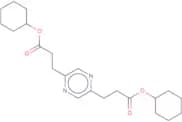
Dihexyl 3,3'-(pyrazine-2,5-diyl)dipropanoate
CAS:Dihexyl 3,3'-(pyrazine-2,5-diyl)dipropanoate is a drug product that is used as an impurity standard for the determination of metabolites in drug development and metabolism studies. It has been shown to be a metabolite in the human body and is also found in rat urine. The purity of this substance is high and can be custom synthesized to meet specific needs. Dihexyl 3,3'-(pyrazine-2,5-diyl)dipropanoate can be used as an analytical standard for HPLC analysis. This compound can also be used in pharmacopoeia as a reference substance for the determination of purity and impurities.Fórmula:C22H36N2O4Pureza:Min. 95%Forma y color:Off-white to yellow liquid.Peso molecular:392.53 g/molTrandolaprilat
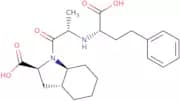
CAS:Trandolaprilat is a prodrug of enalaprilat, which is an angiotensin-converting enzyme (ACE) inhibitor. Trandolaprilat binds to the active site of ACE and inhibits its activity, thereby causing a decrease in the formation of angiotensin II, a potent vasoconstrictor. Trandolaprilat has been shown to be effective in treating congestive heart failure and other cardiac disorders. Trandolaprilat has also been shown to have an effect on energy metabolism, as it inhibits the binding of ATPase to adenosine triphosphate (ATP). This inhibition leads to increased levels of ATP in cells and may be responsible for its cardioprotective effects.
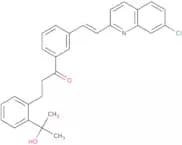
Fórmula:C22H32N2O6Pureza:Min. 95%Forma y color:White PowderPeso molecular:420.5 g/molMontelukast ketone impurity
CAS:The impurity (2,6-dichlorobenzaldehyde) is a metabolite of montelukast. It is an analytical impurity that has been quantified in the drug product and has also been found to be present in the synthetic process. The impurity standard was developed using HPLC. It can be used as a high purity reference material for pharmacopoeia and custom synthesis.Fórmula:C29H26ClNO2Pureza:Min. 95%Forma y color:PowderPeso molecular:455.97 g/molLisinopril EP Impurity E
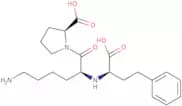
CAS:Lisinopril EP Impurity E is an impurity of lisinopril, which is a prescription drug used to treat high blood pressure. This impurity was found in a preparative high performance liquid chromatography (HPLC) and mass spectroscopy analysis of the drug. The molecular weight of Lisinopril EP Impurity E was determined to be 317.2 amu, which corresponds to the molecular formula C7H13NO2. The FT-IR spectrum showed that this impurity has an ammonium group at 1859 cm-1 and butanoic acid at 1647 cm-1.Fórmula:C21H31N3O5Pureza:Min. 98 Area-%Forma y color:PowderPeso molecular:405.49 g/mol2-[4-(2-Methylpropanoyl)phenyl] propanoic acid
CAS:2-[4-(2-Methylpropanoyl)phenyl] propanoic acid is a pharmaceutical intermediate that is used for the production of carprofen. It has been found to be an analytical method for the determination of 4-hydroxybenzoic acid and 4-isobutylacetophenone. The compound is analyzed by chromatographic methods and electrophoresis methods. The optimization of the solvent composition, flow rate, and impurities during the synthesis process are also studied in this research. 2-[4-(2-Methylpropanoyl)phenyl] propanoic acid has been found to be a meaningful validation of analytical methods for medicines, with an impurity limit of 0.1%.Fórmula:C13H16O3Pureza:Min. 98 Area-%Forma y color:PowderPeso molecular:220.26 g/molD-His(1)-Semaglutide
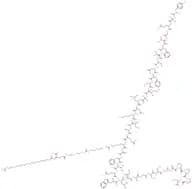
D-His(1)-Semaglutide is a semaglutide impurity. The amino acid at position 1 has been replaced by the D-form of the amino acid D-histidine (D-His). Semaglutide impurities are structurally related compounds that arise during synthesis, purification, or storage of semaglutide, a long-acting GLP-1 receptor agonist for managing type 2 diabetes and obesity.Fórmula:C187H291N45O59Peso molecular:4,113.64 g/mol2-Mercaptobenzimidazole
CAS:2-Mercaptobenzimidazole is a chemical compound that can be used for the treatment of infectious diseases. It has been shown to have antioxidative properties and inhibit the growth of bacteria. 2-Mercaptobenzimidazole also has an effect on human serum, which may be due to its ability to bind with proteins in serum and form hydrogen bonds. 2-Mercaptobenzimidazole is stable at high temperatures and has been shown as an effective antimicrobial agent against gram positive and gram negative bacteria.
Fórmula:C7H6N2SPureza:Min. 99 Area-%Forma y color:White/Off-White SolidPeso molecular:150.19 g/molDes-His(1)-Semaglutide
Des-His(1)-semaglutide is a semaglutide-related impurity. This des-amino acid form has the histidine (His) amino acid from position 1 removed from the peptide chain. Semaglutide impurities are structurally related compounds that arise during synthesis, purification, or storage of semaglutide, a long-acting GLP-1 receptor agonist used for managing type 2 diabetes and obesity.Fórmula:C181H284N42O58Peso molecular:3,976.5 g/molOxytocin
CAS:Natriuretic hormone; induces uterine contraction and lactation
Fórmula:C43H66N12O12S2Pureza:Min. 98 Area-%Forma y color:White Off-White PowderPeso molecular:1,007.19 g/molFluticasone furoate impurity F
Fluticasone furoate impurity F is a synthetic, high-purity, pharmacopoeia grade drug product. It has been developed for research and development purposes only. Impurity standard: Fluticasone furoate impurity F is a metabolite of fluticasone furoate. Synthetic: Fluticasone furoate impurity F is a synthetic compound that has been custom synthesized to meet your requirements. Drug Development: Fluticasone furoate impurity F has been developed as a drug product to be used in the development of new drugs. Metabolism Studies: Fluticasone furoate impurity F can be used in metabolism studies and analytical determinations.END>>Pureza:Min. 95%N-Desmethyl cyamemazine maleate
CAS:Cyamemazine is an antipsychotic drug that has been used for the treatment of schizophrenia and other psychotic disorders. N-Desmethyl cyamemazine maleate, a metabolite of cyamemazine, has been shown to have neuroprotective effects in vitro.Fórmula:C18H19N3S·C4H4O4Pureza:Min. 95%Peso molecular:425.5 g/molD-Ser(8)-Semaglutide
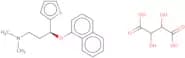
D-Ser(8)-Semaglutide is a semaglutide impurity. The amino acid at position 8 has been replaced by the D-form of the amino acid D-serine (D-Ser). Semaglutide impurities are structurally related compounds that arise during synthesis, purification, or storage of semaglutide, a long-acting GLP-1 receptor agonist for managing type 2 diabetes and obesity.Fórmula:C187H291N45O59Peso molecular:4,113.64 g/molN,N-Dimethyl-3-(1-naphthalenyloxy)-3-(2-thienyl) propanamine tartrate
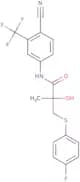
CAS:N,N-Dimethyl-3-(1-naphthalenyloxy)-3-(2-thienyl) propanamine tartrate (DMNPA) is a synthetic compound with the molecular formula C14H17NO. DMNPA is used as an analytical reference standard for the quantification of N,N-dimethyl-3-(1-naphthalenyloxy)-3-(2thienyl) propanamine HCl by HPLC. DMNPA has been shown to be a metabolite of the drug product, where it is formed from oxidation of the parent drug.Fórmula:C19H21NOS·C4H6O6Pureza:Min. 95%Peso molecular:461.53 g/molBicalutamide sulfide
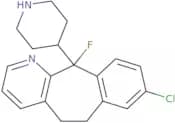
CAS:Bicalutamide sulfide is a synthetic, phosphotungstic acid-reactive, bifunctional reagent that is synthesized from the reaction of bicalutamide and trifluoroacetic acid. This product can be used for the separation of fatty acids in environmental pollutants. The product has been shown to be useful for the analysis of fatty acid esters in recycled oils and fats. Bicalutamide sulfide is also used as an intermediate in the synthesis of pharmaceuticals, such as phosphotungstitane derivatives.Fórmula:C18H14F4N2O2SPureza:Min. 95%Forma y color:White To Off-White SolidPeso molecular:398.37 g/mol11-Fluoro desloratadine
CAS:11-Fluoro desloratadine is a metabolite of the antihistamine, loratadine. It has shown to be an analytical standard for HPLC, and impurity standard for pharmacopoeia. 11-Fluoro desloratadine is typically synthesized by reacting loratadine with fluorinating reagent such as N-fluorosuccinimide (NFSI) in the presence of a base catalyst such as sodium methoxide. 11-Fluoro desloratadine is also found in breast milk at concentrations of up to 1.2% of total loratadine concentration, which has been attributed to incomplete metabolism or passive transfer from mother to child.
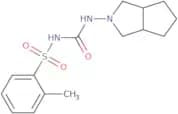
Fórmula:C19H20N2ClFPureza:Min. 95%Forma y color:PowderPeso molecular:330.83 g/molGliclazide impurity F
CAS:Gliclazide is a sulfonylurea drug that is used to treat type 2 diabetes. The impurity F, which is an impurity standard, can be synthesized by reacting 1-chloro-2,6-difluoroaniline with sodium methoxide in methanol. It is also an API impurity found in the synthesis of gliclazide and can be custom synthesized for research and development purposes. Gliclazide impurity F has a CAS number of 1076198-18-9 and the molecular formula C8H4ClF3NOS. This product has a purity of >99% and is classified as synthetic. It has been shown to have pharmacopoeia activity and can also be used for niche applications such as drug development.Fórmula:C15H21N3O3SPureza:Min. 95%Forma y color:White Off-White PowderPeso molecular:323.41 g/mol2-[[[4-(3-Methoxypropoxy)-3-methyl-2-pyridinyl]methyl]thio]-1H-benzimidazole
CAS:Rabeprazole is a proton pump inhibitor that is used to treat acid-related disorders such as gastroesophageal reflux disease and peptic ulcers. Rabeprazole inhibits the production of gastric acid by blocking the hydrogen/potassium ATPase that is found in the parietal cells of the stomach. The main mechanism of action for rabeprazole is competitive inhibition of the proton pump, which leads to decreased gastric acid secretion. Rabeprazole can be administered orally or intravenously, with a half-life of about 2 hours. It has been shown to have an effect on human liver cytochrome P450s, but does not affect the activity of recombinant cytochrome P450 3A4 (CYP3A4). In clinical studies, rabeprazole was shown to have no adverse effects on CYP3A4 activity and may even increase it slightly.Fórmula:C18H21N3O2SPureza:Min. 95%Forma y color:White PowderPeso molecular:343.44 g/mol

![2-[4-(2-Methylpropanoyl)phenyl] propanoic acid](/_next/image/?url=https%3A%2Fstatic.cymitquimica.com%2Fproducts%2F3D%2Fthumb-webp%2FIM15852.webp&w=3840&q=75)






![2-[[[4-(3-Methoxypropoxy)-3-methyl-2-pyridinyl]methyl]thio]-1H-benzimidazole](/_next/image/?url=https%3A%2Fstatic.cymitquimica.com%2Fproducts%2F3D%2Fthumb-webp%2FIM57863.webp&w=3840&q=75)