Apoptose
Les inhibiteurs de l'apoptose sont des composés qui empêchent ou retardent le processus de mort cellulaire programmée, connu sous le nom d'apoptose. Ces inhibiteurs sont essentiels pour étudier les mécanismes de survie cellulaire et sont utilisés pour enquêter sur les maladies où l'apoptose est dysrégulée, telles que le cancer, les troubles neurodégénératifs et les maladies auto-immunes. En modulant l'apoptose, ces inhibiteurs peuvent aider au développement de thérapies visant à contrôler la mort cellulaire. Chez CymitQuimica, nous offrons une sélection complète d'inhibiteurs de l'apoptose de haute qualité pour soutenir vos recherches en biologie cellulaire, oncologie et domaines connexes.
Sous-catégories appartenant à la catégorie "Apoptose"
- ASK(9 produits)
- BCL(1 produits)
- Caspase(154 produits)
- FOXO1(2 produits)
- IAP(67 produits)
- Mdm2(12 produits)
- PD-1/PD-L1(134 produits)
- PDK(9 produits)
- PERK(23 produits)
- Sérine/thréonine kinase(17 produits)
- Survivant(14 produits)
- TNF(93 produits)
- c-RET(61 produits)
- p53(63 produits)
Affichez 6 plus de sous-catégories
6222 produits trouvés pour "Apoptose"
Trier par
Degré de pureté (%)
0
100
|
0
|
50
|
90
|
95
|
100
FGFR1/VEGFR2-IN-2
FGFR1/VEGFR2-IN-2 (compound 6) is a dual inhibitor targeting both VEGFR2 and FGFR1 with IC50 values of 0.025 µM and 0.026 µM, respectively. This compound also exhibits inhibitory effects on EGFR and PDGFR-β, with IC50 values of 0.106 µM and 0.077 µM, respectively. FGFR1/VEGFR2-IN-2 demonstrates significant anticancer activity in the NCI-60 cell lines, showing a growth inhibition (GI) of 60.38%. In T-47D cell lines, it achieves an IC50 of 8.51 µM, exhibits anti-migratory properties, induces cell cycle arrest in the G1 phase, and promotes both apoptosis and necrosis. Additionally, while it has an IC50 greater than 100 µM in MCF-7 cell lines, it does so with an IC50 of 69.17 µM in MDA-MB-231 cell lines and shows no toxicity to normal cells.Formule :C21H15ClF3NO4SCouleur et forme :SolidMasse moléculaire :469.86PROTAC FGFR2 degrader 1
PROTAC FGFR2 degrader 1 (compound N5) is a potent PROTAC that efficiently targets FGFR2, boasting a DC 50 value of 6.46 nM and an FGFR2 IC 50 of 0.08 nM. This compound exhibits significant anti-proliferative effects and high selectivity. It induces G0/G1 arrest in the cell cycles of KATOIII and SNU16 and inhibits apoptosis by diminishing the activation of p-ERK and p-PLCγ, the downstream proteins of FGFR2. Additionally, PROTAC FGFR2 degrader 1 maintains over 50% inhibition of gastric cancer cells at a concentration of 0.17 nM and effectively suppresses the growth of SNU16 xenograft tumors in a mouse model.Couleur et forme :Odour SolidPamlectabart
Pamlectabart is a humanised antibody targeting TNFRSF17/BCMA, (ADC) Pamlectabart tismanitin multiple myeloma.Degré de pureté :95%Couleur et forme :LiquidMasse moléculaire :145.20 kDaCRM1-IN-2
CRM1-IN-2 (Compound KL2) is a noncovalent inhibitor that targets CRM1, localizing it to the nuclear periphery, depleting its nuclear presence, and inhibitingFormule :C29H48N2O5Degré de pureté :98%Couleur et forme :SolidMasse moléculaire :504.7Thalidomide-O-amido-C3-PEG3-C1-NH2
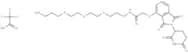
CAS :Thalidomide-based E3 ligase linker for PROTACs with a 3-unit PEG chain.Formule :C27H35F3N4O11Couleur et forme :SolidMasse moléculaire :648.589CSF1R-IN-26
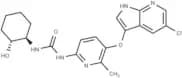
CAS :CSF1R-IN-26 (Compound III-1) is an inhibitor of CSF-1R with an IC50 of 20.07 nM. It promotes the polarization of M2 macrophages to M1 macrophages, inducing apoptosis in MC-38 cancer cells. CSF1R-IN-26 inhibits the activation of the AKT/ERK/STAT3 signaling pathways, remodels the tumor immune microenvironment, and exhibits antitumor activity in mouse models. In SD rats, CSF1R-IN-26 demonstrates favorable pharmacokinetic properties, with a half-life of 1.86 hours and an oral bioavailability of 79.22%.Formule :C20H22ClN5O3Couleur et forme :SoildMasse moléculaire :415.87Ub4ix
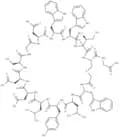
CAS :Ub4ix, a DUB/26S proteasome inhibitor, safeguards K48-linked Ub chains against cleavage by deubiquitinating enzymes (DUBs) and inhibits the proteasomal degradation of Ub-tagged proteins. Additionally, it diminishes the viability of Hela cells and triggers apoptosis, exhibiting an IC 50 value of 1.6 μM.Formule :C84H106N18O23SCouleur et forme :SolidMasse moléculaire :1767.91PROTAC AR Degrader-8
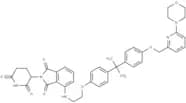
CAS :PROTAC AR Degrader-8 (Compound NP18) functions as a PROTAC degrader targeting the androgen receptor (AR) and effectively degrades AR-FL in both 22Rv1 and LNCaP cells with DC50 values of 0.018 μM and 0.14 μM, respectively. It also degrades AR-V7 in 22Rv1 cells with a DC50 of 0.026 μM. Additionally, PROTAC AR Degrader-8 inhibits the proliferation of 22Rv1 and LNCaP cancer cells, exhibiting IC50 values of 0.038 μM and 1.11 μM. It induces cell cycle arrest at the G2/M phase and triggers apoptosis in 22Rv1 cells (apoptosis). Demonstrating anticancer efficacy, PROTAC AR Degrader-8 shows activity in both mouse and zebrafish models. [Pink: ligand for target protein AR ligand-33; Black: linker; Blue: ligand for E3 ligase Cereblon]Formule :C40H41N5O7Couleur et forme :SolidMasse moléculaire :703.783Thalidomide-O-amido-PEG4-propargyl
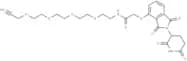
Thalidomide-O-amido-PEG4-propargyl is a polyethylene glycol (PEG)-based linker employed for the synthesis of proteolysis targeting chimeras (PROTACs)[1].Formule :C26H31N3O10Degré de pureté :98%Couleur et forme :SolidMasse moléculaire :545.54Biotin-PEG6-Thalidomide
CAS :Biotin-PEG6-Thalidomide is a PROTAC linker based on PEG.Formule :C37H53N5O12SDegré de pureté :98%Couleur et forme :SolidMasse moléculaire :791.91A011
A011, a potent and selective ataxia-telangiectasia mutated (ATM) inhibitor, exhibits an IC50 of 1.0 nM and triggers apoptosis as well as G2/M phase cell cycleFormule :C27H28N6ODegré de pureté :98%Couleur et forme :SolidMasse moléculaire :452.55c-Met-IN-24
c-Met-IN-24 (compound 3g) serves as a dual-target inhibitor for STAT-3 (=4.7 μM) and c-MET (=12.67 μM), exhibiting anticancer properties. It arrests the G2/M cell cycle and induces apoptosis in SNB-75 cells, making it applicable in the research of central nervous system cancers.Formule :C20H15ClN4O4SCouleur et forme :SolidMasse moléculaire :442.88Nrf2 activator-11
Nrf2 activator-11 (compound M11) is a Nrf2 activator that possesses blood-brain barrier permeability and offers anti-oxidation, anti-inflammation, anti-ferroptosis, and anti-apoptosis properties. It is applicable for use in studying cerebral ischemia-reperfusion (CI/R) injury models.Formule :C20H23N3O2Couleur et forme :SolidMasse moléculaire :337.42Sorafenib-d4
CAS :Sorafenib D4 is deuterium-labeled Sorafenib, a multi-kinase inhibitor (Raf-1, B-Raf, VEGFR-3) with IC50s: 6, 20, 22 nM.Formule :C21H16ClF3N4O3Degré de pureté :98%Couleur et forme :SolidMasse moléculaire :468.85Gemcitabine monophosphate sodium salt hydrate
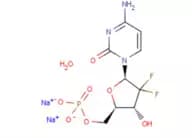
CAS :Gemcitabine monophosphate disodium salt is a monophosphate derivative of Gemcitabine.Formule :C9H12F2N3Na2O8PDegré de pureté :98.86%Couleur et forme :SolidMasse moléculaire :405.16Rosamultic acid
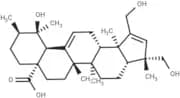
Rosamultic acid is a useful organic compound for research related to life sciences and the catalog number is T125342.Formule :C30H46O5Couleur et forme :SolidMasse moléculaire :486.693F1324
F1324: potent BCL6 inhibitor, IC50=1nM, binding t1/2=441s, strongly inhibits BCL6 PPI.Formule :C83H121N21O20SDegré de pureté :98%Couleur et forme :SolidMasse moléculaire :1765.04RD-23
CAS :RD-23 is an orally active and selective RET PROTAC degrader. It facilitates the ubiquitination and degradation of the RETG810C mutant with a DC50 value of 11.7 nM. Additionally, RD-23 inhibits the activation of downstream Shc signaling and induces apoptosis (Apoptosis). It is useful for studying RET-related cancers.Formule :C52H56N12O4Couleur et forme :SolidMasse moléculaire :913.079CYP51/PD-L1-IN-4
CYP51/PD-L1-IN-4 (compound 14a-2) is a potent dual-target inhibitor of CYP51/PD-L1, displaying IC50 values of 0.17 and 0.021 μM, respectively.Formule :C27H28N4O3Couleur et forme :SolidMasse moléculaire :456.54NL13
NL13, a Polo-like kinase 4 (PLK4) inhibitor, exhibits an IC 50 value of 2.32 μM. It demonstrates the ability to suppress the viability of PC3 and DU145 prostate cancer cells with respective IC 50 values of 3.51 μM and 2.53 μM. NL13 also inhibits tumor growth in prostate cancer mice. Additionally, it deactivates the AKT signaling pathway by reducing CCNB1/CDK1 levels, leading to G2/M cell cycle arrest and initiating apoptosis through caspase-9/caspase-3 cleavage.Formule :C22H19Cl2NO2Couleur et forme :SolidMasse moléculaire :400.3