Apoptose
Les inhibiteurs de l'apoptose sont des composés qui empêchent ou retardent le processus de mort cellulaire programmée, connu sous le nom d'apoptose. Ces inhibiteurs sont essentiels pour étudier les mécanismes de survie cellulaire et sont utilisés pour enquêter sur les maladies où l'apoptose est dysrégulée, telles que le cancer, les troubles neurodégénératifs et les maladies auto-immunes. En modulant l'apoptose, ces inhibiteurs peuvent aider au développement de thérapies visant à contrôler la mort cellulaire. Chez CymitQuimica, nous offrons une sélection complète d'inhibiteurs de l'apoptose de haute qualité pour soutenir vos recherches en biologie cellulaire, oncologie et domaines connexes.
Sous-catégories appartenant à la catégorie "Apoptose"
- ASK(9 produits)
- BCL(1 produits)
- Caspase(154 produits)
- FOXO1(2 produits)
- IAP(67 produits)
- Mdm2(12 produits)
- PD-1/PD-L1(135 produits)
- PDK(9 produits)
- PERK(23 produits)
- Sérine/thréonine kinase(17 produits)
- Survivant(14 produits)
- TNF(93 produits)
- c-RET(61 produits)
- p53(63 produits)
Affichez 6 plus de sous-catégories
6225 produits trouvés pour "Apoptose"
Trier par
Degré de pureté (%)
0
100
|
0
|
50
|
90
|
95
|
100
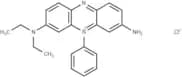
Methylene Violet 3RAX
CAS :Methylene Violet 3RAX is a cationic dye that is a potential photosensitizer in photodynamic therapy and has antitumor activity.Formule :C22H23ClN4Degré de pureté :97.03% - 97.17%Couleur et forme :SolidMasse moléculaire :378.9Bornyl acetate
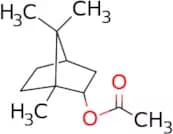
CAS :Bornyl acetate (Isobornyl acetate) has an anti-inflammatory effect. It is the volatile ingredient in some Chinese traditional herbs and numerous conifer oils.Formule :C12H20O2Degré de pureté :99.19%Couleur et forme :LiquidMasse moléculaire :196.29Thalidomide-O-C8-NH2
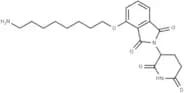
CAS :Thalidomide-O-C8-NH2 is a synthetic cereblon ligand & PROTAC linker, serving as an E3 ligase ligand-linker.Formule :C21H27N3O5Couleur et forme :SolidMasse moléculaire :401.463Ferumoxytol
CAS :Ferumoxytol is an iron oxide nanoparticle with anti-leukemia properties, specifically against acute myeloid leukemia (AML) cells with low ferroportin (FPN) expression. By increasing intracellular iron levels, Ferumoxytol induces the Fenton reaction to produce reactive oxygen species (ROS), resulting in oxidative stress and ferroptosis. It selectively kills leukemia cells with low FPN expression while sparing normal cells, making it useful for studying leukemia targeting iron metabolism abnormalities.Couleur et forme :SolidAc-Pro-Gly-Pro-OH
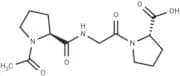
CAS :Ac-Pro-Gly-Pro-OH can be used as a CXCR2 agonist with bactericidal and anti-inflammatory activity for the study of sepsis and lung inflammation.Formule :C14H21N3O5Degré de pureté :98.32%Couleur et forme :SolidMasse moléculaire :311.33STAT3-D11-PROTAC-VHL
STAT3-D11-PROTAC-VHL (Compound D11-PROTAC) is a PROTAC degrader targeting signal transducer and activator of transcription 3 (STAT3). It demonstrates anti-tumor activity with IC50 values of 1335 nM in HeLa cells and 1973 nM in MCF-7 cells. The compound binds to the DNA binding domain of STAT3, recruits the E3 ligase VHL to form a ternary complex, leading to ubiquitination and subsequent proteasomal degradation of STAT3. Additionally, STAT3-D11-PROTAC-VHL inhibits tumor cell growth, induces cell cycle arrest and apoptosis (apoptosis), and suppresses tumor immune evasion.Couleur et forme :Odour SolidZS3-046
ZS3-046 is a TAF1 PROTAC degrader that facilitates the ubiquitination and subsequent degradation of TAF1. It can activate p53 and induce apoptosis in acute myeloid leukemia (AML) cells. Additionally, ZS3-046 demonstrates anti-tumor efficacy in AML xenograft mouse models.Formule :C49H57N9O7Couleur et forme :SolidMasse moléculaire :883.4381Anticancer agent 273
Anticanceragent 273 (Compound 9q) is an effective anticancer compound identified from matrine. It inhibits cancer cell proliferation, with an IC50 of 4.48 μM against HeLa cells. Anticanceragent 273 exerts its anticancer effects by modulating PI3K/AKT expression and activating activating transcription factor 4 (ATF4), which induces endoplasmic reticulum stress and triggers apoptosis. It holds potential for cancer research, including cervical cancer.Couleur et forme :Odour Solidp38α inhibitor 6
p38α inhibitor6 (compound 19) is a p38α inhibitor with an IC50 value of 0.68 μM. It induces apoptosis, arrests the cell cycle in the G0 and G2/M phases, reduces TNF-α concentration, upregulates the expression of the tumor suppressor gene p53, increases the Bax/BCL-2 ratio, and activates caspase3/7.Couleur et forme :Odour SolidApoptosis inducer 27
Apoptosisinducer 27 (compound 1c) is a potent inhibitor of MDA-MB-231 breast cancer cells, demonstrating an IC50 of 12.8 μM and inducing early apoptosis in these cells. Additionally, it can bind to DNA molecules as well as Bax and Bcl-2 proteins, thereby inducing DNA damage.Formule :C29H37BrN2Couleur et forme :SolidMasse moléculaire :493.5212-Deoxyphorbol 13-palmitate
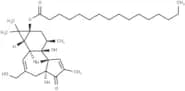
CAS :12-Deoxyphorbol 13-palmitate, a monomer derived from the roots of Euphorbia fischeriana, exhibits notable antitumor activity. This compound induces cell cycle arrest and apoptosis in gastric cancer cells by modulating key cell cycle regulators, such as cyclin B, cyclin A, and CDC2. Additionally, 12-Deoxyphorbol 13-palmitate significantly diminishes liver fibrosis by targeting APOL2 and impairing the APOL2–SERCA2–PERK–HES1 signaling pathway.Formule :C36H58O6Couleur et forme :SolidMasse moléculaire :586.84Ferroptosis inducer-4
Ferroptosisinducer-4 (Compound 5) is a phospholipid-based ferroptosis inducer featuring a terminal double bond at the sn-2 position. It exhibits significant cytotoxicity towards HT-1080 cells with an IC50 value of 18 μM. The toxicity mechanism involves the generation of lipid peroxides and oxidative damage to the cell membrane induced by the terminal double bond. Ferroptosisinducer-4 can be utilized in studies pertaining to the regulation of ferroptosis.Formule :C33H64NO7PCouleur et forme :SolidMasse moléculaire :617.84RAR/RXR agonist-1
Compound 7, also known as RAR/RXR agonist-1, is a chlorinated isomer of retinoic acid and acts as a selective RARα agonist and a partial RXRα agonist. It is capable of activating RXRα, thereby inducing G2/M arrest and apoptosis in cancer cells.Formule :C25H27ClO3Couleur et forme :SolidMasse moléculaire :410.93A-1155905
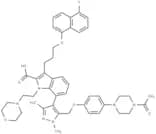
CAS :A-1155905 is an MCL-1 inhibitor with anticancer activity, demonstrating a half maximal inhibitory concentration (IC50) of 33.5 Nm and a dissociation constant (Ki) of 0.58 nM. This compound selectively binds to MCL-1 and possesses sufficient affinity to disrupt the MCL-1-Bim complex in live cells. The induction of death in MCL-1-dependent cell lines by A-1155905 is reliant on caspase proteins and occurs through apoptosis.Formule :C46H51FN6O6Couleur et forme :SolidMasse moléculaire :802.93NL13
NL13, a Polo-like kinase 4 (PLK4) inhibitor, exhibits an IC 50 value of 2.32 μM. It demonstrates the ability to suppress the viability of PC3 and DU145 prostate cancer cells with respective IC 50 values of 3.51 μM and 2.53 μM. NL13 also inhibits tumor growth in prostate cancer mice. Additionally, it deactivates the AKT signaling pathway by reducing CCNB1/CDK1 levels, leading to G2/M cell cycle arrest and initiating apoptosis through caspase-9/caspase-3 cleavage.Formule :C22H19Cl2NO2Couleur et forme :SolidMasse moléculaire :400.3Nrf2 activator-11
Nrf2 activator-11 (compound M11) is a Nrf2 activator that possesses blood-brain barrier permeability and offers anti-oxidation, anti-inflammation, anti-ferroptosis, and anti-apoptosis properties. It is applicable for use in studying cerebral ischemia-reperfusion (CI/R) injury models.Formule :C20H23N3O2Couleur et forme :SolidMasse moléculaire :337.42PROTAC FGFR2 degrader 1
PROTAC FGFR2 degrader 1 (compound N5) is a potent PROTAC that efficiently targets FGFR2, boasting a DC 50 value of 6.46 nM and an FGFR2 IC 50 of 0.08 nM. This compound exhibits significant anti-proliferative effects and high selectivity. It induces G0/G1 arrest in the cell cycles of KATOIII and SNU16 and inhibits apoptosis by diminishing the activation of p-ERK and p-PLCγ, the downstream proteins of FGFR2. Additionally, PROTAC FGFR2 degrader 1 maintains over 50% inhibition of gastric cancer cells at a concentration of 0.17 nM and effectively suppresses the growth of SNU16 xenograft tumors in a mouse model.Couleur et forme :Odour SolidFGFR1/VEGFR2-IN-2
FGFR1/VEGFR2-IN-2 (compound 6) is a dual inhibitor targeting both VEGFR2 and FGFR1 with IC50 values of 0.025 µM and 0.026 µM, respectively. This compound also exhibits inhibitory effects on EGFR and PDGFR-β, with IC50 values of 0.106 µM and 0.077 µM, respectively. FGFR1/VEGFR2-IN-2 demonstrates significant anticancer activity in the NCI-60 cell lines, showing a growth inhibition (GI) of 60.38%. In T-47D cell lines, it achieves an IC50 of 8.51 µM, exhibits anti-migratory properties, induces cell cycle arrest in the G1 phase, and promotes both apoptosis and necrosis. Additionally, while it has an IC50 greater than 100 µM in MCF-7 cell lines, it does so with an IC50 of 69.17 µM in MDA-MB-231 cell lines and shows no toxicity to normal cells.Formule :C21H15ClF3NO4SCouleur et forme :SolidMasse moléculaire :469.86Apoptosis inducer 24
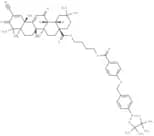
CAS :Apoptosisinducer 24 (Compound 4) inhibits the proliferation of gastric cancer cells with an IC50 range of 1.2-4.8 μM. It arrests the cell cycle at the G2/M phase, induces apoptosis in BGC-823 cells, and causes mitochondrial dysfunction. In mice, Apoptosisinducer 24 exhibits antitumor activity without significant toxicity, having an LD50 of 91.2 mg/kg.Formule :C55H70BNO9Couleur et forme :SolidMasse moléculaire :899.96Apoptosis inducer 26
Apoptosisinducer 26 (compound [AgCl(dap2SH)(PPh3)2]) is a mononuclear Ag(I) ligand-based autophagy inducer that exhibits antibacterial and anticancer activities against various bacterial strains and cancer cell lines. This compound facilitates the accumulation of Ag(I) ions in the periphery of bacteria, effectively inhibiting the growth of both Gram-positive (+) and Gram-negative (-) bacteria. Additionally, Apoptosisinducer 26 can intercalate between the base pairs of CT DNA, inducing apoptosis in A549 cells. It also possesses radical scavenging properties, which helps prevent oxidative stress.Formule :C40H36AgClN4P2SCouleur et forme :SolidMasse moléculaire :810.07