

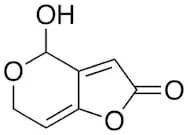

Product Information
Name:Patulin
Synonyms:
- Patulin (6CI)
- 4-Hydroxy-4H-furo[3,2-c]pyran-2(6H)-one
- Acetic acid
- (2,4-dihydroxy-2H-pyran-3(6H)-ylidene)-
- 3,4-lactone
- Clairformin
- Clavacin
- Clavatin
- Claviformin
- DL-Patulin
- Expansin
- Expansin (antibiotic)
- Expansine
- Gigantin
- Leucopin
- Mycoin
- Mycoin C
- Mycoin C3
- NSC 32951
- NSC 8120
- Patuline
- Penicidin
- See more synonyms
Brand:TRC
Description:Stability HygroscopicApplications Patulin (PAT), a mycotoxin produced by certain species of Penicillium, Aspergillus, and Byssochlamys, is mainly found in ripe apple and apple products. Patulin-induced genotoxicity and modulation of glutathione in Hep G2 cells. Patulin is an antibiotic. Patulin-induced nephropathy and gastrointestinal tract malfunction have been demonstrated in several animal models. The oral LD50 value of patulin ranges between 29 and 55 mg/kg body weight in rodents and 170 mg/kg body weight in poultry. The World Health Organization considers patulin cytotoxic and established a safety level of patulin in apple juice at 50 μM. At 100-200 μM, patulin can directly increase intracellular oxidative stress in HEK293 and HL-60 cells. In 1944, this compound was tested in a clinical trial for potential antibiotic Not a dangerous good if item is equal to or less than 1g/ml and there is less than 100g/ml in the packageReferences Scott, P., et al.: J. Agric. Food Chem., 20, 450 (1972), Aden, D., et al.: Nature, 282, 615 (1979), Surralles, J., et al.: Mutat. Res., 341, 169 (1995), Alves, I., et al.: Mutagenesis, 15, 229 (2000), Liu, B., et al.: Toxicol. Appl. Pharmacol., 191, 255 (2003), Puel, O., Galtier, P., and Oswald, I.P. Biosynthesis and toxicological effects of patulin. Toxins 2(4) 613-631 (2010). Liu, B., Wu, T., Yu, F., et al. Induction of oxidative stress response by the mycotoxin patulin in mammalian cells. Toxicol Sci 95(2) 340-347 (2007). Chalmers, I., and Clarke, M. Commentary: The 1994 patulin trial: The first properly controlled multicentre trial conducted under the aegis of the British Medical Research Council. Int J Epidemiol 32 253-260 (2004).
Notice:Our products are intended for lab use only. For any other use, please contact us.
Chemical properties
Molecular weight:154.12
Formula:C7H6O4
Color/Form:Off-White To Yellow
InChI:InChI=1S/C7H6O4/c8-6-3-4-5(11-6)1-2-10-7(4)9/h1,3,7,9H,2H2
InChI key:InChIKey=ZRWPUFFVAOMMNM-UHFFFAOYSA-N
SMILES:O=C1C=C2C(=CCOC2O)O1
Technical inquiry about: Patulin
Please use instead the cart to request a quotation or an order
If you want to request a quotation or place an order, please instead add the desired products to your cart and then request a quotation or order from the cart. It is faster, cheaper, and you will be able to benefit from the available discounts and other advantages.