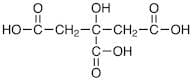
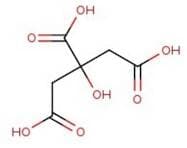
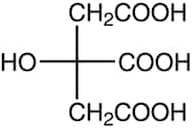
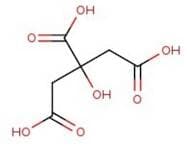
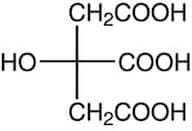
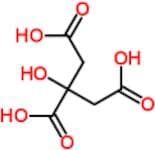
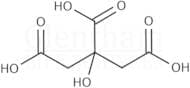
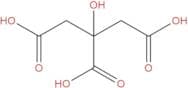
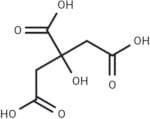
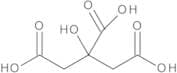
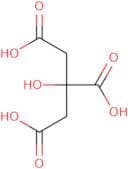
CAS 77-92-9
:Ácido cítrico
- 1,2,3-Propanetricarboxylic acid, 2 hydroxy-
- 2-Hydroxy-1,2,3-propanetricarboxyic acid
- 2-Hydroxy-1,2,3-propanetricarboxylic acid
- 2-Hydroxypropan-1,2,3-tricarboxylic acid
- 2-Hydroxypropane-1,2,3-Tricarboxylate
- 3-Carboxy-3-hydroxy-pentanedioic acid
- 3-Carboxy-3-hydroxypentane-1,5-dioic acid
- 3-Hydroxy-3-carboxy-1,5-pentanedioic acid
- 3-Hydroxy-pentane-1,3-5-trioic acid
- Acide citrique
- Acido Citrico
- Aciletten
- BioLink Acidifier
- C 1949
- Celenex 3P6
- Cellborn SC-C
- Chemfill
- Citretten
- Citric acid anhydride
- Citric acid monoglyceride
- Citric acid, anhydrous
- Citric-Acid, Anhydride Cristo
- Citro
- Citronensaeure
- Citronsyre
- E 330
- EL 4 (polycarboxylic acid)
- F 0001 (polycarboxylic acid)
- F 3500
- F 4020
- Grindsted Pro Tex TR 100
- Hydrocerol A
- Ins 330
- Jet Setter
- Kk 120
- Liquinat L 50
- Monoglyceride citrate
- Nsc 112226
- Nsc 30279
- Nsc 626579
- Pas 33
- Propane-1,2,3-tricarboxylic acid, 2-hydroxy-
- Suby G
- Tba 80
- Uro-trainer
- Zitronensaure
- クエン酸
- Anhydrous Citric Acid
- Citric acid
- BUFFER CONCENTRATE, PH 4.00
- BUFFER CONCENTRATE, PH 12.00
- BUFFER CONCENTRATE, PH 7.00
- BETZ 6251
- BUFFER CONCENTRATE, CITRATE/HYDROCHLORIC ACID
- BUFFER CONCENTRATE, GLYCINE/HYDROCHLORIC ACID
- BUFFER CONCENTRATE, PH 11.00
- BUFFER CONCENTRATE, PH 2.00
- BUFFER CONCENTRATE, PH 3.00
- BORIC ACID-POTASSIUM CHLORIDE-SODIUM HYDROXIDE BUFFER
- BUFFER CONCENTRATE, PH 5.00
- BETZ 0623
- BUFFER CONCENTRATE, PH 1.00
- AMMONIACAL AMMONIUM CHLORIDE BUFFER
- BUFFER CONCENTRATE, CITRATE/SODIUM HYDROXIDE
- BUFFER CONCENTRATE, PH 10.00
- BUFFER CONCENTRATE, BORIC ACID/POTASSIUM CHLORIDE/SODIUM HYDROXIDE
- BUFFER CONCENTRATE, BORATE/HYDROCHLORIC ACID
- BUFFER CONCENTRATE, PH 8.00
- Ver mais sinónimos
Citric Acid
CAS:Fórmula:C6H8O7Pureza:>98.0%(T)Cor e Forma:White to Almost white powder to crystalPeso molecular:192.12Citric acid, Anhydrous, 99.5 to 100.5% (Dry Basis)
CAS:Thermo Scientific Citric acid AnhydrousFórmula:C6H8O7Pureza:100.5%Cor e Forma:White crystalline powderPeso molecular:192.12Citric acid, anhydrous, ACS, 99.5+%
CAS:Citric acid is the most widely used organic acid and pH-control agent in foods, beverages, pharmaceuticals and technical applications. Used in pharmaceutical preparations, especially in effervescent tablets. It is used as a natural preservative. This Thermo Scientific Chemicals brand product was orFórmula:C6H8O7Pureza:99.5+%Cor e Forma:White, SolidPeso molecular:192.12Citric acid, Electrophoresis Grade, 99.5+%
CAS:Citric acid is a starting point in the Krebs cycle and is a key intermediate in metabolism. It has anticoagulant activity; as a calcium chelator, it forms complexes that disrupt the tendency of blood to clot. It may be used to adjust pH and as a sequestering agent for the removal of trace metals. ThFórmula:C6H8O7Pureza:99.5+%Cor e Forma:White, Powder or crystals or crystalline powderPeso molecular:192.12Citric acid, 99+%
CAS:This Thermo Scientific Chemicals brand product was originally part of the Alfa Aesar product portfolio. Some documentation and label information may refer to the legacy brand. The original Alfa Aesar product / item code or SKU reference has not changed as a part of the brand transition to Thermo SciFórmula:C6H8O7Pureza:99+%Cor e Forma:White, Crystals or powder or crystalline powderPeso molecular:192.12CITRIC ACID (ANHYDROUS) CRS
CAS:CITRIC ACID (ANHYDROUS) CRSFórmula:C6H8O7Cor e Forma:Crystalline Powder. White. Powder.Peso molecular:192.1235Citric Acid
CAS:Citric acid (2-hydroxy-1,2,3-propanetricarboxylic acid)Fórmula:C6H8O7Cor e Forma:White CrystalsPeso molecular:192.027Citric acid, 50% solution in water
CAS:Fórmula:C6H8O7Cor e Forma:Clear, colourless liquidPeso molecular:192.13Citric acid, anhydrous, 99.5%, BP, Ph. Eur., USP grade
CAS:Fórmula:C6H8O7Pureza:99.5 - 100.5 % (anhydrous substance)Cor e Forma:Colourless crystals or white crystalline powderPeso molecular:192.13Citric acid, anhydrous, 99%
CAS:Fórmula:C6H8O7Pureza:98.5 - 101.5 %Cor e Forma:White or almost white crystalline powder, or colourless crystalsPeso molecular:192.13Citric Acid, anhydrous
CAS:Fórmula:C6H8O7Pureza:99.0%Cor e Forma:White granularPeso molecular:192.123Fruit Juice Organic Acid Mixture 56 25-2000 µg/mL in Water
CAS:Produto ControladoFórmula:C6H8O7Cor e Forma:MixturePeso molecular:192.12Citric acid
CAS:Citric acid (Citro) is a weak organic tricarboxylic acid found in citrus fruits, a food additive and a natural preservative. High-Quality, Low-Cost!Fórmula:C6H8O7Pureza:98.88%Cor e Forma:White Solid CrystallinePeso molecular:192.12Citric Acid
CAS:Applications Citric acid is a weak organic acid that is known as a commodity chemical, as more than a million tonnes are produced every year by mycological fermentation on an industrial scale using crude sugar solutions, such as molasses and strains of Aspergillus niger. Citric acid is widely distributed in plants and in animal tissues and fluids and exist in greater than grace amounts in variety of fruits and vegetables, most notably in citrus fruits such as lemon and limes. Citric acid is mainly used as an acidifier, flavoring agent and chelating agent. Citric acid is also a metabolite of Dimethyl Fumarate (D464965), a compound used as a treatment for the relapsing forms of multiple sclerosis and psoriasis.
References Dawson, R.M., et al.: Data for Biochem. Rsch., (1959); Gruber, C. M., et al.: J. Pharmacol. Exp. Ther., 94, 65 (1948); Lofty, W.A., et al.: Bioresource. Tech., 98, 3470 (2007); Schimrigk, S., et al.: Eur. J. Neurol., 13, 604 (2006)Fórmula:C6H8O7Cor e Forma:NeatPeso molecular:192.12Citric acid anhydrous
CAS:Citric acid is an organic compound that is a weak organic acid. It is a colorless, odorless solid with a sour taste. Citric acid participates in many biochemical reactions, including the citric acid cycle and fatty acid metabolism. Citric acid can be found in many citrus fruits, such as lemons, limes, and grapefruits. Citric acid also has antioxidant properties and functions as an anti-inflammatory agent. Citric acid is used for the production of citrates and citrate salts, which are added to food preservatives or acidic foods such as lemonade or vinegar. Citric acid can be used to measure water vapor concentration by using fluorescence probes that react with hydrated electrons in water molecules. It also has electrochemical impedance spectroscopy (EIS) applications in biomedical research and biotechnology as an enzyme inhibitor or activator.
Fórmula:C6H8O7Pureza:Min. 95%Cor e Forma:Colorless PowderPeso molecular:192.12 g/molCitric Acid Anhydrous extrapure AR, ACS, ExiPlus, Multi-Compendial, 99.5%
CAS:Fórmula:C6H8O7Pureza:min. 99.5%Cor e Forma:White, Crystalline powder, Clear, ColourlessPeso molecular:192.13