Síntese de Peptídeos
Foram encontrados 87 produtos para "Síntese de Peptídeos".
N,N-Diisopropylethylamine (ca. 10% in N,N-Dimethylformamide) [for Detection of Primary Amines]
CAS:Fórmula:C8H19NCor e Forma:Colorless to Light yellow clear liquidPeso molecular:129.25N,N-Dimethylacetamide
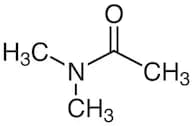
CAS:Fórmula:C4H9NOPureza:>99.0%(GC)Cor e Forma:Colorless to Almost colorless clear liquidPeso molecular:87.12Boc-L-prolinal
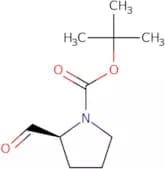
CAS:Boc-L-prolinal is a stereoselective enolate that has been used in the synthesis of organometallic compounds. It is also used in the preparation of monoclonal antibodies, which are proteins that are produced by the immune system to help fight off infections. Boc-L-prolinal has been shown to be an effective agent for treating many cancers, including breast cancer and melanoma. In addition, it has been shown to inhibit epidermal growth factor (EGF) and other growth factors, which may be due to its ability to induce apoptotic signaling. Boc-L-prolinal also contains a carbonyl group, which can undergo acidolysis reactions with nucleophiles such as water or alcohols.
Fórmula:C10H17NO3Pureza:Min. 95%Cor e Forma:Colorless Clear LiquidPeso molecular:199.25 g/molS-2-Propen-1-yl-L-cysteine ethyl ester hydrochloride
CAS:Please enquire for more information about S-2-Propen-1-yl-L-cysteine ethyl ester hydrochloride including the price, delivery time and more detailed product information at the technical inquiry form on this pageFórmula:C8H15NO2S•HClPureza:Min. 95%Peso molecular:225.74 g/molPoly-L-lysine hydrochloride, MW 10000 - 30000
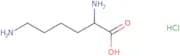
CAS:Poly-L-lysine hydrochloride, MW20000 is a water soluble polymer with an average molecular weight of 20000 Da. It is used in the synthesis of peptides and proteins due to its high purity, high quality, and low cost. Poly-L-lysine hydrochloride, MW20000 has been shown to bind to a wide range of surfaces such as glass, plastic, silicon dioxide, and stainless steel. This makes it useful for surface modification. Poly-L-lysine hydrochloride can be used as a scaffold for chemical reactions or as an intermediate in the synthesis of complex compounds.
Cor e Forma:Powderγ-L-Glutamyl-L-glutamic acid trifluoroacetate
CAS:Please enquire for more information about γ-L-Glutamyl-L-glutamic acid trifluoroacetate including the price, delivery time and more detailed product information at the technical inquiry form on this pageFórmula:C10H16N2O7•C2HF3O2Pureza:Min. 95%Peso molecular:390.27 g/molFmoc-Thr(tBu)-D-Ser(Psi(Me,Me)pro)-OH
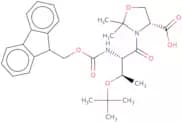
Fmoc-Thr(tBu)-D-Ser(Psi(Me,Me)pro)-OH is a speciality chemical that is used as a reagent for peptide synthesis. It is also useful in the synthesis of complex compounds and scaffolds. This compound has high quality with a CAS number of 56610-81-8. Fmoc-Thr(tBu)-D-Ser(Psi(Me,Me)pro)-OH is a versatile building block that can be used in reactions involving amines and carboxylic acids. Fmoc-Thr(tBu)-D-Ser(Psi(Me,Me)pro)-OH is an intermediate that can be used in the synthesis of many different compounds.
Fórmula:C29H36N2O7Pureza:Min. 95%Cor e Forma:PowderPeso molecular:524.61 g/molFmoc-N-Me-Asp(OtBu)-OH
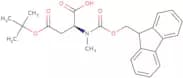
CAS:Fmoc-N-Me-Asp(OtBu)-OH is a synthetic peptide with potential immunosuppressive properties. It has been shown to inhibit the proliferation of human lymphocytes in response to lipopolysaccharides (LPS) and also to suppress the release of cytokines such as IL-1β, IL-6, and TNFα. The effects were dose dependent and could be reversed by the addition of a neutralizing antibody. This peptide can be used as an immunosuppressant in clinical trials that are investigating treatments for myasthenia gravis. Fmoc-N-Me-Asp(OtBu)-OH has been synthesised using chemical synthesis methods from commercially available reagents.Fórmula:C24H27NO6Pureza:Min. 98 Area-%Cor e Forma:PowderPeso molecular:425.47 g/mol4-Hydroxybenzenepropanoic acid 2,5-dioxo-1-pyrrolidinyl ester
CAS:4-Hydroxybenzenepropanoic acid 2,5-dioxo-1-pyrrolidinyl ester is a chemical reagent commonly employed in the field of peptide synthesis. This compound, often utilized as a coupling agent, is derived from the esterification of 4-hydroxybenzenepropanoic acid with N-hydroxysuccinimide (NHS).Fórmula:C13H13NO5Pureza:Min. 95 Area-%Peso molecular:263.25 g/molLL-37 TFA
LL-37 TFA is a reagent, complex compound and useful intermediate for the fine chemical and pharmaceutical industries. It is also an important building block for the synthesis of other chemicals. LL-37 TFA has CAS No. 71428-08-9, which is a speciality chemical that can be used in research as well as in many different reactions. The versatility of this compound makes it a very useful building block for the synthesis of other chemicals.Fórmula:C205H340N60O53•xC2HF3O2Pureza:Min. 95 Area-%Cor e Forma:PowderPeso molecular:4,493.25 g/molH-L-Cys(mdnpe)-OH
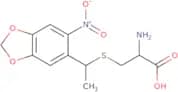
CAS:A novel protected cysteine that can be cleaved by photolysis.Fórmula:C12H14N2O6SPureza:Min. 95%Peso molecular:314.32 g/molFmoc-Cys-(CAMTrt)-OH
CAS:Fmoc-Cys-(CAMTrt)-OH is an amino acid derivative, which is a synthetic compound essential for peptide synthesis. It is derived from natural cysteine, an amino acid found in proteins, and is modified with an Fmoc (9-fluorenylmethoxycarbonyl) protective group and a CAMTrt (trityl sulfonium ion) moiety. This derivative is used primarily in solid-phase peptide synthesis, where the Fmoc group protects the amine during chain elongation, and the CAMTrt group safeguards the thiol function of cysteine, preventing unwanted side reactions during synthesis.
Fórmula:C39H34N2O5SPureza:Min. 98 Area-%Peso molecular:642.76 g/molD-Methionine
CAS:D-methionine is a form of the amino acid methionine that is synthesized in plants. It has been studied for its potential to help with various metabolic disorders, including osteoarthritis and primary sclerosing cholangitis. D-methionine provides methionine to the body, which is essential for the formation of collagen and elastin. In addition, it has been shown to have a protective effect against neuronal death in a model system. D-methionine may be beneficial for people with liver disease, but more research is needed.
Fórmula:C5H11NO2SPureza:Min. 95%Cor e Forma:White Off-White PowderPeso molecular:149.21 g/molSulfo-SMCC sodium
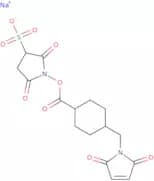
CAS:Crosslinker reacting rapidly with primary amines. It is used as a protein crosslinker where it reacts with cysteine to yield specific conjugates. The cyclohexane bridge confers added stability to the maleimide group making it ideal for maleimide activation of proteins. It is soluble in water and many other aqueous buffers although it is less stable then in DMSO or DMF.
Fórmula:C16H17N2O9SNaPureza:Min. 95 Area-%Cor e Forma:White Off-White PowderPeso molecular:436.37 g/molMALP-2
CAS:Macrophage-activating lipopetide-2 (MALP-2) is a TLR2 agonist and activator of MyD88-dependent signaling pathways. It has potential as a vaccine adjuvant.Fórmula:C99H167N19O30SPureza:Min. 95%Peso molecular:2,135.6 g/molL-Lysyl-L-phenylalanyl-L-lysine trifluoroacetate
CAS:Please enquire for more information about L-Lysyl-L-phenylalanyl-L-lysine trifluoroacetate including the price, delivery time and more detailed product information at the technical inquiry form on this page
Fórmula:C21H35N5O4•(C2HF3O2)xPureza:Min. 95%Cor e Forma:Powder(S)-2-Amino-3,3,3-trifluoropropanoic acid hydrochloride
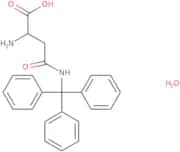
CAS:Please enquire for more information about (S)-2-Amino-3,3,3-trifluoropropanoic acid hydrochloride including the price, delivery time and more detailed product information at the technical inquiry form on this pageFórmula:C3H4F3NO2•HCLPureza:Min. 95%Cor e Forma:PowderPeso molecular:179.52 g/molN-(Triphenylmethyl)-D-asparagine monohydrate
CAS:Please enquire for more information about N-(Triphenylmethyl)-D-asparagine monohydrate including the price, delivery time and more detailed product information at the technical inquiry form on this pageFórmula:C23H22N2O3•H2OPureza:Min. 95%Peso molecular:392.45 g/molDL-Proline
CAS:A useful as an intermediate in the synthesis of peptides, proteins, and other organic molecules. It can be used as a reagent or as an additive to other chemicals.Fórmula:C5H9NO2Pureza:Min. 99 Area-%Peso molecular:115.13 g/mol
![N,N-Diisopropylethylamine (ca. 10% in N,N-Dimethylformamide) [for Detection of Primary Amines]](/_next/image/?url=https%3A%2Fstatic.cymitquimica.com%2Fproducts%2F3B%2Fthumb-webp%2FD2937.webp&w=3840&q=75)