


Glicociência
Subcategorias de "Glicociência"
- Amino açúcares(108 produtos)
- Anticorpos Glico-Relacionados(283 produtos)
- Glicolípidos(46 produtos)
- Glicosaminoglicanos (GAGs)(55 produtos)
- Glicosídeos(419 produtos)
- Monossacáridos(6.618 produtos)
- Oligossacarídeos(3.714 produtos)
- Polissacáridos(505 produtos)
Foram encontrados 11025 produtos de "Glicociência"
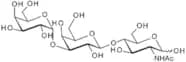
Blood Group B type II linear trisaccharide
CAS:Core antigen fragment in ABO blood group systemFórmula:C20H35NO16Pureza:Min. 95%Cor e Forma:PowderPeso molecular:545.49 g/molLipid IVa
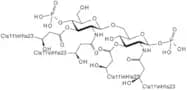
CAS:Lipid IVA is a tetra-acylated precursor molecule of lipid A which is a component of lipopolysaccharides (LPS) on the outer membrane of gram-negative bacteria. On the innate immune cells of hosts there are toll-like receptor 4 (TLR4) and MD-2 which recognize LPS. This recognition event ultimately leads to the activation of NFκB which in turn results in pro-inflammatory cytokine production. Studies have suggested lipid A in Escherichia coli to be an agonist for both mouse and human TLR4, while lipid IVA can induce species specific TLR4 responses. For example for horse and mouse TLR4 and MD-2, Lipid IVA is an agonist where as it is an antagonist for TLR4 and MD-2 in humans.Fórmula:C68H130N2O23P2Pureza:One Main SpotCor e Forma:White PowderPeso molecular:1,405.7 g/molCellulose acetate - MW 30,000
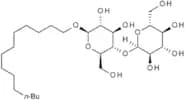
CAS:Cellulose acetate fiber is one of the earliest synthetic fibers and is based on cotton or tree pulp cellulose. Cellulose acetate is used as a film base in photography, as a component in some coatings, and as a frame material for eyeglasses. It is also used as a synthetic fiber in the manufacture of cigarette filters and playing cards. In photographic film, cellulose acetate replaced nitrate film in the 1950s, being far less flammable and cheaper to produce but in recent years has been rendered obsolete by the advent of digital cameras.Cor e Forma:PowderTetradecyl b-D-maltopyranoside
CAS:Tetradecyl b-D-maltopyranoside is a crystalline polymer of high molecular weight that is made up of repeating units of tetradecyl b-D-maltose. It has a lamellar morphology and can be sectioned with techniques such as electron microscopy, X-ray diffraction, and differential scanning calorimetry. Tetradecyl b-D-maltopyranoside is a metastable form of the compound. It has been found in nature in the form of the monomer unit, tetradecyl maltosyl (tetramethyleneglycol) b-d-maltoside. In order to produce this compound as a polymer, it must first be heated to about 160°C for several hours, which causes the monomers to assemble into chains of tetrahedrons. The properties of tetradecyl b-D-maltopyranoside depend on its environmentFórmula:C26H50O11Pureza:Min. 95 Area-%Cor e Forma:PowderPeso molecular:538.67 g/molD-Melibiose anhydrous
CAS:D-Melibiose anhydrous is a disaccharide that is used as an excipient in the pharmaceutical industry. It has been shown to be an active enzyme, which may be due to its ability to sequester galactose. D-Melibiose anhydrous has a redox potential of -0.2 V, indicating that it has a high number of oxidizable groups. The molecular weight of this sugar is 324.14 g/mol, and it has a polarizability of 0.16 D, which classifies it as a polyol with hydrogen bonding properties. This sugar is not soluble in water but can be dissolved in ethanol or propylene glycol. D-Melibiose anhydrous also has carbohydrate properties and may be considered a sugar alcohol because it contains six carbon atoms and one oxygen atom.Fórmula:C12H22O11Pureza:Min. 95%Cor e Forma:PowderPeso molecular:342.3 g/mol2-Benzamido-2-deoxy-D-glucopyranose
CAS:2-Benzamido-2-deoxy-D-glucopyranose is a synthetic, inexpensive, and non-toxic compound that has antibiotic properties. It is used as a reagent for the sulfonylating of aromatic rings and as an intermediate in the synthesis of other compounds. 2-Benzamido-2-deoxy-D-glucopyranose can be radiolabeled with carbon or fluorine atoms to form a resonance labeled probe that can be used in magnetic resonance spectroscopy.Fórmula:C13H17NO6Pureza:Min. 95%Cor e Forma:White PowderPeso molecular:283.28 g/molForodesine
CAS:Forodesine is a purine nucleoside that inhibits the nucleoside phosphorylase enzyme and prevents the synthesis of purines. It has minimal toxicity and is effective against intracellular targets such as mitochondria, which are important for apoptosis induction. Forodesine also inhibits the mcl-1 protein, which is an inhibitor of t-cell lymphomas. This drug has been shown to be effective in animal models of human lymphoma and leukemia.
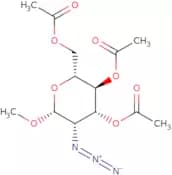
Fórmula:C11H14N4O4Pureza:Min. 95%Cor e Forma:PowderPeso molecular:266.25 g/molMethyl 2-azido-3,4,6-tri-O-acetyl-2-deoxy-b-D-mannopyranoside
CAS:Methyl 2-azido-3,4,6-tri-O-acetyl-2-deoxy-bD mannoside is a custom synthesis that can be modified to suit the needs of the customer. It is an oligosaccharide and polysaccharide that has been modified with methylation and glycosylation. This product has CAS No. 97604-59-6 and is available for purchase in high purity with a purity level of at least 95%. Methyl 2-azido-3,4,6-triO acetyl -2 deoxy b D mannoside has been fluorinated to create a synthetic sugar.
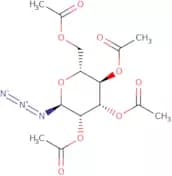
Fórmula:C13H19N3O8Pureza:Min. 95%Cor e Forma:White PowderPeso molecular:345.31 g/mol2,3,4,6-Tetra-O-acetyl-a-D-mannopyranosyl azide
CAS:2,3,4,6-Tetra-O-acetyl-a-D-mannopyranosyl azide is a crystalline solid that can be obtained by heating 2,3,4,6-tetra-O-acetyl-a-D-mannopyranose with sodium azide. This compound has been used in the x-ray crystallographic technique for obtaining electron density maps. The x ray data collected from this compound showed the distinct difference between the electron density of the atoms and their surroundings.Fórmula:C14H19N3O9Cor e Forma:PowderPeso molecular:373.32 g/molα-D-Mannopyranosyl amine
CAS:a-D-Mannopyranosyl amine is a synthetic product that is used as a sugar donor in glycosylation reactions. It can be custom synthesized to suit the needs of the customer. The chemical structure contains a methyl group and an oxygen atom, which are both in their highest oxidation state. This product is not intended for use as a food additive or dietary supplement.Fórmula:C6H13NO5Pureza:Min. 95%Peso molecular:179.17 g/molD-Gluconic acid sodium salt
CAS:D-Gluconic acid sodium salt is a glycol ether that is used as an injection solution. It has been shown to have antibacterial efficacy against wild-type strains of bacteria such as Escherichia coli, Pseudomonas aeruginosa, and Staphylococcus aureus. The in vitro antimicrobial action of D-gluconic acid sodium salt was found to be due to its ability to inhibit bacterial growth by interfering with the synthesis of DNA. D-Gluconic acid sodium salt also has been shown to have antihypertensive effects in rats through the inhibition of angiotensin II type 1 receptor (AT1) signaling pathway and erythrocyte proliferation. This drug also has been shown to bind benzalkonium chloride and x-ray diffraction data show that it is crystalline in nature. The analytical method for determining the concentration of D-gluconic acid sodium salt is by electrochemical impedance
Fórmula:C6H11NaO7Pureza:Min. 95%Cor e Forma:White PowderPeso molecular:218.14 g/mol6-Cyano-6-deoxy-a-cyclodextrin
CAS:Alpha-cyclodextrin (α-CD) derivative with a hydrophilic exterior and lipophilic cavity (smaller than β-CDs and γ-CDs) to allocate certain guest molecules. This structural characteristic enables applications in molecular encapsulation, solubility enhancement, and stabilization across multiple industries. In pharmaceuticals, it serves as a drug delivery vehicle, enhancing the bioavailability and stability of active ingredients. The food industry utilizes it as a stabilizer for flavors, colors, and nutrients, as well as a functional ingredient for its effects on lipid metabolism. In cosmetics, it acts as a complex agent for fragrances and active components. Its applications extend to analytical chemistry for chiral separation and to materials science for developing smart materials and nanosystems.Fórmula:C42H54N6O24Pureza:Min. 95%Peso molecular:1,026.9 g/molDigalactosyldiacylglycerol - 10mg/ml in Chloroform-Methanol
CAS:In plants and algae, the two main galactolipids, monogalactosyldiacyglycerol (MGDG) and digalactosyldiacyglycerol (DGDG), are synthesized by galactosyltransferases in the plastid envelope. They have been linked to the anti-inflammatory and cancer benefits of a green leafy vegetable diet in humans due to their ability to regulate the levels of free radicals like nitric oxide (NO)Fórmula:C51H84O15Pureza:Min. 95%Cor e Forma:PowderPeso molecular:937.2 g/molLacto-N-neofucopentaose
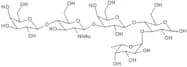
Neutral pentasasaccharide naturally present in human breast milk
Fórmula:C32H55NO25Pureza:Min. 90 Area-%Cor e Forma:PowderPeso molecular:853.77 g/molLactose-PAA-biotin
Lactose-PAA-biotin is a biotin linked to lactose by a polyacrylamide linker
Pureza:Min. 95%Cor e Forma:PowderN-(Formylamidino)-N-b-D-ribofuranosylurea
CAS:Please enquire for more information about N-(Formylamidino)-N-b-D-ribofuranosylurea including the price, delivery time and more detailed product information at the technical inquiry form on this page
Fórmula:C8H14N4O6Pureza:Min. 95%Peso molecular:262.22 g/molMonofucosyllacto-N-hexaose II
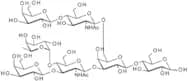
CAS:Monofucosyllacto-N-hexaose II is a tetraol that is used as a reagent in the synthesis of enantioenriched and synthetically tetrasaccharidic products. Monofucosyllacto-N-hexaose II can be obtained by the reaction of Grignard reagents with glucose or by stereoselective reduction of an alpha, beta unsaturated ketone. The presence of the glucose residue in Monofucosyllacto-N-hexaose II makes it an acceptor for esterification reactions. This compound has chiral centers due to its two stereogenic centers at C2 and C3, which are both beta positions on the glucose residue. Monofucosyllacto-N-hexaose II also has a free hydroxyl group at C5 that can be esterified to produce chiral esters.Fórmula:C46H78N2O35Pureza:Min. 95%Peso molecular:1,219.1 g/mol2,3-Di-O-benzyl-6-O-tert-butyldimethylsilyl-gamma-cyclodextrin
This gamma-cyclodextrin (γ-CD) derivative is a modified cyclic oligosaccharide composed of eight glucose units, featuring a larger cavity size than α- and β-cyclodextrins. This structural characteristic allows γ-CDs to form inclusion complexes with a wider range of guest molecules, making it particularly versatile in various industries. In the food sector, it is used as a carrier and stabilizer for flavors, fat-soluble vitamins, and polyunsaturated fatty acids, protecting volatile compounds from evaporation. In pharmaceuticals, it enhances the solubility and bioavailability of poorly water-soluble drugs and, thanks to its larger ring size, allows for the encapsulation of larger molecules or even entire drug molecules. γ-CDs and derivatives are also used for environmental remediation and, in analytical chemistry, for the extraction and concentration of target substances.
Fórmula:C208H288O40SI8Pureza:Min. 95%Peso molecular:4,475.79 g/mol2,5-Anhydro-1,3-O-isopropylidene-6-O-trityl-D-glucitol
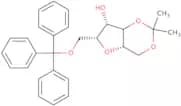
CAS:2,5-Anhydro-1,3-O-isopropylidene-6-O-trityl-D-glucitol is a complex carbohydrate that is synthesized by the modification of glucose. This product has been modified with methylation and glycosylation. 2,5-Anhydro-1,3-O-isopropylidene-6-O-trityl--D--glucitol is a white powder that is soluble in water and ethanol. It can be used for fluoroquinolone resistance studies, which are important for developing new antibiotics to combat bacterial infections.Fórmula:C28H30O5Pureza:Min. 95%Peso molecular:446.53 g/molPhenylmethyl N-[3-[[1-oxo-5-[[3,4,6-tri-O-acetyl-2-(acetylamino)-2-deoxy-β-D-galactopyranosyl]oxy]pentyl]amino]propyl]carbamate
CAS:Please enquire for more information about Phenylmethyl N-[3-[[1-oxo-5-[[3,4,6-tri-O-acetyl-2-(acetylamino)-2-deoxy-β-D-galactopyranosyl]oxy]pentyl]amino]propyl]carbamate including the price, delivery time and more detailed product information at the technical inquiry form on this page
Fórmula:C30H43N3O12Peso molecular:637.68 g/mol









![Phenylmethyl N-[3-[[1-oxo-5-[[3,4,6-tri-O-acetyl-2-(acetylamino)-2-deoxy-β-D-galactopyranosyl]oxy]…](/_next/image/?url=https%3A%2Fstatic.cymitquimica.com%2Fproducts%2F3D%2Fthumb-webp%2FMP184464.webp&w=3840&q=75)