Nucleotídeos
Subcategorias de "Nucleotídeos"
Foram encontrados 2637 produtos de "Nucleotídeos"
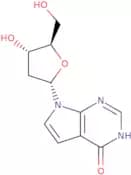
7-Deaza-2'-deoxyinosine
CAS:7-Deaza-2'-deoxyinosine is a purine nucleoside analog that has been shown to be a hydrogen bond donor and formamide acceptor. This drug destabilizes duplex DNA by interfering with the formation of the hydrogen bonds between the bases, which may result in strand breakage. 7-Deaza-2'-deoxyinosine has also been shown to inhibit RNA polymerase activity, thereby inhibiting protein synthesis. It has been used as a tool for studying enzyme mechanisms and in solid phase synthesis.
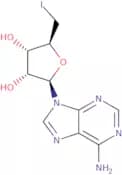
Fórmula:C11H13N3O4Pureza:Min. 95%Cor e Forma:PowderPeso molecular:251.24 g/mol5'-Deoxy-5'-iodoadenosine
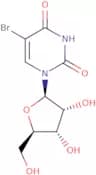
CAS:5'-Deoxy-5'-iodoadenosine is a nucleoside analog that inhibits the activity of the adenosine receptor. This drug binds to adenosine receptors, which are found on the surface of cells. The binding results in an inhibitory effect on viral replication and cell proliferation. 5'-Deoxy-5'-iodoadenosine has been shown to be effective against hepatitis B virus, hepatitis C virus, and human T-cell leukemia virus type 1 (HTLV-1). It is also active against animal models of human diseases such as l1210 murine leukemia and t-cell leukemia. 5'-Deoxy-5'-iodoadenosine has been shown to inhibit the growth of hl-60 cells in cell culture by blocking the synthesis of adenylate cyclase and protein kinase A.Fórmula:C10H12IN5O3Pureza:Min. 95%Cor e Forma:PowderPeso molecular:377.14 g/mol5-Bromouridine
CAS:5-Bromouridine is an energy-related metabolite that is a precursor of uridine. It is a nucleotide base that is incorporated into DNA during DNA replication. 5-Bromouridine has been shown to have radiation resistance and high resistance to viral life. It also binds to the nuclear DNA in cells, where it can act as a transcriptional regulator. 5-Bromouridine is used in the treatment of malignant brain tumors, where it can inhibit tumor growth by binding to the dna of cancer cells and preventing the synthesis of proteins required for cell division. 5-Bromouridine binds with high affinity to basic fibroblast, which may be related to its effects on cancer cells.Fórmula:C9H11BrN2O6Pureza:Min. 95%Cor e Forma:White PowderPeso molecular:323.1 g/mol8-Bromoguanosine 3',5'-cyclic monophosphate sodium salt
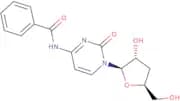
CAS:Activator of cGMP-dependent protein kinasesFórmula:C10H10BrN5NaO7PPureza:Min. 95%Cor e Forma:PowderPeso molecular:446.08 g/molN4-Benzoyl-3'-deoxycytidine
CAS:N4-Benzoyl-3'-deoxycytidine is a novel antiviral agent that has shown activity against DNA and RNA viruses. It is an activator of DNA polymerase, which is essential for replication of viral nucleic acids. The compound is a modified nucleoside with a benzoyl group at the 4' position of the ribose moiety. It also has phosphoramidite, monophosphate, and diphosphate analogues. N4-Benzoyl-3'-deoxycytidine binds to the enzyme DNA polymerase, thereby inhibiting its ability to synthesize deoxyribonucleotides from ribonucleotides. This results in inhibition of viral DNA synthesis and subsequent inhibition of viral replication.Fórmula:C16H17N3O5Pureza:Min. 95%Cor e Forma:White To Off-White SolidPeso molecular:331.32 g/mol5'-Amino-5'-deoxythymidine
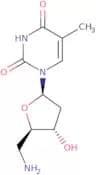
CAS:5'-Amino-5'-deoxythymidine is a nucleoside that is structurally related to thymidine. It has been shown to be a substrate for fatty acid synthase, which is a key enzyme in the synthesis of membrane lipids. 5'-Amino-5'-deoxythymidine has been shown to induce tumorigenesis in mouse bladder carcinoma cells. This compound also does not form stable complexes with DNA duplexes and can inhibit uptake of thymidylate into cells by competitive inhibition. 5'-Amino-5'-deoxythymidine binds to the cell surface and acts as an antibody response modifier.Fórmula:C10H15N3O4Pureza:Min. 98 Area-%Cor e Forma:White Off-White PowderPeso molecular:241.24 g/mol3'-O-Benzoyl-2'-deoxyuridine
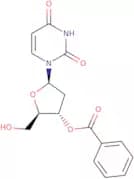
CAS:3'-O-Benzoyl-2'-deoxyuridine is a synthetic nucleoside that is used in the synthesis of DNA and RNA. 3'-O-Benzoyl-2'-deoxyuridine is also an antiviral agent that has shown efficacy against HIV, HSV, and influenza virus. 3'-O-Benzoyl-2'-deoxyuridine is a phosphoramidite monophosphate that can be used as a building block for DNA or RNA synthesis. It is also a diphosphate that can be used to synthesize modified nucleosides. This product has novel properties and high purity, making it suitable for research purposes.Fórmula:C16H16N2O6Pureza:Min. 95%Cor e Forma:PowderPeso molecular:332.31 g/mol2'-Deoxy-5-hydroxyuridine
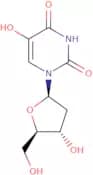
CAS:2'-Deoxy-5-hydroxyuridine is a hydrated form of uracil that is used in the synthesis of nucleic acids. It is also a substrate for DNA polymerases and has been shown to inhibit the replication of herpes simplex virus. 2'-Deoxy-5-hydroxyuridine has been shown to have biological properties, such as inhibition of radiation-induced transformation, inhibition of cancer cell growth, and antiviral activity. The mechanism by which 2'-deoxy-5-hydroxyuridine inhibits the replication of herpes simplex virus is unclear but may be due to its ability to inhibit cellular metabolism.Fórmula:C9H12N2O6Pureza:Min. 95 Area-%Cor e Forma:White PowderPeso molecular:244.21 g/mol2',3'-Dideoxy-5'-O-DMT-cytidine
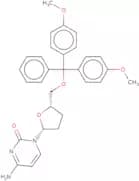
CAS:2',3'-Dideoxy-5'-O-DMT-cytidine is a chemically modified cytidine nucleoside which can be used in synthetic chemistry, especially in nucleic acid synthesis. A dimethoxytrityl (DMT) protecting group is attached to the 5'-oxygen of the sugar. This is not biologically active, but it’s commonly used in solid-phase oligonucleotide synthesis to protect the 5' end during step-by-step DNA or RNA construction.Fórmula:C30H31N3O5Pureza:Min. 95%Cor e Forma:PowderPeso molecular:513.6 g/mol8-(Benzyloxy)guanosine
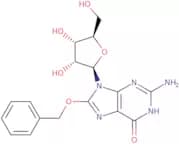
CAS:8-(Benzyloxy)guanosine is a novel nucleoside analog that is an activator of ribonucleotide reductase. It has been shown to inhibit the proliferation of cancer cells in vitro and in vivo, as well as inhibit the production of diphosphate from ATP. This compound also has antiviral activity against herpes simplex virus type 1 (HSV-1) and human immunodeficiency virus type 1 (HIV-1). 8-(Benzyloxy)guanosine is synthesized by reacting the 8-hydroxy group on guanosine with benzaldehyde, followed by phosphorylation with diphosphate. This compound has CAS No. 3868-36-8 and can be used for research purposes only.Fórmula:C17H19N5O6Pureza:Min. 95 Area-%Cor e Forma:White To Off-White SolidPeso molecular:389.36 g/molAdenosine 5'-monophosphate disodium salt
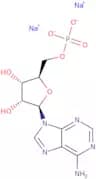
CAS:Adenosine 5'-monophosphate disodium salt (AMP-Na2) is a chemical compound that has been used in the study of metabolic disorders. It belongs to the class of ethylene diamines and has been shown to increase the glomerular filtration rate. Ammonium adenosine 5'-monophosphate disodium salt has also been shown to increase the activity of glutamate decarboxylase, which converts glutamate into GABA, an inhibitory neurotransmitter. The neutral pH optimum for AMP-Na2 is 6.5-7.5, which may be due to its lysine residues. AMP-Na2 has a carbonyl group that can be oxidized by reactive oxygen species and cause oxidative injury to cells in vivo and in vitro. This damage was found mainly in microglia cells, which are responsible for removing dead or damaged neurons from the central nervous system (CNS). AMP-Na2 also activates adFórmula:C10H12N5Na2O7PPureza:Min. 98 Area-%Cor e Forma:PowderPeso molecular:391.19 g/molInosine 5'-triphosphate disodium
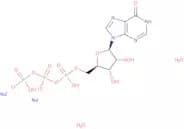
CAS:Inosine 5'-triphosphate disodium salt is a phosphoramidite that can be used as an activator for DNA synthesis. It also has antiviral and anticancer properties. Inosine 5'-triphosphate disodium salt is used in the synthesis of deoxyribonucleosides and other nucleotides.Fórmula:C10H13N4O14P3•Na2Pureza:Min. 95%Cor e Forma:PowderPeso molecular:552.13 g/molStavudine
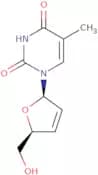
CAS:Anti-viral; reverse transcriptase inhibitorFórmula:C10H12N2O4Pureza:Min. 95%Cor e Forma:White PowderPeso molecular:224.22 g/mol2'-Deoxyuridine-5'-triphosphate trisodium
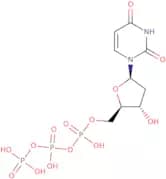
CAS:2'-Deoxyuridine-5'-triphosphate trisodium salt is a fluorophore that is excited by the absorption of light at wavelengths of 365 nm. The emission spectrum ranges from 380 to 500 nm and has a maximum at 480 nm. 2'-Deoxyuridine-5'-triphosphate trisodium salt can be used as a labeling agent for metal ion, molecule, or macrocyclic ligand. It can also be used as an acceptor in fluorescence energy transfer experiments.Fórmula:C9H15N2O14P3•Na3Pureza:Min. 95%Cor e Forma:PowderPeso molecular:537.11 g/mol5,6-Dihydro-5-azacytidine acetate
5,6-Dihydro-5-azacytidine acetate is a monophosphate nucleoside that is used in the synthesis of DNA and RNA. It is an antiviral agent that inhibits the synthesis of DNA by preventing the conversion of deoxyribonucleotides to diphosphates. 5,6-Dihydro-5-azacytidine acetate has been found to have anticancer properties and is used in cancer treatment. This chemical also has a high purity and quality, making it a suitable reagent for use in phosphoramidite coupling reactions for oligonucleotide synthesis. 5,6-Dihydro-5-azacytidine acetate has been shown to be active against a variety of human tumor cell lines, including leukemia cells.Fórmula:C10H17N4O7Pureza:Min. 95%Cor e Forma:White PowderPeso molecular:305.26 g/molN4-Acetyl-2'-deoxycytidine
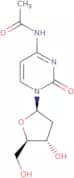
CAS:N4-Acetyl-2'-deoxycytidine is a nucleoside analogue that acts as an inhibitor of DNA synthesis. It binds to the active site of the enzyme ribonucleotide reductase, blocking the conversion of ribonucleotides to deoxyribonucleotides. This prevents DNA synthesis and replication, which leads to cell death. N4-Acetyl-2'-deoxycytidine has been shown to be more efficient than other analogues in terms of energy efficiency, control levels, and constant linear model. This compound is reactive and can cause low yields when isolated from solutions with high concentrations. A diode can be used for analytical purposes, while calcium binding may be used as a mathematical model in order to analyze this drug.Fórmula:C11H15N3O5Pureza:Min. 98 Area-%Cor e Forma:PowderPeso molecular:269.25 g/mol3-Deazaadenosine
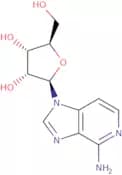
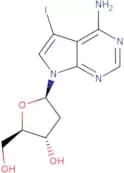
CAS:A potential role in apoptosis and cellular senescence.Fórmula:C11H14N4O4Pureza:Min. 99 Area-%Cor e Forma:PowderPeso molecular:266.26 g/mol7-Deaza-2'-deoxy-7-iodoadenosine
CAS:7-Deaza-2'-deoxy-7-iodoadenosine is an oligomer with a stabilized backbone that has been shown to inhibit the growth of bacteria in vitro. It binds to DNA and prevents RNA synthesis. 7-Deaza-2'-deoxy-7-iodoadenosine is a synthetic nucleotide analogue that is used as a probe for mapping RNA sequences and as an inhibitor of bacterial growth. This compound is also used in the synthesis of oligodeoxynucleotides because it has a high affinity for guanine residues, which can be incorporated into the oligonucleotide chain by chemical ligation. The octameric form of 7-deaza-2'-deoxyadenosine is most active against bacterial cells.
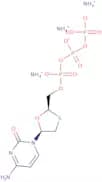
Fórmula:C11H13IN4O3Pureza:Min. 98 Area-%Cor e Forma:White Off-White PowderPeso molecular:376.16 g/molLamivudine 5'-triphosphate triethylammonium salt (Ethanol solution)
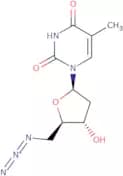
CAS:Sold by weight of nucleoside as solution in ethanol.Fórmula:C20H46N5O12P3SPureza:Min. 95%Cor e Forma:Clear LiquidPeso molecular:673.59 g/mol5'-Azido-5'-deoxythymidine
CAS:5'-Azido-5'-deoxythymidine is a synthetic analogue of thymidine. The compound has been synthesised and fluorescently labelled with ferrocene. 5'-Azido-5'-deoxythymidine is not cytotoxic to cancer cells, but it is shown to be an effective inhibitor of DNA synthesis by binding to the enzyme DNA polymerase. This causes a decrease in the rate of DNA synthesis and thus inhibits cancer cell growth.Fórmula:C10H13N5O4Pureza:Min. 95%Cor e Forma:White PowderPeso molecular:267.24 g/mol