Nucleotídeos
Subcategorias de "Nucleotídeos"
Foram encontrados 2637 produtos de "Nucleotídeos"
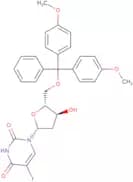
2'-Deoxy-5'-O-DMT-5-iodouridine
CAS:2'-Deoxy-5'-O-DMT-5-iodouridine is an intercalating agent that binds to DNA and RNA. It can be used as a probe for the detection of specific sequences in human cells. The fluorophore attached to the molecule allows it to be detected by fluorescence microscopy, while the chromophore is responsible for its ability to emit light at a wavelength of 535 nm. 2'-Deoxy-5'-O-DMT-5-iodouridine has been shown to enhance nucleotide excision repair and increase the sensitivity of cancer cells to chemotherapy drugs such as cisplatin. The molecule can also be used as a fluorescent protein marker in her-2 gene amplification and overexpression studies.Fórmula:C30H29IN2O7Pureza:Min. 95%Cor e Forma:PowderPeso molecular:656.48 g/molN4-Benzoyl-3'-deoxy-5'-O-DMT-cytidine
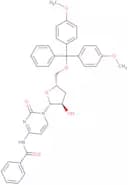
CAS:N4-Benzoyl-3'-deoxy-5'-O-DMT-cytidine is a synthetic nucleoside that is used as an activator for DNA synthesis. It is also used in the preparation of diphosphate derivatives for use as antiviral and anticancer agents or as probes for DNA and RNA research. N4-Benzoyl-3'-deoxy-5'-O-DMT-cytidine is a novel, high purity, and high quality chemical with CAS No. 86234-45-9.
Fórmula:C37H35N3O7Pureza:Min. 95%Peso molecular:633.69 g/mol8-Chloroadenosine
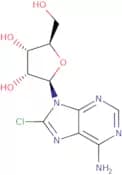
CAS:8-Chloroadenosine is a potent inhibitor of apoptosis, which is the process by which cells die. It has been shown to inhibit cell growth in murine hepatoma cells and synergize with other cytotoxic agents. 8-Chloroadenosine inhibits the activity of bcl-2 protein and thus blocks the release of cytochrome c from mitochondria. This causes DNA damage by inhibiting DNA synthesis and protein synthesis, leading to apoptosis. 8-Chloroadenosine has also been shown to be an active inhibitor of cancer cells, especially myeloma cell lines. The response element for 8-chloroadenosine is located in the promoter region of the gene encoding cyclooxygenase 2 (COX-2), which encodes a protein that produces prostaglandins involved in inflammation and tumor growth. The concentration of camp in cancer tissues determines whether these cells will respond favorably or unfavorably to this drug.Fórmula:C10H12ClN5O4Pureza:Min. 95%Cor e Forma:PowderPeso molecular:301.69 g/molDenufosol tetrasodium
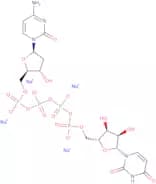
CAS:A P2Y2 receptor agonist that has been studied in cystic fibrosis and retinal diseases such as retinal detachment. Denufosol was studied as an inhaled drug for cystic fibrosis, due to its ability to activate an alternative chloride channel and avoiding the defective CFTR chloride channel. This enhances hydration of the lung mucosa and improves mucociliary clearance. The drug did not progress from phase III clinical trials. Denufosol resulted in subretinal fluid reabsorption in in vivo model of retinal detachment.
Fórmula:C18H23N5Na4O21P4Pureza:Min. 90 Area-%Cor e Forma:PowderPeso molecular:861.25 g/mol3'-Amino-3'-deoxyadenosine
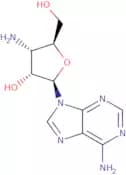
CAS:3'-Amino-3'-deoxyadenosine, also known as spalgomycin, is a natural enediyne antibiotic with potent antibacterial and, more notably, antitumor activity observed in research settings. Its primary use is as a tool to study the mechanisms of enediyne-mediated DNA damage and as a lead compound in the search for novel anticancer therapeutics.Fórmula:C10H14N6O3Cor e Forma:White Off-White PowderPeso molecular:266.26 g/mol2',3'-Dideoxy-5-methylcytidine
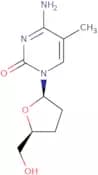
CAS:2',3'-Dideoxy-5-methylcytidine is a synthetic nucleoside analog based on cytidine, a natural building block of DNA and RNA. This molecule is chemically modified to interfere with nucleic acid synthesis, making it a potential tool in antiviral or anticancer therapy, or for studying epigenetics.Fórmula:C10H15N3O3Pureza:Min. 95%Cor e Forma:PowderPeso molecular:225.25 g/molAcetoacetyl coenzyme A lithium salt
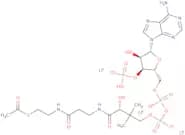
CAS:Acetoacetyl coenzyme A lithium salt is a novel phosphoramidite building block. It's a modified nucleoside that can be used in the synthesis of oligonucleotides and DNA. Acetoacetyl coenzyme A lithium salt has antiviral, anticancer, and antifungal activities.Fórmula:C25H36N7O18P3SLi4·5H2OPureza:Min. 96 Area-%Cor e Forma:PowderPeso molecular:965.42 g/molCytidyl-3'-5'-uridine ammonium
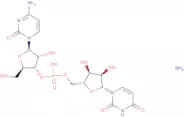
CAS:Cytidyl-3'-5'-uridine ammonium salt is a nucleoside analog that is used as an antiviral and anticancer agent. Cytidyl-3'-5'-uridine ammonium salt inhibits the synthesis of DNA by inhibiting the activity of enzymes such as DNA polymerase, RNA polymerase, or reverse transcriptase. It also has antitumor properties and can be used to treat leukemia and other types of cancer. Cytidyl-3'-5'-uridine ammonium salt has been shown to be more potent than cytidyl-2',4',6'-triaminopyrimidine (CTAP) in inhibiting the growth of lymphocytic leukemia cells.
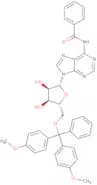
Fórmula:C18H24N5O13P•NH3Pureza:Min. 95%Cor e Forma:PowderPeso molecular:566.42 g/molN6-Benzoyl-5'-O-DMT-adenosine
CAS:N6-Benzoyl-5'-O-DMT-adenosine is a synthetic nucleoside with antiviral activity. It is an activator of viral DNA polymerase and inhibits viral replication by inhibiting DNA synthesis in the host cell. N6-Benzoyl-5'-O-DMT-adenosine has shown anticancer activity in tumor cells, which may be due to its ability to inhibit ribonucleotide reductase and diphosphate kinase.
Fórmula:C38H35N5O7Pureza:Min. 95%Cor e Forma:White PowderPeso molecular:673.73 g/molN4-Acetylcytidine
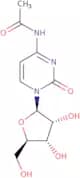
CAS:N4-Acetylcytidine is a modified nucleoside and endogenous urinary nucleoside product of the degradation of tRNA. N4-Acetylcytidine is a biological marker for various cancers with elevated concentrations present in urine. N4-Acetylcytidine is also a partially protected cytidine and therefore can be used as a synthetic building block to prepare further derivatized nucleosides such as 2’,3’-dideoxycytidine.Fórmula:C11H15N3O6Pureza:Min. 95%Cor e Forma:White PowderPeso molecular:285.25 g/molN6-Benzoyl-3'-O-methyladenosine
CAS:N6-Benzoyl-3'-O-methyladenosine is a novel modified nucleoside that has antiviral activity. It has been shown to possess high purity and high quality, and can be used as an activator for DNA synthesis. N6-Benzoyl-3'-O-methyladenosine is synthesized from 3'-O-methyladenosine with the use of phosphoramidites, ribonucleosides, or monophosphate nucleotides. The compound is CAS No. 85090-30-8 and is soluble in water.Fórmula:C18H19N5O5Pureza:Min. 96 Area-%Cor e Forma:Off-White PowderPeso molecular:385.37 g/molAdenosine 2',3'-cyclic monophosphate sodium
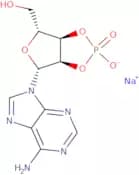
CAS:Adenosine 2',3'-cyclic monophosphate sodium (AMP-Na) is a chemical compound that is found in Streptomyces coelicolor. It has been shown to have an active role in the biotechnology industry for research and development. AMP-Na inhibits the synthesis of carbohydrates by binding to enzymes such as adenosyl-l-methionine peroxidase, which is involved in the metabolism of carbohydrates. Adenosine 2',3'-cyclic monophosphate sodium also has a long half-life, which makes it useful for therapeutic purposes.Fórmula:C10H11N5NaO6PPureza:Min. 95%Cor e Forma:PowderPeso molecular:351.19 g/mol5-(Azidomethyl)-2’-deoxyuridine
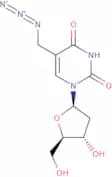
CAS:5-azidomethyl-2-deoxyuridine (AmdU) is a nucleoside that contains an azide group. The structure of the nucleoside is similar to thymidine, and it is incorporated into nascent DNA by cellular polymerases, similarly to EdU (NE08701). Unlike EdU that needs to be further modified with azides in the presence of copper catalyst, AmdU can also react in the absence of copper catalyst using spAAC Click Chemistry with strained cycloalkynes, such as cyclooctynes. This enables detection of nascent DNA in benign, copper free conditions.
Fórmula:C10H13N5O5Pureza:Min. 95%Cor e Forma:PowderPeso molecular:283.24 g/mol2'-O-(2-Methoxyethyl)adenosine
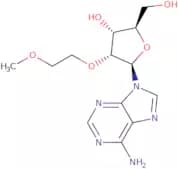
CAS:2'-O-(2-Methoxyethyl)adenosine is a nucleoside derivative that is produced by the methylation of 2'-deoxyadenosine. It is used in organic synthesis as a reagent for the alkylation of aromatic hydrocarbons and as an intermediate in the synthesis of purines. The product can be isolated with yields of 78% or greater, depending on reaction conditions and purification methods. Isomeric purity can be achieved with high purity (>99%) by recrystallization from water or ethanol. The compound has a number of physical properties that are similar to those of adenosine, including boiling point, melting point, density, and refractive index. The molecule also has two chiral centers at C2 and C4 that contribute to its isomeric nature. Adenosine is found in human connective tissue cells, where it plays a role in cell metabolism by regulating the production of RNA and DNA.Fórmula:C13H19N5O5Pureza:Min. 95%Cor e Forma:White Off-White PowderPeso molecular:325.32 g/mol2-Chloro-6-O-methylinosine
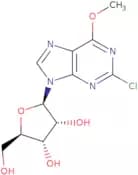
CAS:2-Chloro-6-O-methylinosine is a modified nucleoside analog. Its structure is based on inosine and at position 2 a chlorine atom replaces the hydrogen. At position 6, the keto oxygen (normally part of the purine ring) is O-methylated, forming a methoxy group (-OCH₃)Fórmula:C11H13ClN4O5Pureza:Min. 95%Cor e Forma:PowderPeso molecular:316.7 g/molL-Adenosine 5'-monophosphate disodium
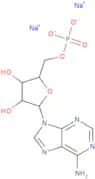
CAS:L-Adenosine 5'-monophosphate disodium is a high quality, novel, modified phosphoramidite used for the synthesis of deoxyribonucleosides and nucleosides. It is also used as an antiviral agent and has anti-cancer properties. L-Adenosine 5'-monophosphate disodium is an activator of ribonucleoside activities and inhibits viral replication by inhibiting the enzyme RNA polymerase. It has been shown to be effective against HIV, herpes simplex virus (HSV), cytomegalovirus (CMV), Epstein-Barr virus (EBV), influenza A virus, and influenza B virus.Fórmula:C10H12N5Na2O7PPureza:Min. 98 Area-%Cor e Forma:PowderPeso molecular:391.18 g/mol8-Bromoinosine
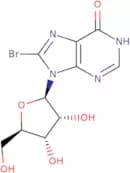
CAS:8-Bromoinosine is a potent chemical probe that can be used to study the molecular mechanism of cGMP-dependent protein kinase (PKG). 8-Bromoinosine reacts with the acceptor site in PKG, which is located at the base of the active site cleft. Electrons from hydrogen bond donor sites on 8-bromoadenosine are transferred to chloride ion and the resulting 8-bromoinosine chloride complex is an effective inhibitor of PKG. It has been shown that stereoselectivity plays a role in this reaction mechanism.
Fórmula:C10H11BrN4O5Pureza:Min. 95%Cor e Forma:PowderPeso molecular:347.13 g/molPseudothymidine
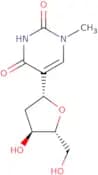
CAS:Pseudothymidine is the nucleobase analog of thymidine. It is a synthetic substance that has been used in the polymerase chain reactions (PCRs) to form DNA molecules. Pseudothymidine is not naturally found in cells and can be used as a substitute for thymidine during PCR to make more copies of DNA sequences. It has been shown that pseudothymidine can be incorporated into DNA without disrupting the polymerase chain reaction. The thermal denaturation of pseudothymidine is 10 °C lower than that of thymidine, allowing it to be used at higher temperatures with less risk of degradation.Fórmula:C10H14N2O5Pureza:Min. 95%Cor e Forma:PowderPeso molecular:242.23 g/mol1-(β-D-Arabinofuranosyl)cytosine 5'-monophosphate
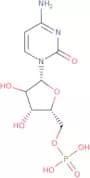
CAS:1-(β-D-Arabinofuranosyl)cytidine 5'-monophosphate (ara-CMP) is a nucleotide derivative of cytidine, specifically a nucleotide where the ribose sugar is replaced by the arabinose sugar. It's a pyrimidine nucleotide commonly known as Cytarabine 5'-monophosphate or arabinosylcytosine 5'-monophosphate.Fórmula:C9H14N3O8PPureza:Min. 95 Area-%Cor e Forma:White PowderPeso molecular:323.2 g/molClofarabine
CAS:Clofarabine is FDA-approved for treating relapsed or refractory acute lymphoblastic leukaemia (ALL) in children after at least two other types of treatment have failedFórmula:C10H11ClFN5O3Pureza:Min. 98 Area-%Cor e Forma:White Off-White PowderPeso molecular:303.68 g/mol