CAS 100-18-5
:1,4-Diisopropylbenzene
Description:
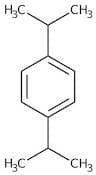
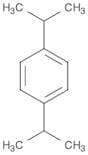
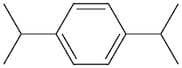
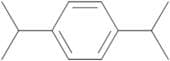
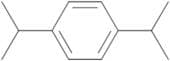
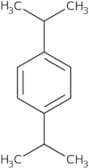
1,4-Diisopropylbenzene, also known as p-diisopropylbenzene, is an organic compound characterized by its aromatic structure featuring two isopropyl groups attached to the benzene ring at the 1 and 4 positions. This compound is a colorless liquid at room temperature and is known for its distinctive sweet odor. It is relatively non-polar, making it soluble in organic solvents but less so in water. The presence of the isopropyl groups contributes to its hydrophobic nature and influences its reactivity, particularly in electrophilic aromatic substitution reactions. 1,4-Diisopropylbenzene is used in various applications, including as a solvent and in the synthesis of other organic compounds. It is important to handle this substance with care, as it may pose health risks if inhaled or ingested, and appropriate safety measures should be taken to minimize exposure. Additionally, it is classified as a volatile organic compound (VOC), which can contribute to air pollution and should be managed accordingly in industrial settings.
Formula:C12H18
InChI:InChI=1/C12H18/c1-9(2)11-5-7-12(8-6-11)10(3)4/h5-10H,1-4H3
InChI key:InChIKey=SPPWGCYEYAMHDT-UHFFFAOYSA-N
SMILES:C(C)(C)C1=CC=C(C(C)C)C=C1
Synonyms:- 1,4-Bis(1-methylethyl)benzene
- 1,4-Bis(isopropyl)benzene
- 1,4-Bis(propan-2-yl)benzene
- 1,4-Di(Propan-2-Yl)Benzene
- Benzene, 1,4-bis(1-methylethyl)-
- Benzene, p-diisopropyl-
- Brn 1854739
- Hsdb 5331
- Nsc 84198
- p-Di-iso-propylbenzene
- p-Diisopropylbenzene
- p-Diisopropylbenzol
- para-Diisopropylbenzene
- 1,4-DIISOPROPYLBENZENE
- 4-05-00-01126 (Beilstein Handbook Reference)
- 1,4-Diisopropylbenzene
- Bis(1-methylethyl)benzene, 1-4: (p-or 1,4-Diisopropylbenzene)
- 1,4-Diisopropylbenzene97%
- 1,4-bis(1-methylethyl)-benzen
- p-bis(1-methylethyl)benzene
- 1,4-DIISOPROPYLBENZENE 98+%
- 1,4-DIISOPROPYLBENZENE, STANDARD FOR GC
- p-diisopropyl-benzen
- Benzene,1,4-bis(1-methylet
- Benzene, 1,4-di-(1-methylethyl)
- See more synonyms
Sort by
Purity (%)
0
100
|
0
|
50
|
90
|
95
|
100
Found 11 products.
1,4-Diisopropylbenzene
CAS:Formula:C12H18Purity:>98.0%(GC)Color and Shape:Colorless to Almost colorless clear liquidMolecular weight:162.281,4-Diisopropylbenzene, 98%
CAS:1,4-Diisopropylbenzene is used as an intermediate for the synthesis of stabilizers, polymers, synthetic lubricants and hydroperoxides. It is also used in the trivalent actinide-lanthanide separation by phosphorus reagent extraction from aqueous komplexes (TALSPEAK) process for separating trivalent lFormula:C12H18Purity:98%Color and Shape:Clear colorless, LiquidMolecular weight:162.28Ref: 54-OR79870
1kgTo inquire2.5lTo inquire5mlTo inquire25mlTo inquire100gTo inquire100mlTo inquire500gTo inquire500mlTo inquire1,4-Diisopropylbenzene
CAS:1,4-Diisopropylbenzene is a benzene derivative widely used in biochemical experiments and drug synthesis research.Formula:C12H18Purity:98.64%Color and Shape:SolidMolecular weight:162.271,4-Diisopropylbenzene
CAS:Controlled ProductFormula:C12H18Color and Shape:NeatMolecular weight:162.271,4-Diisopropylbenzene
CAS:1,4-Diisopropylbenzene is an aromatic hydrocarbon that can be used in the production of nylon. It is a reactive compound that reacts with hydrogen chloride to form 1,4-dichlorobenzene. It undergoes nucleophilic attack by the addition of hydrogen fluoride to produce a dihydrochloride salt. The reaction of 1,4-diisopropylbenzene with hydrochloric acid yields 1,2-dichlorobenzene and hydrogen chloride gas. The reaction mechanism for this chemical reaction is shown below:
Formula:C12H18Purity:Min. 95%Molecular weight:162.27 g/mol